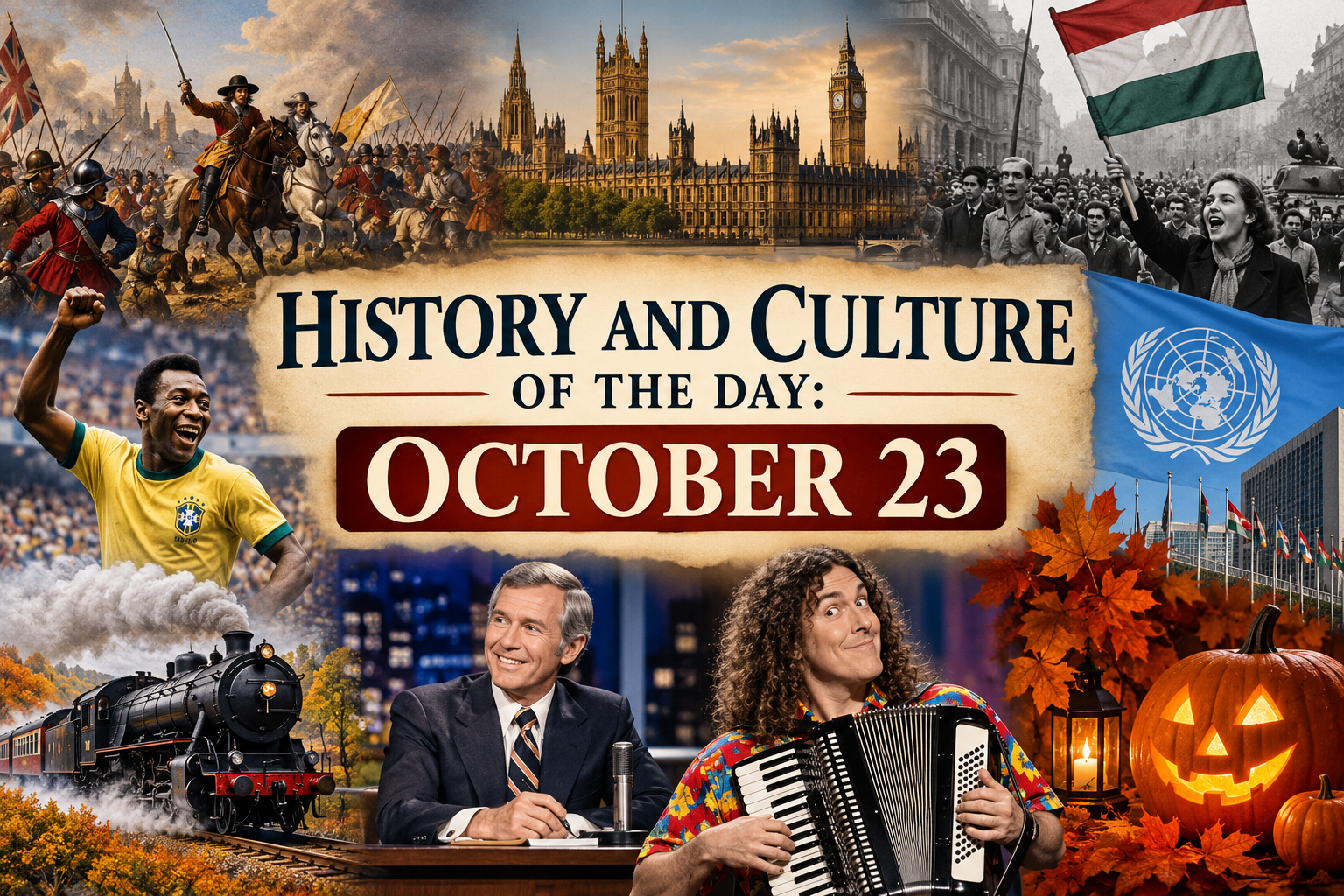
Every date on the calendar carries pieces of the past with it. October 23 is no exception. Across centuries, this day has been connected to war and peace, political change, scientific discovery, entertainment, literature, music, sports, and cultural traditions.
Some events associated with October 23 changed nations. Others influenced popular culture in ways that can still be felt today. There are also birthdays of notable people whose work left lasting marks on art, science, entertainment, and society.
Looking back at October 23 reminds us that history is not simply a collection of dates. It is the continuing story of people—their decisions, discoveries, struggles, creativity, failures, and accomplishments.
The Battle of Edgehill — 1642
One of the major historical events connected with October 23 occurred in England in 1642.
The Battle of Edgehill was fought between the Royalist forces supporting King Charles I and Parliamentary forces during the English Civil War.
The conflict developed from deep disagreements over political authority, religion, taxation, and the relationship between Parliament and the monarchy.
Neither side achieved a decisive victory at Edgehill, but the battle demonstrated that the struggle would not be settled quickly.
The English Civil Wars ultimately transformed Britain. King Charles I was executed in 1649, the monarchy was temporarily abolished, and England became a republic under the Commonwealth.
Although the monarchy was restored in 1660, the political struggles of the era contributed to the long-term development of constitutional government and limitations on royal power.
October 23 therefore marks an important moment in the history of the relationship between rulers and representative institutions.
The First Parliament of Great Britain Meets — 1707
October 23, 1707, was also significant in British political history.
Earlier that year, the Acts of Union brought England and Scotland together politically as the Kingdom of Great Britain.
On October 23, the first Parliament of Great Britain assembled.
England and Scotland had shared a monarch for more than a century before political union, but they maintained separate parliaments. The union created a single Parliament based at Westminster.
The political relationship between England and Scotland would continue evolving over the following centuries, but 1707 represented a major turning point in the development of the modern British state.
A New Era of Transportation
October 23 also falls within a period of history when transportation was being transformed dramatically.
The Industrial Revolution changed how people traveled, traded, communicated, and worked.
Steam power helped make railroads one of the defining technologies of the nineteenth century. Journeys that had once taken days could eventually be completed in hours.
Railways did more than move passengers.
They carried mail, food, raw materials, manufactured products, newspapers, and information across enormous distances.
Railroads also changed the way people thought about time itself. As railway networks expanded, standardized time became increasingly important because communities could no longer rely entirely on their own local measurements of the day.
Transportation technology was quietly reshaping culture along with economics.
The Rise of Modern Communication
The nineteenth and twentieth centuries brought another transformation: communication across great distances became faster than previous generations could have imagined.
The telegraph made it possible to transmit information rapidly over wires.
The telephone brought voices across distances.
Radio eventually allowed news, entertainment, speeches, and music to reach millions of people simultaneously.
Television added moving images.
Then computers and the internet transformed communication once again.
Today, someone can send a message across the planet almost instantly.
That feels ordinary because we live with it every day. Historically, however, it represents one of humanity’s most dramatic cultural changes.
For most of human civilization, information could travel only as quickly as a person, horse, ship, or other physical means of transportation could carry it.
Modern communication separated information from physical travel.
That changed everything.
The United Nations and the Search for International Cooperation
October also carries particular significance in international history because the United Nations officially came into existence on October 24, 1945—one day after October 23.
Its creation followed the devastation of World War II.
Tens of millions of people had died, cities had been destroyed, populations had been displaced, and the world had witnessed the catastrophic consequences of global warfare.
World leaders hoped a new international organization could provide a forum where countries might resolve disputes through diplomacy rather than armed conflict.
The United Nations has faced criticism, controversy, successes, and failures throughout its history, but its creation represented a powerful idea: nations with profoundly different interests could still attempt to cooperate.
The proximity of October 23 to United Nations Day makes this an appropriate time to remember how strongly the experiences of war shaped international institutions during the twentieth century.
Hungary Rises Against Soviet Control — 1956
One of the most significant events associated with October 23 occurred in Hungary in 1956.
On that day, demonstrations in Budapest developed into what became known as the Hungarian Revolution.
Students and other protesters demanded political reforms, greater freedom, and independence from Soviet domination.
The demonstrations quickly grew.
For a brief period, it appeared Hungary might succeed in breaking away from Soviet control.
But Soviet forces eventually intervened militarily.
The uprising was crushed, and thousands of Hungarians were killed while many more fled the country.
Although the revolution failed to achieve immediate independence, it became an enduring symbol of resistance against authoritarian rule.
Decades later, communist rule in Hungary finally ended.
In a powerful historical connection, the Republic of Hungary was officially proclaimed on October 23, 1989—the anniversary of the 1956 revolution.
October 23 consequently carries extraordinary national importance in Hungary.
It represents both remembrance and renewal.
The Cold War Changed Everyday Culture
The Hungarian Revolution occurred during the Cold War, an era that shaped much of the second half of the twentieth century.
The rivalry between the United States and Soviet Union influenced politics around the world, but its effects went far beyond diplomacy.
It influenced movies, television programs, books, education, technology, sports, advertising, and everyday fears.
Children practiced civil-defense drills.
Families were encouraged to think about fallout shelters.
Space exploration became part of the competition between political systems.
The Olympic Games sometimes became stages for national rivalry.
Science-fiction stories reflected fears about nuclear war and technological change.
The Cold War demonstrates something important about culture: major political conflicts rarely remain confined to governments.
They eventually become part of everyday life.
Pelé and the Global Culture of Soccer
October 23 is also associated with one of the greatest names in sports history.
Brazilian soccer legend Pelé was born on October 23, 1940.
Born Edson Arantes do Nascimento, Pelé became an international symbol of soccer and helped introduce generations of people to the beauty of the game.
He won three FIFA World Cups with Brazil—in 1958, 1962, and 1970.
His success came during an era when television was helping transform athletes into international celebrities.
People who might never visit Brazil could watch Pelé perform.
His fame demonstrated how sports could cross national, cultural, and linguistic boundaries.
Soccer was already the world’s game, but players such as Pelé helped give it recognizable global icons.
His legacy extends beyond statistics.
He became part of worldwide popular culture.
Johnny Carson and American Late-Night Television
Another major entertainment figure born on October 23 was Johnny Carson, born in 1925.
Carson became one of the most influential personalities in American television history through his long tenure as host of The Tonight Show.
From 1962 until 1992, Carson became a familiar late-night presence in millions of American homes.
Television during this era had enormous cultural influence because audiences had far fewer viewing options than they have today.
A successful television personality could become known throughout the country.
Carson interviewed actors, musicians, politicians, comedians, authors, athletes, and other public figures.
His program also became an important platform for comedians. Appearing successfully on The Tonight Show could dramatically boost a performer’s career.
Modern late-night television still carries traces of the format Carson helped popularize.
Weird Al Yankovic and the Culture of Parody
October 23 is also the birthday of musician and comedian “Weird Al” Yankovic, born in 1959.
Yankovic built a remarkable career by combining music, comedy, satire, and parody.
Rather than simply making jokes about popular songs, his work often reflected the culture surrounding them.
His career demonstrates how parody can become its own creative art form.
Popular culture constantly references itself. Movies reference older movies. Music samples and reinterprets earlier music. Comedy responds to politics, entertainment, fashion, and social trends.
Parody allows audiences to laugh at the culture they participate in.
Yankovic became one of the most recognizable practitioners of that tradition.
October and the Changing Rhythm of the Year
History is not only about wars, governments, famous people, and inventions.
Culture is also shaped by seasons.
In much of the Northern Hemisphere, October represents a transition.
Temperatures fall.
Leaves change color.
Daylight grows shorter.
Harvest traditions become prominent.
Pumpkins appear on porches.
Halloween decorations fill neighborhoods.
Families begin preparing for the holiday season.
These seasonal traditions have deep historical roots.
Before modern supermarkets and refrigeration, harvest time carried tremendous importance. Communities depended on successful crops to survive the coming winter.
Harvest festivals therefore represented gratitude, celebration, preparation, and community.
Modern autumn celebrations may look very different, but echoes of those older traditions remain.
The Cultural Evolution of Halloween
With Halloween only eight days away, October 23 sits firmly within what many people now consider Halloween season.
Halloween developed through a complicated mixture of traditions and influences.
The ancient Celtic festival of Samhain is frequently connected with some of Halloween’s distant origins, while Christian observances including All Saints’ Day and All Souls’ Day also influenced later customs.
Immigration brought traditions together, particularly in the United States.
Over time, Halloween became increasingly associated with costumes, trick-or-treating, pumpkins, haunted attractions, parties, horror movies, and seasonal decorations.
It also became a major commercial celebration.
Candy companies, costume manufacturers, entertainment businesses, theme parks, restaurants, and retailers all participate in modern Halloween culture.
This transformation shows how traditions evolve.
Culture rarely remains frozen in one historical moment.
Each generation inherits customs and then changes them.
Why Studying History and Culture Matters
It can be tempting to think of history as something finished.
It isn’t.
The world we live in is built from decisions made by people who came before us.
Political institutions have histories.
Holidays have histories.
Foods have histories.
Music has histories.
Sports have histories.
Languages have histories.
Even ordinary behaviors that seem completely natural may have developed because of circumstances that existed generations ago.
Studying history allows us to ask an important question:
Why is the world the way it is?
Culture helps answer another:
Why do people live, celebrate, communicate, believe, create, and behave in the ways they do?
Together, history and culture give us context.
Without context, events can appear isolated.
With context, connections begin appearing everywhere.
October 23 Reminds Us That History Is Still Alive
October 23 contains stories of political conflict, revolution, international cooperation, entertainment, sports, technology, and cultural change.
The Battle of Edgehill reminds us of struggles over political authority.
The first Parliament of Great Britain represents the continuing evolution of government.
The Hungarian Revolution demonstrates the extraordinary risks ordinary people sometimes take in pursuit of freedom.
Pelé’s birthday reminds us that sports can become a universal cultural language.
Johnny Carson represents an era when television helped create shared national experiences.
“Weird Al” Yankovic shows how humor and creativity can reinterpret popular culture.
And the traditions surrounding late October demonstrate how ancient customs can evolve into modern celebrations.
These stories may appear unrelated at first.
Yet they share something important.
They were created by people.
People challenged governments.
People invented technologies.
People wrote songs.
People played games.
People created traditions.
People resisted oppression.
People entertained one another.
People passed stories from one generation to another.
That is ultimately what history and culture are—the enormous collection of human experiences that brought us to where we are today.
A Thought for October 23
History is not simply about remembering what happened.
It is about understanding what those events can teach us.
Every generation inherits a world shaped by people it never met. We inherit their achievements, traditions, conflicts, inventions, mistakes, and lessons.
Then we add our own chapter.
Someday, the ordinary events happening around us today will become history too.
The question is not whether we are part of history.
We already are.
The better question is:
What will our generation contribute to the story?
Leave a Reply