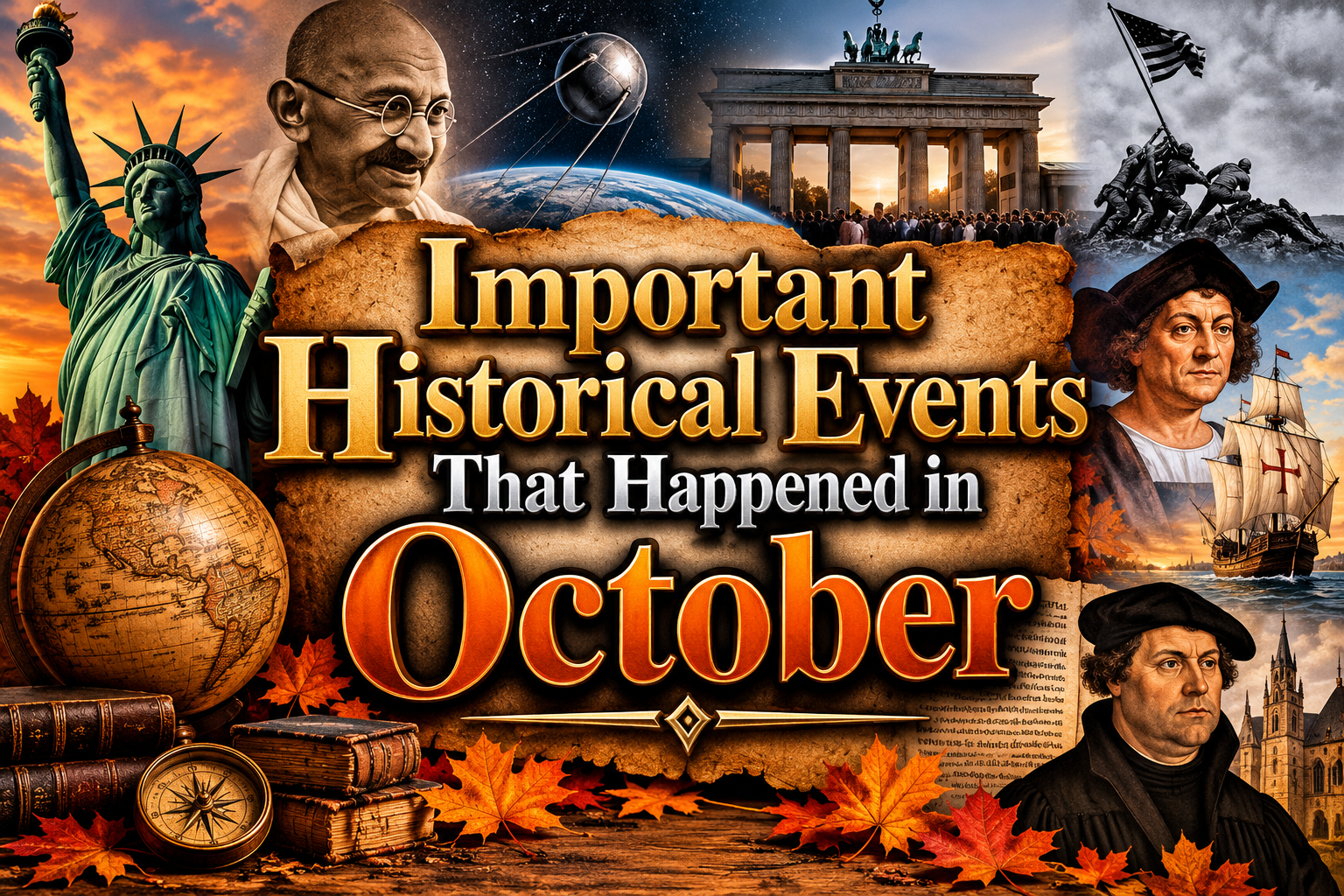
October is a month filled with remarkable historical events that have shaped nations, changed societies, inspired movements, and influenced the course of human civilization. From groundbreaking scientific discoveries and major political revolutions to historic battles, acts of courage, and milestones in civil rights, October has witnessed some of the most significant moments in world history.
Throughout the centuries, this month has been associated with exploration, independence, conflict, innovation, and transformation. Some events brought hope and progress, while others left behind lessons about the devastating consequences of war, injustice, and human suffering.
Understanding these historical moments helps us appreciate how the past continues to influence the world we live in today.
Here are some of the most important historical events that happened in October.
1. October 1, 1949 – The People’s Republic of China Is Established
On October 1, 1949, Mao Zedong proclaimed the establishment of the People’s Republic of China in Beijing.
The announcement followed years of civil war between Communist forces and the Nationalist government. The Communist victory fundamentally changed China’s political system and its relationship with the rest of the world.
The Nationalist government retreated to Taiwan, creating a political division that continues to influence international relations.
Today, October 1 is celebrated as China’s National Day.
Why it matters: The establishment of the People’s Republic of China marked the beginning of a new political era for one of the world’s largest countries and helped reshape global politics during the Cold War.
2. October 2, 1869 – Mahatma Gandhi Is Born
Mohandas Karamchand Gandhi was born on October 2, 1869, in Porbandar, India.
Gandhi became one of history’s most influential advocates of nonviolent resistance. His philosophy of peaceful protest and civil disobedience played a central role in India’s struggle for independence from British colonial rule.
His methods later influenced civil rights leaders around the world, including Martin Luther King Jr.
The United Nations recognizes October 2 as the International Day of Non-Violence.
Why it matters: Gandhi demonstrated how organized, nonviolent resistance could challenge powerful political systems and inspire movements for freedom and equality.
3. October 3, 1990 – Germany Is Reunified
On October 3, 1990, East Germany and West Germany officially became one nation.
Germany had been divided following World War II, with East Germany under Communist rule and West Germany developing as a democratic state.
The fall of the Berlin Wall on November 9, 1989, opened the way for reunification.
Less than a year later, Germany was formally reunited, ending more than four decades of division.
Why it matters: German reunification became a powerful symbol of the end of the Cold War and the political transformation of Europe.
4. October 4, 1957 – Sputnik 1 Launches the Space Age
On October 4, 1957, the Soviet Union launched Sputnik 1, the world’s first artificial satellite.
The small spherical spacecraft successfully orbited Earth, demonstrating that humanity could send objects into space.
The achievement shocked the United States and intensified competition between the two superpowers.
This rivalry, known as the Space Race, accelerated scientific research, technological innovation, and investment in space exploration.
Why it matters: Sputnik 1 marked the beginning of the Space Age and helped lay the foundation for satellites, human spaceflight, and modern space exploration.
5. October 6, 1973 – The Yom Kippur War Begins
On October 6, 1973, Egypt and Syria launched a coordinated attack against Israeli forces on Yom Kippur, the holiest day in Judaism.
The conflict centered on territories Israel had occupied during the Six-Day War in 1967.
The fighting lasted several weeks and involved major international diplomatic efforts.
The war also contributed to the 1973 oil crisis, which affected economies around the world.
Why it matters: The conflict reshaped Middle Eastern diplomacy and helped set the stage for later peace negotiations between Egypt and Israel.
6. October 7, 2001 – The War in Afghanistan Begins
On October 7, 2001, the United States and its allies began military operations in Afghanistan following the September 11 terrorist attacks.
The campaign targeted al-Qaeda and the Taliban government that had provided sanctuary to its leadership.
The conflict developed into America’s longest war, lasting nearly twenty years before the withdrawal of U.S. forces in 2021.
Why it matters: The Afghanistan War profoundly influenced international security policy, military strategy, and the lives of millions of people.
7. October 10, 1911 – The Chinese Revolution Begins
On October 10, 1911, the Wuchang Uprising began in China, triggering the revolution that eventually ended the Qing dynasty.
The Qing dynasty had ruled China since the seventeenth century.
The revolution led to the establishment of the Republic of China in 1912, bringing more than two thousand years of imperial rule to an end.
Why it matters: The revolution marked a turning point in Chinese history and began a new period of political transformation.
8. October 12, 1492 – Christopher Columbus Reaches the Caribbean
On October 12, 1492, Christopher Columbus and his expedition reached an island in the Bahamas after crossing the Atlantic Ocean.
Although Columbus believed he had reached islands near Asia, his voyage became a major turning point in European exploration of the Americas.
Indigenous peoples had inhabited the Americas for thousands of years before his arrival, and Norse explorers had reached North America centuries earlier.
Columbus’s voyages accelerated sustained contact between Europe and the Americas, bringing trade and cultural exchange alongside colonization, disease, enslavement, and devastating consequences for Indigenous populations.
Why it matters: The voyage helped initiate a period of global transformation whose effects continue to shape societies across the Americas and beyond.
9. October 14, 1947 – Chuck Yeager Breaks the Sound Barrier
On October 14, 1947, American test pilot Chuck Yeager became the first person officially recognized for breaking the sound barrier in level flight.
Flying the Bell X-1 experimental aircraft over California’s Mojave Desert, Yeager reached a speed greater than the speed of sound.
At the time, scientists and engineers were still learning how aircraft behaved at extremely high speeds.
His successful flight demonstrated that controlled supersonic flight was possible.
Why it matters: Yeager’s achievement opened the door to advances in military aviation, aerospace engineering, and supersonic aircraft development.
10. October 14–28, 1962 – The Cuban Missile Crisis
In October 1962, the United States and the Soviet Union came dangerously close to nuclear war.
American reconnaissance aircraft photographed Soviet missile installations under construction in Cuba on October 14. President John F. Kennedy was informed on October 16.
On October 22, Kennedy publicly announced the discovery and ordered a naval quarantine around Cuba.
For several days, the world feared that tensions between the two nuclear superpowers could escalate into a devastating conflict.
On October 28, Soviet leader Nikita Khrushchev announced that the missiles would be removed.
Why it matters: The Cuban Missile Crisis demonstrated the dangers of nuclear confrontation and encouraged stronger communication between the United States and the Soviet Union.
11. October 16, 1859 – John Brown’s Raid on Harpers Ferry
On October 16, 1859, abolitionist John Brown led an armed raid on the federal arsenal at Harpers Ferry, Virginia, now part of West Virginia.
Brown hoped to seize weapons and encourage an uprising against slavery.
The raid failed, and Brown was captured by U.S. Marines under the command of Robert E. Lee.
Brown was later executed, but his actions intensified national disagreements over slavery.
Why it matters: The raid increased tensions between Northern and Southern states and became one of the events leading toward the American Civil War.
12. October 19, 1781 – The British Surrender at Yorktown
On October 19, 1781, British General Charles Cornwallis’s army formally surrendered to American and French forces at Yorktown, Virginia.
General George Washington commanded the combined American and French ground forces, while French naval support helped prevent British reinforcements from reaching Yorktown.
The victory effectively ended major fighting in the American Revolutionary War.
Although the war formally ended with the Treaty of Paris in 1783, Yorktown was the decisive military turning point.
Why it matters: The victory secured the path toward American independence and demonstrated the importance of international alliances.
13. October 24, 1945 – The United Nations Is Founded
On October 24, 1945, the United Nations officially came into existence when its founding Charter entered into force.
Created after the devastation of World War II, the organization was established to promote international peace, cooperation, security, and human rights.
Its founding reflected the hope that countries could resolve disagreements through diplomacy rather than armed conflict.
Today, the United Nations plays a major role in humanitarian assistance, international development, and global diplomacy.
Why it matters: Its establishment created a permanent international forum for addressing conflicts and challenges affecting humanity.
14. October 24–29, 1929 – The Wall Street Stock Market Crash
In late October 1929, the American stock market experienced a devastating collapse.
October 24 became known as Black Thursday, when investors began selling enormous quantities of stocks amid growing panic.
Further dramatic declines occurred on October 28, known as Black Monday, and October 29, known as Black Tuesday.
The crash helped deepen the economic crisis that developed into the Great Depression.
Millions of people eventually faced unemployment, poverty, bank failures, and financial hardship.
Why it matters: The crash exposed weaknesses in the financial system and contributed to major changes in economic policy and financial regulation.
15. October 28, 1886 – The Statue of Liberty Is Dedicated
On October 28, 1886, President Grover Cleveland officially dedicated the Statue of Liberty in New York Harbor.
The monument was a gift from France to the United States, commemorating friendship between the two nations and celebrating liberty.
Designed by French sculptor Frédéric Auguste Bartholdi, the statue became one of America’s most recognizable landmarks.
Over time, it also became a powerful symbol of hope for immigrants arriving in the United States.
Why it matters: The Statue of Liberty remains an internationally recognized symbol of freedom, opportunity, and democratic ideals.
16. October 31, 1517 – Martin Luther and the Protestant Reformation
On October 31, 1517, German theologian Martin Luther traditionally is said to have posted his Ninety-Five Theses on the door of the Castle Church in Wittenberg, Germany.
The theses challenged practices associated with the sale of indulgences in the Catholic Church.
Whether Luther physically nailed them to the church door remains debated, but the publication of his arguments helped ignite the Protestant Reformation.
The movement transformed Christianity, European politics, education, and religious institutions.
Why it matters: The Protestant Reformation became one of the most influential religious and cultural transformations in European history.
Why October Holds Such an Important Place in History
Looking back at these historical events reveals several themes that connect different centuries and civilizations.
The struggle for freedom: From the American Revolution to Indian independence movements and German reunification, October reminds us that freedom and political change often require tremendous determination.
The consequences of conflict: The Yom Kippur War, the Cuban Missile Crisis, and the Afghanistan War demonstrate how military confrontations can influence generations and reshape international relationships.
The power of innovation: Sputnik 1 and Chuck Yeager’s historic flight show how scientific breakthroughs can expand humanity’s understanding of what is possible.
The importance of economic stability: The stock market crash of 1929 demonstrates how financial instability can affect ordinary families and communities worldwide.
The influence of ideas: Martin Luther’s writings and Gandhi’s philosophy of nonviolence illustrate how beliefs and movements can change societies long after their founders are gone.
Final Thoughts
October is much more than a month associated with autumn, changing leaves, and Halloween. It is a month filled with historical moments that helped shape the modern world.
Some October events represented humanity’s greatest achievements, while others revealed the dangers of war, economic instability, and political division.
Each event reminds us that history is not simply a collection of dates. It is the story of people, decisions, struggles, discoveries, and consequences that continue to influence our lives.
By studying these important moments, we gain a deeper understanding of where we came from, how our world developed, and what lessons we can carry into the future.
Which historical event that happened in October do you believe had the greatest impact on the world, and why?

Leave a Reply