
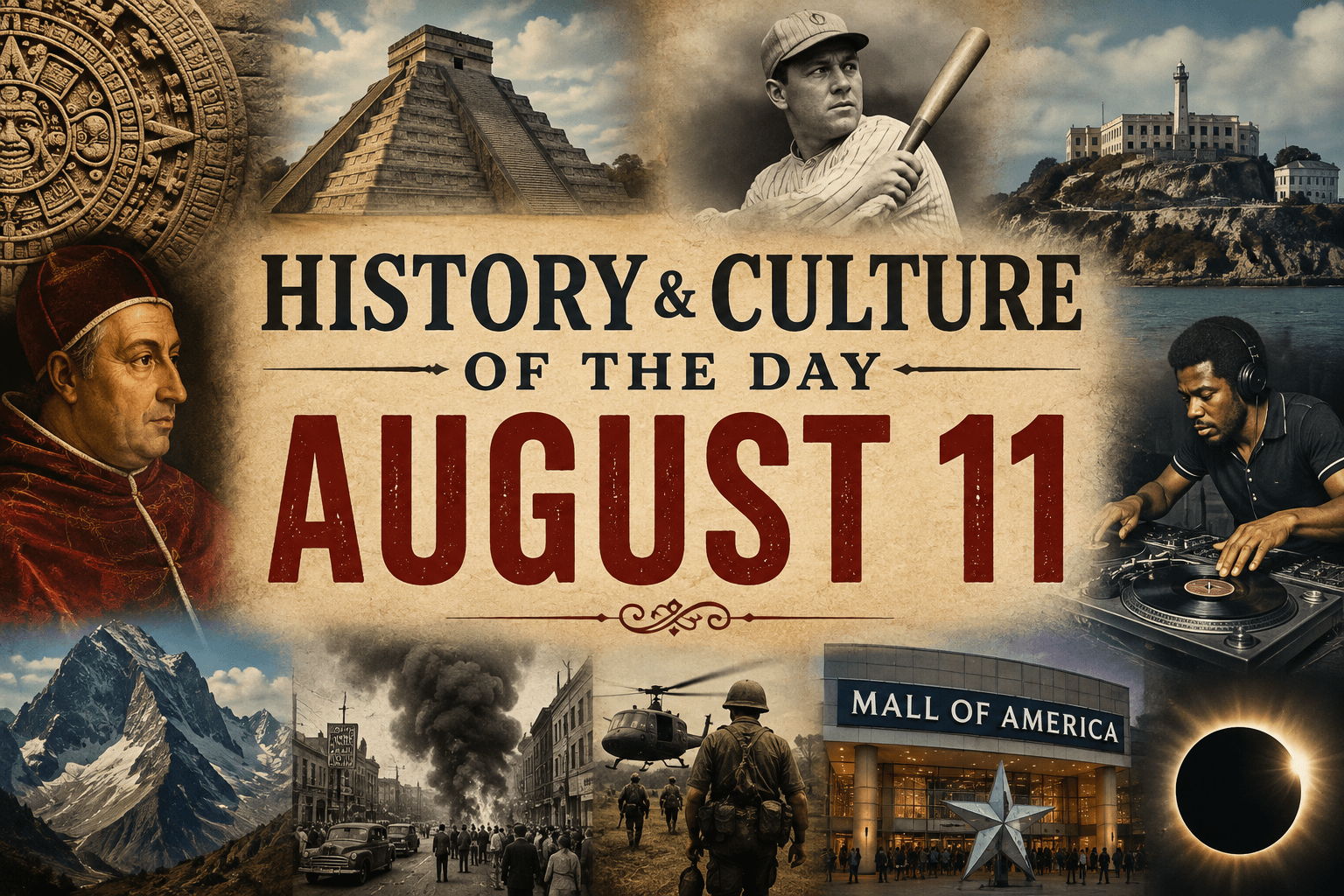
Every day carries pieces of the human story, and August 11 is filled with moments that have influenced politics, music, sports, science, technology, exploration, and popular culture.
Some historical dates are remembered because of a single monumental event. August 11 is different. Its history stretches across thousands of years and touches many different parts of civilization.
On this date, we can explore the sophisticated calendar systems of the ancient Maya, the politics of Renaissance Europe, daring mountaineering achievements, the rise of one of America’s most infamous prisons, important moments in the Vietnam War, and milestones in American sports.
But perhaps one of the greatest cultural legacies associated with August 11 comes from a relatively modest party held inside an apartment building in the Bronx in 1973.
That party became closely associated with the birth of hip-hop, a cultural movement that would eventually influence music, fashion, language, dance, art, business, movies, television, and youth culture around the world.
August 11 reminds us that history isn’t always created inside palaces, government buildings, or on battlefields.
Sometimes history begins at a neighborhood party.
Sometimes it happens on a baseball field.
Sometimes it happens on the side of a mountain.
And sometimes people don’t realize they are witnessing history until decades later.
Let’s travel through time and explore some of the fascinating history and culture connected to August 11.
Ancient History: The Maya Long Count Calendar
One of the oldest historical connections associated with August 11 takes us thousands of years into the past.
According to a commonly used correlation between the Maya calendar and the modern Gregorian calendar, August 11, 3114 BC corresponds to the beginning of the Maya Long Count.
The Maya civilization developed one of the most sophisticated systems of timekeeping in the ancient world.
Maya scholars carefully observed the movements of the Sun, Moon, planets, and stars. Their understanding of astronomy allowed them to create calendars capable of tracking both everyday events and enormous periods of time.
The Long Count calendar was particularly important because it allowed dates to be recorded across periods far longer than a normal human lifetime.
Rather than simply thinking of time as a straight line, Maya culture frequently viewed time through repeating cycles.
These cycles were connected with religion, astronomy, agriculture, political authority, and ceremonial life.
The Maya Were Extraordinary Astronomers
The Maya civilization flourished across areas that are now part of Mexico, Guatemala, Belize, Honduras, and El Salvador.
Their achievements included:
- Advanced mathematics
- Complex writing systems
- Monumental architecture
- Astronomy
- Calendar development
- Agricultural innovation
- Art and sculpture
- Large urban centers
Maya astronomers carefully tracked celestial events without telescopes or modern technology.
Their observations were recorded across generations.
This allowed Maya scholars to calculate astronomical cycles with impressive accuracy.
The Maya also developed a mathematical system that included the concept of zero, an achievement that demonstrates the sophistication of their mathematics.
The 2012 Calendar Misunderstanding
The Maya Long Count became famous in popular culture during the years leading up to December 21, 2012.
Some modern interpretations claimed the calendar predicted that the world would end on that date.
That idea spread through television programs, books, websites, movies, and social media.
However, the end of that particular Long Count cycle did not represent the end of time.
It was essentially the completion of one major calendar cycle and the beginning of another.
The world obviously continued.
What remains important is not the modern mythology surrounding 2012, but the extraordinary astronomical and mathematical knowledge developed by Maya civilization.
1492 – Rodrigo Borgia Becomes Pope Alexander VI
On August 11, 1492, Cardinal Rodrigo Borgia was elected pope and became Pope Alexander VI.
His election came during one of the most transformative periods in European history.
The Renaissance was reshaping art, philosophy, science, politics, and culture.
Powerful families competed for influence throughout Italy.
European kingdoms were expanding their political ambitions.
And overseas exploration was beginning to change the world’s political and economic landscape.
Only days before Alexander VI’s election, Christopher Columbus had departed Spain on the voyage that would bring Europeans into sustained contact with the Americas.
The consequences of European exploration would eventually transform societies across the globe.
The Powerful Borgia Family
The Borgia family became one of the most famous—and controversial—families of Renaissance Europe.
They accumulated significant political and religious influence.
Stories surrounding the Borgias include political alliances, family rivalries, accusations of corruption, and struggles for power.
Over the centuries, separating historical fact from later legend has sometimes been difficult.
Nevertheless, the Borgias became cultural symbols of Renaissance political intrigue.
Their story has inspired:
- Historical novels
- Movies
- Television series
- Documentaries
- Academic studies
- Historical biographies
More than five centuries later, the Borgia name remains associated with the complicated politics of Renaissance Italy.
1858 – The First Recorded Ascent of the Eiger
On August 11, 1858, climbers Charles Barrington, Christian Almer, and Peter Bohren completed the first recorded ascent of the Eiger in Switzerland.
The Eiger rises more than 13,000 feet in the Bernese Alps.
Over time, it became one of the most famous mountains in European mountaineering.
The mountain’s dramatic north face would eventually gain a particularly fearsome reputation.
The Golden Age of Mountaineering
The middle of the 19th century became known as an important period in the development of modern mountaineering.
Explorers and climbers attempted to reach Alpine summits that had never previously been documented as climbed.
Equipment was primitive compared with today’s standards.
Early mountaineers did not have modern:
- Synthetic insulated clothing
- Lightweight climbing ropes
- GPS devices
- Satellite communication
- Detailed weather forecasts
- Modern climbing protection
- Emergency helicopters
Climbing required extraordinary endurance, judgment, teamwork, and courage.
The first ascent of the Eiger became another milestone in humanity’s long fascination with reaching difficult and dangerous places.
Mountaineering eventually developed its own international culture built around adventure, exploration, respect for nature, and personal challenge.
1929 – Babe Ruth Hits His 500th Home Run
On August 11, 1929, baseball history was made when Babe Ruth hit the 500th home run of his Major League Baseball career.
He became the first player in MLB history to reach the milestone.
Ruth wasn’t simply a successful baseball player.
He helped transform the way baseball was played and watched.
Baseball Before Babe Ruth
During the early 20th century, baseball often emphasized strategy, stolen bases, bunting, pitching, and defensive play.
Then came Babe Ruth.
His enormous home runs captivated fans.
People wanted to see the ball leave the stadium.
The home run became one of baseball’s greatest spectacles.
Ruth’s personality also made him ideal for America’s rapidly expanding newspaper culture.
Stories about him appeared constantly.
He became one of the first true American sports celebrities.
The Meaning of 500 Home Runs
Today, the 500-home-run club is considered one of baseball’s most prestigious groups.
But before Ruth reached the milestone, no such club existed.
He created the benchmark.
His accomplishment helped establish standards future generations of baseball players would chase.
Babe Ruth became part of American mythology.
Even people who know very little about baseball often recognize his name.
That is cultural influence far beyond statistics.
1934 – Federal Prisoners Arrive at Alcatraz
On August 11, 1934, the first group of federal prisoners arrived at Alcatraz Island in San Francisco Bay.
Few prisons in American history have captured the public imagination like Alcatraz.
Nicknamed “The Rock,” the prison became synonymous with isolation, maximum security, notorious criminals, and seemingly impossible escape attempts.
Why Alcatraz?
The federal government wanted a prison capable of holding inmates considered particularly dangerous, disruptive, or likely to escape.
Alcatraz appeared ideal.
The island was surrounded by the cold waters of San Francisco Bay.
Strong currents added another obstacle.
Even if someone escaped the prison buildings and reached the shoreline, they still faced a dangerous journey through the water.
The psychological effect of seeing San Francisco across the bay may have made imprisonment even more difficult.
Freedom looked close.
But for the prisoners, it remained painfully out of reach.
Famous Alcatraz Prisoners
Over the years, Alcatraz housed some of America’s most notorious criminals.
Among them were:
Al Capone
The Chicago gangster became one of the most famous organized-crime figures in American history.
George “Machine Gun” Kelly
A Prohibition-era gangster associated with kidnapping and organized crime.
Robert Stroud
Better known as the “Birdman of Alcatraz,” although much of his famous work studying birds occurred before he was transferred to Alcatraz.
Alvin “Creepy” Karpis
A prominent criminal associated with the Barker-Karpis gang.
The Mystery of the 1962 Escape
One story continues to fascinate people more than almost any other event connected to Alcatraz.
In June 1962, prisoners Frank Morris and brothers John and Clarence Anglin escaped their cells.
They used an elaborate plan involving widened ventilation openings, homemade tools, dummy heads, and a raft constructed from raincoats.
They disappeared into the night.
Authorities concluded that the men most likely drowned.
However, their bodies were never definitively recovered.
The mystery created decades of speculation.
Did they survive?
Did they reach shore?
Did they quietly begin new lives somewhere else?
The questions helped turn the escape into one of America’s greatest unsolved prison mysteries.
Alcatraz Today
The federal prison closed in 1963.
Today, Alcatraz is preserved as a historic destination and remains one of the most recognizable landmarks in San Francisco Bay.
Visitors travel to the island to walk through the cellblocks, learn about the prisoners and guards, explore the island’s military history, and hear stories about famous escape attempts.
The island also has important history beyond its federal-prison years, including its military uses and the Native American occupation that began in 1969.
Alcatraz demonstrates how a location can accumulate many different layers of history over time.
1965 – The Watts Uprising Begins in Los Angeles
On August 11, 1965, a traffic stop in Los Angeles escalated into days of unrest known as the Watts uprising, Watts rebellion, or Watts riots, depending on historical interpretation.
California Highway Patrol officers arrested Marquette Frye, a young Black motorist suspected of driving while intoxicated.
A crowd gathered.
Tensions increased.
The confrontation soon grew into widespread unrest that continued for several days.
The Problems Went Far Beyond One Arrest
The uprising cannot be understood simply by looking at the traffic stop.
Black residents in Los Angeles had long experienced frustrations involving:
- Housing discrimination
- Employment inequality
- Economic hardship
- Segregation
- Police-community tensions
- Limited economic opportunities
- Racial discrimination
The unrest reflected deeper social problems.
By the time it ended, 34 people had died, more than 1,000 had been injured, thousands had been arrested, and extensive property damage had occurred.
A Turning Point in the Civil Rights Era
The Watts uprising occurred during a complicated period in American history.
The Civil Rights Act of 1964 had recently become law.
The Voting Rights Act of 1965 had been signed only days before the Watts unrest began.
Major legal victories were being achieved by the Civil Rights Movement.
But passing laws did not immediately eliminate economic inequality, segregation, discrimination, or strained relationships between communities and police.
Watts demonstrated that civil rights involved more than legislation.
Questions involving economic opportunity, housing, education, policing, and community investment would continue shaping national debates.
1972 – The Last U.S. Ground Combat Unit Leaves South Vietnam
On August 11, 1972, the last American ground combat unit in South Vietnam departed the country.
The withdrawal was part of the gradual reduction of U.S. forces during the Vietnam War.
The conflict had become one of the most divisive events in modern American history.
The Vietnam War Changed American Society
The war affected millions of people.
American service members fought thousands of miles from home.
Families waited anxiously for letters and news.
Television brought disturbing images of combat into living rooms.
College campuses became centers of antiwar activism.
Veterans returned to a nation deeply divided over the conflict.
The experience also affected American trust in government and shaped political debates for decades.
Although ground combat forces were leaving, America’s involvement did not immediately end.
The Paris Peace Accords were signed in January 1973.
Two years later, in April 1975, Saigon fell to North Vietnamese forces.
The Vietnam War left lasting consequences for Vietnam, the United States, neighboring countries, veterans, refugees, and generations of families.
August 11, 1973 – A Bronx Party Becomes Hip-Hop History
One of the greatest cultural milestones connected to August 11 occurred in 1973.
Inside the recreation room at 1520 Sedgwick Avenue in the Bronx, a back-to-school party was held.
The party was organized by Cindy Campbell, and her brother Clive Campbell—better known as DJ Kool Herc—provided the music.
The event has become widely recognized as a symbolic birthplace of hip-hop.
What Did DJ Kool Herc Do Differently?
Kool Herc noticed something important when playing funk and soul records.
Dancers responded especially strongly to instrumental sections called breaks.
Instead of simply letting the record continue, Herc used two turntables and copies of records to extend those break sections.
That gave dancers more time to show their moves.
The technique became a foundation of hip-hop DJ culture.
The dancers who performed during the breaks became known as B-boys and B-girls.
A new culture was developing.
The Four Elements of Hip-Hop
Hip-hop eventually became associated with several interconnected forms of creative expression.
DJing
DJs became musical innovators.
They experimented with records, turntables, breaks, mixing, scratching, and sound systems.
The DJ was originally the center of the hip-hop party.
MCing and Rap
MCs initially helped energize crowds and introduce DJs.
Over time, their rhythmic speech became increasingly complex.
Rhymes developed into stories, battles, social commentary, humor, and personal expression.
Rap eventually became one of the world’s dominant forms of popular music.
Breaking
B-boys and B-girls developed athletic dance styles involving footwork, freezes, spins, and power moves.
Breaking spread internationally and became a global dance culture.
Graffiti
Young artists transformed walls, trains, and other urban spaces into visual canvases.
Graffiti became controversial because of its association with unauthorized public art, but its styles also influenced graphic design, fashion, advertising, and contemporary art.
Hip-Hop Goes Global
What began in neighborhoods of New York City became a worldwide cultural movement.
Hip-hop eventually influenced nearly every area of popular culture.
Its impact can be seen in:
- Music
- Fashion
- Dance
- Language
- Film
- Television
- Advertising
- Sports
- Visual art
- Politics
- Social activism
- Business
- Technology
Artists from countries around the world adapted hip-hop to their own languages and experiences.
Rap became a tool for storytelling.
Some artists discussed poverty.
Others discussed racism.
Others wrote about family, relationships, violence, ambition, neighborhoods, politics, success, grief, or everyday life.
Hip-hop proved that powerful culture could emerge from communities often overlooked by mainstream institutions.
Why August 11 Matters to Hip-Hop
No cultural movement can truly be traced to a single moment or one individual.
Hip-hop developed through the contributions of countless DJs, MCs, dancers, artists, promoters, and young people throughout New York City.
Nevertheless, the August 11, 1973 party at 1520 Sedgwick Avenue has become a powerful historical symbol.
Fifty years later, in 2023, hip-hop’s 50th anniversary was celebrated across the United States and around the world.
A party created by young people in the Bronx had become part of global history.
1984 – Ronald Reagan’s Cold War Microphone Joke
On August 11, 1984, President Ronald Reagan was preparing for his weekly radio address when he made an off-the-record joke during a microphone test.
He joked that he had signed legislation outlawing Russia and that bombing would begin shortly.
The statement wasn’t intended for broadcast.
But it became public.
Why the Joke Became International News
The United States and Soviet Union were locked in the Cold War.
Both countries possessed enormous nuclear arsenals.
The possibility of nuclear conflict was a genuine fear for millions of people.
Children participated in nuclear preparedness exercises.
Movies and television programs explored nuclear war.
Political leaders constantly discussed arms control and international tensions.
Against that background, even a joke involving bombing the Soviet Union could create controversy.
The incident also demonstrated an important lesson that remains relevant in today’s digital world:
Public figures are rarely completely off the record.
Today, smartphones and social media can spread an accidental comment worldwide within minutes.
In 1984, television, newspapers, and radio played that role.
1992 – Mall of America Opens
On August 11, 1992, the Mall of America opened in Bloomington, Minnesota.
It became one of America’s most famous shopping destinations.
The enormous complex represented the peak of America’s late-20th-century mall culture.
When the Mall Was More Than Shopping
For generations of Americans, malls were social centers.
People didn’t necessarily visit only because they needed to buy something.
Teenagers met friends there.
Couples went on dates.
Families ate at food courts.
Children visited arcades.
People went to movie theaters.
Holiday shopping became a major seasonal tradition.
The mall became part of suburban American life.
Mall of America took the concept further by combining shopping with major entertainment attractions.
It represented the idea that shopping could become an entire experience.
How Shopping Culture Changed
The rise of internet shopping later transformed retail.
Consumers could suddenly buy products without leaving home.
Online retailers grew.
Traditional department stores struggled.
Some shopping malls closed or were redeveloped.
Yet Mall of America remains an important cultural symbol of the era when enormous shopping centers became community gathering places and entertainment destinations.
1999 – Millions Watch a Total Solar Eclipse
On August 11, 1999, millions of people looked toward the sky as a total solar eclipse crossed parts of Europe, the Middle East, and Asia.
The path of totality traveled across a large portion of the Eastern Hemisphere.
People gathered outdoors wearing protective eclipse glasses.
Television networks broadcast the event.
Scientists conducted observations.
Families and travelers positioned themselves along the eclipse path.
Then daylight briefly disappeared.
Why Total Solar Eclipses Are Extraordinary
A total solar eclipse occurs when the Moon passes directly between Earth and the Sun and completely blocks the Sun for observers within the path of totality.
During totality, observers can experience:
- Sudden darkness
- Falling temperatures
- Visible stars or planets
- Changes in animal behavior
- The Sun’s corona surrounding the Moon
Although science can predict eclipses precisely, experiencing one can still feel mysterious and overwhelming.
Eclipses Throughout History
Ancient civilizations sometimes viewed eclipses as supernatural warnings.
Some cultures believed mythical creatures were consuming the Sun.
Others interpreted eclipses as messages involving kings or gods.
Today, astronomy explains exactly what causes them.
Yet the emotional experience remains powerful.
Millions of strangers can stand together, look upward, and experience the same extraordinary natural event.
Notable Birthdays on August 11
History isn’t only about events.
It is also shaped by people.
August 11 is the birthday of several individuals who influenced literature, technology, sports, and entertainment.
Alex Haley – Born August 11, 1921
Writer Alex Haley became one of the most influential American authors of the 20th century.
He collaborated with Malcolm X on The Autobiography of Malcolm X, one of the most widely read works connected to the civil rights era.
Haley later became famous for Roots: The Saga of an American Family.
The book traced a family’s history from Africa through slavery and later generations in America.
Its television adaptation became a major cultural event in 1977.
Millions watched.
The success of Roots encouraged many Americans to explore their own ancestry.
Genealogy became more than an academic pursuit.
People began asking:
Where did my family come from?
Who were my ancestors?
What did they experience?
What stories have been lost?
Those questions remain deeply meaningful today.
Steve Wozniak – Born August 11, 1950
Technology pioneer Steve Wozniak was born on August 11, 1950.
Along with Steve Jobs, Wozniak co-founded Apple Computer.
His engineering talent helped create early personal computers that made computing more accessible to ordinary consumers.
Before the personal computer revolution, computers were often enormous machines associated with governments, universities, and corporations.
Eventually, computers became household devices.
Then came laptops.
Smartphones.
Tablets.
Cloud computing.
Social media.
Streaming entertainment.
Artificial intelligence.
The digital world we live in today was built through decades of technological innovation, and Wozniak played an important role in the early personal-computer revolution.
Hulk Hogan – Born August 11, 1953
Professional wrestler Hulk Hogan, born Terry Bollea, became one of the biggest entertainment personalities of the 1980s wrestling boom.
His enormous popularity helped professional wrestling expand beyond traditional wrestling audiences.
“Hulkamania” became a cultural phenomenon.
Children wore Hulk Hogan shirts.
Fans imitated his poses.
His matches filled arenas.
He appeared in movies, television programs, commercials, and merchandise.
Professional wrestling increasingly blended athletics, storytelling, music, celebrity culture, and theatrical entertainment.
Hogan became one of the central figures in that transformation.
Chris Hemsworth – Born August 11, 1983
Australian actor Chris Hemsworth was born on August 11, 1983.
He achieved worldwide fame portraying Thor in the Marvel Cinematic Universe.
The role helped make him one of the most recognizable actors of his generation.
His success also represents an interesting cultural transformation.
Superheroes once primarily belonged to comic books.
Today, superhero movies have become global entertainment events generating billions of dollars and attracting audiences around the world.
Characters created decades earlier have found entirely new generations of fans through film, television, streaming, video games, and merchandise.
August 11 Through the Lens of American Culture
Looking at August 11 reveals something important about history.
History isn’t limited to politics.
Culture can shape generations just as powerfully.
Consider what this single date represents.
Babe Ruth helped transform sports celebrity culture.
Alcatraz became part of America’s fascination with crime and punishment.
The Watts uprising reflected unresolved struggles over race and inequality.
The Vietnam War changed American politics and public trust.
Hip-hop transformed global popular culture.
The Mall of America represented a particular era of American consumer life.
Steve Wozniak helped advance the personal-computer revolution.
Each story represents a different side of human experience.
Together, they create a richer understanding of the past.
How Ordinary Moments Become History
One of the greatest lessons from August 11 is that people rarely know when they are living through a historical moment.
Imagine being at 1520 Sedgwick Avenue on August 11, 1973.
You might simply think you were going to a neighborhood party.
There would be music.
Dancing.
Friends.
Conversation.
Nobody could look 50 years into the future and see hip-hop dominating global music charts.
Nobody could predict rap artists becoming international celebrities.
Nobody could know breaking would eventually reach the Olympic stage.
They were simply creating something.
History recognized its significance later.
That happens constantly.
The inventions, ideas, conversations, songs, businesses, photographs, communities, and traditions being created today may someday become subjects historians study.
History Is More Than Memorizing Dates
Many people remember history classes as lists of names and dates.
But history becomes much more interesting when we ask deeper questions.
Why did something happen?
What changed afterward?
How did ordinary people experience it?
What cultural effects remain today?
Consider Alcatraz.
The date prisoners arrived matters.
But the larger story involves America’s ideas about crime, punishment, rehabilitation, security, and justice.
Consider Watts.
The date matters.
But understanding the economic and racial conditions surrounding the uprising matters even more.
Consider hip-hop.
August 11, 1973 matters symbolically.
But the larger story is about young people using creativity to build culture from the resources available to them.
That is when history becomes meaningful.
Did You Know? August 11 History & Culture Facts
Here are a few interesting facts connected with today’s stories:
Did you know? Babe Ruth was the first Major League Baseball player to hit 500 career home runs.
Did you know? Alcatraz operated as a federal penitentiary for less than 30 years, from 1934 until 1963.
Did you know? Alcatraz Island had important military and Native American history in addition to its famous prison years.
Did you know? The August 11, 1973 party at 1520 Sedgwick Avenue is widely commemorated as a foundational moment in hip-hop history.
Did you know? Hip-hop grew from local communities in New York City into a worldwide cultural movement.
Did you know? The Mall of America opened in 1992 as shopping malls were major centers of American retail and social culture.
Did you know? A total solar eclipse can turn daytime into near darkness for people standing within the narrow path of totality.
Did you know? Maya civilizations developed advanced mathematical and astronomical systems centuries before modern scientific instruments.
What August 11 Can Teach Us
Looking across thousands of years of history reveals several recurring themes.
Creativity Can Come From Anywhere
Hip-hop did not begin because a major corporation decided to create a new cultural movement.
Young people created something using music, turntables, dance, language, art, and imagination.
Creativity often begins in unexpected places.
Technology Changes Everyday Life
From Maya astronomy to personal computers, humanity continually develops new ways to understand and interact with the world.
Technology doesn’t simply change machines.
It changes culture.
Sports Can Become Cultural History
Babe Ruth’s 500th home run was an athletic accomplishment, but its significance extended beyond baseball.
Sports heroes become part of national culture.
Their achievements become shared memories passed between generations.
Difficult History Still Deserves to Be Remembered
Not every historical event is inspiring.
The Watts uprising and Vietnam War involved enormous suffering.
History includes conflict, injustice, tragedy, mistakes, and disagreement.
Remembering difficult history can help societies understand how problems developed and how their consequences continue.
Ordinary People Shape History
History books often focus on presidents, kings, generals, and celebrities.
But cultural change frequently begins with ordinary people.
Musicians.
Artists.
Workers.
Families.
Immigrants.
Activists.
Inventors.
Students.
Athletes.
Entrepreneurs.
Communities.
Every generation contributes to history.
History & Culture of the Day – August 11
From ancient civilizations studying the heavens to DJs transforming music in the Bronx, August 11 connects thousands of years of human history.
It is a date associated with exploration, political power, sports achievement, social unrest, war, technological innovation, retail culture, astronomy, and musical creativity.
The stories couldn’t be more different.
Yet they share something important.
Each reminds us that the world we live in today was shaped by countless moments that came before us.
Some were dramatic.
Others appeared ordinary at the time.
Some changed governments.
Some changed technology.
Some changed music.
Some changed how people understood themselves.
And some simply planted seeds that would grow for generations.
Final Thoughts
August 11 is a powerful reminder that history and culture are constantly being created.
The ancient Maya looked toward the heavens and developed sophisticated ways of measuring time.
Mountaineers challenged themselves against towering Alpine peaks.
Babe Ruth changed baseball and helped define the modern sports superstar.
Alcatraz became one of America’s most famous prisons.
The Watts uprising exposed deep divisions in American society.
The Vietnam War reshaped a generation.
And in the Bronx, young people gathered around turntables and created the foundations of a cultural movement that would eventually influence the entire world.
That may be the most important lesson of today’s journey through history.
We don’t always recognize history when it is happening.
A neighborhood gathering can become the symbolic birthplace of a global culture.
A technological experiment can help launch a revolution in personal computing.
A baseball swing can establish a milestone athletes chase for generations.
And the events happening around us today will someday become the history future generations study.
History isn’t simply something that happened long ago.
History is yesterday’s life remembered today—and today’s world becoming tomorrow’s story.
So on August 11, take a moment to look back, learn something new, and appreciate the people, cultures, struggles, discoveries, and creative ideas that helped shape our world.
Because when we understand where we have been, we gain a better understanding of where we are—and perhaps where we are going next.
Leave a ReplyCancel reply