
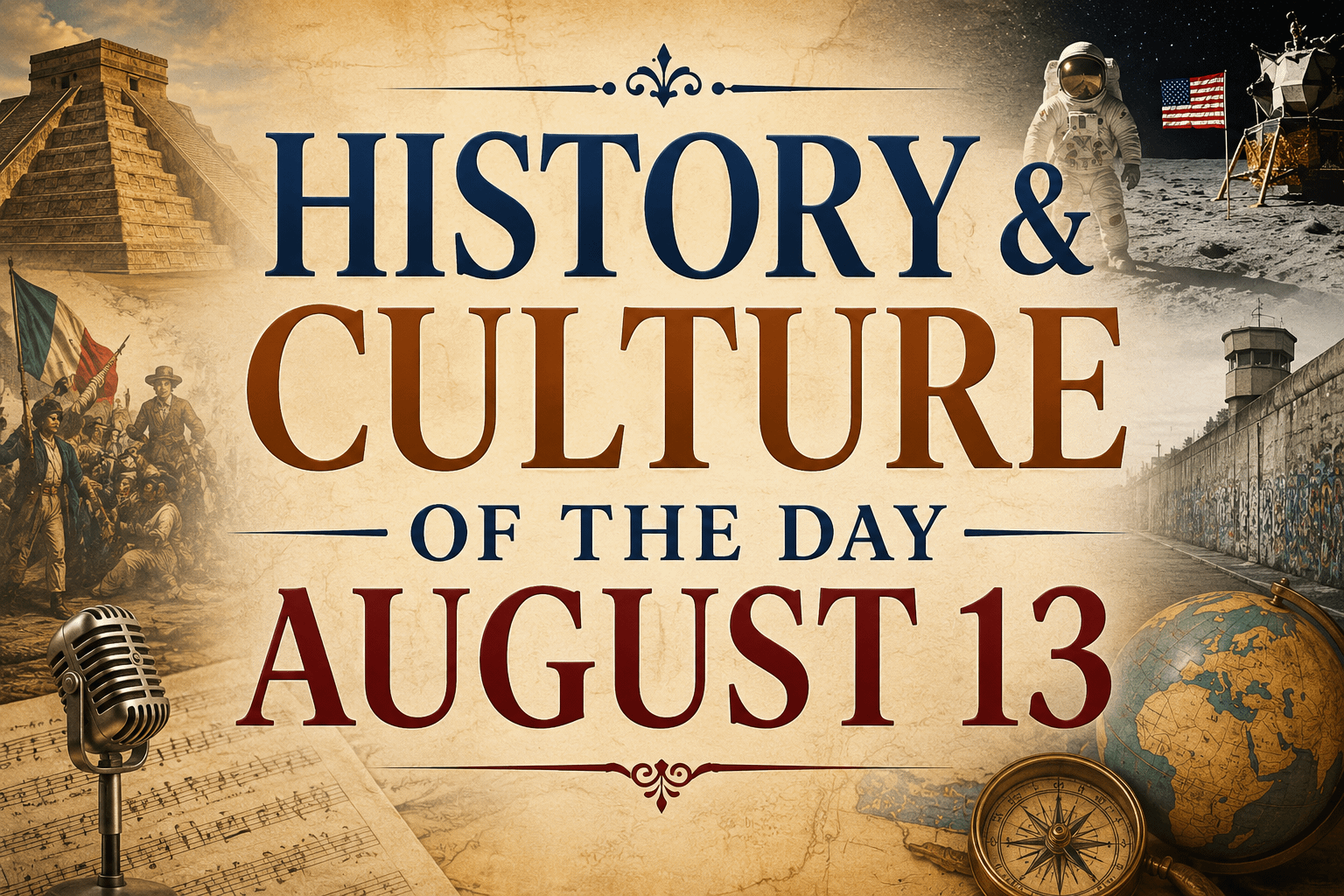
Every date on the calendar carries stories from the past, but some days connect an especially fascinating collection of historical events and cultural milestones. August 13 is one of those dates.
Across hundreds of years, August 13 has witnessed the collapse of a powerful Indigenous capital, dramatic changes during the French Revolution, breakthroughs for women in the military, an important moment in American music history, African independence, the construction of one of the Cold War’s most infamous barriers, and celebrations honoring humanity’s journey to the Moon.
August 13 is also recognized for lighter cultural traditions, including International Left-Handers Day, which celebrates the millions of people who experience the world from a slightly different perspective.
Taken together, these events reveal something important about history: human civilization is constantly changing.
Empires rise and fall. Governments change. Borders appear and disappear. Music crosses cultural boundaries. Technology makes the impossible possible. People challenge traditions that once seemed permanent.
Let’s travel through history and explore some of the people, events, and cultural moments that make August 13 a fascinating day to remember.
1521 – The Fall of Tenochtitlan Changes the Americas
One of the most significant events associated with August 13 occurred in 1521, when Tenochtitlan, capital of the Mexica, or Aztec, Empire, fell after a devastating siege.
Tenochtitlan was an extraordinary city.
Founded on islands in Lake Texcoco, it developed into one of the largest and most sophisticated urban centers in the Americas. Causeways connected the island city to the surrounding mainland, while canals allowed people and goods to move throughout the capital.
The city contained enormous temples, marketplaces, palaces, neighborhoods, gardens, and public spaces.
Agriculture was supported partly through chinampas, highly productive artificial agricultural plots sometimes described as “floating gardens.”
When Spanish forces led by Hernán Cortés first encountered Tenochtitlan, they entered a complex political world containing many Indigenous nations with their own alliances, rivalries, and grievances.
That complexity became crucial.
The Conquest Was Not Spain Against the Aztecs Alone
Older versions of the story sometimes portray the conquest as a small group of Spaniards defeating an enormous empire almost entirely on their own.
The reality was far more complicated.
Cortés relied heavily on thousands of Indigenous allies, including groups that had conflicts with or resented Mexica political power.
European diseases, particularly smallpox, also devastated Indigenous populations and weakened resistance.
After months of fighting, starvation, disease, and destruction, Tenochtitlan finally fell on August 13, 1521.
The capture of the city became a major turning point in the history of the Americas.
Spanish colonial rule expanded, Christianity spread through missionary activity and colonial institutions, and Indigenous political structures were transformed or destroyed.
At the same time, Indigenous cultures did not simply disappear.
Languages, foods, traditions, artistic practices, agricultural knowledge, and beliefs continued to influence Mexican society.
Modern Mexico emerged through centuries of interaction among Indigenous, European, African, and other peoples.
The fall of Tenochtitlan therefore represents not simply the end of one civilization, but the beginning of an enormously complicated new chapter.
1792 – The French Monarchy Moves Toward Its End
More than 270 years later, another dramatic political transformation was unfolding in Europe.
On August 13, 1792, King Louis XVI and members of the French royal family were imprisoned in the Temple in Paris, following the revolutionary uprising that had overwhelmed the Tuileries Palace several days earlier.
The event represented another major step toward the destruction of the French monarchy.
The French Revolution, which began in 1789, had been fueled by a combination of economic hardship, political inequality, government debt, food shortages, Enlightenment ideas, and anger toward the privileges enjoyed by the aristocracy and clergy.
French society had been organized under a system in which political power and social privilege were distributed very unevenly.
Calls for reform eventually turned into demands for revolutionary change.
The monarchy struggled to survive.
By August 1792, the situation had become increasingly radical.
Louis XVI’s imprisonment demonstrated that royal authority had effectively collapsed.
France soon abolished the monarchy and declared itself a republic.
In January 1793, Louis XVI was executed by guillotine.
The Cultural Legacy of the French Revolution
The French Revolution became one of the defining political events of the modern era.
Its influence extended far beyond France.
Ideas involving citizenship, equality before the law, representative government, secular authority, nationalism, and individual rights spread throughout Europe and beyond.
But the Revolution also demonstrated the dangers of political instability and extremism.
Violence increased, rival revolutionary factions fought for control, and France eventually entered the period known as the Reign of Terror.
The French Revolution remains an important example of how movements seeking freedom and equality can transform society—but also how revolutions can become unpredictable once established institutions collapse.
1918 – Opha May Johnson Makes U.S. Military History
August 13 also holds an important place in the history of women serving in the United States military.
On August 13, 1918, Opha May Johnson became the first woman to enlist in the United States Marine Corps.
Her enlistment occurred during World War I, when the military needed additional personnel to perform administrative and support duties.
By allowing women to fill certain positions, more male Marines could be assigned to overseas combat responsibilities.
Johnson became the first of hundreds of women who joined the Marine Corps Reserve during the war.
Her role may seem modest compared with the opportunities available to women in today’s military, but at the time it represented a significant cultural change.
Breaking Barriers One Generation at a Time
Women’s military service continued expanding throughout the 20th and early 21st centuries.
During World War II, women served in enormous numbers throughout different branches of the armed forces.
Later generations gained access to increasingly diverse military careers.
Restrictions gradually disappeared.
Women became pilots, commanders, intelligence specialists, engineers, military police officers, and eventually combat troops.
Opha May Johnson could not have known exactly how far that transformation would eventually go when she enlisted in 1918.
But someone had to be first.
Her story demonstrates how major social changes sometimes begin with individual people quietly stepping into places where people like them had rarely—or never—been allowed before.
1952 – Big Mama Thornton Records “Hound Dog”
August 13 also holds an important place in American music history.
In 1952, blues and rhythm-and-blues singer Willie Mae “Big Mama” Thornton recorded “Hound Dog,” written by the young songwriting team Jerry Leiber and Mike Stoller.
Thornton’s recording became an R&B hit.
Her powerful voice gave the song an attitude and intensity that helped make it memorable.
Several years later, Elvis Presley recorded a dramatically different version of “Hound Dog,” which became one of the most famous songs of the early rock-and-roll era.
Presley’s enormous popularity introduced the song to a much wider mainstream audience.
But understanding the earlier history of “Hound Dog” reveals something important about American popular music.
The Roots of Rock and Roll
Rock and roll did not suddenly appear during the 1950s.
Its development came through decades of musical interaction involving:
- Blues
- Rhythm and blues
- Gospel
- Jazz
- Country
- Boogie-woogie
- Folk traditions
Black American musicians played an especially important role in developing the rhythms, vocal styles, instrumentation, and performance traditions that helped shape rock music.
Big Mama Thornton’s “Hound Dog” represents one piece of that larger cultural history.
Her story also reminds us that popular culture sometimes remembers the most commercially successful version of a song while overlooking earlier artists who helped establish it.
Exploring those earlier recordings gives us a richer understanding of where modern music came from.
1960 – Independence for the Central African Republic
Another important event associated with August 13 occurred in Africa.
On August 13, 1960, the Central African Republic gained independence from France.
The event was part of a much larger wave of decolonization sweeping across Africa.
For generations, European powers had controlled enormous portions of the continent.
Following World War II, independence movements became increasingly powerful.
African political leaders, activists, intellectuals, workers, veterans, and ordinary citizens challenged colonial governments and demanded the right to govern themselves.
1960 – The “Year of Africa”
The year 1960 became especially important.
Seventeen African nations gained independence that year, leading historians to sometimes call it the “Year of Africa.”
The transformation dramatically changed the international political landscape.
New nations entered the United Nations.
Colonial boundaries became national borders.
African governments faced the enormous challenge of building political institutions and economies after decades of colonial rule.
Independence did not automatically solve every problem.
Many newly independent nations inherited difficult borders, limited infrastructure, economic dependence, political divisions, and institutions originally designed to serve colonial governments.
Nevertheless, independence represented something fundamental:
the right of people to determine their own political future.
For the Central African Republic, August 13 remains an important date in its national history.
1961 – The Berlin Wall Begins to Divide a City
One of the most recognizable events associated with August 13 occurred during the Cold War.
During the early morning hours of August 13, 1961, East German authorities began closing the border separating East Berlin from West Berlin.
Barbed wire was stretched across streets.
Roads were blocked.
Train connections were interrupted.
Soldiers and police guarded crossing points.
Berliners woke to discover that the geography of their everyday lives had suddenly changed.
The operation became known as “Barbed Wire Sunday.”
The temporary barriers eventually developed into the heavily fortified structure remembered as the Berlin Wall.
Why Was Berlin Divided?
To understand the Berlin Wall, we have to return to the end of World War II.
After Nazi Germany surrendered in 1945, Germany was divided into occupation zones controlled by the victorious Allied powers.
Berlin was also divided, even though the city was located deep inside the Soviet-controlled portion of Germany.
As tensions between the Soviet Union and Western powers increased, Germany eventually became two separate countries.
West Germany developed close ties with the United States and Western Europe.
East Germany, officially known as the German Democratic Republic, became part of the Soviet-dominated communist bloc.
Berlin became one of the most visible front lines of the Cold War.
East Germans Were Leaving
Before the wall was constructed, many East Germans were able to travel into East Berlin and then cross into West Berlin.
From there, they could continue into West Germany.
Millions left East Germany during the years following World War II.
Among those leaving were young workers, doctors, engineers, teachers, professionals, and students.
The loss created serious economic and political problems for the East German government.
Rather than allowing the population movement to continue, authorities decided to close the border.
The operation began on August 13.
Families Were Separated Overnight
Political history often focuses on presidents, governments, armies, and treaties.
But the Berlin Wall reminds us that political decisions affect ordinary people.
Imagine going to sleep knowing that your parents, children, grandparents, friends, or coworkers lived only a few streets away.
Then imagine waking up and discovering that armed guards and barbed wire suddenly prevented you from reaching them.
That became reality for countless Berliners.
Some people could see family members across the barrier but could not visit them.
Workers were separated from jobs.
Students were separated from schools.
Neighborhoods that had existed as connected communities became divided by politics.
The Wall Becomes a Symbol of the Cold War
The early barbed-wire barriers were gradually replaced with increasingly sophisticated fortifications.
Concrete walls were built.
Guard towers appeared.
Additional fencing, lighting, patrol roads, and security systems were installed.
East German authorities attempted to prevent people from escaping into West Berlin.
Despite the enormous danger, escape attempts continued.
People dug tunnels.
Some hid inside vehicles.
Others climbed, jumped, or used homemade devices in desperate attempts to reach the West.
Some escaped successfully.
Others were captured.
Some died while trying.
The Berlin Wall eventually became much more than a physical barrier.
It became an international symbol of the ideological division between East and West.
1989 – The Wall Finally Opens
For nearly three decades, the Berlin Wall seemed permanent.
But history rarely remains still.
By the late 1980s, communist governments throughout Eastern Europe were facing increasing political and economic pressure.
Demonstrations grew.
Citizens demanded greater freedom.
Then, on November 9, 1989, confusion surrounding new travel regulations resulted in enormous crowds gathering at Berlin border crossings.
Guards eventually allowed people through.
East and West Berliners celebrated together.
People climbed onto the wall.
Others began breaking pieces away with hammers and tools.
Images of people celebrating on top of the Berlin Wall became some of the most unforgettable scenes of the 20th century.
A structure that had begun appearing on August 13, 1961, was finally losing its power.
Germany officially reunified the following year.
1969 – Apollo 11 Astronauts Receive a Hero’s Welcome
Only eight years after the Berlin Wall began dividing Berlin, August 13 became associated with a very different chapter of history.
On August 13, 1969, Apollo 11 astronauts Neil Armstrong, Buzz Aldrin, and Michael Collins were honored during massive celebrations after returning from humanity’s first successful crewed Moon landing.
Only weeks earlier, on July 20, 1969, Armstrong and Aldrin had landed the lunar module Eagle on the Moon.
Armstrong became the first human to step onto another world.
Aldrin followed him onto the lunar surface.
Meanwhile, Collins remained aboard the command module Columbia, orbiting the Moon while his crewmates explored below.
Their journey captured worldwide attention.
A Celebration in New York City
On August 13, the Apollo 11 crew received an enormous ticker-tape parade in New York City.
Crowds packed streets and sidewalks.
Paper filled the air as the astronauts traveled through the city.
The celebration reflected the extraordinary excitement surrounding the Moon landing.
Later that day, additional celebrations honored the astronauts elsewhere in the United States.
For millions of people, Apollo 11 represented something greater than technological achievement.
It represented possibility.
The Space Age Changes Popular Culture
The space race influenced much more than science.
It transformed popular culture.
Children dreamed of becoming astronauts.
Science-fiction television programs and movies grew in popularity.
Space-age design influenced furniture, architecture, automobiles, advertising, toys, fashion, and household products.
Words such as rocket, space-age, lunar, orbit, and cosmic became part of marketing and everyday culture.
The Moon itself changed in the public imagination.
For thousands of years, humans had looked upward and wondered about it.
In 1969, humans finally walked there.
The August 13 celebration reflected humanity’s excitement at realizing that something once confined to imagination had become reality.
International Left-Handers Day
Not everything associated with August 13 involves wars, revolutions, political change, or space exploration.
August 13 is also recognized as International Left-Handers Day.
The observance celebrates left-handed people while drawing attention to the everyday challenges that can come from living in a world largely designed around right-handed users.
Most people probably don’t think much about which hand they use.
But design matters.
Throughout history, many ordinary objects have been created primarily for right-handed people.
These can include:
- Scissors
- School desks
- Can openers
- Kitchen utensils
- Computer equipment
- Musical instruments
- Tools
- Sports equipment
- Notebooks and binders
For a left-handed person, seemingly simple activities can sometimes require adjustment.
International Left-Handers Day gives people an opportunity to recognize those differences.
Changing Attitudes Toward Left-Handedness
Left-handedness has also carried unusual cultural meanings throughout history.
In some societies, left-handed people were treated with suspicion or encouraged to use their right hand instead.
Some children were historically forced to write right-handed even when using their left hand felt natural.
Modern attitudes have changed considerably.
Today, left-handedness is generally understood as a normal variation among people.
The observance therefore provides an interesting example of how cultural attitudes toward human differences can change over generations.
What Connects the Events of August 13?
At first glance, these events may seem unrelated.
What could the fall of Tenochtitlan possibly have in common with Apollo 11?
What connects the French Revolution with Big Mama Thornton?
How does the Berlin Wall belong in the same historical conversation as International Left-Handers Day?
The answer is change.
August 13 repeatedly reminds us that human societies are never completely permanent.
Political systems change.
Borders change.
Technology changes.
Music changes.
Cultural attitudes change.
Ideas about who can serve, lead, create, explore, or participate change.
Sometimes those changes happen gradually.
Sometimes they happen overnight.
History Is Experienced by Ordinary People
One of the most valuable ways to study history is to imagine events from the perspective of the people who experienced them.
Today we can look at August 13, 1961, and say:
That was the day construction of the Berlin Wall began.
But imagine being there.
You wouldn’t know that the wall would remain for decades.
You wouldn’t know that it would eventually fall.
You would simply know that your city had suddenly been divided.
The same is true throughout history.
Someone living in Tenochtitlan in 1521 did not know how profoundly the conquest would reshape the Americas.
A person living through the French Revolution could not know what political system would ultimately emerge.
Opha May Johnson could not know how dramatically opportunities for women in the military would expand.
Big Mama Thornton could not know exactly how much rock and roll would transform global popular culture.
The Apollo 11 astronauts could not know how future generations would remember their journey.
They were simply living their lives while history unfolded around them.
The Past Was Once the Present
That may be one of history’s most important lessons.
Every historical event was once somebody’s present day.
The photographs we study were once ordinary moments.
The famous speeches we quote were once words being heard for the first time.
The buildings we preserve were once new.
The borders shown on old maps once determined where real people could travel.
The people whose names appear in textbooks didn’t know exactly how future generations would judge them.
And the same thing is happening today.
We are living through history without knowing which moments future generations will consider important.
Culture Gives History Its Human Side
History is sometimes taught primarily through wars, presidents, kings, elections, treaties, and political events.
Those things matter.
But culture tells another part of the human story.
Music tells us what people listened to.
Food tells us how communities lived and interacted.
Fashion reveals changing attitudes and technology.
Movies show us what societies feared, admired, or dreamed about.
Language demonstrates how ideas spread.
Celebrations and observances show us what communities choose to remember.
That is why a cultural milestone such as Big Mama Thornton recording “Hound Dog” deserves a place alongside political events.
Music can influence generations just as political movements can.
Culture helps explain not only what happened, but also what life felt like.
Remembering History From Multiple Perspectives
Another lesson from August 13 is the importance of examining history from more than one perspective.
The conquest of Tenochtitlan can be viewed through Spanish accounts, Indigenous experiences, military strategy, disease, religion, politics, and colonial history.
The French Revolution can be examined through revolutionaries, royalists, ordinary workers, women, political leaders, and neighboring nations.
The Berlin Wall looks different depending on whether someone lived in East Berlin, West Berlin, East Germany, West Germany, the United States, or the Soviet Union.
History becomes richer when we recognize that major events rarely have only one story.
Different people can experience the same event in dramatically different ways.
Understanding those perspectives doesn’t require ignoring facts.
Instead, it helps us understand the human consequences behind those facts.
Why August 13 Still Matters
The events of August 13 may belong to different centuries, but many of their themes remain relevant.
People still debate political freedom.
Countries continue struggling with the consequences of colonialism.
Women continue breaking barriers in traditionally male-dominated fields.
Musicians continue building upon traditions created by earlier generations.
Borders continue separating people.
Technology continues challenging our understanding of what humans can accomplish.
Societies continue learning how to recognize and respect individual differences.
History doesn’t repeat itself perfectly, but human beings repeatedly face similar questions.
Who has power?
Who gets opportunities?
Who controls borders?
Who receives credit?
How do societies respond to change?
What freedoms are worth protecting?
How far can human curiosity take us?
Those questions connect yesterday with today.
A Day of Contrasts
Perhaps the most fascinating thing about August 13 is the contrast between its historical moments.
1521: A great city falls.
1792: A monarchy moves toward collapse.
1918: A woman enters a new chapter of American military history.
1952: A blues singer records a song that will become part of rock-and-roll history.
1960: A nation celebrates independence.
1961: A city is divided.
1969: Astronauts who traveled to another world are welcomed home as heroes.
And today, people also use August 13 to celebrate something as everyday and personal as being left-handed.
Together, these stories show the enormous range of human experience.
History can happen on battlefields.
It can happen inside government buildings.
It can happen inside recording studios.
It can happen at military recruiting offices.
It can happen along city streets.
And sometimes history happens hundreds of thousands of miles away on the surface of the Moon.
Final Thoughts: What August 13 Teaches Us
August 13 is a remarkable day of history and culture filled with stories of conquest, revolution, independence, courage, division, creativity, exploration, and change.
The fall of Tenochtitlan reminds us how civilizations can be transformed through conflict, alliances, disease, and conquest.
The French Revolution reminds us that political systems that appear permanent can collapse when societies demand change.
Opha May Johnson’s enlistment reminds us that progress often begins when someone becomes the first to cross a barrier.
Big Mama Thornton’s recording of “Hound Dog” reminds us to look deeper into cultural history and recognize the artists whose influence helped shape later generations.
The independence of the Central African Republic reminds us of the global struggle for self-determination that transformed the 20th century.
The Berlin Wall reminds us of the human consequences of political division—and the extraordinary power of people who refuse to believe those divisions must last forever.
Apollo 11 reminds us of what human imagination, science, courage, cooperation, and determination can accomplish.
And International Left-Handers Day reminds us that history and culture aren’t only found in monumental events. They’re also found in the everyday differences that make people unique.
Perhaps the greatest lesson of August 13 is simply this:
The world can change more quickly than we imagine.
A city can fall.
A monarchy can disappear.
A barrier can rise overnight.
A barrier can eventually fall.
A song can influence generations.
Someone can become the first to open a door for others.
A nation can declare its independence.
And human beings who spent thousands of years staring at the Moon can eventually walk across its surface.
History isn’t finished.
Every generation inherits the consequences of what came before while adding another chapter to the human story.
Today is tomorrow’s history.
The choices we make, the people we help, the barriers we challenge, the traditions we preserve, and the dreams we pursue may become part of the story future generations tell about our time.
So as we remember the history and culture of August 13, we aren’t simply looking backward.
We’re also reminded that we are participating in history ourselves—and each new day gives us another opportunity to shape what comes next.
Leave a ReplyCancel reply