
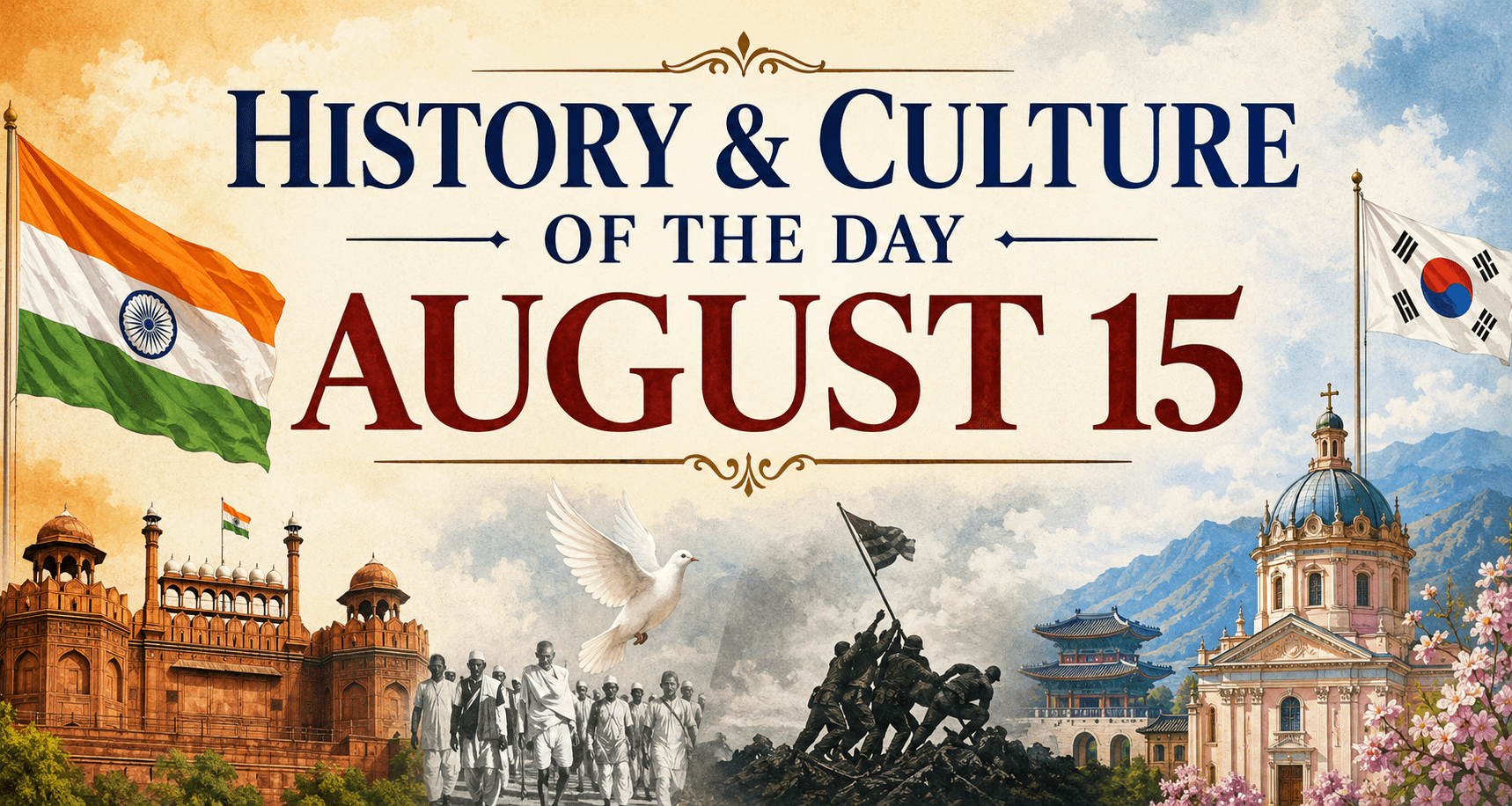
Every date on the calendar carries stories from the past, but August 15 is especially rich in history and cultural significance. Across continents and centuries, this date has become associated with independence, liberation, the end of war, religious faith, ancient traditions, national identity, and remembrance.
For hundreds of millions of people, August 15 is not simply another summer day.
It is Independence Day in India, commemorating the end of British colonial rule in 1947. It is associated with Korea’s liberation from Japanese colonial rule in 1945. The Republic of the Congo celebrates its independence from France on this date. In Europe and elsewhere, Christians observe the Assumption of the Blessed Virgin Mary. In Italy, August 15 is also Ferragosto, a major summer celebration whose origins reach back to ancient Rome.
The date is also inseparable from the final chapter of World War II, as Japan’s announcement accepting Allied surrender terms on August 15, 1945, signaled that the world’s deadliest conflict was finally coming to an end.
Together, these events make August 15 a remarkable day for examining how history becomes culture—and how events from decades or even centuries ago continue to shape modern identities and traditions.
🇮🇳 August 15, 1947 – India Becomes Independent
One of the defining events associated with August 15 occurred in 1947, when India achieved independence from British rule.
British influence on the Indian subcontinent stretched back centuries, initially through commercial activity associated with the British East India Company and eventually through direct colonial government.
Resistance to British rule developed over generations.
By the late nineteenth and early twentieth centuries, organized political movements increasingly demanded greater self-government and eventually complete independence.
The Indian National Congress, founded in 1885, became one of the major organizations involved in the independence movement.
Over time, numerous political leaders, activists, writers, students, workers, religious figures, and ordinary citizens became involved.
Among the most internationally recognized was Mahatma Gandhi.
Mahatma Gandhi and Nonviolent Resistance
Gandhi became famous for promoting nonviolent resistance, or satyagraha, as a way of confronting injustice.
Rather than attempting to defeat British authority primarily through armed conflict, Gandhi encouraged mass participation in peaceful demonstrations, boycotts, marches, strikes, and civil disobedience.
One of the most famous examples occurred in 1930 with the Salt March.
British colonial laws restricted Indians from freely producing salt and imposed taxes on it. Gandhi and his followers walked hundreds of miles to the Arabian Sea, where he symbolically produced salt in defiance of British law.
The event attracted international attention and demonstrated the power of organized nonviolent protest.
Gandhi’s philosophy later influenced civil-rights and social-justice movements far beyond India.
His ideas became particularly influential to leaders such as Martin Luther King Jr., who studied Gandhi’s methods while developing strategies for the American Civil Rights Movement.
But India’s independence movement was larger than any single person.
Jawaharlal Nehru, Vallabhbhai Patel, Subhas Chandra Bose, B. R. Ambedkar, Muhammad Ali Jinnah, Sarojini Naidu and countless lesser-known activists all played roles in the complicated political transformation of the subcontinent.
“A Tryst With Destiny”
As British rule approached its end, India prepared for a historic transition.
Near midnight on August 14–15, 1947, Jawaharlal Nehru addressed India’s Constituent Assembly.
His famous speech became known as “Tryst with Destiny.”
Nehru spoke about India’s emergence into independence after years of struggle and sacrifice.
As August 15 began, a new chapter in Indian history opened.
Nehru became the country’s first prime minister, and the Indian national flag became one of the central symbols of the newly independent nation.
Today, India’s Independence Day remains one of the country’s most important national holidays.
How India Celebrates Independence Day Today
Every August 15, celebrations take place throughout India.
The Indian tricolor is displayed prominently on homes, schools, government buildings, businesses, and public spaces.
A major national ceremony takes place at the historic Red Fort in Delhi, where India’s prime minister raises the national flag and addresses the country.
Schools frequently organize patriotic programs, speeches, performances, songs, and flag ceremonies.
Communities hold celebrations highlighting India’s history and cultural diversity.
The holiday is therefore about more than remembering the transfer of political power in 1947.
It has become an annual celebration of Indian identity, democracy, sacrifice, culture, and national pride.
The Other Side of 1947: Partition
Independence brought tremendous celebration, but the events of 1947 also produced one of the most traumatic migrations in modern history.
British India was divided primarily into two new independent dominions: India and Pakistan.
Pakistan marks its independence on August 14, while India celebrates on August 15.
Partition resulted largely from complicated political and religious tensions surrounding the future of the subcontinent.
The creation of new borders suddenly placed millions of people on what they considered the “wrong” side of the boundary.
Muslims migrated toward Pakistan, while many Hindus and Sikhs moved toward India.
Millions were displaced.
Families abandoned homes where generations had lived.
Communities that had existed together for decades or centuries were separated.
Violence erupted across several regions, resulting in enormous loss of life.
The exact number of deaths remains debated, but historians generally agree that the human cost was staggering.
For survivors and their descendants, Partition became an enduring part of family memory.
This makes August 15 historically complex.
It represents extraordinary freedom and national achievement while also reminding us that major political transformations can carry painful human consequences.
🇯🇵 August 15, 1945 – Japan Announces Its Surrender
Two years before India’s independence, August 15 became associated with another enormous historical turning point.
In 1945, World War II had devastated much of Europe and Asia.
Germany had surrendered in May, ending the war in Europe, but fighting continued in the Pacific.
By the summer of 1945, Japan faced devastating military losses, widespread destruction, naval blockades, and bombing campaigns.
Then came two events that would forever remain among the most debated and consequential moments of the war.
The United States dropped an atomic bomb on Hiroshima on August 6, 1945, followed by another atomic bomb on Nagasaki on August 9.
The Soviet Union also entered the war against Japan in August.
Faced with a rapidly deteriorating situation, Japan moved toward accepting the Allied surrender terms.
On August 15 in Japan, Emperor Hirohito’s recorded announcement was broadcast to the Japanese people, communicating acceptance of the Potsdam Declaration.
The war was effectively ending.
Victory Celebrations Across the Allied World
The news produced extraordinary scenes of celebration.
After nearly six years of global warfare—and almost four years of direct American involvement—millions of people finally believed peace was returning.
Crowds gathered in cities throughout the United States and other Allied nations.
People danced in streets.
Church bells rang.
Flags appeared everywhere.
Strangers hugged one another.
Families began imagining their loved ones returning from overseas.
For those who had spent years following casualty reports and worrying about soldiers, sailors, Marines, and airmen, the announcement represented tremendous relief.
The celebrations became associated with Victory over Japan Day, often shortened to V-J Day.
The Famous Times Square Photograph
One of the most recognizable photographs connected with the end of World War II was taken amid the celebrations in Times Square in New York City.
The photograph shows a sailor kissing a woman dressed in white while crowds celebrate around them.
Photographer Alfred Eisenstaedt captured the famous image for Life magazine.
Another photographer, Victor Jorgensen, photographed the same moment from a different angle.
The image became one of the most recognizable photographs of the twentieth century and came to symbolize the spontaneous excitement surrounding the end of the war.
Modern discussion of the photograph has also examined the circumstances of the kiss and questions of consent, demonstrating how cultural interpretations of historical images can change over time.
History does not remain frozen. Later generations often reconsider famous moments through new social and cultural perspectives.
September 2, 1945 – The Formal Surrender
Although August 15 is closely associated with Japan’s surrender announcement, the formal surrender ceremony occurred several weeks later.
On September 2, 1945, Japanese representatives boarded the American battleship USS Missouri in Tokyo Bay.
Representatives of Japan and the Allied powers signed the official surrender documents.
World War II was formally over.
The conflict had transformed nearly every aspect of international politics.
Tens of millions of people had died.
Cities had been destroyed.
Entire populations had been displaced.
The Holocaust had murdered six million Jews along with millions of other victims of Nazi persecution and warfare.
The atomic age had begun.
And the international balance of power had dramatically changed.
August 15 therefore represents both celebration and remembrance.
A New World Emerges After World War II
The end of World War II did not simply restore the world that existed before 1939.
It created something new.
The United States and Soviet Union emerged as rival superpowers.
Their ideological and political competition soon developed into the Cold War.
Europe began the long process of rebuilding.
The United Nations, established in 1945, attempted to create a new international framework for diplomacy, security, development, and human rights.
Colonial empires increasingly faced demands for independence.
Nationalist movements expanded throughout Asia, Africa, the Middle East, and elsewhere.
Within only a few decades, dozens of new nations would emerge.
The postwar world also witnessed tremendous technological advancement.
Aviation expanded.
Television entered millions of homes.
Nuclear technology transformed military strategy.
Medicine advanced.
Space exploration began.
Computers eventually transformed society.
The world after August 1945 would never be the same.
🇰🇷 August 15 – Korea’s National Liberation Day
August 15 also holds extraordinary significance for the Korean people.
From 1910 until 1945, Korea was under Japanese colonial rule.
Korean language, political activity, economic life, education, and cultural identity were heavily affected by colonial policies.
Resistance movements developed both inside and outside Korea.
When Japan surrendered in August 1945, decades of colonial rule ended.
August 15 became a symbol of liberation.
In South Korea, the holiday is known as Gwangbokjeol, commonly translated as “Restoration of Light Day.”
The name itself is powerful.
It represents the idea that national sovereignty and identity had returned after a long period of foreign domination.
Korea After Liberation
Liberation did not immediately create a unified independent Korean state.
After Japan’s surrender, Korea was divided into occupation zones.
Soviet forces occupied the north while American forces occupied the south.
Political tensions increased as the Cold War developed.
In 1948, separate governments emerged.
The Republic of Korea, commonly called South Korea, was established on August 15, 1948.
The Democratic People’s Republic of Korea, commonly called North Korea, was established shortly afterward.
Only a few years later, the Korean War began in 1950.
The conflict devastated the peninsula and reinforced the division between North and South.
No comprehensive peace treaty has ever formally ended the Korean War; the large-scale fighting stopped with an armistice in 1953.
This makes August 15 particularly meaningful in Korean history.
It represents liberation and national pride, but it also sits at the beginning of a complicated postwar period that ultimately produced the divided Korean Peninsula that exists today.
🇨🇬 August 15, 1960 – Independence for the Republic of the Congo
Another important independence anniversary falls on August 15.
On August 15, 1960, the Republic of the Congo gained independence from France.
The country, sometimes called Congo-Brazzaville to distinguish it from the neighboring Democratic Republic of the Congo, had been part of French colonial Africa.
Its independence came during one of the greatest periods of political transformation in African history.
1960 – The “Year of Africa”
The year 1960 is frequently called the “Year of Africa.”
Seventeen African countries gained independence during that single year.
Across the continent, colonial systems that European powers had established during the nineteenth and early twentieth centuries were rapidly changing.
New national flags were raised.
New governments formed.
Political leaders faced the enormous challenge of building institutions, economies, education systems, diplomatic relationships, and national identities after colonial rule.
The Republic of the Congo was part of this historic transformation.
Its August 15 independence anniversary remains an important celebration of national sovereignty.
⛪ August 15 – The Assumption of the Blessed Virgin Mary
Long before the political events of the twentieth century, August 15 already held major religious importance.
For Roman Catholics and some other Christian traditions, August 15 is associated with the Assumption of the Blessed Virgin Mary.
Catholic teaching holds that Mary, the mother of Jesus Christ, was taken body and soul into heavenly glory at the end of her earthly life.
The belief has ancient roots in Christian tradition.
In 1950, Pope Pius XII formally defined the Assumption as a dogma of the Roman Catholic Church.
But celebrations connected with Mary’s departure from earthly life existed many centuries before the formal declaration.
A Celebration Across Cultures
The Assumption is particularly interesting because the same religious observance can look very different depending on local culture.
In some communities, people attend special Masses.
Elsewhere there are elaborate processions carrying statues or images of Mary.
Church bells may ring.
Flowers decorate churches.
Families gather for meals.
Towns organize festivals.
Music, dancing, fireworks, and local foods may accompany the religious observance.
In several traditionally Catholic countries, August 15 is also a public holiday.
The result is a fascinating combination of faith, family, community, and cultural tradition.
🇮🇹 Ferragosto – Italy’s Great August Holiday
Few countries embrace August 15 quite like Italy.
The Italian celebration known as Ferragosto combines ancient Roman history, Christian tradition, family gatherings, travel, food, and summer vacation.
Its origins stretch back more than two thousand years.
The name Ferragosto is derived from the Latin Feriae Augusti, or the “rest of Augustus.”
The holiday was associated with Roman Emperor Augustus, whose reign began an important period in Roman history.
Ancient festivities offered a period of rest after demanding agricultural labor.
Workers, farmers, and animals could receive relief from work while communities participated in celebrations.
From Ancient Rome to Christian Italy
As Christianity became dominant within the Roman world, older cultural traditions were often transformed or incorporated into Christian calendars.
Over the centuries, Ferragosto became closely connected with the Feast of the Assumption on August 15.
The result is a holiday with layers of history.
Its roots reach into ancient Roman civilization.
Its religious meaning comes from Christianity.
Its modern form reflects contemporary Italian culture.
That combination demonstrates something important about culture: traditions rarely remain unchanged.
Instead, societies reinterpret customs generation after generation.
What Ferragosto Looks Like Today
Modern Ferragosto is one of the highlights of the Italian summer.
For many Italians, mid-August means vacation.
Cities can become noticeably quieter as residents travel to coastal towns, mountain communities, countryside destinations, lakes, or family homes.
Beaches fill with vacationers.
Families organize large meals.
Restaurants and resorts may host special events.
Communities hold festivals and concerts.
Fireworks often illuminate summer skies.
Friends gather outdoors.
Food naturally plays an important role.
Regional dishes vary dramatically because Italian cuisine is strongly connected with local traditions.
Ferragosto is therefore more than a single holiday.
It represents the Italian appreciation of family, food, leisure, community, tradition, and summer life.
Why National Holidays Matter
The events associated with August 15 demonstrate why national holidays are about more than taking a day off from work.
National celebrations help societies tell stories about themselves.
They answer questions such as:
Who are we?
Where did we come from?
What struggles shaped our country?
Which sacrifices should we remember?
What values do we want future generations to preserve?
Independence celebrations frequently include flags, monuments, speeches, songs, parades, military ceremonies, traditional clothing, and historical reenactments because these symbols reinforce a shared national story.
But those stories can also be complicated.
Independence for one group may have coincided with displacement for another.
Military victory can be remembered alongside devastating civilian suffering.
Liberation may be followed by political division.
Good historical understanding requires making room for those complexities.
History Is More Than Dates and Names
When people think about history, they sometimes imagine memorizing dates from textbooks.
But history becomes much more meaningful when we examine the people behind those dates.
Imagine being an Indian family waking up on August 15, 1947, realizing British colonial rule had ended.
Imagine being a Korean family in August 1945 hearing that decades of Japanese colonial rule were over.
Imagine being an American parent learning that the Pacific War was ending and hoping a son or daughter serving overseas would soon return home.
Imagine living in the Republic of the Congo in 1960 as your country became independent.
Or imagine an Italian family continuing a summer tradition whose origins reach back through generations and ultimately to ancient Rome.
Those human experiences are what turn historical dates into living memory.
Culture Keeps History Alive
Culture is one of the primary ways societies preserve their past.
People tell stories.
They cook traditional foods.
They sing songs.
They raise flags.
They attend religious services.
They visit monuments.
They gather with relatives.
They teach children why certain dates matter.
Eventually, an event that happened decades or centuries ago becomes part of a community’s identity.
That is why history and culture are so closely connected.
History records what happened. Culture helps determine how people remember it.
Different Countries, Similar Human Themes
India, Korea, the Republic of the Congo, Italy, Japan, and the United States have very different histories.
Yet the August 15 stories associated with these places reveal several shared human themes.
Freedom
People throughout history have struggled for the ability to determine their own political futures.
Identity
Language, religion, customs, food, music, clothing, and shared memories help communities understand who they are.
Sacrifice
Major historical transformations frequently come at enormous human cost.
Remembrance
Societies create holidays and memorials so important events are not forgotten.
Faith
Religious traditions connect people not only with their beliefs but also with generations who practiced those traditions before them.
Community
Celebrations bring people together and transform historical memory into a shared experience.
Renewal
Many August 15 observances involve the beginning of something new—independence, liberation, peace, sovereignty, or spiritual hope.
August 15 Through the Generations
Perhaps the most fascinating part of August 15 is how dramatically its meaning changes depending on where you are standing.
A child in India may associate the day with flags, school celebrations, patriotic songs, and stories about independence.
Someone in South Korea may think about liberation and national identity.
A family in Italy may associate August 15 with Mass, Ferragosto, vacation, the beach, and a large family meal.
A World War II historian may immediately think about Japan’s surrender announcement.
A family whose relative served in the Pacific may think about an old photograph, military uniform, medal, or story passed down from a grandparent.
History becomes personal in this way.
A date on a calendar can connect global events with individual family stories.
Preserving History for Future Generations
As the people who personally witnessed events such as World War II and Indian independence grow fewer, preserving historical memory becomes increasingly important.
Documents, photographs, oral histories, letters, newspapers, museums, monuments, recordings, and family stories allow future generations to understand events they never personally experienced.
But preserving history requires more than keeping artifacts.
We must also continue asking questions.
What happened?
Why did it happen?
Who was affected?
Whose voices were overlooked?
How did the event change society?
What can we learn from it today?
Those questions transform history from memorization into understanding.
What August 15 Can Teach Us
August 15 demonstrates that history rarely fits neatly into categories of celebration or tragedy.
Sometimes both exist together.
India’s independence brought freedom while Partition brought tremendous suffering.
Japan’s surrender brought relief and peace after a devastating war while leaving nations to confront enormous destruction and loss.
Korea’s liberation ended colonial rule but was followed by political division and eventually war.
African independence created sovereign nations while newly independent governments faced enormous political and economic challenges.
Even ancient cultural traditions such as Ferragosto demonstrate change, adaptation, and continuity over thousands of years.
History is complicated because human beings are complicated.
Recognizing that complexity does not diminish celebrations. It gives them greater meaning.
August 15: A Day of Independence, Liberation, Faith, and Remembrance
Few dates bring together as many different chapters of human history as August 15.
It is a day when India celebrates independence.
It is a day when Koreans remember liberation.
It is the independence anniversary of the Republic of the Congo.
It is deeply connected with the end of World War II.
It is the Christian Feast of the Assumption.
And throughout Italy, it is Ferragosto, one of the most beloved celebrations of the summer.
These traditions developed in different places and for very different reasons, yet they share powerful themes.
Freedom.
Faith.
Identity.
Sacrifice.
Family.
Community.
Remembrance.
Hope.
The stories of August 15 remind us that history is not simply something that happened long ago.
History continues to live through the traditions we practice, the stories we tell, the people we remember, and the lessons we choose to carry forward.
Every generation inherits the stories of those who came before it.
Our responsibility is to learn those stories, preserve them, understand their complexities, and pass them along.
That is why August 15 is more than another date on the calendar.
It is a remarkable window into the struggles, celebrations, beliefs, and traditions that have shaped our shared human story.
Leave a ReplyCancel reply