
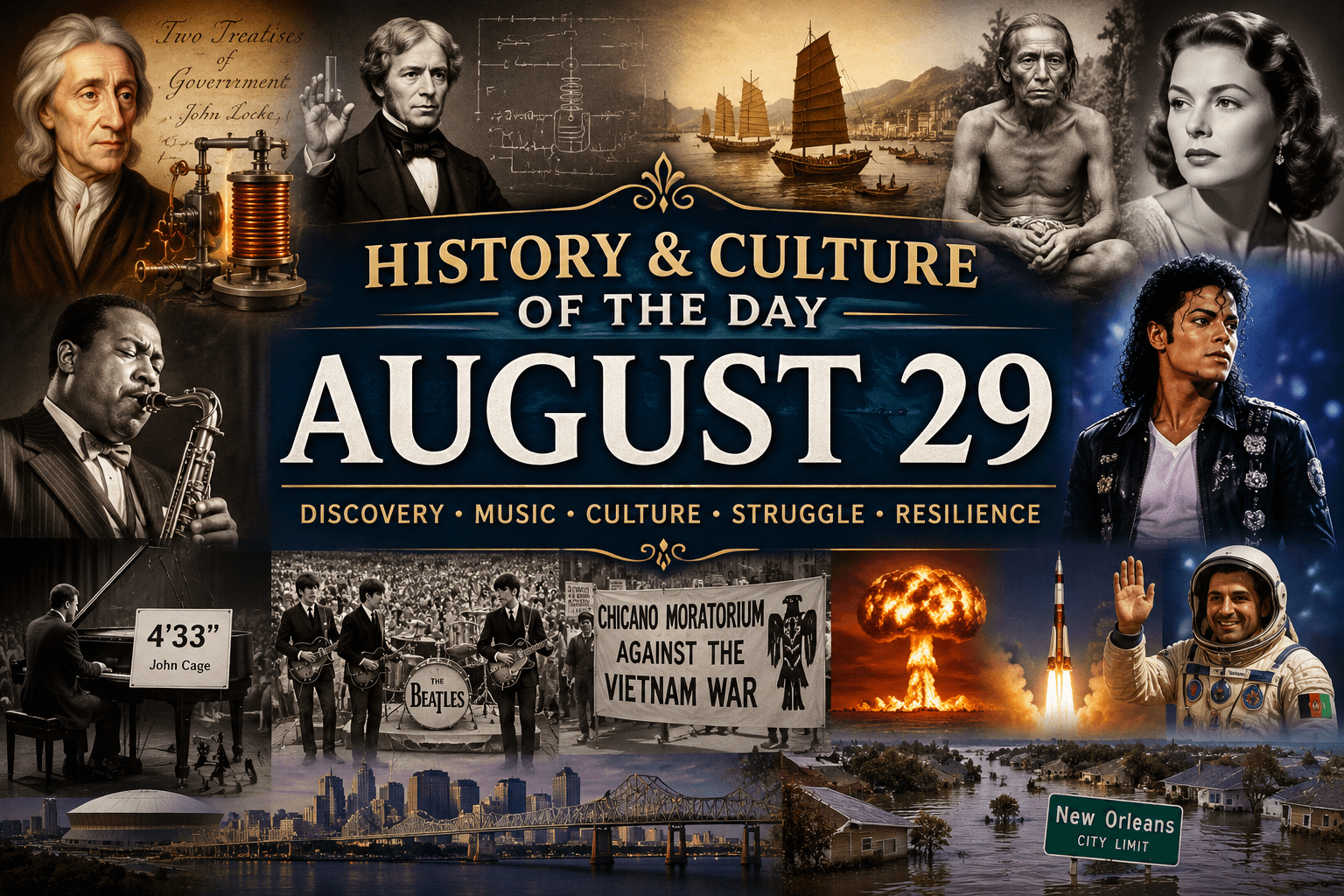
Every date on the calendar carries stories, but August 29 is especially rich with events that helped shape science, politics, music, civil rights, entertainment, and modern culture.
Across several centuries, August 29 has witnessed groundbreaking scientific discoveries, international treaties, cultural milestones, legendary birthdays, social movements, technological achievements, and devastating tragedy.
It is the date associated with Michael Faraday’s experiments with electromagnetic induction, the end of the First Opium War, the emergence of Ishi in California, the birth of jazz legend Charlie Parker, the Soviet Union’s first successful atomic bomb test, the premiere of John Cage’s controversial 4’33”, the birth of Michael Jackson, the Beatles’ final scheduled concert before a paying audience, the Chicano Moratorium, and the devastating landfall of Hurricane Katrina.
Taken together, these moments show how history is not simply a collection of dates.
History is the story of people making discoveries, challenging traditions, fighting for change, creating art, surviving disasters, and leaving behind ideas that continue influencing generations.
Let’s travel through the remarkable history and culture connected to August 29.
1632 – Philosopher John Locke Is Born
Our journey begins on August 29, 1632, with the birth of English philosopher John Locke.
Locke would become one of the most influential thinkers of the Enlightenment.
His writings explored questions that remain central to political life today:
What rights belong naturally to individuals?
Where does government receive its authority?
When does a government lose the right to govern?
What responsibilities do governments have toward their citizens?
Locke argued that people possess natural rights and that legitimate government depends upon the consent of the governed.
His political philosophy influenced Enlightenment thinkers throughout Europe and eventually helped shape political ideas in America.
Concepts involving individual liberty, representative government, property, religious tolerance, and limitations on political authority became increasingly important during the 17th and 18th centuries.
More than three centuries after Locke’s birth, debates about liberty, government authority, individual rights, and political responsibility continue.
That lasting influence demonstrates one of history’s most powerful truths:
Ideas can survive far longer than the people who first expressed them.
1831 – Michael Faraday and the Discovery That Helped Power the Modern World
On August 29, 1831, British scientist Michael Faraday carried out experiments that demonstrated the principle of electromagnetic induction.
At first glance, this may seem like a scientific event belonging primarily in textbooks.
In reality, Faraday’s work helped lay the foundation for the electrical civilization surrounding us today.
Faraday discovered that a changing magnetic field could generate an electric current.
That relationship between electricity and magnetism became fundamental to the development of generators and transformers.
Consider how dependent modern civilization has become on electricity.
Homes are illuminated by it.
Hospitals depend upon it.
Factories operate with it.
Computers require it.
Communication networks depend upon it.
Transportation increasingly relies upon it.
Phones, televisions, refrigerators, air conditioners, medical equipment, data centers, traffic systems, and countless other technologies all depend upon electrical power.
Faraday could not have imagined every device that would eventually emerge from the scientific principles he studied.
Yet his work demonstrates how a discovery made in a laboratory can eventually transform everyday human life.
Scientific progress often happens this way.
One person discovers a principle.
Another improves upon it.
Engineers find practical applications.
Businesses develop new technologies.
Infrastructure is built.
Eventually something that once seemed extraordinary becomes so ordinary that people barely think about it.
Today, flipping a light switch feels effortless.
Behind that simple action lies centuries of experimentation, discovery, engineering, and innovation.
1842 – The Treaty of Nanking Changes Relations Between China and Britain
On August 29, 1842, representatives of Britain and China’s Qing dynasty signed the Treaty of Nanking, bringing the First Opium War to an end.
The agreement became one of the most consequential treaties in modern Chinese history.
Under its terms, China ceded Hong Kong Island to Britain and opened several ports to British trade.
The treaty also imposed significant financial and commercial obligations on China.
It became the first in a series of agreements later remembered in China as the “unequal treaties.”
The consequences stretched far beyond the immediate end of the war.
Foreign influence within China expanded.
Traditional systems governing international trade were disrupted.
Chinese sovereignty came under increasing pressure from foreign powers.
Additional conflicts and agreements followed.
The treaty also began a long chapter in Hong Kong’s history.
Hong Kong remained under British rule for more than a century before sovereignty was transferred to China in 1997.
Understanding the Treaty of Nanking helps explain why events from the 19th century remain important to discussions of Chinese national identity and China’s relationships with Western nations.
History does not always stay safely in the past.
Treaties, wars, borders, occupations, and political decisions can influence how nations understand one another generations later.
1911 – Ishi Appears Near Oroville, California
One of the most moving events associated with August 29 occurred in California.
On August 29, 1911, a Native American man later widely known as Ishi emerged near Oroville.
His appearance attracted considerable public attention.
He was identified with the Yahi people, whose population had been devastated during the violent expansion of settlers into California.
Ishi eventually became connected with anthropologists associated with the University of California.
Researchers documented aspects of his language, stories, traditions, knowledge, and craftsmanship.
For many years, popular accounts referred to him as the “last wild Indian” or the “last Yahi.”
Those descriptions are now approached more critically.
They can oversimplify Indigenous history and reduce a human being and an entire culture to a dramatic label.
Ishi’s story should instead encourage deeper reflection on what happened to Native peoples during California’s development.
Indigenous communities experienced displacement, violence, disease, forced assimilation, destruction of traditional lands, and enormous population losses.
These were not abstract historical processes.
They happened to families and communities.
Languages disappeared.
Traditions were threatened.
Generations were separated from ancestral lands.
Ishi’s story therefore represents more than the story of one man appearing outside Oroville.
It is connected to the much larger history of Indigenous survival, cultural preservation, colonial expansion, and the consequences of violence against Native communities.
1915 – Ingrid Bergman Is Born
On August 29, 1915, actress Ingrid Bergman was born in Stockholm, Sweden.
She would become one of the most respected and recognizable performers of Hollywood’s golden age.
Bergman possessed a screen presence that could communicate vulnerability, intelligence, strength, uncertainty, and emotional depth.
Her international career eventually brought her to Hollywood, where she appeared in several celebrated films.
Among them were:
Casablanca
Gaslight
Spellbound
Notorious
Anastasia
Her performance opposite Humphrey Bogart in Casablanca became one of the defining performances of classic American cinema.
Released in 1942 during World War II, the film combined romance, sacrifice, political tension, and moral responsibility.
Decades later, Casablanca remains one of the most frequently celebrated films in cinema history.
Bergman eventually won three Academy Awards during her career.
In an extraordinary coincidence, she died on August 29, 1982, her 67th birthday.
She therefore entered and left the world on the same calendar date.
Her films, however, ensured that her performances would continue long afterward.
August 29 and the Transformation of Music
August 29 has an unusually strong connection to music history.
Jazz, experimental composition, rock and roll, and global pop culture all intersect with this single date.
Four moments in particular stand out.
1920 – Charlie Parker Is Born and Jazz Will Never Be the Same
On August 29, 1920, legendary saxophonist Charlie Parker was born in Kansas City, Kansas.
Known as “Bird,” Parker became one of the most influential musicians in jazz history.
During the 1940s, Parker and musicians including Dizzy Gillespie helped develop the revolutionary jazz style known as bebop.
Earlier forms of jazz had become enormously popular as dance music.
Bebop moved jazz toward something different.
The music emphasized sophisticated harmony, fast tempos, complicated melodic lines, rhythmic experimentation, and extraordinary improvisational ability.
For musicians, bebop demanded enormous technical skill.
For listeners, it opened new possibilities for what jazz could become.
Parker’s saxophone playing influenced generations of musicians.
His phrasing, harmonic imagination, speed, creativity, and improvisational vocabulary became essential areas of study for aspiring jazz musicians.
His personal life was troubled, and he died in 1955 at only 34 years old.
His musical influence, however, greatly exceeded his short lifetime.
Today, Charlie Parker remains one of the foundational figures of modern jazz.
1949 – The Soviet Union Tests Its First Atomic Bomb
August 29 also marks one of the most consequential moments of the early Cold War.
On August 29, 1949, the Soviet Union successfully tested its first atomic bomb at the Semipalatinsk test site in what is now Kazakhstan.
The event shocked the United States.
Since the end of World War II, America had possessed the world’s only operational nuclear arsenal.
That monopoly was now over.
The Soviet test fundamentally changed global politics.
Two competing superpowers now possessed nuclear weapons.
The development accelerated the arms race between the United States and Soviet Union.
Both countries would eventually produce increasingly powerful nuclear weapons, including hydrogen bombs.
Military planners faced a terrifying new reality.
A future war between major powers could potentially destroy entire cities within minutes.
Eventually, the concept of nuclear deterrence became central to Cold War strategy.
Each side built enough nuclear weapons to make attacking the other potentially suicidal.
The terrifying logic was that the possibility of mutual destruction might prevent either side from launching a nuclear attack.
The nuclear age also affected popular culture.
Movies imagined atomic destruction.
Schools practiced emergency drills.
Families considered fallout shelters.
Scientists warned about radiation.
Political leaders negotiated arms-control agreements.
Entire generations grew up knowing that nuclear war was possible.
The Soviet test of August 29, 1949, therefore represented far more than a successful weapons experiment.
It announced that the nuclear arms race had truly begun.
1952 – John Cage’s 4’33” Asks: What Is Music?
On August 29, 1952, composer John Cage introduced audiences to one of the most unusual compositions in modern music.
The piece was titled 4’33”.
Pianist David Tudor performed the work at the Maverick Concert Hall in Woodstock, New York.
But instead of playing a traditional piano composition, Tudor intentionally produced no conventional musical notes during the work’s three movements.
The audience instead heard the sounds already present around them.
Movement.
Breathing.
Coughing.
Rustling.
Wind.
Rain.
The shifting sounds of the environment.
Cage’s composition challenged listeners to reconsider the boundary between music and sound.
Does music require melody?
Does it require an instrument?
Does a composer need to create every sound?
Can silence itself become part of a musical experience?
4’33” remains controversial.
Some listeners consider it brilliant.
Others consider it absurd.
But that disagreement is part of its cultural importance.
Art sometimes becomes influential not because everyone likes it, but because it forces people to ask questions they had never considered before.
1958 – Michael Jackson Is Born
On August 29, 1958, Michael Jackson was born in Gary, Indiana.
Few entertainers would have a greater impact on worldwide popular culture.
Jackson began performing professionally as a child with his brothers in the Jackson 5.
The group produced a remarkable string of hits, and Michael quickly became its most recognizable member.
As he grew older, Jackson developed a solo career that eventually turned him into a global superstar.
Albums including Off the Wall, Thriller, Bad, and Dangerous became major cultural events.
His influence went beyond record sales.
Jackson helped transform the music video into a major entertainment medium.
Productions such as “Thriller” approached music videos as short films rather than simple promotional clips.
His dancing became equally influential.
The moonwalk became one of the most recognizable dance moves in popular culture.
His stage performances influenced generations of singers, dancers, choreographers, and concert producers.
His fashion became recognizable.
His concerts became global events.
His celebrity crossed national and cultural boundaries.
His life and legacy also became complicated by controversy and serious allegations, making his place in popular culture the subject of continuing discussion.
Still, from the standpoint of musical and entertainment history, his influence remains enormous.
His birthday makes August 29 one of the most recognizable dates on the popular-music calendar.
1966 – The Beatles Play Their Final Scheduled Concert for Paying Fans
Eight years after Michael Jackson’s birth, another extraordinary musical event occurred on August 29.
On August 29, 1966, the Beatles performed at Candlestick Park in San Francisco.
It became their final scheduled concert before a paying audience.
The Beatles had spent several years at the center of worldwide Beatlemania.
Their concerts attracted enormous crowds.
Fans screamed so loudly that the musicians often struggled to hear themselves.
The sound equipment available for stadium concerts was primitive compared with modern concert technology.
Touring also brought security problems, exhaustion, controversy, and constant pressure.
By 1966, the Beatles had grown increasingly frustrated with performing live.
Candlestick Park became the end of that chapter.
But stopping touring did not mean stopping music.
Instead, the Beatles turned their attention toward the recording studio.
Without having to reproduce every song onstage, they could experiment more freely with instruments, tape effects, arrangements, orchestration, and recording techniques.
That creative freedom contributed to some of their most ambitious later work.
In that sense, the August 29 concert represents both an ending and a beginning.
The touring Beatles were finished.
The studio era of the Beatles was accelerating.
Their decision helped reinforce the idea that a record could be more than documentation of a live performance.
The recording studio itself could become an instrument.
1970 – The Chicano Moratorium
On August 29, 1970, tens of thousands of people gathered in East Los Angeles for one of the most significant demonstrations of the Chicano movement.
The event became known as the National Chicano Moratorium Against the Vietnam War.
Mexican American activists had become increasingly concerned about the number of young Chicanos being sent to fight and die in Vietnam.
But the demonstration represented more than opposition to the war.
It reflected broader frustrations involving discrimination, political representation, education, policing, economic inequality, and cultural identity.
Participants marched through East Los Angeles before gathering at Laguna Park.
The event initially had a peaceful atmosphere.
Later, confrontations involving law enforcement erupted.
Chaos followed.
Three people died.
Among them was Rubén Salazar, a respected journalist who had written extensively about the Mexican American community.
Salazar’s death became one of the most remembered events associated with the Chicano movement.
The Chicano Moratorium remains historically important because it illustrates how the Vietnam War intersected with America’s ongoing civil rights struggles.
Different communities experienced the war differently.
For many Mexican American activists, opposition to Vietnam could not be separated from demands for equality and justice at home.
1982 – Meitnerium Is Created
Science returned to the August 29 timeline in 1982.
Researchers working in Darmstadt, West Germany, successfully synthesized element 109.
The element would eventually receive the name meitnerium, with the chemical symbol Mt.
It was named in honor of physicist Lise Meitner.
Meitner played an important role in the scientific understanding of nuclear fission, although recognition of her contributions was complicated by the politics, discrimination, and upheaval surrounding 20th-century European science.
Meitnerium does not exist naturally in quantities that can simply be collected from the Earth.
Scientists create it artificially by colliding atomic nuclei under carefully controlled conditions.
Only tiny numbers of atoms can be produced, and they decay rapidly.
Why create something that exists for such a short time?
Because exploring superheavy elements helps scientists understand the structure of matter itself.
It pushes human knowledge toward the outer boundaries of the periodic table.
1988 – Afghanistan Reaches Space
On August 29, 1988, Abdul Ahad Mohmand launched aboard the Soviet spacecraft Soyuz TM-6.
He became the first Afghan citizen to travel into space.
Mohmand’s journey took him to the Soviet Mir space station.
For Afghanistan, his mission represented an extraordinary national milestone.
It also reflected the international dimension of Soviet space exploration.
During the Cold War, spaceflight was closely connected to international politics.
The United States and Soviet Union competed fiercely for technological prestige, but their programs also became symbols of scientific achievement.
Having citizens from allied or partner countries participate in space missions extended that prestige internationally.
For Mohmand, however, the achievement remains simple and remarkable:
He became the first person from Afghanistan to look down upon Earth from space.
2005 – Hurricane Katrina Devastates the Gulf Coast
August 29 is remembered not only for discovery and culture but also for tragedy.
On August 29, 2005, Hurricane Katrina struck the Gulf Coast of the United States.
Communities in Louisiana, Mississippi, Alabama, and surrounding areas suffered catastrophic damage.
New Orleans became the most visible symbol of the disaster.
After Katrina struck, failures within the levee and floodwall system contributed to catastrophic flooding throughout large portions of the city.
Entire neighborhoods disappeared beneath water.
Residents became trapped in homes.
People waited on rooftops for rescue.
Families were separated.
Hospitals struggled to operate.
Thousands sought refuge in large public facilities.
Images from New Orleans were broadcast around the world.
The disaster ultimately killed nearly 1,400 people according to later official accounting, displaced enormous numbers of residents, and caused roughly $200 billion in damage.
But Katrina was not simply a weather story.
It became a national conversation about infrastructure, emergency preparedness, poverty, race, government responsibility, evacuation planning, housing, environmental vulnerability, and inequality.
Some people had transportation and resources that allowed them to evacuate.
Others did not.
The disaster demonstrated how the same hurricane can affect communities very differently depending upon wealth, transportation, housing, infrastructure, age, disability, and access to assistance.
The Cultural Losses of Hurricane Katrina
Katrina also threatened something that cannot easily be measured in dollars.
Culture.
New Orleans is one of America’s most culturally distinctive cities.
Jazz.
Blues.
Brass bands.
Creole traditions.
Cajun influences.
Mardi Gras.
Neighborhood restaurants.
Second-line parades.
Historic architecture.
Family traditions.
Local dialects.
Church communities.
Generations of residents had created a culture unlike anywhere else in the United States.
When Katrina displaced residents, many feared that parts of that culture might disappear permanently.
Musicians relocated.
Families moved to other states.
Neighborhood populations changed.
Businesses never reopened.
Homes that had belonged to families for generations were destroyed.
Yet New Orleans also demonstrated remarkable cultural resilience.
Musicians continued playing.
Restaurants reopened.
Festivals returned.
Communities rebuilt.
Mardi Gras continued.
People fought to preserve the traditions that made their city unique.
Katrina therefore became both a story of enormous loss and a story of cultural survival.
August 29: An Extraordinary Day in Music History
When the events of August 29 are viewed together, its connection to music is remarkable.
1920: Charlie Parker is born.
1952: John Cage’s 4’33” premieres.
1958: Michael Jackson is born.
1966: The Beatles play their final scheduled concert for paying fans.
Each event represents a completely different musical tradition.
Charlie Parker helped reinvent jazz.
John Cage challenged audiences to reconsider what music could be.
The Beatles transformed songwriting, recording, youth culture, and rock music.
Michael Jackson helped redefine the global pop superstar.
Very few dates connect so many influential musical developments.
Famous Birthdays on August 29
August 29 has also produced several notable figures whose influence extends across philosophy, politics, entertainment, science, and culture.
John Locke – Born August 29, 1632
The English philosopher helped shape Enlightenment thinking about government, liberty, natural rights, and political authority.
Ingrid Bergman – Born August 29, 1915
The acclaimed actress became one of the defining performers of classic international cinema and Hollywood’s golden age.
Charlie Parker – Born August 29, 1920
The legendary saxophonist helped create bebop and changed the direction of modern jazz.
John McCain – Born August 29, 1936
McCain served as a U.S. naval aviator, became a prisoner of war in Vietnam, later represented Arizona in the U.S. Senate, and was the Republican presidential nominee in 2008.
Temple Grandin – Born August 29, 1947
Grandin became internationally known for her work in animal science and livestock handling as well as her writing and public advocacy concerning autism.
Michael Jackson – Born August 29, 1958
Jackson became one of the world’s most recognizable entertainers and one of the most influential figures in modern popular music.
What August 29 Teaches Us About History
One fascinating aspect of studying a single date is discovering how many unrelated stories can intersect on the calendar.
August 29 contains science and philosophy.
It contains war and peace.
It contains jazz and rock.
It contains civil rights and political protest.
It contains cinema and experimental art.
It contains space exploration.
It contains natural disaster.
Some August 29 events represent humanity’s extraordinary creativity.
Others represent humanity’s capacity for conflict.
Still others demonstrate our vulnerability when confronted by forces beyond our control.
Together they provide several larger lessons.
Discovery Can Change Everyday Life
Michael Faraday could not possibly have predicted every modern technology influenced by electromagnetic induction.
Scientific discovery frequently begins without knowing exactly where it will lead.
Curiosity creates knowledge.
Knowledge creates possibilities.
Possibilities eventually create technologies that reshape civilization.
Music Can Change Culture
Charlie Parker, John Cage, the Beatles, and Michael Jackson approached music in completely different ways.
Yet each challenged expectations.
Parker changed improvisation.
Cage challenged the definition of music.
The Beatles pushed popular recording into new territory.
Jackson transformed performance, dance, music videos, and global pop celebrity.
Culture evolves because artists are willing to experiment.
Political Decisions Can Echo for Generations
The Treaty of Nanking was signed in 1842, yet its consequences influenced relations between China and Western powers for generations.
The Soviet atomic test occurred in 1949, yet nuclear weapons remain central to international security today.
Political events rarely disappear when the headlines fade.
Their consequences can stretch across centuries.
Protest Is Part of the American Story
The Chicano Moratorium reminds us that American history is shaped not only by presidents, generals, and government institutions.
It is also shaped by ordinary people who gather together and demand change.
Civil rights movements often begin because people believe existing institutions are failing to hear them.
Understanding those movements helps us understand how American democracy has changed over time.
Disasters Reveal the Strengths and Weaknesses of Society
Hurricane Katrina demonstrated the destructive power of nature.
But it also revealed weaknesses in infrastructure, emergency planning, communication, and government response.
Disasters often expose problems that existed long before the emergency began.
At the same time, they reveal another side of humanity.
Neighbors rescue neighbors.
Volunteers arrive.
Communities organize.
Families rebuild.
Artists preserve traditions.
People return home.
Recovery becomes part of history too.
August 29 Through the Centuries
Imagine looking at the date August 29 across nearly four hundred years.
In 1632, John Locke was born into a world without electricity, automobiles, airplanes, telephones, or modern democracy.
By 1831, Faraday was uncovering principles that would help make an electrical world possible.
By 1842, global empires were reshaping international trade and territory.
By 1911, America was confronting the devastating consequences of its treatment of Indigenous peoples.
By 1920, jazz was entering a period of remarkable transformation.
By 1949, humanity possessed weapons capable of destroying entire cities.
By 1952, artists were questioning whether silence itself could be music.
By 1958, a future global superstar named Michael Jackson had entered the world.
By 1966, the Beatles were demonstrating how dramatically popular culture had changed.
By 1970, Chicano activists were demanding equality and questioning America’s war in Vietnam.
By 1982, scientists were manufacturing elements that nature barely allows to exist.
By 1988, an Afghan citizen was traveling beyond Earth.
And by 2005, Hurricane Katrina demonstrated that even a technologically advanced society remained vulnerable to catastrophic natural disasters and infrastructure failure.
That is the extraordinary thing about history.
Human civilization can change enormously within only a few generations.
Remembering August 29
History is not valuable simply because it tells us what happened.
It matters because it helps explain why the world looks the way it does today.
Electricity did not simply appear.
Democratic ideas did not simply appear.
Jazz did not simply appear.
Civil rights did not simply appear.
Space exploration did not simply appear.
Every achievement grew from earlier discoveries, struggles, experiments, failures, risks, and sacrifices.
August 29 gives us a remarkable cross-section of that human journey.
It reminds us that one person’s experiment can eventually power cities.
One philosopher’s ideas can influence governments centuries later.
One musician can change an entire genre.
One concert can mark the end of a cultural era.
One march can become part of a larger movement for equality.
One storm can permanently change communities.
And one date on the calendar can contain hundreds of years of human experience.
Final Thoughts: History & Culture of the Day – August 29
August 29 is a day of discovery, creativity, transformation, struggle, tragedy, and remembrance.
It connects Michael Faraday’s laboratory experiments to the electrical world of today.
It connects John Locke’s philosophical ideas to continuing debates about individual liberty and government.
It connects Charlie Parker’s saxophone to the evolution of jazz.
It connects John Cage’s silence to continuing debates about art.
It connects the Beatles’ final scheduled concert at Candlestick Park to a new era of studio experimentation.
It connects Michael Jackson’s birth to decades of global popular culture.
It connects the Chicano Moratorium to America’s continuing story of civil rights activism.
And it connects Hurricane Katrina to questions about disaster preparedness, inequality, community, resilience, and cultural survival.
Some moments on this date deserve celebration.
Others demand reflection.
Others should never be forgotten.
Together, they demonstrate why exploring history one day at a time can be so fascinating.
Behind every date are people.
Behind every event are consequences.
Behind every cultural milestone is a story.
And behind August 29 is an extraordinary collection of stories that continue to influence the world around us.
History & Culture Question of the Day
If you could travel back in time and witness one August 29 moment firsthand, which would you choose: Michael Faraday’s experiments, Charlie Parker during the rise of bebop, John Cage’s unusual 4’33” premiere, the Beatles at Candlestick Park, Michael Jackson’s rise as a cultural icon, or another moment from August 29 history?
Share your choice and why—you may be surprised by which moments other people would want to witness.
Leave a ReplyCancel reply