
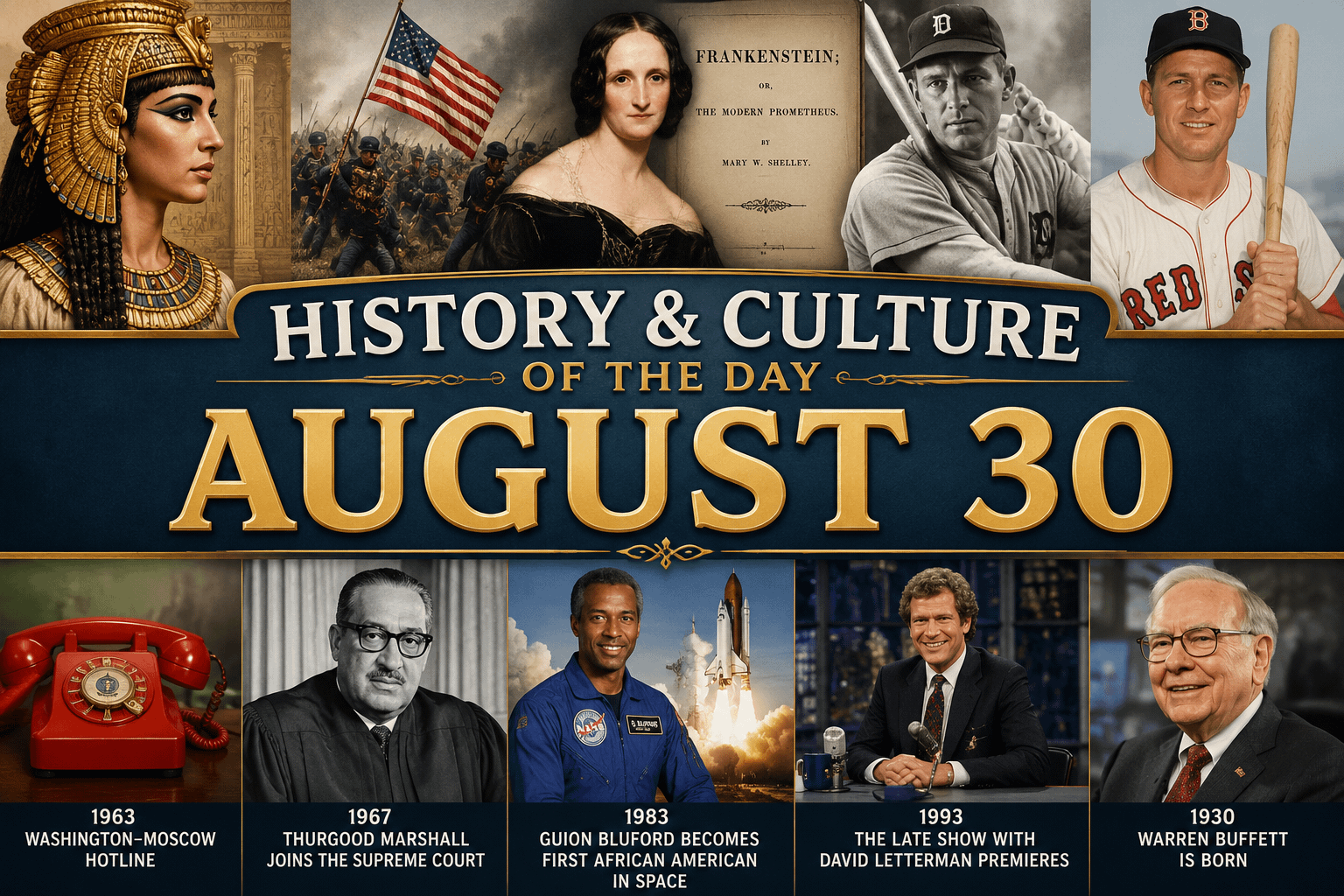
Every date on the calendar carries pieces of the human story, and August 30 is no exception. Across centuries, this date has been connected with war and peace, civil rights, literature, sports, business, space exploration, television, and cultural change.
August 30 takes us from the ancient Mediterranean world to the battlefields of the American Civil War, from Major League Baseball diamonds to the United States Supreme Court, and from the tensions of the Cold War to the frontier of space.
It is also the birthday of influential figures such as Mary Shelley, Ted Williams, and Warren Buffett, each of whom left a very different mark on culture.
Looking back at August 30 reminds us that history isn’t simply a collection of dates. It is a record of people making decisions, confronting challenges, creating new ideas, and sometimes changing the direction of society.
Here is an expanded journey through the history and culture of August 30.
30 BC – Cleopatra and the End of Ptolemaic Egypt
Few ancient rulers have captured the imagination of later generations as completely as Cleopatra VII.
The final active ruler of Egypt’s Ptolemaic dynasty died in 30 BC following the defeat of her forces and those of Mark Antony by Octavian, the future Roman emperor Augustus. Ancient chronologies place her death in August, though the precise date remains uncertain.
Cleopatra ruled during an extraordinarily dangerous period.
Rome was becoming the dominant power of the Mediterranean, and internal struggles among Roman leaders threatened Egypt’s independence.
Cleopatra first became politically connected with Julius Caesar. After Caesar’s assassination in 44 BC, she later formed an alliance and relationship with Mark Antony.
Their political fortunes became tied together.
When Octavian defeated Antony and Cleopatra’s forces at the Battle of Actium in 31 BC, their position became increasingly desperate.
Antony and Cleopatra died the following year.
Octavian subsequently brought Egypt under Roman control.
Cleopatra Becomes a Cultural Legend
Cleopatra’s political importance alone would have secured her place in history, but her cultural legacy became even larger.
Writers and artists repeatedly reinvented her.
William Shakespeare’s Antony and Cleopatra transformed her story into one of literature’s great tragedies.
Painters depicted her death.
Novelists reimagined her life.
Hollywood eventually turned Cleopatra into one of cinema’s most recognizable historical figures, most famously with Elizabeth Taylor portraying her in the massive 1963 production Cleopatra.
The historical Cleopatra was a sophisticated monarch navigating an extraordinarily complicated political environment.
The Cleopatra of popular culture became something even larger—a symbol of beauty, power, romance, ambition, tragedy, and political intrigue.
1813 – The Fort Mims Massacre
On August 30, 1813, one of the most devastating events of the Creek War occurred at Fort Mims, located in present-day Alabama.
Hundreds of settlers, militia members, enslaved people, and Creek allies had gathered inside the fortified settlement.
Red Stick Creek warriors attacked the fort.
The fighting became extraordinarily violent, and hundreds of people were killed.
News of the attack quickly spread.
Fear and anger intensified throughout the American frontier, and military forces were mobilized against the Red Sticks.
The conflict eventually helped propel Andrew Jackson to greater national prominence.
The Larger Creek War
The Fort Mims attack cannot be understood without recognizing the broader conflict taking place among Creek communities.
The Creek War involved divisions within the Creek Nation as well as increasing pressure from American expansion.
Some Creek people attempted to accommodate growing American influence, while others resisted.
The Red Stick movement represented those who wanted to defend traditional Creek culture and resist American territorial expansion.
The conflict eventually became intertwined with the larger War of 1812.
Andrew Jackson’s forces defeated the Red Sticks at the Battle of Horseshoe Bend in 1814.
The resulting Treaty of Fort Jackson forced the Creek Nation to surrender enormous amounts of territory.
Those lands later became part of the expanding American South.
The events surrounding Fort Mims therefore remain an important chapter in both American and Native American history.
1862 – The Second Battle of Bull Run Reaches Its Climax
On August 30, 1862, Union and Confederate armies fought the final major phase of the Second Battle of Bull Run, also called the Second Battle of Manassas.
The battle took place near Manassas, Virginia.
It was remarkably close to the location of the First Battle of Bull Run, where the Civil War’s first major land battle had occurred in July 1861.
But by 1862, the war had changed dramatically.
Both armies were larger.
Commanders were more experienced.
Casualties were increasing.
And hopes that the conflict would end quickly had largely disappeared.
Confederate General Robert E. Lee faced Union forces commanded by Major General John Pope.
After intense fighting, Confederate forces launched a major counterattack that forced the Union army to retreat.
The Confederate victory strengthened Lee’s position.
Soon afterward, he moved his army north into Maryland.
That campaign eventually led to the Battle of Antietam in September 1862—the bloodiest single day in American military history.
America Realizes the War Will Not End Quickly
The Second Battle of Bull Run represented something larger than another Confederate victory.
It demonstrated the increasing scale of the Civil War.
The romantic ideas about warfare that had existed when the conflict began were disappearing.
Families across the country were receiving casualty reports.
Communities were losing sons, fathers, brothers, and friends.
The Civil War was becoming a national tragedy whose consequences would reshape the United States permanently.
1797 – Mary Shelley Is Born
On August 30, 1797, Mary Wollstonecraft Shelley was born in London.
Few writers could have imagined that a novel written while they were still a teenager would influence literature and popular culture for more than two centuries.
Yet that is exactly what happened with Mary Shelley’s Frankenstein; or, The Modern Prometheus.
Shelley grew up surrounded by intellectual ideas.
Her father was political philosopher William Godwin, while her mother was pioneering writer and women’s rights advocate Mary Wollstonecraft.
Mary Wollstonecraft died shortly after giving birth to her daughter.
Mary Shelley later became involved with poet Percy Bysshe Shelley, whom she eventually married.
The Famous Birth of Frankenstein
The origins of Frankenstein have become almost as famous as the novel itself.
During the unusually cold and rainy summer of 1816, Mary Shelley spent time near Lake Geneva with Percy Shelley, Lord Byron, and others.
The group challenged one another to write ghost stories.
Mary began imagining the horrifying possibility of a scientist discovering how to create life.
That idea eventually became Frankenstein.
The novel was published anonymously in 1818.
Mary Shelley was only about 20 years old.
More Than a Monster Story
Modern popular culture often reduces Frankenstein to a monster story.
Shelley’s novel is far more complicated.
It asks questions that remain surprisingly modern:
What responsibilities do creators have toward what they create?
Should science pursue everything it is capable of achieving?
What happens when people are rejected by society?
How much responsibility does society have for creating the people it fears?
What are the consequences of uncontrolled ambition?
Those questions have become increasingly relevant as humanity develops technologies Shelley could never have imagined.
Frankenstein Takes Over Popular Culture
The creature eventually escaped the pages of Shelley’s novel and became one of the world’s most recognizable fictional characters.
Stage productions adapted the story.
Then Hollywood transformed it.
The 1931 film Frankenstein, starring Boris Karloff as the creature, helped establish the visual image most people recognize today.
The flattened head, heavy boots, laboratory machinery, electrical equipment, and towering creature became permanent pieces of horror culture.
Frankenstein now appears in movies, cartoons, comic books, Halloween decorations, toys, television programs, advertisements, and countless parodies.
Mary Shelley’s creation became larger than the original book.
1905 – Ty Cobb Makes His Major League Baseball Debut
On August 30, 1905, a young baseball player named Ty Cobb made his Major League debut for the Detroit Tigers.
Few people watching that game could have known they were witnessing the beginning of one of baseball’s most famous careers.
Cobb became one of the dominant hitters of the early 20th century.
He was known for his remarkable ability to reach base, steal bases, hit for average, and pressure opposing teams.
His aggressive style became legendary.
Baseball During the Dead-Ball Era
Cobb played much of his career during what became known as baseball’s dead-ball era.
Home runs were relatively uncommon compared with later decades.
Teams relied heavily on strategy.
Players bunted.
They stole bases.
They attempted hit-and-run plays.
Pitchers often dominated games.
Cobb became one of the masters of that style.
His career helped define an era when professional baseball was becoming deeply embedded in American culture.
Baseball stadiums became community gathering places, players became national celebrities, and newspapers devoted enormous space to the sport.
Cobb remains one of the most recognizable names from baseball’s early history.
1918 – Ted Williams Is Born
Another baseball legend connected with August 30 arrived thirteen years after Cobb’s debut.
Ted Williams was born on August 30, 1918, in San Diego, California.
Williams eventually became one of baseball’s greatest hitters.
Playing for the Boston Red Sox, he developed an almost scientific approach to hitting.
He studied pitchers.
He understood the strike zone.
He practiced relentlessly.
And he became famous for refusing to swing at pitches he believed he could not hit effectively.
The Legendary 1941 Season
Williams achieved one of baseball’s most famous accomplishments in 1941.
He finished the season with a batting average above .400.
No qualified Major League Baseball player has finished a season at .400 or better since.
The achievement became one of baseball’s legendary benchmarks.
Baseball Career Interrupted by War
Williams’ life was about more than baseball.
His career was interrupted by military service during World War II.
He later returned to military duty during the Korean War.
Williams served as a Marine aviator and flew combat missions.
Those years removed significant playing time from what was already an extraordinary baseball career.
Despite those interruptions, Williams remains one of the most celebrated hitters in baseball history.
1930 – Warren Buffett Is Born
On August 30, 1930, future investor and philanthropist Warren Buffett was born in Omaha, Nebraska.
Buffett developed an interest in money and business while still young.
He reportedly experimented with small entrepreneurial ventures and became fascinated by investing.
That interest eventually developed into one of the most successful investment careers in modern history.
Buffett became closely associated with Berkshire Hathaway, transforming it into a massive holding company with investments and ownership interests spanning numerous industries.
The Oracle of Omaha
Buffett became known as the “Oracle of Omaha.”
Rather than constantly chasing financial trends, he became famous for emphasizing patience and long-term value.
His investment philosophy generally focused on understanding businesses, evaluating their long-term prospects, and avoiding unnecessary speculation.
Buffett also became culturally unusual because of the contrast between his enormous wealth and his comparatively modest public lifestyle.
His annual Berkshire Hathaway shareholder meetings became major events, attracting investors from around the world.
A Legacy of Philanthropy
Buffett also pledged to give away most of his fortune.
Along with Bill and Melinda Gates, he helped launch the Giving Pledge, encouraging wealthy individuals to commit significant portions of their fortunes to charitable causes.
His legacy therefore extends beyond investing into philanthropy and discussions about the responsibilities associated with extraordinary wealth.
1963 – The Washington–Moscow Hotline Begins Operation
One of the most important Cold War communication developments became operational on August 30, 1963.
The United States and Soviet Union established a direct communications link between Washington and Moscow.
The decision followed one of the most dangerous moments in human history.
In October 1962, the Cuban Missile Crisis brought the United States and Soviet Union frighteningly close to nuclear war.
Soviet nuclear missiles had been discovered in Cuba.
President John F. Kennedy’s administration demanded their removal.
For nearly two weeks, the world waited while two nuclear superpowers confronted each other.
Communication Could Mean Survival
One major problem became painfully obvious during the crisis.
Messages between the governments could take too long.
When nuclear weapons were involved, delays or misunderstandings could have catastrophic consequences.
The hotline provided a more reliable way for American and Soviet leaders to communicate during emergencies.
Popular culture later imagined the hotline as a dramatic red telephone sitting on the president’s desk.
Reality was less cinematic.
The original system relied primarily on written communication.
Still, the cultural image of the red phone became enormously powerful.
Movies, television shows, political cartoons, and advertisements repeatedly used it as shorthand for emergency communication between superpowers.
The hotline represented something profoundly important:
Even enemies need to communicate.
1967 – Thurgood Marshall Is Confirmed to the Supreme Court
On August 30, 1967, the United States Senate confirmed Thurgood Marshall as an associate justice of the U.S. Supreme Court.
Marshall became the first Black justice in Supreme Court history.
His confirmation represented an extraordinary milestone.
But Marshall’s influence on American law had begun decades earlier.
The Lawyer Who Challenged Segregation
Before becoming a judge, Marshall worked as an attorney fighting racial discrimination.
He became one of the country’s leading civil rights lawyers.
His most famous case was Brown v. Board of Education.
In 1954, the Supreme Court ruled that racial segregation in public schools violated the Constitution.
The decision became one of the defining legal victories of the Civil Rights Movement.
Marshall later served as a federal appeals court judge and U.S. solicitor general before President Lyndon B. Johnson nominated him to the Supreme Court.
A Historic Moment for Representation
Marshall’s arrival on the Supreme Court carried enormous cultural significance.
For generations, Black Americans had been excluded from many of the nation’s most powerful institutions.
Now a Black American would sit on the country’s highest court.
Marshall served until 1991.
His life remains closely connected with America’s continuing struggle to fulfill its promises of equality and justice under the law.
1983 – Guion Bluford Becomes the First African American in Space
On August 30, 1983, another barrier in American history was broken.
NASA astronaut Guion S. Bluford Jr. became the first African American to travel into space.
Bluford launched aboard the Space Shuttle Challenger during the STS-8 mission.
Before joining NASA, Bluford had already built an impressive career.
He was an Air Force pilot, engineer, and Vietnam War veteran.
Representation Beyond Earth
Bluford’s flight carried significance far beyond the technical objectives of the mission.
Millions of Americans saw an African American astronaut traveling into space.
For young people watching the launch—particularly Black children interested in science and engineering—the moment demonstrated that careers once seemingly closed to them were becoming possible.
Bluford eventually completed four space shuttle missions.
His career became part of the broader story of America’s space program and its gradual expansion to include people from increasingly diverse backgrounds.
1993 – David Letterman Begins a New Era of Late-Night Television
On August 30, 1993, American television entered another memorable chapter when Late Show with David Letterman premiered on CBS.
Letterman had already developed a loyal audience during his years hosting Late Night with David Letterman on NBC.
After Johnny Carson retired from The Tonight Show, many observers expected Letterman to become Carson’s successor.
Instead, the position went to Jay Leno.
Letterman moved to CBS.
The result was one of television history’s most famous rivalries.
Letterman vs. Leno
Throughout the 1990s, audiences and entertainment journalists constantly compared Letterman and Leno.
Ratings became news.
Celebrity appearances became competitive.
Monologues were analyzed.
The rivalry demonstrated how culturally important late-night television had become.
Letterman’s Influence
David Letterman’s humor often rejected the polished conventions of traditional television.
He embraced awkwardness.
He made fun of television itself.
He introduced strange characters and unusual comedy segments.
His famous Top Ten Lists became part of American popular culture.
Letterman’s influence can still be seen in generations of comedians and late-night hosts who followed him.
He remained at CBS until his retirement in 2015.
2003 – Charles Bronson Dies
Actor Charles Bronson died on August 30, 2003, at the age of 81.
Bronson became one of Hollywood’s most recognizable tough-guy actors.
His career included appearances in several classic films, including:
- The Magnificent Seven
- The Great Escape
- The Dirty Dozen
- Once Upon a Time in the West
- Death Wish
Bronson’s quiet, rugged screen presence became his trademark.
He rarely needed long speeches to communicate danger or determination.
During the 1970s and 1980s, he became especially associated with action and revenge films.
The success of the Death Wish series helped shape the vigilante-action genre that would become increasingly common in Hollywood.
Famous Birthdays on August 30
August 30 has produced an impressive collection of influential figures from literature, sports, entertainment, music, business, and athletics.
Mary Shelley – 1797
Author of Frankenstein, Shelley helped establish many of the ideas associated with modern science fiction.
Ted Williams – 1918
The Boston Red Sox legend became one of baseball’s greatest hitters and remains the last qualified MLB player to finish a season batting .400 or better.
Kitty Wells – 1919
Known as one of country music’s pioneering female stars, Kitty Wells helped open doors for generations of women in country music.
Warren Buffett – 1930
One of the world’s best-known investors, Buffett became famous for long-term investing and philanthropy.
John Phillips – 1935
Musician John Phillips became closely associated with the 1960s group The Mamas & the Papas.
Their music became part of the soundtrack of the counterculture era.
Jean-Claude Killy – 1943
French skier Jean-Claude Killy became one of alpine skiing’s greatest champions and won three gold medals at the 1968 Winter Olympics.
Peggy Lipton – 1946
Actress Peggy Lipton became famous through The Mod Squad and later appeared in the cult television series Twin Peaks.
Lewis Black – 1948
Comedian Lewis Black became known for his distinctive style of frustrated, energetic observational comedy.
Michael Chiklis – 1963
Actor Michael Chiklis became widely recognized through television series including The Commish and The Shield, as well as his portrayal of The Thing in Fantastic Four films.
Cameron Diaz – 1972
Actress Cameron Diaz became one of Hollywood’s most recognizable stars of the 1990s and 2000s, appearing in films including The Mask, There’s Something About Mary, Charlie’s Angels, and Shrek.
August 30 and the Evolution of American Culture
When the events of August 30 are viewed together, several important themes emerge.
Communication Can Prevent Conflict
The Washington–Moscow hotline reminds us that communication is sometimes more important when people disagree than when they agree.
During the Cold War, misunderstandings could potentially have triggered nuclear conflict.
Creating reliable communication between rival governments was therefore not simply diplomatic—it was potentially lifesaving.
That lesson continues to matter today.
Representation Changes What Future Generations Believe Is Possible
Thurgood Marshall’s confirmation to the Supreme Court and Guion Bluford’s journey into space occurred sixteen years apart.
Both moments represented barriers being broken.
Marshall entered an institution where no Black justice had previously served.
Bluford traveled somewhere no African American had previously gone.
Representation alone cannot erase inequality, but visible milestones can change expectations.
A child watching Bluford launch into space could imagine becoming an astronaut.
A young student studying Marshall could imagine becoming a lawyer or Supreme Court justice.
Historical milestones can become invitations for future generations.
Sports Become Part of National Identity
The stories of Ty Cobb and Ted Williams demonstrate how deeply baseball became intertwined with American culture.
Baseball was never merely a game.
It became connected with childhood, neighborhoods, cities, family traditions, radio broadcasts, newspapers, summer afternoons, and national memory.
Generations of Americans could identify players simply by hearing their names.
Cobb represented baseball’s early professional era.
Williams became one of the defining stars of the game’s mid-20th-century period.
Their careers helped transform athletes into national cultural figures.
Literature Can Outlive Its Creator
Mary Shelley could never have known exactly what would happen to Frankenstein.
She created a story.
Culture created an icon.
That transformation demonstrates one of the fascinating aspects of art.
Once writers, musicians, filmmakers, and artists release their work into the world, future generations reinterpret it.
Sometimes the creation becomes more famous than the creator.
Today, millions of people recognize Frankenstein’s creature even if they have never read Shelley’s novel.
Yet behind every Halloween costume and movie adaptation remains the imagination of a young woman born on August 30, 1797.
Television Creates Shared Cultural Moments
David Letterman’s CBS debut represents another kind of cultural transformation.
Before streaming services and social media fragmented entertainment audiences, television programs could become enormous shared experiences.
Millions of people watched the same programs.
They discussed the same interviews.
They repeated the same jokes.
They recognized the same personalities.
Late-night television became particularly influential because it blended entertainment with current events.
Hosts commented on politicians, celebrities, scandals, movies, sports, and everyday life.
Those shows became informal historical records of American culture.
August 30 Through the Centuries
One of the most fascinating things about studying a single date is seeing how dramatically civilization changes.
Imagine traveling through the August 30s represented in this article.
In the ancient world, Egypt was being absorbed into Roman power.
By 1797, Mary Shelley was being born into an age of political revolution and intellectual experimentation.
By 1862, Americans were fighting one another during the Civil War.
By 1905, professional baseball was becoming a national obsession.
By 1963, nuclear weapons had made global communication a matter of human survival.
By 1967, the Civil Rights Movement was transforming American institutions.
By 1983, human beings were routinely traveling beyond Earth’s atmosphere aboard reusable spacecraft.
By 1993, television networks were battling for millions of viewers during the late-night hours.
Each generation believes its world is modern.
History reminds us how quickly “modern” becomes the past.
What August 30 Can Teach Us
The history of August 30 contains several lessons worth remembering.
Progress often requires someone to go first.
Thurgood Marshall and Guion Bluford stepped into places where African Americans had previously been excluded.
Communication matters.
The Cold War hotline existed because leaders recognized that misunderstanding could have catastrophic consequences.
Creativity can survive for centuries.
Mary Shelley’s Frankenstein remains culturally relevant more than 200 years after its publication.
Sports can become history.
Players such as Ty Cobb and Ted Williams became part of America’s cultural memory.
Entertainment reflects its era.
David Letterman’s television career provides a window into American humor and popular culture during the late 20th and early 21st centuries.
And perhaps most importantly:
History is still being written.
The people living through these moments rarely knew exactly how future generations would remember them.
Neither do we.
Remembering August 30
August 30 connects remarkably different pieces of the human experience.
It carries stories of conflict and reconciliation.
It reminds us of the dangers of war and the importance of communication.
It celebrates achievements in literature, sports, civil rights, science, business, and entertainment.
From Mary Shelley’s imagination to Ted Williams’ legendary swing, from Thurgood Marshall’s place on the Supreme Court to Guion Bluford looking down at Earth from space, the date contains stories of people pushing against boundaries.
Some boundaries were political.
Some were social.
Some were technological.
Others existed only in the imagination.
That is what makes studying history so valuable.
History allows us to see that the world we know today was not inevitable. It was created through countless choices, struggles, discoveries, failures, victories, and ideas.
Tomorrow will be shaped in much the same way.
History & Culture Question of the Day
If you could travel back in time and witness one event or meet one person connected with August 30, which would you choose?
Would you meet Mary Shelley and ask what inspired Frankenstein?
Would you watch Ted Williams step into the batter’s box?
Would you witness Thurgood Marshall’s historic confirmation?
Would you watch Guion Bluford launch into space aboard Challenger?
Or would you choose another moment entirely?
Share your answer and tell us why that piece of August 30 history interests you most.
Final Thought
Every day has a history.
Every generation adds another chapter.
And every person living today is participating in events that future generations may someday study.
August 30 reminds us to look backward with curiosity, understand the struggles and achievements that brought us here, and recognize that the history of tomorrow is being created today.
Leave a ReplyCancel reply