
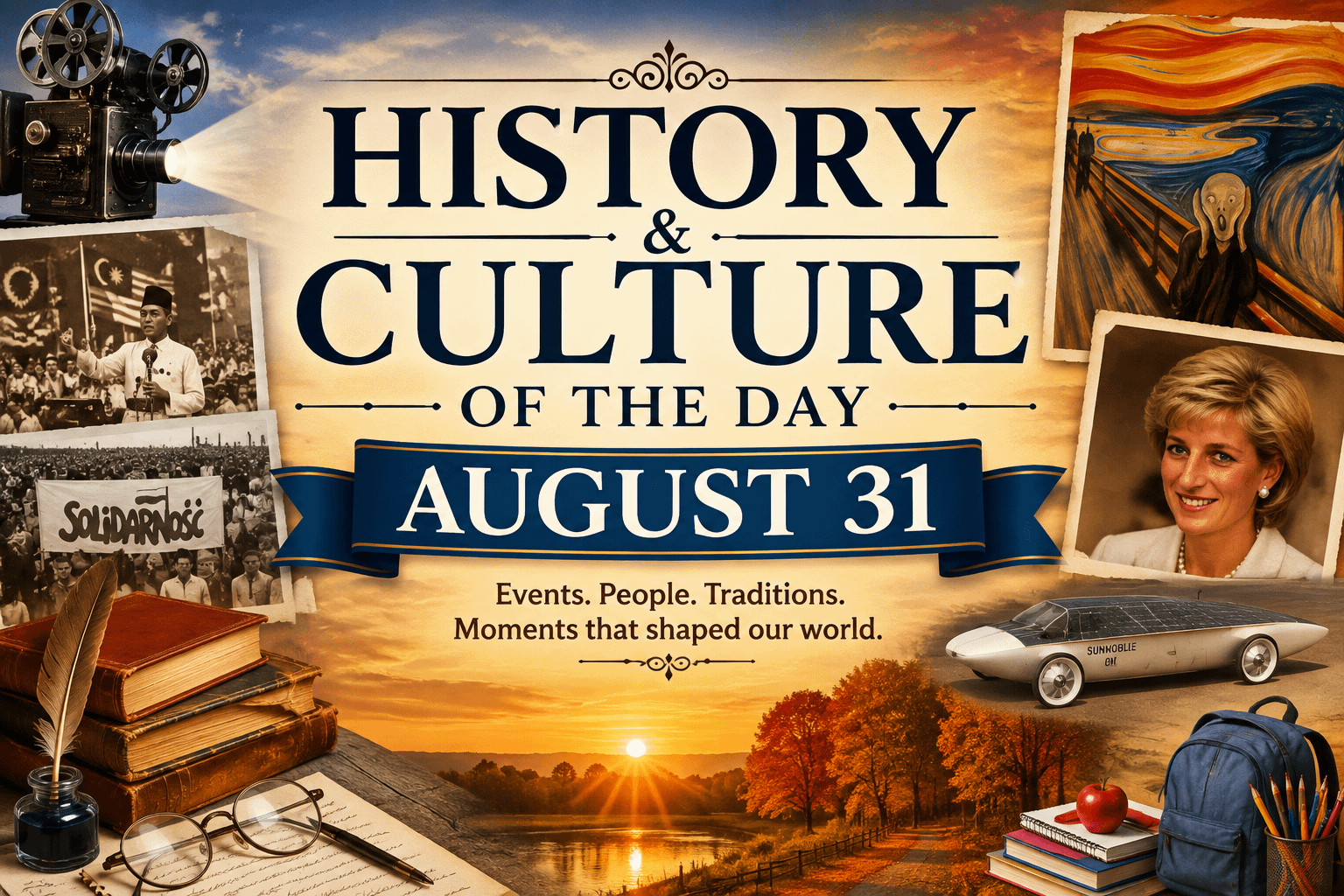
August 31 is the final day of August, standing at the crossroads between the long days of summer and the arrival of September. For many people, it represents the unofficial closing chapter of summer—a time when vacations wind down, children return to school, college campuses fill with students, football season approaches, and thoughts begin turning toward autumn.
But August 31 is much more than a seasonal transition.
Throughout history, this date has witnessed important developments in politics, independence movements, technology, art, entertainment, labor rights, and popular culture. Nations have celebrated their freedom on August 31. Revolutionary technologies have been introduced. Political movements have challenged powerful governments. The world has mourned famous figures, celebrated influential artists and entertainers, and witnessed events whose effects continued long after the calendar turned to September.
From the streets of Victorian London to the shipyards of Poland, from the independence celebrations of Malaysia and Trinidad and Tobago to the development of early motion-picture technology, August 31 provides a fascinating window into the many ways history and culture become intertwined.
Let’s explore the people, events, traditions, and cultural moments that have helped make August 31 a memorable date in world history.
1888 – The Whitechapel Murder That Became Part of an Enduring Mystery
During the early morning hours of August 31, 1888, the body of Mary Ann Nichols was discovered in London’s Whitechapel district.
Nichols is generally considered the first of the five “canonical” victims traditionally associated with the unidentified murderer who became known as Jack the Ripper.
The killings created fear throughout London’s East End and quickly became an international sensation.
Newspapers competed intensely for readers, publishing dramatic reports, theories, letters, rumors, and descriptions of the police investigation. The extensive coverage helped transform the Whitechapel murders into one of history’s most famous unsolved criminal mysteries.
But the historical importance of the case extends beyond speculation about the killer’s identity.
The murders brought increased attention to the severe poverty experienced by many residents of London’s East End during the Victorian era.
Whitechapel was an overcrowded district where thousands of people struggled with unstable employment, poor housing, hunger, homelessness, alcoholism, and limited social assistance.
For many women living in poverty, survival could be especially difficult.
The crimes also raised questions about policing, journalism, public safety, social inequality, and the treatment of society’s poorest citizens.
More than a century later, historians continue studying the Whitechapel murders not simply because of the mystery but because they provide a disturbing glimpse into life in late Victorian London.
1897 – Thomas Edison and the Development of Motion Pictures
August 31 also has an important connection to the development of cinema.
On August 31, 1897, Thomas Edison received a United States patent associated with the Kinetograph, an early motion-picture camera developed through work at his laboratory.
Edison is often associated with the invention, although the development of the system involved significant work by his employee and collaborator William Kennedy Laurie Dickson.
The technology represented an important step toward capturing moving images.
During the late 19th century, inventors around the world were experimenting with photography, projection, cameras, and methods of creating the illusion of movement.
These experiments eventually helped produce one of the most influential cultural industries in human history: motion pictures.
Early films were extremely short by modern standards.
Audiences might watch simple scenes of people dancing, athletes performing, workers completing tasks, trains moving, or other everyday activities.
Yet seeing motion captured and replayed was extraordinary.
Within only a few decades, movies evolved from technological curiosities into a major form of entertainment.
Movie theaters opened throughout cities and towns.
Actors became international celebrities.
Hollywood emerged as a center of filmmaking.
Silent movies gave way to synchronized sound.
Black-and-white films increasingly gave way to color.
Eventually television, home video, digital filmmaking, streaming services, smartphones, and online video transformed visual entertainment again.
The motion-picture experiments of the late 1800s helped begin a cultural revolution that continues today.
1935 – The United States Attempts to Remain Neutral
On August 31, 1935, President Franklin D. Roosevelt signed the Neutrality Act of 1935.
The legislation reflected the widespread desire among many Americans to avoid another overseas war.
The memory of World War I remained powerful.
The conflict had killed millions of people, devastated large portions of Europe, disrupted economies, and left many Americans questioning whether U.S. participation had been worth the enormous cost.
During the 1930s, isolationist sentiment became influential in American politics.
Many Americans believed the United States should concentrate on domestic problems—particularly the Great Depression—rather than becoming involved in conflicts overseas.
The Neutrality Act placed restrictions on the export of weapons and military materials to nations involved in war.
The hope was that limiting American involvement with belligerent nations would reduce the possibility of the United States being drawn into another conflict.
History, however, would soon demonstrate how difficult neutrality could become.
Germany under Adolf Hitler expanded aggressively across Europe. Italy pursued military expansion. Japan continued its campaigns in Asia.
As the international situation deteriorated, American policy gradually changed.
By the early 1940s, the United States was providing increasing assistance to nations fighting the Axis powers.
Then came December 7, 1941.
Japan attacked Pearl Harbor, and the United States formally entered World War II.
The Neutrality Act of 1935 therefore represents an important chapter in understanding America’s complicated journey from isolationism to global wartime involvement.
1955 – An Early Glimpse of Solar-Powered Transportation
Long before electric vehicles became common on highways and renewable energy became a major international industry, engineers were experimenting with the possibility of using sunlight to power transportation.
On August 31, 1955, engineer William G. Cobb demonstrated a small solar-powered automobile known as the Sunmobile.
The miniature vehicle was displayed by General Motors.
It used photovoltaic cells to convert sunlight into electricity, which powered a small motor.
The Sunmobile was not designed to transport passengers. It was a demonstration model intended to show what solar technology could potentially accomplish.
At the time, solar cells were expensive and relatively inefficient.
Yet the basic concept was remarkably forward-looking.
Today, photovoltaic technology is used to generate electricity for homes, businesses, satellites, remote facilities, large solar farms, charging systems, and experimental vehicles.
Solar panels have become familiar sights on rooftops and across landscapes around the world.
The little Sunmobile of 1955 serves as a reminder that revolutionary technologies often begin as experiments that seem impractical before advances make them increasingly useful.
1957 – Malaya Achieves Independence
August 31 is one of the most important dates in Malaysian history.
On August 31, 1957, the Federation of Malaya gained independence from British colonial rule.
The achievement followed years of political negotiation and efforts toward self-government.
Tunku Abdul Rahman became the country’s first prime minister and emerged as a central figure in the independence movement.
The independence celebrations became famous for the proclamation of “Merdeka!”—meaning independence or freedom.
The modern country of Malaysia would later take shape in 1963.
Today, August 31 is celebrated as Hari Merdeka.
The holiday is marked by patriotic displays, ceremonies, parades, performances, flags, community celebrations, and reflections on Malaysia’s history.
Malaysia’s culture reflects centuries of interaction among different peoples and traditions.
Malay, Chinese, Indian, Indigenous, Islamic, European, and other influences have contributed to the country’s architecture, languages, clothing, celebrations, music, customs, and cuisine.
Food is particularly important to Malaysian cultural identity.
Dishes and traditions involving nasi lemak, satay, laksa, roti canai, curries, noodles, rice dishes, tropical fruits, spices, and countless regional specialties demonstrate how cultural influences can combine into something distinctive.
August 31 therefore represents not simply political independence but also the celebration of national identity.
1962 – Trinidad and Tobago Becomes Independent
Five years after Malaya’s independence, another country celebrated freedom from British colonial rule on August 31.
Trinidad and Tobago officially became independent on August 31, 1962.
Eric Williams became the country’s first prime minister.
The achievement represented an important turning point after centuries shaped by colonialism, migration, slavery, indentured labor, plantation economies, and cultural exchange.
Those complicated historical experiences contributed to the remarkably diverse culture for which Trinidad and Tobago is known today.
African, Indian, European, Indigenous, Chinese, Middle Eastern, and Caribbean influences can all be found within the country’s cultural traditions.
Perhaps its most internationally famous celebration is Carnival.
Trinidad Carnival is known for elaborate costumes, music, dancing, masquerade traditions, street celebrations, and enormous community participation.
The country also played an important role in the development of calypso and soca music.
Another extraordinary cultural contribution is the steelpan.
Developed in Trinidad and Tobago, the steelpan became an internationally recognized musical instrument and an important symbol of Caribbean creativity.
August 31 is therefore a celebration not only of political independence but also of the country’s remarkable cultural identity.
1980 – Solidarity and the Fight for Workers’ Rights in Poland
On August 31, 1980, striking workers at the Lenin Shipyard in Gdańsk reached a historic agreement with Poland’s communist government.
The Gdańsk Agreement represented an extraordinary political breakthrough.
Among other concessions, workers gained greater freedom to organize independent trade unions.
From this movement emerged Solidarity, known in Polish as Solidarność.
Electrician Lech Wałęsa became one of the movement’s most recognizable leaders.
Solidarity quickly grew beyond a traditional labor union.
Millions of people joined or supported the movement, making it one of the largest organized challenges to communist authority in Eastern Europe.
The Polish government eventually imposed martial law in 1981 and attempted to suppress Solidarity.
Leaders and activists were arrested.
The movement was forced underground.
But it did not disappear.
Throughout the 1980s, Solidarity continued influencing Polish society.
By the end of the decade, negotiations between communist authorities and opposition leaders contributed to partially free elections and enormous political change.
The transformation in Poland became part of a much larger wave sweeping across Eastern Europe.
Communist governments collapsed.
The Berlin Wall fell.
The Cold War moved toward its conclusion.
The agreement signed on August 31, 1980, therefore became part of a historical chain of events that eventually helped reshape Europe.
1997 – The Death of Princess Diana Shocks the World
Few events associated with August 31 produced as immediate and emotional a global response as the death of Diana, Princess of Wales.
During the early morning hours of August 31, 1997, Diana died following a car crash in Paris.
She was only 36 years old.
News of the tragedy spread rapidly around the world.
Television networks interrupted regular programming.
Newspapers produced special editions.
People gathered outside Kensington Palace and other royal residences.
Mountains of flowers, photographs, letters, stuffed animals, candles, and personal messages appeared as millions mourned.
Diana had become much more than a member of the British royal family.
She was one of the most recognizable women on Earth.
Her fashion choices were closely followed.
Her relationships became constant subjects of media attention.
But her humanitarian work became an equally important part of her public identity.
One of her most significant contributions involved changing public attitudes toward HIV/AIDS.
During the height of the AIDS crisis, misinformation and fear caused many people living with HIV to experience severe discrimination and isolation.
Diana publicly shook hands and interacted with AIDS patients without gloves, helping challenge the false belief that HIV could be spread through ordinary physical contact.
She also brought attention to the dangers posed by landmines.
Images of Diana walking through a cleared path in an Angolan minefield became internationally recognized symbols of the campaign against landmines.
Her death also generated enormous discussion about celebrity culture and aggressive media attention.
Decades later, Diana remains an influential cultural figure remembered for her humanitarian efforts, personal struggles, fashion, public compassion, and complicated relationship with royal life.
2006 – The Scream Returns
August 31 also has a fascinating connection to the art world.
On August 31, 2006, Norwegian authorities announced that two famous artworks by Edvard Munch—The Scream and Madonna—had been recovered.
They had been stolen from the Munch Museum in Oslo during a daylight robbery in 2004.
The theft generated international headlines because The Scream had become one of the most recognizable images in Western art.
Munch created multiple versions of the composition.
The haunting image features a figure with an open mouth and hands pressed against its face while a dramatic landscape appears behind it.
The work is often interpreted as representing anxiety, psychological distress, fear, loneliness, or existential uncertainty.
Its cultural influence has extended far beyond museums.
The Scream has appeared in advertisements, cartoons, movies, television shows, merchandise, political satire, internet memes, and countless parodies.
Even people who know little about art history often immediately recognize the image.
That recognition demonstrates something important about culture: certain artworks eventually become part of our shared visual language.
August 31 and the Cultural End of Summer
History isn’t created only through wars, elections, inventions, and political movements.
History is also found in everyday traditions.
For millions of people, August 31 carries a much simpler cultural meaning.
Summer is ending.
Astronomically, summer continues in the Northern Hemisphere until the September equinox. Culturally, however, late August often feels like summer’s conclusion.
Vacations end.
Children return to school.
Teachers return to classrooms.
College students move into dormitories.
Fall sports begin.
Stores replace summer merchandise with Halloween and autumn decorations.
Football returns.
Days gradually become shorter.
Evenings begin feeling different.
August 31 can therefore create an unusual combination of nostalgia and anticipation.
There is sadness about summer ending, but excitement about what comes next.
The Back-to-School Tradition
Few experiences define late August in the United States quite like back-to-school season.
For generations, families have prepared for another academic year by shopping for supplies.
Backpacks.
Notebooks.
Pencils.
Folders.
Lunch boxes.
New shoes.
School clothes.
Calculators.
Computers and tablets have increasingly joined that list.
For children, returning to school can bring many emotions.
There is excitement about seeing friends again.
There is curiosity about new teachers.
There may be nervousness about entering a new grade or attending a new school.
For students beginning kindergarten, middle school, high school, or college, the transition can represent a major milestone.
Parents experience their own emotions.
The first day of school can be especially meaningful because it reminds parents how quickly children grow.
Those seemingly ordinary first-day-of-school photographs eventually become treasured family memories.
College Football and the Return of Fall Sports
Late August also carries enormous significance for sports culture.
Football season begins returning to American life.
College campuses prepare for packed stadiums, marching bands, fight songs, tailgating, rivalries, mascots, and traditions that have often existed for generations.
High school football also becomes an important part of community life in towns and cities across the country.
Friday nights bring together students, families, alumni, teachers, and local residents.
Sports are more than competition.
They create rituals and traditions that connect generations.
A grandparent, parent, and child may all cheer for the same school or team decades apart.
That is one of the ways culture survives—through traditions repeatedly shared from one generation to the next.
The Changing Food Culture of Late Summer
August 31 also arrives during one of the richest periods of the year for seasonal food.
Late summer traditionally brings abundant harvests of tomatoes, corn, peppers, peaches, melons, berries, zucchini, cucumbers, and other produce.
Across agricultural communities, late summer has historically been associated with preserving food for the months ahead.
Families canned vegetables.
Fruit became jams and preserves.
Cucumbers became pickles.
Tomatoes became sauces.
Food was dried, stored, fermented, or otherwise preserved.
Modern refrigeration and global food distribution have changed how people eat, but many late-summer traditions continue.
Farmers markets overflow with seasonal produce.
Families gather for barbecues.
Communities hold fairs and festivals.
Gardens reach peak production.
These traditions connect modern life with agricultural practices that sustained generations before us.
The Approach of Autumn
August 31 stands on the edge of another culturally important season.
September brings autumn closer.
Soon come changing leaves, apple picking, pumpkin patches, harvest festivals, cooler nights, football games, Halloween decorations, and eventually Thanksgiving preparations.
People begin exchanging summer clothing for jackets and sweaters.
Coffee shops and restaurants introduce seasonal flavors.
Homes begin displaying autumn decorations.
For many people, the shift toward fall creates a feeling of comfort and familiarity.
That makes August 31 an interesting date psychologically.
It represents both an ending and a beginning.
Notable People Born on August 31
August 31 has also given us influential people whose work shaped education, literature, film, music, comedy, and popular culture.
Maria Montessori – Born August 31, 1870
Maria Montessori was an Italian physician and educator whose ideas transformed childhood education.
Her Montessori method emphasized independence, curiosity, hands-on learning, and carefully designed environments where children could develop at their own pace.
Instead of viewing children simply as passive recipients of information, Montessori believed they naturally wanted to explore and learn.
Her ideas spread internationally.
More than a century later, Montessori schools continue educating children around the world.
William Saroyan – Born August 31, 1908
American writer William Saroyan became known for stories and plays focusing on ordinary people, immigrant families, hardship, humor, hope, and human dignity.
His Armenian-American background influenced much of his writing.
Saroyan’s work often found beauty and meaning within everyday life.
Buddy Hackett – Born August 31, 1924
Comedian and actor Buddy Hackett entertained generations of audiences.
Known for his distinctive voice and comedic storytelling, Hackett appeared in movies, television programs, and live performances.
Younger audiences may recognize his voice as Scuttle, the eccentric seagull from Disney’s The Little Mermaid.
James Coburn – Born August 31, 1928
James Coburn became one of Hollywood’s most recognizable actors.
His long career included memorable appearances in films such as The Magnificent Seven, The Great Escape, and Affliction.
His performance in Affliction earned him the Academy Award for Best Supporting Actor.
Van Morrison – Born August 31, 1945
Northern Irish singer-songwriter Van Morrison became one of modern music’s influential performers.
His music has incorporated elements of rock, folk, blues, jazz, soul, rhythm and blues, and Celtic traditions.
His extensive career demonstrates how musical genres constantly interact and influence one another.
Richard Gere – Born August 31, 1949
Richard Gere became an internationally recognized actor through films including An Officer and a Gentleman, Pretty Woman, Primal Fear, and Chicago.
His career spans decades of changing Hollywood culture.
Chris Tucker – Born August 31, 1971
Actor and comedian Chris Tucker became famous for his energetic comedic performances.
His role as Detective James Carter alongside Jackie Chan in the Rush Hour movies made him internationally recognizable.
The success of those movies also demonstrated the increasingly global nature of modern entertainment.
What August 31 Teaches Us About Culture
When we look at everything connected with August 31, an interesting theme appears.
Culture is constantly evolving.
A technological experiment becomes cinema.
A labor strike becomes part of a democratic movement.
Political independence becomes an annual national celebration.
An artist’s painting becomes an internationally recognized symbol.
A humanitarian gesture helps challenge social stigma.
An educational philosophy survives for more than a century.
And everyday seasonal traditions become memories passed from parents to children.
History isn’t something separate from culture.
History creates culture, and culture keeps history alive.
Every time people tell stories, cook traditional foods, listen to old songs, celebrate national holidays, visit museums, watch classic movies, attend community festivals, or teach younger generations about the past, they are participating in that process.
History Is Happening Right Now
It is easy to imagine history as something that happened long ago.
But every generation lives through events that future generations will study.
Technologies being developed today may transform daily life decades from now.
Music being created today may eventually be considered classic.
Today’s political movements may appear in tomorrow’s textbooks.
Photographs taken today may someday become historical documents.
Even ordinary family traditions become personal history.
The meals shared around a table, vacations taken together, first days of school, birthday celebrations, neighborhood gatherings, and conversations between generations all become pieces of a family’s cultural story.
History isn’t only written by presidents, kings, generals, inventors, and celebrities.
Everyone leaves behind stories.
Final Thoughts – Saying Goodbye to August
August 31 invites us to look backward and forward at the same time.
Looking backward, we find a remarkable collection of events.
We see technological experimentation that helped lead toward modern cinema.
We see countries celebrating independence.
We see workers standing together for political and economic freedom.
We remember a princess whose humanitarian efforts touched people around the world.
We recognize artists, musicians, actors, writers, educators, and innovators whose contributions became part of our shared culture.
But August 31 also reminds us of something much simpler.
Time keeps moving.
Summer becomes autumn.
Children enter new classrooms.
Families return from vacations.
Harvest season approaches.
Another month becomes part of our personal history.
Tomorrow begins September.
And just as generations before us experienced their own ordinary days without knowing which moments would eventually become historically important, we are living through history right now.
Some of today’s events will appear in textbooks.
Some will become cultural traditions.
Others will survive only within families as photographs, stories, recipes, memories, and lessons passed from one generation to another.
That may be one of the most important lessons history can teach us.
History isn’t simply the story of what happened before us.
It is the continuing story of people—their struggles, discoveries, celebrations, creativity, relationships, traditions, failures, victories, and dreams.
On August 31, we can appreciate the final moments of another summer month while remembering the countless people whose lives helped shape the world we inherited.
And as September begins, we get another opportunity to create the history and memories that will someday tell our own story.
History & Culture Question of the Day:
What is your favorite memory or tradition connected with the end of summer and the beginning of fall?
Leave a ReplyCancel reply