
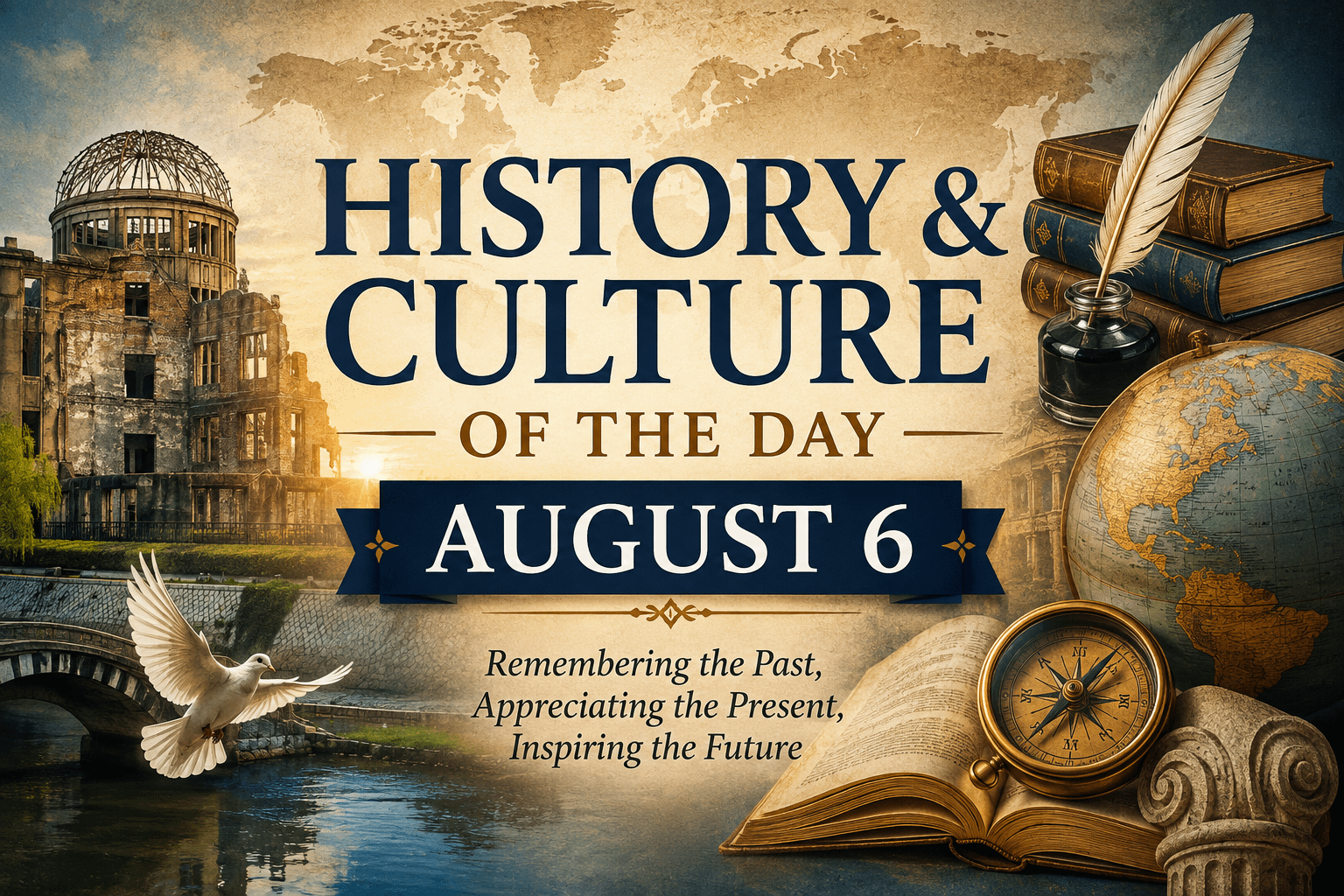
Reflecting on a Day That Changed the World
History is filled with dates that remind us of humanity’s greatest triumphs and its deepest tragedies. August 6 is one of those days. It is a date that encourages reflection, learning, and appreciation for the many events that have shaped civilizations, inspired innovation, and influenced cultures around the globe.
From one of the most significant moments of World War II to the birthdays of influential artists and writers, August 6 offers countless opportunities to learn about our shared past. Understanding history helps us recognize how today’s world was formed while reminding us that every generation has the power—and responsibility—to shape the future.
Whether you’re passionate about world history, literature, art, science, or cultural traditions, August 6 serves as a meaningful reminder that the past continues to influence the present in countless ways.
Hiroshima: A Day the World Will Never Forget
The event most closely associated with August 6 occurred in 1945, when the United States dropped the atomic bomb known as “Little Boy” on the Japanese city of Hiroshima during World War II.
Within moments, much of the city was destroyed. Tens of thousands of people lost their lives instantly, while many others suffered severe injuries and long-term illnesses caused by radiation exposure. Entire neighborhoods disappeared, families were forever changed, and the world entered the nuclear age.
Three days later, another atomic bomb was dropped on Nagasaki. Shortly afterward, Japan announced its surrender, bringing World War II to an end.
While historians continue to debate the military and political decisions surrounding the bombings, there is broad agreement that the human cost was enormous. Today, Hiroshima has transformed itself into an international symbol of peace, reconciliation, and hope.
Each year on August 6, people from around the world gather for memorial ceremonies honoring those who died and reaffirming the importance of preventing nuclear war.
The Hiroshima Peace Memorial Park, the Atomic Bomb Dome, and the Peace Memorial Museum stand as lasting reminders of both tragedy and resilience. Visitors leave with a deeper understanding of the importance of diplomacy, compassion, and international cooperation.
The Beginning of the Nuclear Age
The bombing of Hiroshima marked more than the closing chapter of World War II—it also marked the beginning of a new era.
For the first time in history, humanity possessed weapons capable of destroying entire cities within seconds. Nations suddenly faced questions unlike any before:
- How could such powerful weapons be controlled?
- Could lasting peace exist in a nuclear world?
- What responsibilities come with scientific discovery?
These questions remain relevant today as countries continue discussing nuclear security, arms reduction, and global peace initiatives.
The events of August 6 remind us that technological progress must always be guided by ethics, wisdom, and respect for human life.
Learning From the Past
One reason history matters is because it teaches lessons that textbooks alone cannot.
The events of August 6 encourage us to think about:
- The cost of war
- The value of diplomacy
- The importance of international cooperation
- The resilience of communities recovering from tragedy
- The need for responsible scientific advancement
History gives us the opportunity to examine difficult moments honestly so future generations can make better decisions.
The Power of Human Resilience
Although Hiroshima experienced unimaginable devastation, its recovery remains one of the most remarkable examples of resilience in modern history.
Today, the city is home to more than one million people and has become a thriving center of education, commerce, technology, and culture.
Its transformation demonstrates that even after profound loss, hope can return through determination, unity, and a commitment to rebuilding.
Communities around the world often look to Hiroshima as an example of how healing, while never easy, is possible.
Celebrating the World’s Diverse Cultures
History isn’t only about wars and political events.
Culture is equally important because it tells the story of how people live, celebrate, create, and connect with one another.
Every civilization contributes traditions that enrich our shared human experience.
These include:
- Traditional music
- Dance
- Art
- Literature
- Architecture
- Cuisine
- Clothing
- Festivals
- Storytelling
- Religious practices
- Family customs
Learning about different cultures encourages understanding, appreciation, and respect among people from every background.
When we explore cultures beyond our own, we discover that while customs may differ, many human values—love, family, hope, kindness, and perseverance—remain universal.
Literature That Continues to Inspire
August 6 is also the birthday of Alfred, Lord Tennyson, born in 1809.
As one of Britain’s greatest poets, Tennyson explored themes of love, courage, grief, hope, and perseverance. His writing continues to be studied around the world because it captures timeless human emotions.
Many readers still find inspiration in his famous works, including The Charge of the Light Brigade and Ulysses, which encourage resilience and determination in the face of life’s challenges.
Literature allows every generation to learn from voices of the past while discovering truths that remain meaningful today.
Lucille Ball Changed Television Forever
Born on August 6, 1911, Lucille Ball became one of television’s greatest pioneers.
Her groundbreaking sitcom I Love Lucy revolutionized television production, introduced innovative filming techniques, and became one of the most influential comedy series in history.
Beyond acting, Ball became one of Hollywood’s first successful female studio executives, opening doors for countless women in the entertainment industry.
Her legacy continues to influence comedians, actors, writers, and producers decades after her career began.
Andy Warhol and the Pop Art Revolution
Another famous August 6 birthday belongs to Andy Warhol, born in 1928.
Warhol transformed modern art by turning everyday objects into cultural icons.
His colorful works featuring soup cans, celebrities, and consumer products challenged traditional ideas about what art could be.
Today, his influence can still be seen in advertising, fashion, graphic design, photography, and digital media.
His work reminds us that creativity often comes from seeing ordinary things in extraordinary ways.
Scientific Progress That Shapes Everyday Life
History celebrates not only famous individuals but also scientific discoveries that quietly improve our lives.
Every generation builds upon the knowledge of those before it.
Advances in:
- Medicine
- Engineering
- Communications
- Agriculture
- Transportation
- Computing
- Space exploration
have dramatically increased life expectancy, connected continents, and created opportunities that previous generations could scarcely imagine.
Innovation rarely happens overnight. Instead, it is the result of countless researchers, inventors, teachers, and dreamers working together over decades.
Preserving History for Future Generations
Museums, libraries, monuments, archives, and historical societies play an important role in protecting our collective memory.
Without preservation efforts, valuable stories could be lost forever.
Historic landmarks allow us to experience the places where important events occurred, while museums preserve artifacts that help tell the stories of previous generations.
Every community has its own history worth protecting.
Whether it’s an old church, a family farmhouse, a veterans memorial, or a local museum, preserving history strengthens our connection to those who came before us.
Why History and Culture Matter Today
Understanding history isn’t about memorizing dates.
It’s about understanding people.
History helps explain:
- Why nations developed differently.
- How cultures evolved.
- Why traditions continue.
- How societies overcome hardship.
- What mistakes should never be repeated.
- How innovation changes the world.
Likewise, culture reminds us that humanity’s diversity is one of its greatest strengths.
When we learn about other people and their traditions, we become more compassionate, informed, and connected.
Final Thoughts
August 6 is a day of remembrance, reflection, and appreciation. It calls us to honor the lives affected by one of history’s most devastating events while also celebrating the artists, writers, innovators, and cultural traditions that continue to enrich our world.
History is not merely a record of what happened long ago—it is a guide for the future. The lessons of courage, resilience, creativity, and peace found throughout history inspire us to build stronger communities, value cultural diversity, and leave a positive legacy for the generations that follow.
As we observe August 6, may we remember the past with honesty, learn from its lessons with humility, and move forward with hope for a more peaceful and united world.
Leave a ReplyCancel reply