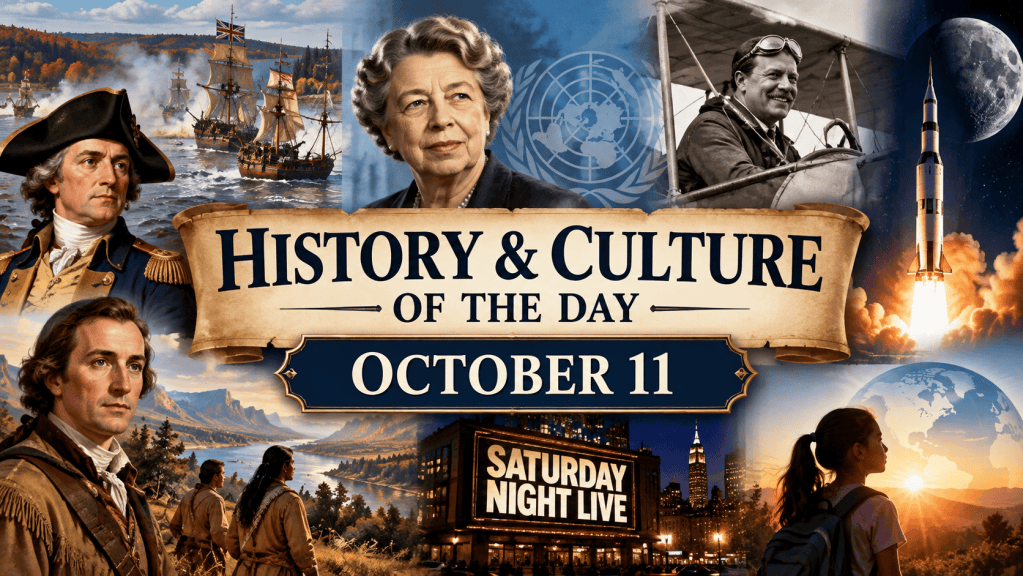
Every date on the calendar carries stories from the past, and October 11 is no exception. Across centuries, this day has been connected to political turning points, technological achievements, cultural milestones, exploration, entertainment, and events that helped shape the world we know today.
History is more than a collection of dates. It is the story of people making decisions, taking risks, creating new ideas, overcoming challenges, and sometimes changing the direction of entire nations. Looking back at October 11 gives us an opportunity to understand how individual moments can leave an influence that lasts for generations.
From the American Revolution and the early days of aviation to space exploration and landmark moments in television, October 11 offers plenty to explore.
1776 – The Battle of Valcour Island
One of the most significant early events associated with October 11 occurred during the American Revolutionary War.
On October 11, 1776, American and British naval forces fought the Battle of Valcour Island on Lake Champlain.
The American fleet was commanded by Benedict Arnold, years before his name became synonymous with betrayal because of his later attempt to turn West Point over to the British.
At this stage of the Revolution, however, Arnold was still fighting for the American cause.
The British hoped to move south from Canada through the Lake Champlain and Hudson River corridor. Control of this route could have helped them isolate New England from the other colonies.
Arnold understood the importance of slowing their advance.
The American fleet was significantly weaker than the British force. During the battle, the Americans suffered heavy losses and eventually withdrew. From a strictly tactical perspective, the engagement was a British victory.
But the larger strategic consequences were more complicated.
The battle and subsequent American resistance helped delay the British advance. Winter was approaching, and the delay contributed to the British decision to postpone further major operations southward until the following year.
That additional time allowed American forces to reorganize and prepare.
The struggle for control of the region would eventually contribute to the circumstances surrounding the American victory at Saratoga in 1777, one of the major turning points of the Revolutionary War.
Valcour Island is therefore an excellent example of how history cannot always be understood simply by asking who won a particular battle.
Sometimes delaying an opponent can be strategically important even when the immediate battle is lost.
1809 – Meriwether Lewis Dies
October 11 is also associated with one of the most famous figures in the history of American exploration.
Meriwether Lewis, co-leader of the Lewis and Clark Expedition, died in Tennessee in October 1809 at the age of 35.
Lewis and William Clark had led the expedition formally known as the Corps of Discovery, which traveled across the North American continent between 1804 and 1806.
President Thomas Jefferson commissioned the expedition following the Louisiana Purchase.
The journey had several purposes.
The explorers were expected to study the geography, plants, animals, and Indigenous nations of the western territories while searching for practical transportation routes across the continent.
The expedition became one of the most famous journeys in American history.
Lewis and Clark traveled thousands of miles through landscapes that were largely unfamiliar to Americans of European descent, though these lands had been home to Indigenous peoples for countless generations.
The expedition recorded extensive information about the region.
It also depended heavily on assistance from Indigenous communities.
One of the expedition’s most famous participants was Sacagawea, a Lemhi Shoshone woman whose knowledge, language skills, and presence assisted the expedition during portions of its journey.
Lewis’s death remains a subject of historical discussion.
His death was officially reported as suicide, although alternative theories, including murder, have persisted for generations.
Regardless of the unresolved questions surrounding his final hours, Lewis remains closely connected with the history of exploration and the expansion of American knowledge about the West.
1884 – Eleanor Roosevelt Is Born
On October 11, 1884, Eleanor Roosevelt was born in New York City.
She would become one of the most influential first ladies in American history.
Eleanor married Franklin D. Roosevelt in 1905. When Franklin became president in 1933, she transformed expectations surrounding the role of the first lady.
Rather than limiting herself primarily to ceremonial responsibilities, Eleanor traveled extensively, held press conferences, wrote newspaper columns, visited communities across the country, and publicly advocated for numerous social and humanitarian causes.
She frequently addressed issues involving poverty, racial discrimination, women’s opportunities, workers, young people, and human rights.
Her public career did not end with Franklin Roosevelt’s death in 1945.
President Harry S. Truman appointed her as a delegate to the newly formed United Nations.
There she became deeply involved in international human-rights efforts.
She chaired the United Nations Human Rights Commission during the development of the Universal Declaration of Human Rights, which the United Nations General Assembly adopted in 1948.
The declaration established a broad international statement concerning fundamental human rights and freedoms.
Eleanor Roosevelt’s October 11 birthday provides an opportunity to remember how the position of first lady evolved during the twentieth century and how one individual used public visibility to advocate for issues extending far beyond the White House.
1890 – The Daughters of the American Revolution Is Founded
Another organization with a strong connection to American history traces its beginnings to October 11.
On October 11, 1890, the Daughters of the American Revolution, commonly known as the DAR, was founded.
The organization was created by women who wanted to preserve the history and memory of people involved in the American Revolution.
Membership is based on documented lineal descent from a person who aided the cause of American independence.
Over the decades, the organization became involved in historical preservation, education, genealogy, patriotism, scholarships, and the preservation of historical sites and records.
Organizations such as the DAR also illustrate how Americans during the late nineteenth century became increasingly interested in preserving historical memory.
As the Revolutionary generation disappeared, later generations began creating monuments, museums, historical organizations, and genealogical societies designed to protect connections with the country’s early history.
1910 – Theodore Roosevelt Takes to the Sky
Today, political leaders regularly travel aboard airplanes.
In 1910, however, aviation was still astonishingly new.
On October 11, 1910, former President Theodore Roosevelt took a short airplane flight near St. Louis, Missouri.
The aircraft was piloted by Arch Hoxsey, an aviator associated with the Wright brothers’ exhibition team.
The flight lasted only a few minutes, but it became historically notable because Roosevelt was the first former U.S. president to fly in an airplane.
Consider how remarkable that must have seemed at the time.
The Wright brothers had completed their famous powered flight at Kitty Hawk only seven years earlier, in 1903.
Airplanes were still experimental machines. Commercial air travel did not exist in anything resembling its modern form, and many people had never seen an airplane fly.
Roosevelt, famous for his adventurous personality, was willing to climb aboard.
Within only a few decades, airplanes would transform transportation, warfare, commerce, communication, tourism, and international relations.
Roosevelt’s brief flight therefore represents a fascinating snapshot of a society witnessing the beginning of the aviation age.
1958 – Pioneer 1 and America’s Early Space Program
October 11 also belongs to the history of space exploration.
On October 11, 1958, the United States launched Pioneer 1, an early NASA spacecraft intended to travel toward the Moon.
NASA itself was extremely new.
The agency had officially begun operations only days earlier, on October 1, 1958.
Pioneer 1 did not accomplish its intended lunar mission because its launch vehicle failed to provide sufficient velocity. Nevertheless, the spacecraft reached a considerable altitude and returned useful scientific information before reentering Earth’s atmosphere.
Early space missions frequently involved setbacks.
But each mission produced knowledge that engineers and scientists could use to improve future spacecraft.
The late 1950s were the beginning of an extraordinary technological competition between the United States and the Soviet Union.
The Soviet launch of Sputnik 1 in 1957 had shocked many Americans and accelerated investment in science, engineering, education, rocketry, and space exploration.
Just over a decade after Pioneer 1, American astronauts would walk on the Moon during Apollo 11.
That extraordinary achievement was built partly upon lessons learned during these earlier experimental missions.
1968 – Apollo 7 Launches
Exactly ten years after Pioneer 1, another major American space mission launched on October 11.
On October 11, 1968, NASA launched Apollo 7.
The crew consisted of astronauts Walter Schirra, Donn Eisele, and Walter Cunningham.
Apollo 7 was particularly important because it was the first crewed mission of the Apollo program following the tragic Apollo 1 fire of January 1967.
Astronauts Gus Grissom, Ed White, and Roger Chaffee had died during a launch-pad test.
NASA subsequently conducted an extensive review and made numerous changes to the spacecraft.
Apollo 7 became a crucial test of the redesigned command and service module.
The mission lasted nearly eleven days and demonstrated that important Apollo systems could function successfully in space.
It also included live television broadcasts from orbit.
Those broadcasts helped bring the space program directly into American homes.
The success of Apollo 7 helped clear the way for Apollo 8, which traveled around the Moon later that year.
Less than a year after Apollo 7, Apollo 11 astronauts Neil Armstrong and Buzz Aldrin would walk on the lunar surface.
1975 – Saturday Night Live Debuts
October 11 is not only about wars, exploration, and technology.
It is also an important date in American entertainment history.
On October 11, 1975, a new late-night comedy program premiered on NBC.
Originally called NBC’s Saturday Night, the program eventually became known as Saturday Night Live, or SNL.
Created by Lorne Michaels, the show introduced audiences to a young cast of comedians who would become major entertainment figures.
The original cast included performers such as Dan Aykroyd, John Belushi, Chevy Chase, Jane Curtin, Garrett Morris, Laraine Newman, and Gilda Radner.
The first episode was hosted by comedian George Carlin.
SNL combined live comedy sketches, music, political satire, celebrity hosts, recurring characters, and topical humor.
Its live format gave the program a sense of unpredictability that became part of its identity.
Over the decades, the show became an important launching point for generations of comedians, actors, and writers.
Its influence extended well beyond television.
Characters and catchphrases entered popular culture, sketches became part of national conversations, and former cast members went on to major careers in television and film.
October 11 and International Day of the Girl
October 11 also has an important modern international observance.
The United Nations recognizes October 11 as the International Day of the Girl Child.
The observance focuses attention on challenges facing girls around the world while promoting their rights, education, opportunities, safety, and empowerment.
The United Nations General Assembly established the observance in 2011, with the first International Day of the Girl Child held in 2012.
Issues highlighted through the observance have included education, child marriage, violence, economic opportunity, health, digital access, leadership, and equal participation in society.
It demonstrates how dates on the calendar can acquire new historical and cultural meanings over time.
October 11 connects events hundreds of years apart—from eighteenth-century naval warfare to twenty-first-century international advocacy.
A Day Connected to Exploration
One particularly interesting theme running through October 11 is exploration and pushing boundaries.
Meriwether Lewis helped lead an expedition across a continent.
Theodore Roosevelt climbed into an airplane when powered flight was still in its infancy.
Scientists and engineers launched Pioneer 1 toward the Moon.
The Apollo 7 astronauts tested technology that would soon help humans reach another world.
Each event occurred under dramatically different circumstances, yet all involved people confronting uncertainty.
Exploration requires accepting that the outcome is not always guaranteed.
Some missions succeed completely.
Others fall short of their original goals while still producing valuable knowledge.
That lesson appears repeatedly throughout history.
Culture Changes Alongside Technology
October 11 also demonstrates how technology changes culture.
Imagine explaining today’s world to someone watching Theodore Roosevelt climb into an airplane in 1910.
Commercial aircraft now routinely cross oceans in hours.
Satellites orbit Earth.
Humans have walked on the Moon.
Robotic spacecraft have explored every planet in our solar system.
People carry devices in their pockets capable of communicating instantly across much of the planet.
Meanwhile, television programs such as Saturday Night Live demonstrate another side of technological change.
Television did more than provide entertainment. It created shared cultural experiences in which millions of people could watch the same event, joke, performance, or news broadcast.
Later technologies—including cable television, the internet, social media, podcasts, and streaming services—continued changing how culture is created and shared.
Why October 11 Matters
The importance of October 11 does not come from one single event.
Instead, the date provides a cross-section of history.
It includes war and independence, exploration and aviation, human rights and civic activism, spaceflight and science, television and popular culture.
The Battle of Valcour Island reminds us that an apparent military defeat can still influence a larger campaign.
Meriwether Lewis reminds us of the ambition and complexity surrounding American exploration and westward expansion.
Eleanor Roosevelt’s life shows how public roles can evolve and how advocacy can extend from national politics to international human rights.
Theodore Roosevelt’s airplane ride captures the wonder of a revolutionary new technology.
Pioneer 1 and Apollo 7 show how experimentation, setbacks, engineering, and persistence helped open the space age.
Saturday Night Live demonstrates the lasting influence entertainment can have on culture.
And International Day of the Girl Child reminds us that history is not only about looking backward. It is also about recognizing challenges that continue to shape people’s lives today.
Final Thoughts
October 11 is a day filled with stories of courage, experimentation, discovery, culture, and change.
From wooden ships battling on Lake Champlain to astronauts orbiting high above Earth, the events connected with this date cover an extraordinary span of human experience.
They also remind us that the people living through historic moments rarely know exactly how future generations will remember them.
An experimental airplane flight can become part of aviation history.
An imperfect spacecraft mission can contribute knowledge needed for future exploration.
A new television comedy show can become a cultural institution lasting for generations.
A naval battle that appears to end in defeat can still help change the timetable of a war.
History is built this way—one decision, one experiment, one journey, and one day at a time.
When we study dates like October 11, we are doing more than memorizing what happened. We are looking at the connections between people, technology, culture, conflict, discovery, and the ideas that shaped the world around us.
Which October 11 event do you think had the greatest impact on the world we live in today?
Leave a Reply