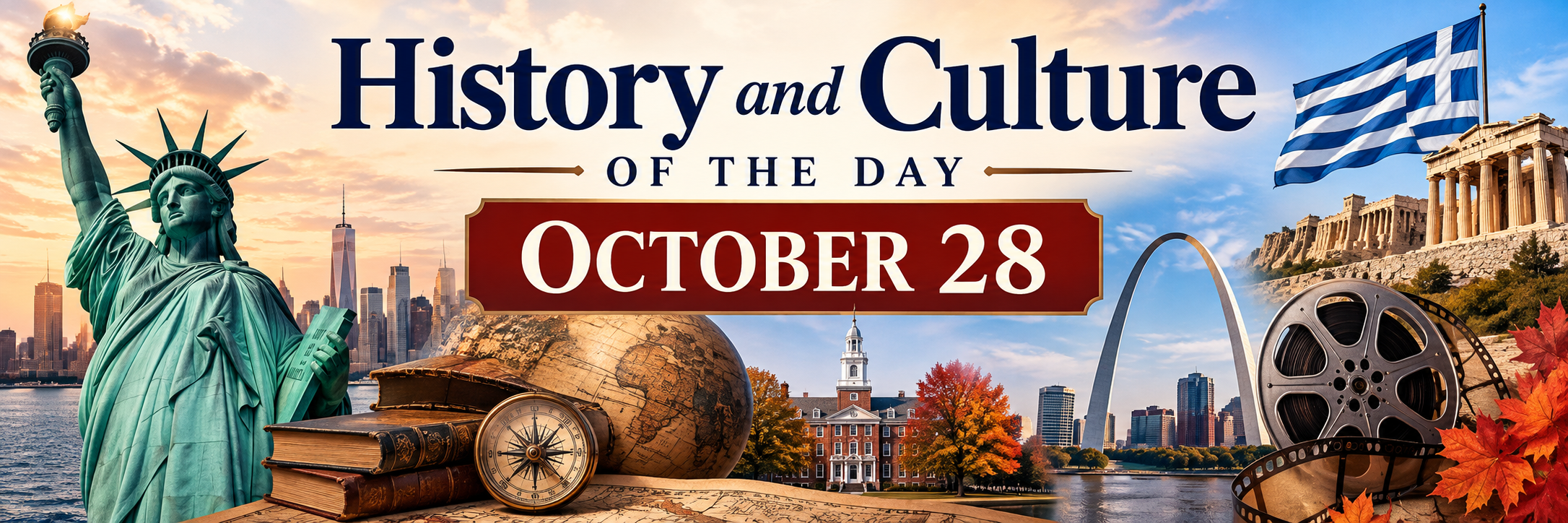
October 28 is a date filled with fascinating stories of political change, scientific achievement, cultural traditions, and historic turning points. From the dedication of one of America’s most recognizable landmarks to the founding of an independent European nation, this day has witnessed events that continue to shape our world.
History is more than a collection of dates and famous names. It is the story of how people, communities, and civilizations have evolved through courage, innovation, conflict, and creativity.
Every historical event leaves behind lessons about the decisions people made, the challenges they faced, and the legacies they created.
Today, we explore the important events, cultural milestones, famous birthdays, and fascinating traditions associated with October 28.
The Statue of Liberty Was Dedicated – October 28, 1886
One of the most significant events associated with October 28 occurred in 1886, when the Statue of Liberty was officially dedicated in New York Harbor.
The dedication ceremony was led by President Grover Cleveland, who celebrated the monument as a symbol of friendship between France and the United States.
The statue, officially named Liberty Enlightening the World, was a gift from the people of France to the American people.
French sculptor Frédéric Auguste Bartholdi designed the statue, while engineer Gustave Eiffel contributed to its internal supporting structure.
Standing on Liberty Island, the monument depicts a robed woman holding a torch above her head and a tablet bearing the date of American independence.
The statue quickly became one of the most recognizable landmarks in the world.
A Symbol of Freedom and Opportunity
Although the statue originally celebrated liberty and Franco-American friendship, it eventually became closely associated with immigration and the American dream.
Millions of immigrants arriving through New York Harbor saw the statue as they approached the United States.
For many families, it represented hope, opportunity, and the possibility of building a better future.
The famous poem The New Colossus, written by Emma Lazarus in 1883, helped strengthen the statue’s association with welcoming immigrants.
Today, the Statue of Liberty remains a powerful symbol of freedom, democracy, and human aspiration.
Its dedication on October 28, 1886, represents an important moment in both American history and international cultural relations.
Czechoslovakia Declares Independence – October 28, 1918
October 28, 1918, marked a turning point in European history when Czechoslovakia declared its independence from the Austro-Hungarian Empire.
The declaration came during the final weeks of World War I, as the empire was rapidly collapsing.
For generations, Czech and Slovak communities had lived under imperial rule while preserving their languages, traditions, and cultural identities.
The creation of Czechoslovakia represented the culmination of years of political organizing and national aspirations.
The Birth of a New Nation
Tomáš Garrigue Masaryk became the first president of Czechoslovakia and played a central role in establishing the new republic.
The country brought together Czech and Slovak populations, along with several other ethnic communities, under a new democratic government.
Despite facing political, economic, and ethnic challenges, Czechoslovakia developed into an important Central European nation.
Its independence demonstrated how World War I fundamentally reshaped Europe’s political landscape.
October 28 in Modern Czech Culture
Although Czechoslovakia peacefully separated into the Czech Republic and Slovakia in 1993, October 28 remains an important national holiday in the Czech Republic.
Known as Independent Czechoslovak State Day, the holiday commemorates the country’s historical origins.
Ceremonies, commemorations, and cultural events celebrate the values of independence and national identity.
This anniversary illustrates how historical events can continue shaping national traditions long after political borders change.
The Cuban Missile Crisis Moves Toward Resolution – October 28, 1962
One of the most dangerous confrontations of the Cold War reached a major turning point on October 28, 1962.
On that day, Soviet leader Nikita Khrushchev publicly announced that the Soviet Union would dismantle its offensive missile installations in Cuba.
The announcement helped bring the Cuban Missile Crisis toward an end.
For nearly two weeks, the United States and Soviet Union had been involved in a tense confrontation over Soviet nuclear missiles positioned in Cuba.
President John F. Kennedy had announced a naval quarantine around Cuba and demanded the removal of the missiles.
The crisis brought the world dangerously close to nuclear conflict.
Diplomacy During a Global Emergency
The resolution resulted from intense diplomatic communication, negotiations, and difficult decisions by leaders on both sides.
The Soviet Union agreed to remove its missiles from Cuba in exchange for American assurances against invading the island.
A separate, confidential understanding also involved the later removal of American Jupiter missiles from Turkey.
Although the immediate confrontation began to ease on October 28, additional negotiations and verification continued afterward.
The crisis demonstrated the catastrophic consequences that could result from misunderstandings between nuclear powers.
It also encouraged improvements in communication between Washington and Moscow, including the establishment of a direct communications link in 1963.
The Historical Lesson
The Cuban Missile Crisis remains an important example of how diplomacy, restraint, and communication can prevent international conflicts from escalating into disasters.
October 28, 1962, reminds us that some of history’s most significant victories occur when leaders choose negotiation over war.
Harvard University Was Founded – October 28, 1636
October 28 is associated with the founding of Harvard University, the oldest institution of higher education in the United States.
On October 28, 1636, according to the modern Gregorian calendar, the Massachusetts Bay Colony’s General Court authorized funding for the establishment of a college.
The original colonial record used the Julian calendar, dating the decision to October 18.
The institution was established to educate future religious and civic leaders in the growing colony.
In 1639, the college was named Harvard in honor of John Harvard, a minister who had left his library and a portion of his estate to the institution.
From Colonial College to Global Institution
Harvard began with a small student body and a curriculum heavily influenced by classical studies and religious education.
Over the centuries, it expanded into a major research university with programs covering medicine, law, science, business, literature, and many other disciplines.
Its history reflects the broader transformation of American education.
Early colleges primarily served limited groups of students, while modern universities became centers for research, professional development, and scientific innovation.
Harvard’s origins also remind us that educational institutions can influence society for centuries.
The Gateway Arch Was Completed – October 28, 1965
Another important American architectural milestone occurred on October 28, 1965, when construction of the Gateway Arch in St. Louis, Missouri, reached completion.
The monument was designed by Finnish-American architect Eero Saarinen.
Rising 630 feet above the Mississippi River waterfront, the Gateway Arch commemorates the westward expansion of the United States.
Its distinctive stainless-steel design made it one of the most recognizable structures in American architecture.
The Meaning Behind the Monument
St. Louis played an important role in westward migration and exploration, earning the nickname “Gateway to the West.”
The arch symbolizes this historical identity.
However, the history of westward expansion also includes the displacement of Native American communities, conflicts over land, and profound changes to Indigenous cultures.
Understanding the monument requires acknowledging both the ambitions of American expansion and its human consequences.
The Gateway Arch stands today as a reminder that public monuments can represent complex historical experiences.
Its completion on October 28 marked an important achievement in engineering and modern design.
The International Animation Day Celebration – October 28
October 28 is also celebrated as International Animation Day.
Established by the International Animated Film Association, the observance recognizes the history, creativity, and cultural importance of animation.
The date commemorates an early public presentation of projected animated images by French artist Charles-Émile Reynaud in Paris on October 28, 1892.
Reynaud used his Théâtre Optique system to present moving illustrated stories to audiences.
His work helped lay the foundation for modern animation.
The Evolution of Animation
Animation developed from early hand-drawn sequences into one of the world’s most influential entertainment and storytelling mediums.
Over time, artists introduced new techniques involving stop-motion photography, cel animation, computer-generated imagery, and digital production.
Animated films and television programs became important parts of childhood experiences across generations.
Animation also developed into a powerful artistic medium for adults, exploring subjects such as identity, history, relationships, politics, and personal struggles.
Animation as Cultural Expression
Different countries have developed distinctive animation traditions.
Japanese anime, American cartoons, European experimental animation, and other international styles reflect the cultural identities of their creators.
Animation can preserve folklore, introduce audiences to unfamiliar traditions, and communicate ideas across language barriers.
International Animation Day celebrates the artists, storytellers, designers, and innovators who continue expanding the possibilities of animated storytelling.
The Second Vatican Council and Nostra Aetate – October 28, 1965
October 28, 1965, also marked an important moment in religious and cultural history.
On that date, Pope Paul VI promulgated Nostra Aetate, a declaration adopted during the Second Vatican Council.
The document addressed the Catholic Church’s relationship with non-Christian religions.
It encouraged greater understanding and respectful dialogue among religious communities.
A Turning Point in Interfaith Relations
Nostra Aetate is particularly significant for its rejection of antisemitism and its discussion of the relationship between Christianity and Judaism.
It also acknowledged elements of truth and holiness found in other religious traditions.
The declaration helped encourage interfaith dialogue and cooperation in the decades that followed.
Its influence extended beyond religious institutions, contributing to broader conversations about tolerance, cultural understanding, and mutual respect.
October 28, 1965, therefore represents an important milestone in the history of modern religious relations.
Famous People Born on October 28
Throughout history, October 28 has also been the birthday of influential figures in literature, politics, technology, entertainment, and culture.
Erasmus of Rotterdam – Traditionally Dated October 28, 1466 or 1469
Desiderius Erasmus was one of the most influential scholars of the European Renaissance.
His exact birth year and date remain uncertain, although October 28 is commonly associated with his birthday.
Erasmus became known for his humanist scholarship, religious writings, and criticism of corruption.
His work helped shape intellectual debates during a period of major religious and cultural transformation.
He promoted education, classical learning, and the careful study of religious texts.
Jonas Salk – October 28, 1914
American physician and medical researcher Jonas Salk was born on October 28, 1914.
He is best known for developing the first widely successful inactivated polio vaccine.
Polio had caused widespread fear because the disease could lead to paralysis and death, particularly among children.
The announcement of the vaccine’s successful large-scale testing in 1955 represented a major medical breakthrough.
Salk’s research helped transform public health and contributed to efforts to control polio around the world.
His legacy demonstrates how scientific innovation can improve millions of lives.
Bill Gates – October 28, 1955
Microsoft co-founder Bill Gates was born on October 28, 1955.
Gates played a major role in the development and commercialization of personal computing software.
Alongside Paul Allen, he co-founded Microsoft in 1975.
The company’s operating systems and productivity applications helped make computers common tools in homes, schools, and workplaces.
Gates later became widely known for his philanthropic work supporting global health, education, and development.
His career illustrates the enormous influence technology has had on modern culture and communication.
Julia Roberts – October 28, 1967
Academy Award-winning actress Julia Roberts was born on October 28, 1967.
She became one of Hollywood’s most recognizable performers through films such as Pretty Woman, My Best Friend’s Wedding, and Erin Brockovich.
Her performance in Erin Brockovich earned her the Academy Award for Best Actress.
Roberts has remained an influential figure in American film and popular culture.
Her career reflects the lasting cultural impact of cinema and storytelling.
Joaquin Phoenix – October 28, 1974
Actor Joaquin Phoenix was born on October 28, 1974.
He is known for emotionally complex performances in films including Walk the Line, Her, and Joker.
His portrayal of Arthur Fleck in Joker earned him the Academy Award for Best Actor.
Phoenix’s work demonstrates how film can explore difficult questions about human behavior, isolation, identity, and society.
Cultural Traditions and Celebrations Associated With October 28
Beyond major historical events, October 28 carries cultural significance through national holidays, artistic celebrations, and seasonal traditions.
Greek Ohi Day
October 28 is celebrated in Greece and Cyprus as Ohi Day, also written as Oxi Day.
The holiday commemorates Greece’s rejection of an Italian ultimatum on October 28, 1940, during World War II.
Italian dictator Benito Mussolini demanded permission for Axis forces to occupy strategic locations in Greece.
Greek Prime Minister Ioannis Metaxas rejected the ultimatum, and Italian forces invaded Greece shortly afterward.
The word ohi means “no” in Greek.
Over time, that refusal became a national symbol of resistance and determination.
Today, Ohi Day is observed through parades, ceremonies, patriotic displays, and educational activities.
The holiday honors those who resisted invasion and defended their country.
Czech Independence Celebrations
In the Czech Republic, October 28 is a national holiday honoring the establishment of independent Czechoslovakia in 1918.
Commemorative ceremonies recognize the country’s history, democratic traditions, and cultural identity.
The holiday often includes official events, historical reflections, and public recognition of individuals who have contributed to Czech society.
International Animation Day
Animation organizations, filmmakers, museums, and cultural institutions may celebrate October 28 through film screenings, exhibitions, educational programs, and artistic events.
The observance encourages people to appreciate animation not only as entertainment but also as an important art form.
October 28 and the Cultural Atmosphere of Autumn
In much of the Northern Hemisphere, October 28 falls during the final days leading up to Halloween.
This seasonal setting gives the date additional cultural meaning.
Communities prepare for costume celebrations, harvest festivals, neighborhood gatherings, and traditional autumn activities.
The season reflects a combination of ancient customs, religious observances, folklore, and modern entertainment.
The Influence of Ancient Harvest Traditions
Many autumn celebrations developed from agricultural communities marking the transition between growing seasons and winter.
Harvest gatherings provided opportunities to celebrate successful crops, share food, and prepare for colder months.
Over generations, these customs became associated with community identity and seasonal festivals.
The Approach of Halloween
Halloween, celebrated on October 31, developed through a complex mixture of traditions, including customs associated with the Gaelic festival of Samhain and Christian observances surrounding All Saints’ Day.
By October 28, Halloween preparations are often well underway.
Pumpkin carving, costumes, haunted attractions, and seasonal decorations reflect how traditional observances can evolve into modern cultural celebrations.
These activities also demonstrate the importance of shared experiences in bringing families and communities together.
What October 28 Teaches Us About History
The events associated with October 28 cover many different periods and subjects, yet several important themes connect them.
Freedom and independence: The dedication of the Statue of Liberty, the creation of Czechoslovakia, and Greece’s resistance during World War II all reflect the importance of national identity and self-determination.
The power of diplomacy: The Cuban Missile Crisis demonstrated how communication and compromise can prevent devastating conflict.
Innovation and achievement: Harvard’s founding, the completion of the Gateway Arch, and the development of animation highlight humanity’s commitment to education, engineering, and creativity.
Cultural understanding: The adoption of Nostra Aetate demonstrated how institutions can reconsider relationships and encourage dialogue between communities.
Individual contributions: Figures such as Jonas Salk, Bill Gates, Julia Roberts, and Joaquin Phoenix illustrate how individuals can influence science, technology, entertainment, and society.
These connections remind us that history is not made through one type of achievement alone.
Progress emerges through many different human experiences.
Why Remembering Historical Dates Matters
It can be easy to view history as something distant from everyday life.
However, the world we experience today is shaped by decisions made generations before us.
Political boundaries, educational institutions, scientific discoveries, cultural traditions, and international relationships all have historical foundations.
Learning about specific dates helps us understand how these developments occurred.
It also encourages us to recognize that people living through historic events often had no way of knowing how significant their actions would become.
The individuals who attended the Statue of Liberty dedication in 1886 could not have fully anticipated how powerful its symbolism would become.
The leaders negotiating during the Cuban Missile Crisis could not know exactly how future generations would interpret their decisions.
The early pioneers of animation could scarcely have imagined the global entertainment industry their experiments would help inspire.
History teaches us that ordinary moments can become extraordinary milestones.
Final Thoughts: October 28 Is a Day of Freedom, Innovation, and Cultural Legacy
October 28 stands out as a date connected to some of history’s most meaningful events.
From the dedication of the Statue of Liberty to the establishment of Czechoslovakia, from the peaceful resolution of a dangerous Cold War confrontation to the celebration of artistic creativity, this day demonstrates the many ways human actions shape the future.
It is a reminder that history involves more than wars, governments, and famous individuals.
History also lives in the traditions we celebrate, the stories we tell, the discoveries we make, and the values we pass to future generations.
Each generation inherits a world shaped by those who came before it, while also carrying the responsibility of influencing what comes next.
As we reflect on October 28, we can appreciate the courage of those who defended freedom, the creativity of those who expanded human expression, and the determination of those who worked toward a better future.
History is not simply about remembering what happened yesterday. It is about understanding how yesterday continues to shape today and tomorrow.
Which historical event or cultural milestone from October 28 do you find the most fascinating, and why does it stand out to you?

Leave a Reply