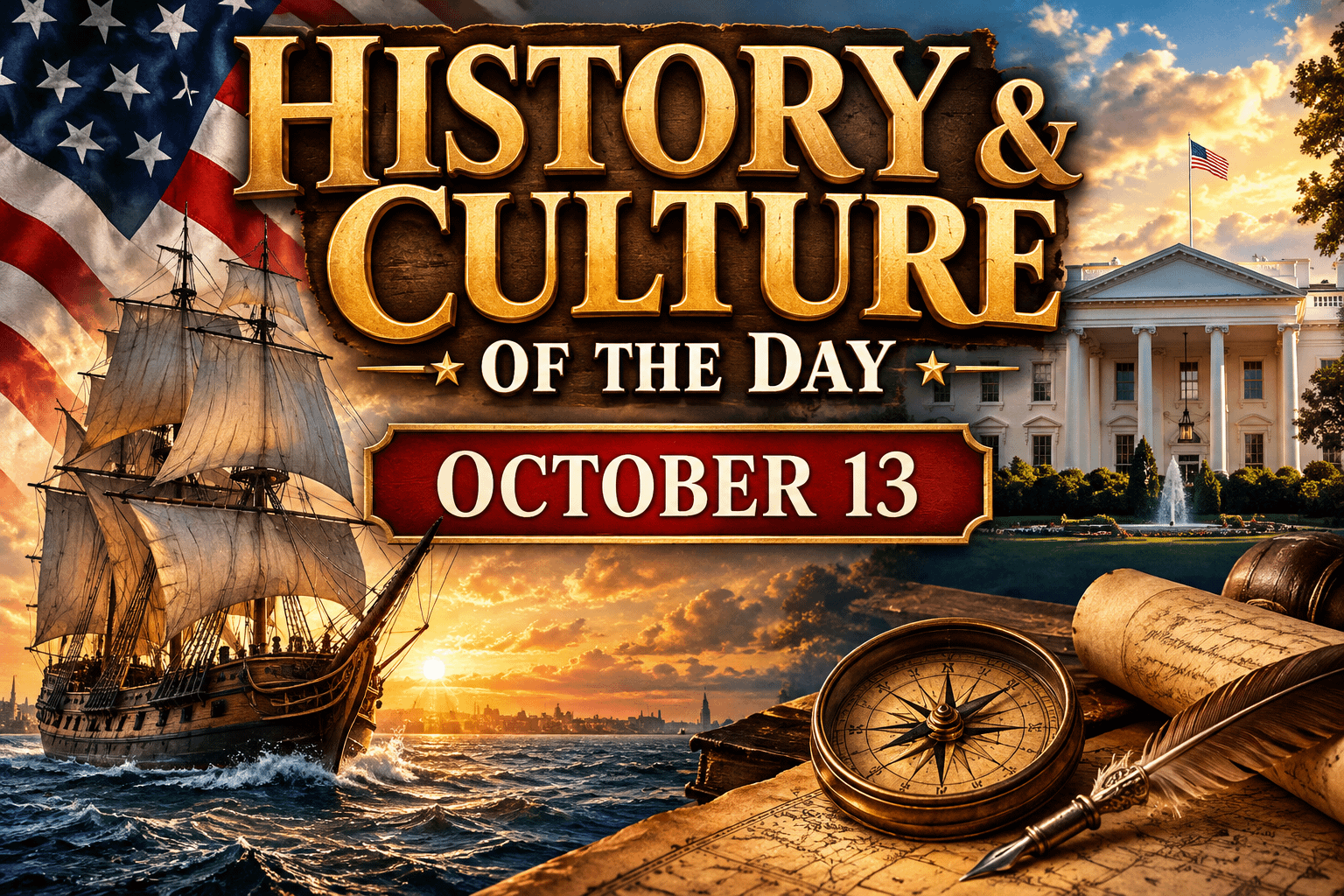
October 13 is a date filled with moments that helped shape the United States and the wider world. From the birth of an American naval force during the Revolutionary era to the beginning of construction on one of the most recognizable buildings in the world, this date offers a fascinating look at how decisions made centuries ago can continue to influence culture, government, and national identity.
History is more than a collection of dates. It is the story of people making decisions without knowing exactly where those decisions will lead. October 13 gives us several powerful examples.
1775 – The Birth of the American Navy
One of the most significant events associated with October 13 occurred during the early months of the American Revolution.
On October 13, 1775, the Continental Congress authorized the fitting out of armed vessels to intercept British ships carrying military supplies. The congressional resolution called for one swift vessel armed with ten carriage guns, along with another vessel for the same general purpose.
The decision is commemorated as the birth of what became the United States Navy.
At the time, the American colonies were confronting one of the world’s most formidable naval powers. Britain possessed an established Royal Navy, while the rebellious colonies did not have anything resembling the naval force the United States would eventually develop.
Yet control of the sea mattered enormously.
British ships transported soldiers, weapons, ammunition, food, and other supplies across the Atlantic. If the Americans could intercept even some of those vessels, they could disrupt British operations while obtaining badly needed supplies of their own.
The Continental Congress therefore began taking steps toward creating an organized naval force.
It was a modest beginning.
There were no enormous fleets of American aircraft carriers, destroyers, submarines, or naval bases. Those belonged to a distant future nobody in 1775 could have imagined.
Instead, there were a handful of ships and an ambitious idea.
Today, October 13 is officially commemorated as the birthday of the United States Navy. The formal Navy-wide recognition of the date began in 1972 under Chief of Naval Operations Admiral Elmo Zumwalt.
In 2026, the Navy marks its 251st birthday.
From those small beginnings during the American Revolution grew one of the world’s major naval institutions.
1792 – The White House Cornerstone Is Laid
Seventeen years after the Continental Congress took its historic naval action, another important American event occurred on October 13.
On October 13, 1792, construction of the President’s House—later known as the White House—officially began with the laying of its cornerstone during a Masonic ceremony.
Irish-born architect James Hoban had won the competition to design the building earlier that year. President George Washington approved the design and had taken an active role in planning the new federal city, although Washington himself was in Philadelphia and did not attend the cornerstone ceremony.
At that moment, nobody could have known everything the building would eventually witness.
Presidents would make decisions of war and peace inside its walls.
Families would celebrate weddings, births, holidays, and personal milestones there.
The nation would endure assassinations, wars, economic crises, political scandals, terrorist attacks, social upheaval, and dramatic cultural changes while the White House remained one of the central symbols of the American presidency.
But its construction also tells a more complicated story about early America.
The workforce that built the President’s House included European immigrants, free African Americans, and enslaved African Americans. Enslaved laborers helped clear land, quarry and transport stone, produce bricks, and perform other construction work. Historical records even preserve the names of several enslaved craftsmen involved in the project.
Recognizing those workers provides a fuller picture of American history—one containing both the aspirations of the young republic and the contradictions that existed within it.
A Building That Became an American Symbol
The White House did not become the presidential residence immediately.
Construction continued for years, and President John Adams became the first president to live there in 1800.
Since then, the building has become much more than a residence.
Images of the White House are instantly recognizable throughout much of the world. It serves simultaneously as a home, workplace, ceremonial location, historic building, tourist destination, and symbol of the American presidency.
Its appearance has also changed throughout history.
The building survived fire and reconstruction following the British attack on Washington during the War of 1812. Later generations expanded, renovated, restored, and modernized the structure.
Yet underneath all of that history lies a beginning:
October 13, 1792.
A cornerstone was placed into the ground, and construction began.
Interestingly, the location of that original cornerstone remains something of a historical mystery. The White House Historical Association notes that it has not been seen since it was installed, and even the enormous Truman-era renovation failed to locate it.
That mystery adds another intriguing chapter to the history of one of America’s most famous buildings.
October 13 and the Meaning of Beginnings
The founding of an American naval force and the laying of the White House cornerstone have something important in common.
Both were beginnings.
Neither looked in 1775 or 1792 exactly like what they would eventually become.
The early American naval force consisted of comparatively modest ships created for an immediate wartime purpose.
The President’s House began as a construction site in a developing federal city.
Centuries later, both became deeply connected to American history and identity.
That is one of the most interesting lessons history can teach us: important things often begin much smaller than they eventually become.
The people involved cannot always see the long-term significance of what they are doing.
History reveals that significance later.
History Is Built One Decision at a Time
When we study history, it is tempting to imagine that the people involved knew they were participating in historic moments.
Usually, they didn’t.
They were solving problems.
They were making decisions.
They were responding to circumstances.
Members of the Continental Congress needed a way to intercept British supplies in 1775. Their decision became part of the origin story of the United States Navy.
American leaders needed a permanent presidential residence in their new capital. Workers began building one in 1792, and it eventually became one of the world’s most recognizable political buildings.
History often works this way.
Something that appears practical or ordinary in one generation can become deeply significant to generations that follow.
Why October 13 Still Matters
October 13 reminds us that history is not created only through famous speeches, enormous battles, or dramatic moments.
Sometimes history begins quietly.
A resolution is passed.
A ship is prepared.
A cornerstone is laid.
Workers begin building.
An idea takes shape.
Then decades or centuries pass, and we finally understand how significant that moment became.
That is why studying individual dates can be so fascinating. Behind almost every date on the calendar are stories of courage, conflict, creativity, sacrifice, progress, failure, and change.
October 13 is no exception.
From the waters of the American Revolution to the construction grounds of the young nation’s capital, this date represents beginnings that would leave lasting marks on American history and culture.
Remembering the People Behind the History
It is also important to remember that history isn’t really about buildings, ships, governments, or institutions.
It is about people.
Sailors stepped aboard those early vessels without knowing what the future American Navy would become.
Craftsmen and laborers—free and enslaved—worked on the President’s House without knowing that millions of people would someday recognize the building instantly.
Political leaders made decisions while facing uncertainty about whether their young country would even survive.
Their lives remind us that the people who make history rarely know how future generations will remember them.
They simply live their lives and make choices.
We are doing the same thing today.
Final Thoughts
October 13 gives us an opportunity to look backward while also thinking about the future.
On this date in 1775, the Continental Congress took an important step toward establishing an American naval force.
On this date in 1792, the cornerstone of the President’s House was laid in Washington.
Neither moment came with a guarantee of what would follow.
Yet both became chapters in a much larger American story.
History teaches us that beginnings matter.
The project that seems small today may become something enormous tomorrow. The decision that feels ordinary today could influence people long after we are gone. And the foundation we build today—whether for a country, a community, a family, or our own life—may carry something forward that we cannot yet see.
What are we building today that future generations may one day consider history?