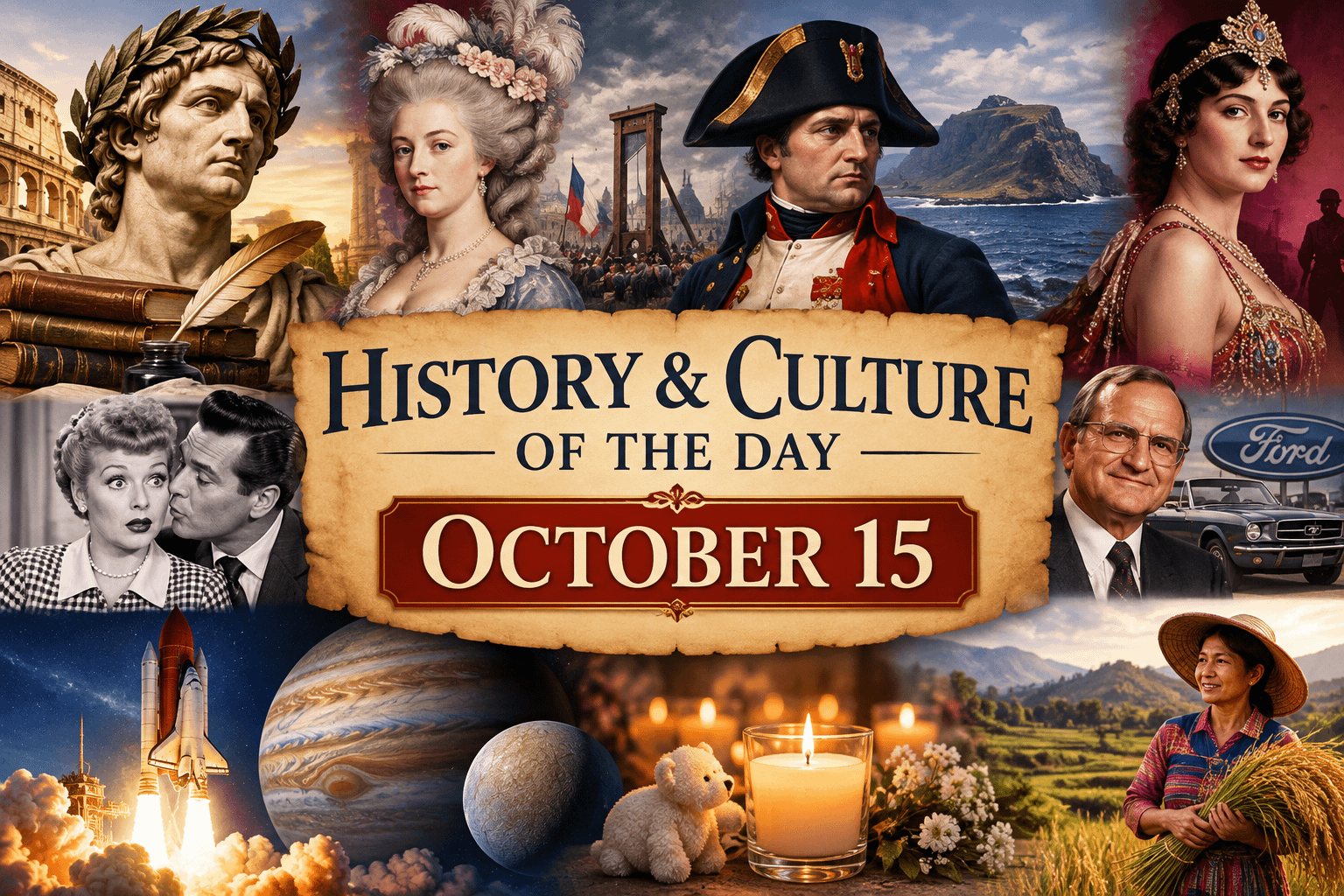
October 15 is a date filled with fascinating moments in history, cultural milestones, scientific achievements, and stories of people who helped shape the world we know today.
From the ancient world to the exploration of space, October 15 reminds us that history is not simply a collection of dates. It is the story of people—their discoveries, struggles, creativity, courage, failures, and determination.
The events connected to October 15 stretch across centuries and touch subjects ranging from ancient Rome and European history to aviation, entertainment, literature, technology, and space exploration.
It is also a meaningful day for remembrance and awareness. For many families, October 15 carries a deeply personal significance as Pregnancy and Infant Loss Remembrance Day, a time to remember babies whose lives, however brief, left a permanent place in the hearts of those who loved them.
Here is a closer look at the history and culture connected to October 15.
Virgil Was Born — 70 BC
One of the most influential poets of the ancient world was born on October 15, 70 BC.
Publius Vergilius Maro, better known simply as Virgil, became one of ancient Rome’s greatest literary figures.
Virgil is best remembered for writing the Aeneid, an epic poem telling the story of Aeneas, a Trojan hero who journeys to Italy after the destruction of Troy.
The work became enormously influential in Roman culture.
The Aeneid helped connect Rome’s identity to the legendary world of Troy while exploring themes such as duty, sacrifice, destiny, leadership, war, family, and the responsibilities people carry toward future generations.
Virgil’s influence continued long after the Roman Empire.
His writings became foundational works of Western literature and were studied for centuries throughout Europe.
His influence can also be seen in later literary masterpieces. Dante famously chose Virgil as his guide through much of The Divine Comedy.
More than 2,000 years after Virgil’s birth, his work remains an important part of the study of classical literature.
The Story of Marie Antoinette
October 15, 1793, was the day before one of the most famous executions of the French Revolution.
On that day, former French queen Marie Antoinette was tried before the Revolutionary Tribunal.
France had undergone enormous political and social upheaval. The monarchy had collapsed, King Louis XVI had already been executed, and revolutionary leaders were attempting to reshape the country.
Marie Antoinette became one of the most recognizable symbols of the old monarchy.
She had been born an Austrian archduchess before marrying the future Louis XVI of France. As queen, she became the subject of intense criticism, political attacks, rumors, and propaganda.
Some accusations against her were based on genuine political opposition, while others were exaggerated or false.
After her trial, she was convicted and sentenced to death.
Marie Antoinette was executed by guillotine on October 16, 1793.
Her life and death continue to fascinate historians, filmmakers, authors, and the public.
Her story demonstrates how historical reputations can be shaped not only by what people actually did but also by political conflict, public perception, rumor, and propaganda.
Napoleon Begins His Exile on Saint Helena — 1815
October 15, 1815, marked another significant moment in European history when Napoleon Bonaparte arrived at Saint Helena.
Napoleon had once controlled much of Europe.
His military campaigns transformed European politics, changed borders, influenced legal systems, and contributed to conflicts that affected millions of people.
After his defeat at Waterloo in June 1815, Napoleon’s political and military career effectively came to an end.
British authorities eventually sent him to Saint Helena, a remote island in the South Atlantic Ocean.
Its isolation made escape extremely difficult.
Napoleon spent the remaining years of his life there.
He died on Saint Helena in 1821.
The image of the once-powerful emperor living his final years on a distant island became one of history’s most dramatic examples of how quickly political power can disappear.
Mata Hari Is Executed — 1917
October 15, 1917, is associated with one of the most mysterious figures of World War I.
Mata Hari, whose real name was Margaretha Geertruida Zelle, was executed by a French firing squad after being convicted of spying for Germany.
She had become famous in Europe as an exotic dancer and performer.
Her relationships with military officers and powerful men across several countries eventually drew the attention of intelligence agencies during World War I.
French authorities accused her of working as a German spy.
She was arrested, tried, convicted, and sentenced to death.
However, historians have continued debating the true extent of her espionage activities.
Over time, Mata Hari became a cultural symbol of the mysterious female spy.
Books, movies, television programs, and fictional characters have drawn inspiration from her story.
The legend surrounding Mata Hari eventually became almost as famous as the real person.
The Birth of a Famous American Auto Executive — 1924
On October 15, 1924, Lee Iacocca was born in Allentown, Pennsylvania.
Iacocca became one of the most recognizable business executives in American automotive history.
He spent many years at Ford Motor Company, where he became closely associated with the development and marketing of several vehicles, most famously the Ford Mustang.
Introduced during the 1960s, the Mustang became an American cultural icon.
After leaving Ford, Iacocca became president and later chairman of Chrysler.
At the time, Chrysler was experiencing severe financial problems.
Iacocca became the public face of the company’s recovery efforts and gained national recognition through advertisements in which he personally appeared.
His career helped establish the modern idea of the celebrity corporate executive.
“I Love Lucy” Premieres — 1951
American television changed forever on October 15, 1951.
That evening, I Love Lucy premiered on CBS.
The sitcom starred Lucille Ball and Desi Arnaz as Lucy and Ricky Ricardo.
The program became one of the most influential television shows in American history.
Lucille Ball’s physical comedy, timing, facial expressions, and willingness to make herself look ridiculous for a laugh helped create some of television’s most memorable comedic moments.
The show was also technically important.
Its production techniques helped establish methods that influenced television sitcoms for decades, including the use of multiple cameras while filming before a live studio audience.
The marriage between Lucy and Ricky also reflected something noteworthy for American television at the time.
Lucille Ball was a white American woman, while Desi Arnaz was Cuban-born.
Their real-life marriage and fictional television marriage brought an interracial and intercultural relationship into millions of American homes during the 1950s.
More than seven decades later, I Love Lucy remains an important part of American popular culture.
The Great Storm of 1987 Begins to Develop
October 15, 1987, became memorable in Britain as an exceptionally powerful storm struck parts of southern England and northern France overnight into October 16.
The event became known as the Great Storm of 1987.
Extremely strong winds caused widespread damage.
Millions of trees were reportedly brought down, buildings were damaged, transportation was disrupted, and communities experienced power outages.
The storm also became culturally famous because of weather forecasting.
Before the storm, BBC meteorologist Michael Fish made comments that later became strongly associated with the event.
The episode became a lasting reminder of the challenges involved in forecasting unusual and rapidly developing weather systems.
Space Shuttle Atlantis Launches Galileo — 1989
October 15, 1989, was an important day in the history of space exploration.
NASA’s Space Shuttle Atlantis launched on mission STS-34 carrying the Galileo spacecraft.
Galileo’s destination was Jupiter.
The spacecraft eventually became one of the most important planetary exploration missions ever conducted.
Because of the enormous distance involved and the complicated mechanics of interplanetary travel, Galileo did not simply fly directly from Earth to Jupiter.
It used gravitational assists from other planets to gain the speed necessary to reach its destination.
Galileo arrived at Jupiter in 1995.
The mission dramatically expanded scientists’ understanding of Jupiter and its moons.
It observed Jupiter’s atmosphere, studied its magnetic environment, and provided valuable information about several major moons.
One of the most exciting discoveries involved Europa.
Evidence gathered during the Galileo mission strengthened the possibility that a vast salty ocean might exist beneath Europa’s icy surface.
That possibility transformed Europa into one of the most intriguing places in the solar system in the search for environments that could potentially support life.
October 15 and Pregnancy and Infant Loss Remembrance
October 15 also holds profound emotional meaning for families around the world.
It is widely observed as Pregnancy and Infant Loss Remembrance Day.
The observance recognizes babies lost through miscarriage, stillbirth, neonatal death, and other forms of pregnancy or infant loss.
For many parents and families, these losses can carry tremendous grief.
One of the most recognized traditions associated with October 15 is the Wave of Light.
Families and supporters are encouraged to light candles at 7 p.m. local time in memory of babies who died.
As candles are lit across different time zones, the idea is to create a symbolic wave of light traveling around the world.
Behind every candle is a story.
Behind every name is a family.
Behind every loss is love.
Observances such as this also help challenge the silence that has historically surrounded pregnancy and infant loss.
Grief deserves acknowledgment even when a life was extremely brief.
A parent’s love is not measured by how many years they had with their child.
International Day of Rural Women
October 15 is also recognized by the United Nations as the International Day of Rural Women.
The observance highlights the contributions rural women make to families, agriculture, food production, communities, and economies around the world.
Women in rural communities frequently play essential roles in farming and food systems while also caring for families and contributing to local economic activity.
Yet many continue to face unequal access to land ownership, financing, technology, education, infrastructure, and other resources.
The observance calls attention to both their contributions and the challenges they face.
It is another example of how October 15 connects history with issues that continue affecting people today.
A Day Connecting the Ancient World to Space Exploration
Few things demonstrate the enormous span of human history better than looking at everything connected with a single date.
October 15 begins more than two thousand years ago with the birth of Virgil.
It takes us through the political turmoil of revolutionary France.
It brings us to Napoleon’s exile on a remote island.
It introduces us to the complicated legend of Mata Hari.
It moves into American business and automobile culture.
It takes us into living rooms across America for the premiere of I Love Lucy.
And eventually, October 15 carries us beyond Earth aboard Space Shuttle Atlantis as humanity sends a spacecraft toward Jupiter.
Think about that progression.
Human beings once looked into the night sky and created stories about the planets.
Centuries later, we built machines capable of traveling to them.
That transformation represents one of the extraordinary stories of civilization.
Why Learning History Matters
History is sometimes taught as though it were simply about memorizing names and dates.
But history is much more valuable when we look at the people behind those dates.
People experienced uncertainty.
They made difficult choices.
They loved.
They fought.
They created.
They failed.
They discovered.
They dreamed.
And they grieved.
The technology surrounding us changes, governments rise and fall, and cultures evolve, but many parts of the human experience remain surprisingly familiar.
That is one reason history matters.
It gives us perspective.
Understanding where society has been can help us better understand the world in which we currently live.
Remembering October 15
October 15 offers an extraordinary journey through history and culture.
It is the birthday of one of ancient Rome’s greatest poets.
It marks Napoleon’s arrival at the isolated place where he would spend his final years.
It remembers the controversial life and death of Mata Hari.
It celebrates an important milestone in television history with the premiere of I Love Lucy.
It marks a major step in humanity’s exploration of Jupiter through the Galileo mission.
It recognizes the essential contributions of rural women around the world.
And for countless families, it is a solemn day to light a candle and remember babies who were deeply loved and are deeply missed.
History contains moments of triumph and tragedy, discovery and loss, laughter and grief.
October 15 contains a little of all of them.
Perhaps that is what makes studying history so meaningful.
The world we live in today was built from millions of moments that came before us—and every generation adds another chapter to the story.
Which historical or cultural event connected to October 15 stands out most to you, and why?