
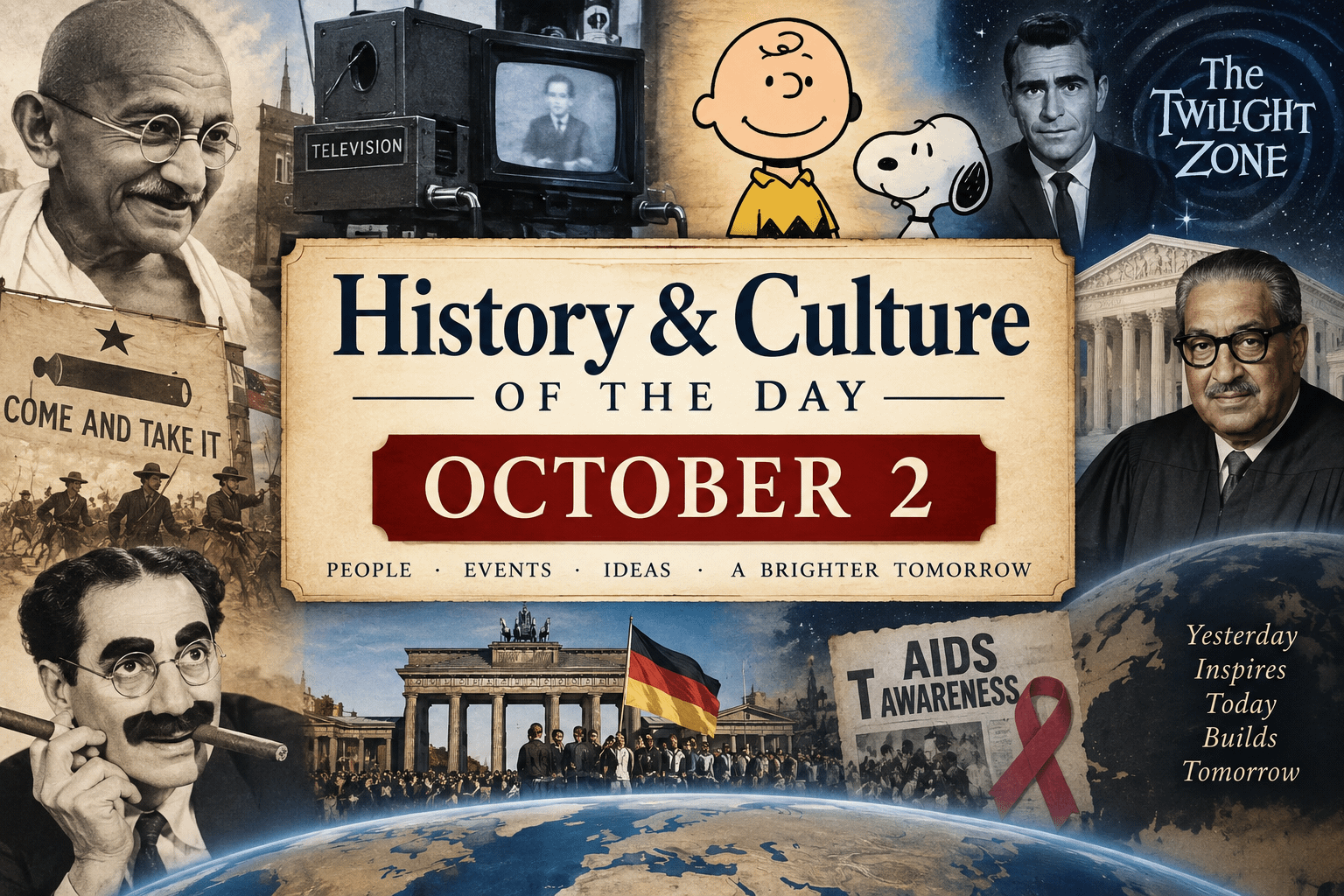
October 2 is a date filled with moments that have influenced politics, entertainment, technology, exploration, and popular culture. Across different centuries, October 2 has witnessed the births of influential figures, groundbreaking television premieres, important political developments, and events that became part of the historical record.
History is more than a collection of dates. Every day connects us with people who lived before us, decisions that changed societies, and cultural moments that continue to influence how we live today. October 2 provides plenty of examples.
1780 — Major John André Is Executed During the American Revolution
On October 2, 1780, British Army officer Major John André was executed as a spy during the American Revolutionary War.
André had become closely connected to one of the most infamous episodes of the Revolution: American General Benedict Arnold’s attempt to turn over the strategic fortifications at West Point to the British.
Arnold had once been celebrated for his military service to the American cause, but growing resentment and other factors eventually led him to secretly negotiate with the British. André served as an intermediary in the conspiracy.
After meeting with Arnold, André was captured while attempting to return to British-controlled territory. Documents related to West Point were discovered in his possession.
Arnold escaped to the British side, but André was tried by an American military board and convicted as a spy. He was hanged on October 2.
The episode helped transform Benedict Arnold’s name into an enduring American synonym for betrayal, while André’s fate became one of the Revolution’s most remembered espionage stories.
1835 — The Texas Revolution and the Battle of Gonzales
October 2, 1835, is traditionally associated with the beginning of the Texas Revolution because of the Battle of Gonzales.
Tensions had been increasing between Mexican authorities and settlers in Texas. Mexican officials sought the return of a small cannon that had previously been provided to settlers at Gonzales for protection.
The settlers refused.
Their challenge became associated with the famous phrase:
“Come and Take It.”
A confrontation followed between Texian settlers and Mexican soldiers. The battle itself was relatively small, but its symbolism became enormous.
The conflict represented an open break between the Texian rebels and the Mexican government. Over the following months, the revolution expanded dramatically, eventually producing famous events including the Battle of the Alamo and the Battle of San Jacinto.
The “Come and Take It” flag remains one of the best-known symbols connected with Texas history.
1869 — Mahatma Gandhi Is Born
Mohandas Karamchand Gandhi was born on October 2, 1869, in Porbandar, in what is now Gujarat, India.
Known throughout the world as Mahatma Gandhi, he became one of history’s most influential advocates of nonviolent resistance.
Gandhi developed and promoted the principle of satyagraha, a philosophy centered on nonviolent resistance and commitment to truth.
His campaigns challenged British colonial rule in India while emphasizing civil disobedience rather than armed revolution.
Among the most famous episodes associated with Gandhi was the Salt March of 1930, when he and his followers challenged Britain’s monopoly and taxation of salt.
Gandhi’s methods eventually influenced civil-rights and social-justice movements far beyond India.
Leaders including Martin Luther King Jr. studied Gandhi’s approach to nonviolent resistance while developing strategies during the American Civil Rights Movement.
Because Gandhi was born on October 2, the United Nations later designated the date as the International Day of Non-Violence.
It is an appropriate legacy for someone whose ideas about peaceful resistance influenced movements around the world.
1890 — Groucho Marx Is Born
October 2 also marks the birthday of one of America’s most recognizable comedians.
Julius Henry “Groucho” Marx was born on October 2, 1890.
Together with his brothers, Groucho became a major figure in American comedy. The Marx Brothers built their reputation in vaudeville before moving into Broadway productions and motion pictures.
Groucho became instantly recognizable because of his exaggerated mustache, glasses, eyebrows, cigar, quick delivery, and relentless wordplay.
Films including Duck Soup, Animal Crackers, Monkey Business, and A Night at the Opera helped establish the Marx Brothers as comedy legends.
Groucho’s influence extended beyond movies.
He later became the host of the radio and television game show You Bet Your Life, introducing his distinctive humor to another generation.
His rapid-fire jokes, sarcasm, improvisation, and verbal comedy helped influence countless comedians who followed.
1919 — President Woodrow Wilson Suffers a Severe Stroke
On October 2, 1919, President Woodrow Wilson suffered a serious stroke.
Wilson had recently been traveling around the United States attempting to build public support for the Treaty of Versailles and American participation in the League of Nations.
His health deteriorated during the tour, and the stroke left him significantly impaired.
The situation created an extraordinary constitutional problem.
At the time, there was no clear modern procedure for determining presidential inability and transferring presidential powers temporarily because of a serious medical condition.
Wilson remained president until the end of his term in 1921.
Decades later, concerns surrounding presidential incapacity contributed to the development of the 25th Amendment, which was ratified in 1967 and established clearer procedures involving presidential succession and inability.
1925 — John Logie Baird Demonstrates an Early Television System
The development of television was not the work of a single inventor or a single breakthrough. Instead, numerous inventors contributed technologies that eventually produced modern television.
One important pioneer was Scottish inventor John Logie Baird.
On October 2, 1925, Baird successfully transmitted recognizable images using an experimental mechanical television system.
His early system was primitive compared with today’s technology, but these experiments represented an important step in television’s development.
Imagine experiencing something like this in the 1920s.
For centuries, communication over long distances had primarily involved written messages or sound. Suddenly, inventors were demonstrating the possibility of transmitting moving images.
Television would eventually become one of the most powerful cultural forces of the 20th century.
News, entertainment, sports, advertising, politics, education, and popular culture would all be transformed by it.
1950 — The Peanuts Comic Strip Debuts
On October 2, 1950, newspaper readers were introduced to a comic strip that would become a global cultural phenomenon.
Charles M. Schulz’s Peanuts made its syndicated newspaper debut.
The strip featured characters who would eventually become cultural icons, including Charlie Brown, Snoopy, Lucy, Linus, Sally, Peppermint Patty, Woodstock, and others.
What made Peanuts special was that beneath its simple artwork and childhood setting were surprisingly deep observations about life.
Charlie Brown struggled with disappointment.
Lucy offered questionable advice.
Linus found comfort in his blanket.
Snoopy escaped into an extraordinary imagination.
The characters dealt with friendship, insecurity, failure, hope, loneliness, love, and perseverance.
Over time, Peanuts expanded far beyond newspapers.
Television specials such as A Charlie Brown Christmas and It’s the Great Pumpkin, Charlie Brown became traditions for generations of families.
Snoopy became one of the world’s most recognizable fictional characters.
The strip ultimately demonstrated how a few small cartoon panels could explore some very large human emotions.
1959 — The Twilight Zone Premieres
Imagine turning on your television on October 2, 1959, and hearing Rod Serling introduce viewers to another dimension.
That evening, The Twilight Zone premiered on American television.
The anthology series blended science fiction, fantasy, suspense, horror, and social commentary.
But the show’s monsters, aliens, strange towns, and alternate realities were often only part of the story.
Many episodes explored deeply human subjects such as prejudice, conformity, loneliness, fear, war, technology, greed, and the misuse of power.
Rod Serling frequently used science fiction as a way to examine social issues that could be difficult to address directly on television at the time.
The show’s twist endings became particularly famous.
More than six decades later, people still use the phrase “Twilight Zone” to describe something strange, surreal, or difficult to explain.
That alone demonstrates how deeply the program entered popular culture.
1967 — Thurgood Marshall Becomes the First Black U.S. Supreme Court Justice
On October 2, 1967, Thurgood Marshall was sworn in as an associate justice of the United States Supreme Court, becoming the first Black justice in the Court’s history.
Long before joining the Supreme Court, Marshall had already played an enormously important role in American legal history.
As an attorney for the NAACP Legal Defense and Educational Fund, he argued numerous civil-rights cases.
His most famous legal victory came in Brown v. Board of Education, the landmark 1954 Supreme Court case in which the Court ruled that racial segregation in public schools violated the Constitution.
President Lyndon B. Johnson nominated Marshall to the Supreme Court in 1967.
Marshall served on the Court until 1991.
His career connected two major chapters of American history: the legal struggle against segregation and the increasing representation of Black Americans within major national institutions.
1985 — Rock Hudson Dies and America’s Understanding of AIDS Changes
Actor Rock Hudson died on October 2, 1985, at age 59 from complications related to AIDS.
Hudson had been one of Hollywood’s biggest stars during the 1950s and 1960s.
His diagnosis became internationally significant because AIDS was still widely misunderstood and heavily stigmatized.
During the early years of the AIDS epidemic, fear and misinformation were widespread. Many people had little understanding of how HIV was transmitted, and those affected often faced severe discrimination.
Hudson’s illness brought unprecedented mainstream attention to the epidemic.
His death became an important cultural moment in the history of HIV/AIDS awareness in the United States, helping push the crisis further into public conversation.
The epidemic would ultimately claim hundreds of thousands of American lives and millions worldwide while inspiring enormous efforts in medical research, activism, education, and public health.
1990 — German Reunification Is Hours Away
October 2, 1990, was the final full day of a divided Germany.
Following World War II, Germany had been separated into East Germany and West Germany. Berlin itself became one of the most visible symbols of the Cold War division between communist Eastern Europe and the democratic West.
The Berlin Wall, constructed in 1961, physically divided the city.
Then, in November 1989, the wall opened.
Less than a year later, German reunification became reality.
At midnight between October 2 and October 3, 1990, East Germany ceased to exist as a separate state and Germany was formally reunited.
That makes October 2 an interesting historical threshold — the final day before one of the Cold War’s most visible divisions officially disappeared.
October 2 and the Power of Culture
One of the fascinating things about studying a single date is seeing how different kinds of history overlap.
October 2 isn’t defined by one event.
It includes revolution and political conflict.
It includes civil rights.
It includes technological innovation.
It includes television, comics, comedy, international history, and social change.
Consider the cultural range represented by just a few October 2 anniversaries.
Gandhi’s philosophy influenced movements for nonviolent change around the world.
Thurgood Marshall helped transform American constitutional law.
Charles Schulz transformed newspaper comics.
Rod Serling transformed television storytelling.
Groucho Marx helped redefine comedy.
John Logie Baird contributed to technology that eventually brought television into billions of homes.
Each operated in a completely different field, yet all became part of the cultural history we inherited.
Why Looking Back Still Matters
History can sometimes seem distant because we already know what happened afterward.
People living through these moments didn’t.
When early television experiments were being conducted, nobody could fully predict streaming video, smartphones, or worldwide digital broadcasting.
When Peanuts first appeared in newspapers, nobody knew Snoopy and Charlie Brown would still be recognized generations later.
When The Twilight Zone premiered, nobody knew people would still be watching and discussing its episodes more than 60 years later.
When the Berlin Wall divided Germany, generations grew up believing it might remain there indefinitely.
History reminds us that people living through major events rarely know which moments future generations will consider important.
We are living through tomorrow’s history right now.
Final Thoughts
October 2 connects some remarkably different stories.
It takes us from the American Revolution and Texas Revolution to India’s independence movement, the American Civil Rights Movement, early television technology, classic comedy, newspaper comics, groundbreaking television, the AIDS epidemic, and the final hours before German reunification.
Some events changed governments.
Others changed technology.
Others changed culture.
And some changed the way people thought about one another.
That is what makes exploring history one day at a time so interesting. A single date can open doors into centuries of human experience.
October 2 reminds us that history isn’t simply about memorizing what happened.
It is about understanding how people, ideas, inventions, struggles, creativity, and courage shaped the world that came afterward.
Which October 2 moment do you think had the greatest lasting impact on history or culture?
Leave a ReplyCancel reply