
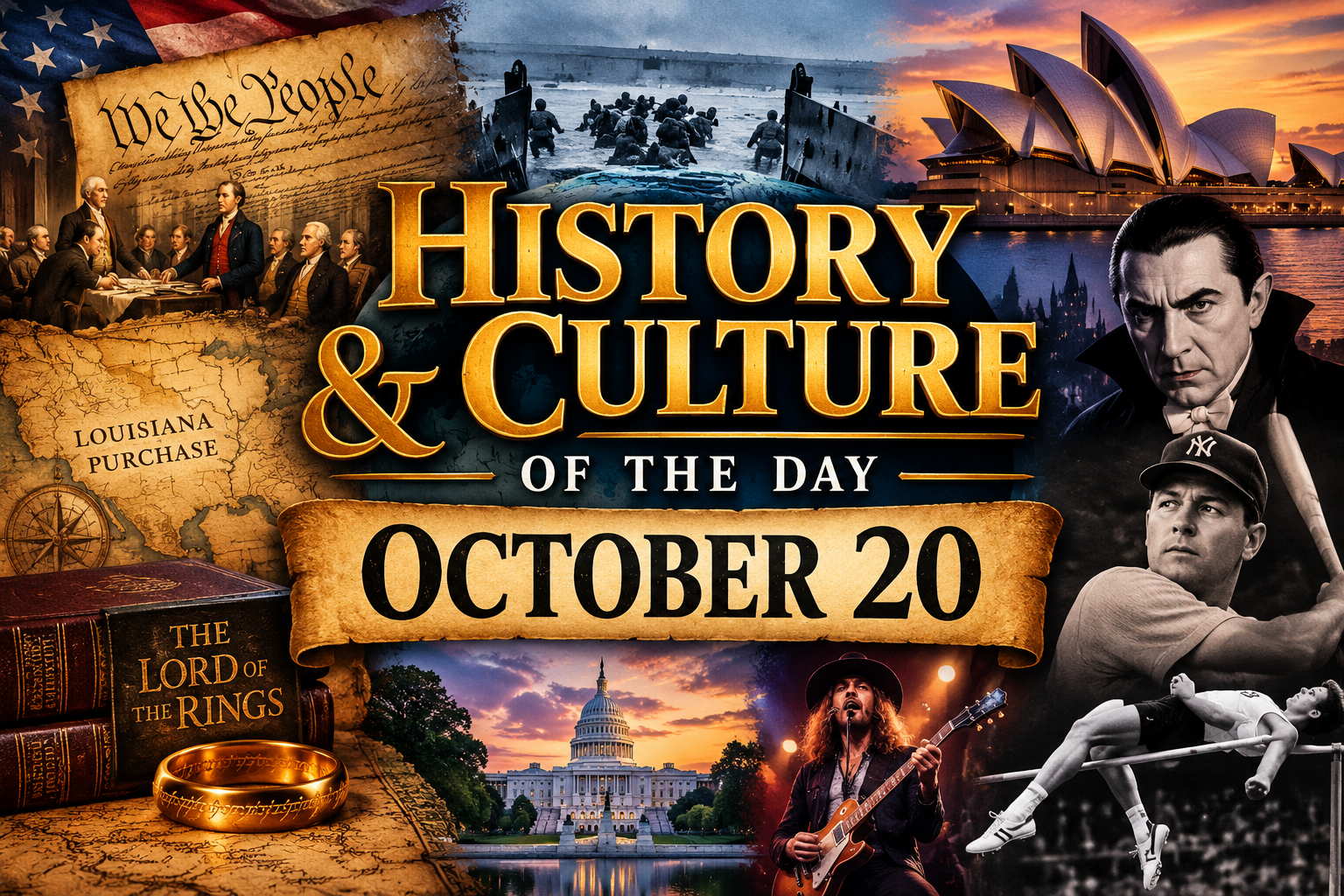
Every date on the calendar carries stories from the past, but October 20 has witnessed an especially interesting combination of political turning points, wartime events, cultural milestones, architectural achievements, and moments that continue to influence the world today.
From the Louisiana Purchase reshaping the United States to General Douglas MacArthur returning to the Philippines, the opening of the Sydney Opera House, the Watergate crisis, and unforgettable moments in music and popular culture, October 20 reminds us just how much can happen on a single date.
Here is a journey through the history and culture of October 20.
1774 – The Continental Association Is Created
One of the earliest major events associated with October 20 occurred during the growing conflict between the American colonies and Great Britain.
On October 20, 1774, the First Continental Congress adopted the Continental Association, an agreement designed to economically pressure Britain through restrictions on British imports and other trade.
The measure came in response to the Coercive Acts, commonly called the Intolerable Acts by American colonists. These laws had been enacted by Britain following the Boston Tea Party.
The Continental Association represented something larger than an economic boycott. It demonstrated that colonies with different interests could cooperate in opposition to British policies.
Less than a year later, fighting at Lexington and Concord would begin the American Revolutionary War.
The events of 1774 therefore became another important step along the road toward American independence.
1803 – The Louisiana Purchase Treaty Is Ratified
One of the most consequential events in American history occurred on October 20, 1803.
The United States Senate voted 24–7 to approve the treaty with France for the Louisiana Purchase.
The Louisiana Purchase involved more than 828,000 square miles of territory and effectively doubled the size of the United States.
President Thomas Jefferson had originally been concerned about French control of Louisiana, particularly because access to the Mississippi River and New Orleans was extremely important to American commerce.
American representatives Robert Livingston and James Monroe negotiated with Napoleon Bonaparte’s government. Instead of simply selling New Orleans, France ultimately agreed to sell the enormous Louisiana Territory.
The total purchase price was approximately $15 million.
The acquisition eventually contributed territory to numerous future states and opened enormous areas west of the Mississippi River to American expansion.
That expansion also had profound consequences for the Indigenous nations already living throughout those lands. The Louisiana Purchase is therefore both a defining moment in American territorial growth and part of the much larger, complicated history of westward expansion.
October 20, 1803, changed the geographic future of the United States.
1818 – The Convention of 1818
October 20 also played an important role in defining the relationship between the United States and British North America.
On October 20, 1818, the United States and Great Britain signed the Convention of 1818.
Among its important provisions, the agreement established much of the boundary between the United States and what would eventually become Canada along the 49th parallel.
Borders can seem permanent when looking at a modern map, but many were established through years of negotiation, conflict, compromise, and treaties.
The Convention of 1818 helped establish one of the most recognizable international boundaries in North America.
1882 – Bela Lugosi Is Born
October 20 also has an important connection to the history of horror movies.
Actor Bela Lugosi was born on October 20, 1882, in what was then Austria-Hungary.
Lugosi would become forever associated with one of popular culture’s greatest monsters: Count Dracula.
His portrayal of Dracula in the 1931 Universal film helped define how generations imagined the famous vampire.
The cape, formal mannerisms, dramatic stare, and distinctive delivery became deeply embedded in popular culture.
Even people who have never watched the entire movie often recognize the style of Dracula that Lugosi helped popularize.
Nearly a century later, countless Halloween decorations, cartoons, television shows, costumes, advertisements, and horror movies still contain echoes of his performance.
1931 – Mickey Mantle Is Born
Another American cultural icon was born on October 20, 1931: baseball legend Mickey Mantle.
Mantle became one of the defining players of the New York Yankees and one of baseball’s most recognizable stars.
His career arrived during an era when baseball occupied an enormous place in American popular culture. Generations followed games through newspapers, radio, television, and trips to the ballpark.
Mantle eventually became more than an athlete. He became part of baseball mythology, remembered through statistics, World Series appearances, photographs, baseball cards, and stories passed between generations.
His October 20 birthday provides another connection between this date and American cultural history.
1944 – General Douglas MacArthur Returns to the Philippines
One of the most dramatic moments of World War II occurred on October 20, 1944.
American forces landed on Leyte in the Philippines, beginning a major phase of the campaign to liberate the islands from Japanese occupation. The U.S. Navy notes that the Seventh Fleet supported the landing of four Army divisions that day.
General Douglas MacArthur also came ashore.
His arrival carried enormous symbolic importance.
MacArthur had left the Philippines in 1942 as Japanese forces advanced. He had famously promised:
“I shall return.”
On October 20, 1944, that promise became reality.
After arriving on Leyte, MacArthur addressed the Filipino people and announced his return.
The fighting was far from finished. The Philippines campaign would involve months of difficult and deadly combat.
But the October 20 landing became one of the most recognizable moments of the Pacific War.
1947 – Hollywood and the Red Scare
October 20, 1947, marked the beginning of another significant chapter in American cultural and political history.
The House Un-American Activities Committee began highly publicized hearings examining allegations of Communist influence within the American motion-picture industry.
The hearings became part of the broader Red Scare in the United States.
Actors, directors, screenwriters, producers, and others in Hollywood faced intense scrutiny over their political beliefs and associations.
The period contributed to the creation and enforcement of the Hollywood blacklist, which prevented numerous entertainment professionals from finding work.
The episode remains an important example of the complicated relationship between politics, fear, freedom of expression, and the entertainment industry.
1955 – The Return of the King Is Published
October 20 has a special place in literary and fantasy culture as well.
In 1955, The Return of the King, the third volume of J.R.R. Tolkien’s The Lord of the Rings, was published.
Tolkien’s work would become one of the most influential creations in modern fantasy literature.
Middle-earth, hobbits, elves, orcs, wizards, and Tolkien’s extensive mythology inspired generations of authors and eventually reached an even larger audience through film adaptations.
Modern fantasy novels, role-playing games, movies, television series, and video games all owe something to the enormous cultural influence of Tolkien’s world.
What began on printed pages grew into a global cultural phenomenon.
1968 – Dick Fosbury Changes the High Jump
The 1968 Summer Olympics produced an unusual moment in sports history connected with October 20.
American high jumper Dick Fosbury won Olympic gold using an unconventional technique that would become known as the Fosbury Flop.
Instead of clearing the bar using the traditional techniques common at the time, Fosbury approached the bar differently and went over it backward.
It looked strange.
It worked.
Eventually, variations of the Fosbury Flop became the standard technique used by elite high jumpers.
It is a wonderful example of how innovation sometimes begins with someone being willing to do something differently.
1973 – The Sydney Opera House Opens
October 20, 1973, brought one of the great moments in modern architectural and cultural history.
The Sydney Opera House officially opened in Australia.
Queen Elizabeth II participated in the opening ceremonies after years of construction.
Designed by Danish architect Jørn Utzon, the building’s extraordinary roof forms transformed Sydney’s waterfront.
Today, its distinctive silhouette is recognized around the world.
But the Sydney Opera House is much more than a famous building.
It represents the relationship between architecture and culture.
A building designed for performances eventually became a performance itself—something people travel thousands of miles simply to see.
Its opening on October 20, 1973, gave the world one of its most recognizable cultural landmarks.
1973 – The Saturday Night Massacre
Remarkably, another historic event unfolded on that very same day.
October 20, 1973, became known in American political history for the Saturday Night Massacre, a major episode in the Watergate scandal.
President Richard Nixon ordered the dismissal of Watergate special prosecutor Archibald Cox.
Attorney General Elliot Richardson and Deputy Attorney General William Ruckelshaus would not carry out the dismissal; both left their posts. Solicitor General Robert Bork ultimately dismissed Cox.
The episode intensified the Watergate crisis and increased political pressure surrounding the Nixon administration.
Less than a year later, Nixon resigned the presidency.
The events of October 20 remain an important part of the history of executive power, congressional oversight, the Justice Department, and the Watergate investigation.
1977 – Tragedy Strikes Lynyrd Skynyrd
October 20, 1977, became a tragic date in rock-and-roll history.
A plane carrying members of Lynyrd Skynyrd crashed near Gillsburg, Mississippi.
Six people were killed, including lead singer Ronnie Van Zant, guitarist Steve Gaines, and backing vocalist Cassie Gaines.
The tragedy devastated the band’s fans and abruptly ended one of Southern rock’s most important chapters.
Lynyrd Skynyrd had already created songs that would become staples of classic rock.
The music survived the tragedy.
Decades later, the band’s songs continue to be played, rediscovered, and passed from one generation of listeners to another.
1980 – U2 Releases Boy
October 20 also holds a place in modern music history.
In 1980, Irish rock band U2 released its debut album, Boy.
At the time, few could have predicted just how enormous the band’s cultural influence would become.
U2 would eventually become one of the world’s most successful rock groups, known for albums including The Joshua Tree, Achtung Baby, and All That You Can’t Leave Behind.
Every legendary career has a beginning.
For U2, one of those major beginnings happened on October 20.
October 20 Shows How History and Culture Connect
What makes October 20 fascinating is the incredible range of events attached to it.
There is territorial expansion with the Louisiana Purchase.
There is war and liberation with MacArthur’s return to the Philippines.
There is political turmoil through Watergate.
There is architecture through the Sydney Opera House.
There is literature through Tolkien.
There is innovation through Dick Fosbury.
There is baseball through Mickey Mantle.
There is horror cinema through Bela Lugosi.
And there is music through Lynyrd Skynyrd and U2.
At first glance, these events may seem completely unrelated.
But together they demonstrate what history really is.
History isn’t simply a collection of wars, presidents, treaties, and dates. It is also books people read, buildings people admire, songs people remember, athletes who change their sports, movies that influence popular culture, and ideas that continue long after the people who introduced them are gone.
Why Remember October 20?
Looking back at history isn’t simply about memorizing what happened.
It gives us an opportunity to understand how today’s world developed.
The borders on our maps have histories.
Our political institutions have histories.
Our music has a history.
Our favorite books have histories.
Even the techniques athletes use have histories.
October 20 demonstrates how one calendar date can connect hundreds of years of human experience.
Some events represented progress.
Others represented tragedy.
Some changed countries.
Others changed culture.
But each left something behind.
Final Thoughts
October 20 is a day filled with history, culture, courage, controversy, creativity, tragedy, and transformation.
On this date, the United States took a major step toward acquiring the Louisiana Territory. Douglas MacArthur returned to the Philippines. The Sydney Opera House opened its doors. America experienced one of the defining moments of the Watergate scandal. Literature, sports, film, baseball, and rock music also added their own chapters to the story of the day.
That’s what makes exploring history so interesting.
Every date has a story.
Sometimes it has dozens of them.
And when we take the time to look backward, we often discover just how deeply the past continues to shape the world around us.
Which October 20 moment do you find the most fascinating, and why?





Leave a ReplyCancel reply