
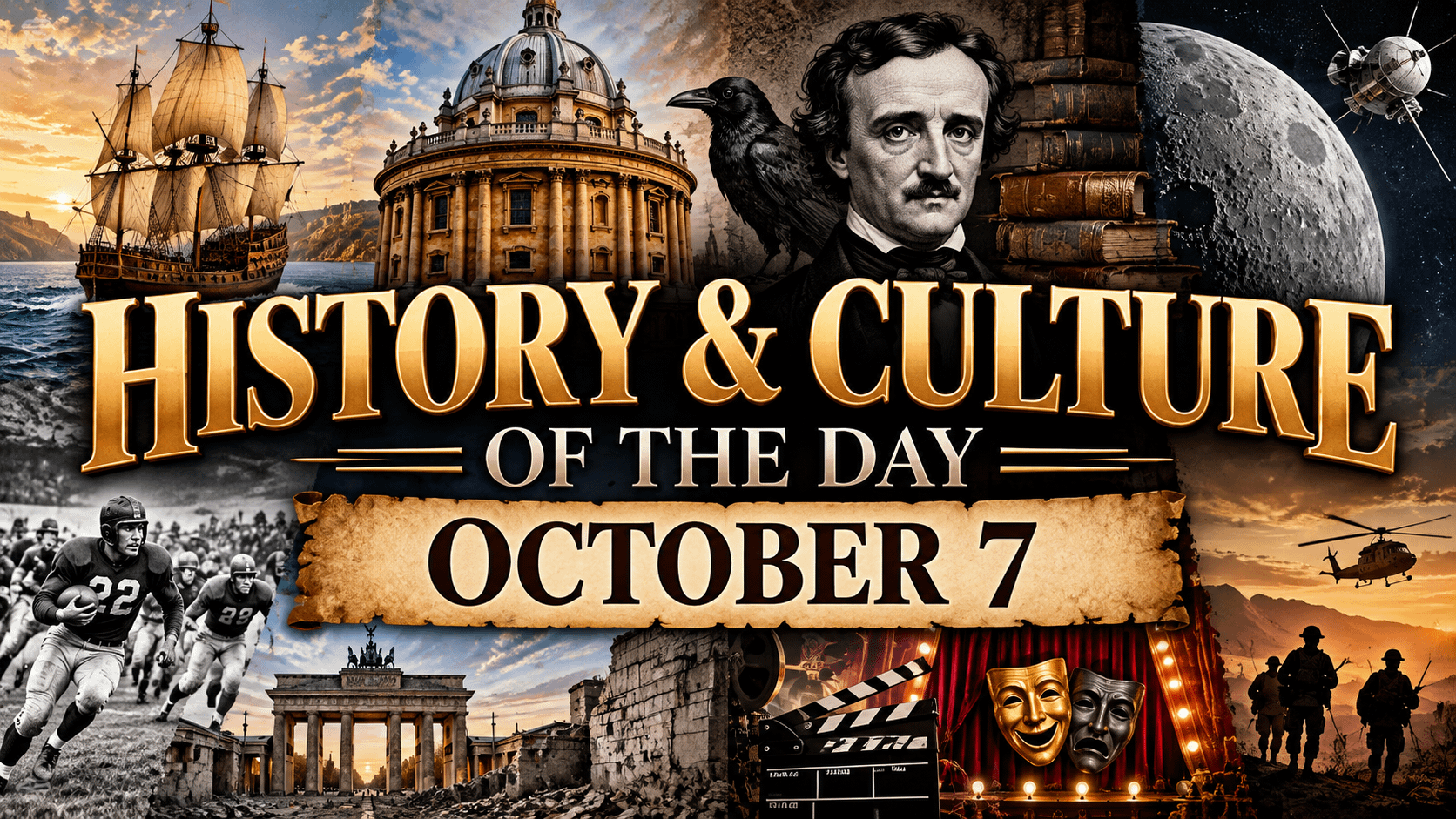
October 7 is a date filled with exploration, invention, music, literature, international events, and moments that helped shape popular culture. From the opening of Oxford University’s Radcliffe Camera to the first photograph of the far side of the Moon and the Broadway debut of Cats, October 7 offers a fascinating journey through centuries of human history.
History is more than wars, elections, and famous leaders. It is also the story of discoveries, books, music, architecture, technology, entertainment, and the everyday cultural changes that influence how generations see the world.
Here are some notable moments connected with October 7.
1769 — Captain James Cook Reaches New Zealand
On October 7, 1769, Captain James Cook and the crew of the HMS Endeavour sighted New Zealand during Cook’s first voyage through the Pacific.
Cook was certainly not the first person to discover New Zealand. Māori people had settled the islands centuries earlier, developing communities, traditions, language, navigation skills, and a rich culture. Dutch explorer Abel Tasman had also reached New Zealand waters in 1642.
Cook’s arrival, however, became an important moment in European exploration of the region.
During the voyage, Cook and his crew extensively charted New Zealand’s coastline. Their maps provided Europeans with much greater geographical knowledge of the islands and helped open a new era of interaction between Europeans and Māori.
Those interactions would eventually have enormous consequences for New Zealand’s Indigenous population, making Cook’s voyages important not only as stories of exploration but also as part of the complicated history of European expansion and colonization.
1748 — The Radcliffe Camera Opens at Oxford
One of the most recognizable buildings at the University of Oxford opened in 1748.
The Radcliffe Camera was designed by architect James Gibbs and funded through the estate of physician John Radcliffe.
Despite its modern meaning, the word “camera” in this case does not refer to photography. It comes from the Latin word for a room or chamber.
The circular building was originally created as a scientific library and eventually became part of Oxford’s famous Bodleian Library system.
Today, its enormous dome and distinctive architecture have made the Radcliffe Camera one of Oxford’s most recognizable landmarks.
It represents something October 7 repeatedly demonstrates throughout history: humanity’s desire to preserve knowledge and pass it from one generation to another.
1849 — Edgar Allan Poe Dies
American writer Edgar Allan Poe died on October 7, 1849, at only 40 years old.
Few writers have had as lasting an influence on horror, mystery, and gothic literature.
Poe wrote famous works including The Raven, The Tell-Tale Heart, The Fall of the House of Usher, The Black Cat, and The Cask of Amontillado.
His influence extends far beyond horror.
Poe’s story The Murders in the Rue Morgue is frequently recognized as one of the earliest modern detective stories. His fictional detective C. Auguste Dupin helped establish storytelling techniques that would later become familiar features of detective fiction.
Poe’s own death has also become surrounded by mystery.
He was discovered in Baltimore in poor condition several days before his death, and the exact circumstances surrounding his final days have remained uncertain.
That mystery seems strangely appropriate for a writer whose stories so often explored fear, death, madness, uncertainty, and the darker corners of the human mind.
More than 175 years later, Poe’s work continues to influence writers, filmmakers, musicians, artists, and popular culture.
1916 — Georgia Tech’s Historic Football Victory
October 7, 1916, produced one of the most extraordinary scores in the history of college football.
Georgia Tech defeated Cumberland College by an astonishing score of 222–0.
Georgia Tech was coached by legendary football coach John Heisman—the man whose name would eventually become associated with college football’s Heisman Trophy.
The game remains famous because of the enormous difference in score and the unusual circumstances surrounding the matchup.
Cumberland had discontinued its football program but was still obligated to play Georgia Tech. A makeshift team was assembled for the game.
The result was one of the most lopsided contests ever recorded in American college football.
Georgia Tech scored repeatedly throughout the game, producing a final score that seems almost impossible by modern standards.
More than a century later, the 222–0 game remains one of college football’s most unusual pieces of history.
1949 — East Germany Is Established
Europe was dramatically reshaped following World War II.
Germany had been divided into occupation zones controlled by the Allied powers. As tensions increased between the Soviet Union and the Western Allies, Germany eventually became divided into two separate states.
On October 7, 1949, the German Democratic Republic—commonly known as East Germany—was officially established in the Soviet occupation zone.
West Germany, officially the Federal Republic of Germany, had been established earlier that year.
The division became one of the defining symbols of the Cold War.
East and West Germany developed under very different political and economic systems, while Berlin itself became divided.
In 1961, construction of the Berlin Wall dramatically reinforced that separation.
For nearly three decades, the wall became one of the world’s most recognizable symbols of Cold War division.
The Berlin Wall fell in November 1989, and Germany was formally reunified on October 3, 1990.
1959 — Humanity Sees the Far Side of the Moon
For most of human history, people could only imagine what existed on the far side of the Moon.
Because the Moon is tidally locked with Earth, essentially the same side continually faces our planet.
That changed during the Space Age.
On October 7, 1959, the Soviet spacecraft Luna 3 transmitted photographs revealing the far side of the Moon.
The images were primitive compared with the detailed photographs produced by modern spacecraft, but their importance was enormous.
For the first time in human history, people could see terrain on the Moon that had previously been hidden from observers on Earth.
The photographs revealed a landscape noticeably different from the familiar near side, including fewer of the large dark plains known as maria.
Luna 3 represented another step in the rapidly developing space race between the Soviet Union and the United States.
Only ten years later, humans would walk on the Moon.
1960 — Spartacus Reaches the Big Screen
October 1960 also brought audiences one of Hollywood’s great historical epics.
Stanley Kubrick’s Spartacus, starring Kirk Douglas, became one of the most famous films of its era.
The movie tells a dramatized version of the story of Spartacus, the gladiator who led a major slave revolt against the Roman Republic.
The film became famous for its enormous battle scenes, powerful performances, and memorable dialogue.
It also became culturally significant because screenwriter Dalton Trumbo had been blacklisted during the anti-communist investigations and controversies that affected Hollywood.
Douglas publicly credited Trumbo for the screenplay, contributing to the weakening of the Hollywood blacklist.
As a result, Spartacus became important not only as a movie but also as part of the history of American entertainment and freedom of expression.
1982 — Cats Opens on Broadway
On October 7, 1982, one of the most successful musicals in Broadway history officially opened at the Winter Garden Theatre in New York City.
Andrew Lloyd Webber’s Cats was inspired by T. S. Eliot’s poetry collection Old Possum’s Book of Practical Cats.
The musical introduced Broadway audiences to the unusual world of the Jellicle cats and featured elaborate costumes, distinctive choreography, and memorable music.
Its best-known song, “Memory,” became famous far beyond the theater.
Few could have predicted just how successful the production would become.
Cats ran on Broadway for nearly 18 years, giving thousands of performances before closing in 2000.
For years, it held the record as Broadway’s longest-running musical.
Its success helped define the era of large-scale theatrical productions that dominated Broadway during the 1980s and 1990s.
1996 — Fox News Channel Launches
The American television landscape changed again on October 7, 1996, when Fox News Channel launched.
Cable television was becoming an increasingly important source of news and entertainment during the 1990s.
The arrival of another 24-hour cable news network increased competition within an industry already being transformed by CNN and other television news outlets.
Over the following decades, cable news would become deeply integrated into American political and cultural life.
At the same time, the internet, social media, smartphones, podcasts, streaming services, and independent digital media would further transform how people receive information.
October 7, 1996, therefore represents one moment in the much larger evolution of modern American media.
2001 — The War in Afghanistan Begins
On October 7, 2001, the United States and its allies began military operations in Afghanistan following the September 11 terrorist attacks.
The initial campaign targeted al-Qaeda and the Taliban government that had provided sanctuary to al-Qaeda leadership.
The conflict developed into America’s longest war.
Over the following two decades, hundreds of thousands of American service members served in Afghanistan, while Afghan civilians, Afghan security forces, international military personnel, aid workers, journalists, and others experienced the consequences of the conflict.
U.S. forces completed their withdrawal from Afghanistan in August 2021.
The war remains an important subject of historical debate concerning terrorism, military strategy, nation-building, diplomacy, intelligence, human rights, and the long-term consequences of military intervention.
October 7 Through the Lens of Culture
Looking across the events connected with October 7 reveals just how broad history can be.
On one date, we encounter explorers crossing the Pacific, writers shaping literature, architects creating landmarks, scientists photographing another world, filmmakers challenging Hollywood conventions, athletes producing unbelievable records, performers transforming Broadway, and nations being reshaped by war and politics.
Each event belongs to a different era.
Yet they all became pieces of the world we inherited.
That is one of the most fascinating things about studying history.
Events that once seemed like ordinary news eventually become chapters in textbooks. Buildings become landmarks. Entertainment becomes cultural history. New technology becomes commonplace. Political boundaries disappear or change. And people who once lived ordinary lives become historical figures remembered generations later.
Why History and Culture Matter
History allows us to understand not simply what happened, but how the world became what it is today.
Culture tells another part of that story.
Books reveal what generations feared and imagined.
Music captures emotions that statistics cannot.
Movies reflect the values and conflicts of their time.
Architecture shows what societies considered worth building.
Technology demonstrates humanity’s constant desire to explore beyond existing boundaries.
Even sports can preserve stories that remain legendary more than a century later.
When these pieces are considered together, history becomes much more than a collection of dates.
It becomes the continuing story of humanity.
Remembering October 7
From the haunting imagination of Edgar Allan Poe to the mysterious far side of the Moon, October 7 connects centuries of exploration, creativity, conflict, discovery, and cultural change.
Some events brought entertainment.
Others expanded human knowledge.
Some reshaped nations.
Others left difficult legacies that continue to be examined and debated.
Together, they remind us that history is constantly being created.
The people living through these moments rarely knew exactly how future generations would remember them. The same is true today. Somewhere in the world, discoveries are being made, stories are being written, traditions are changing, and events are unfolding that may someday appear in another generation’s history books.
Which October 7 moment do you find the most fascinating?
Leave a ReplyCancel reply