
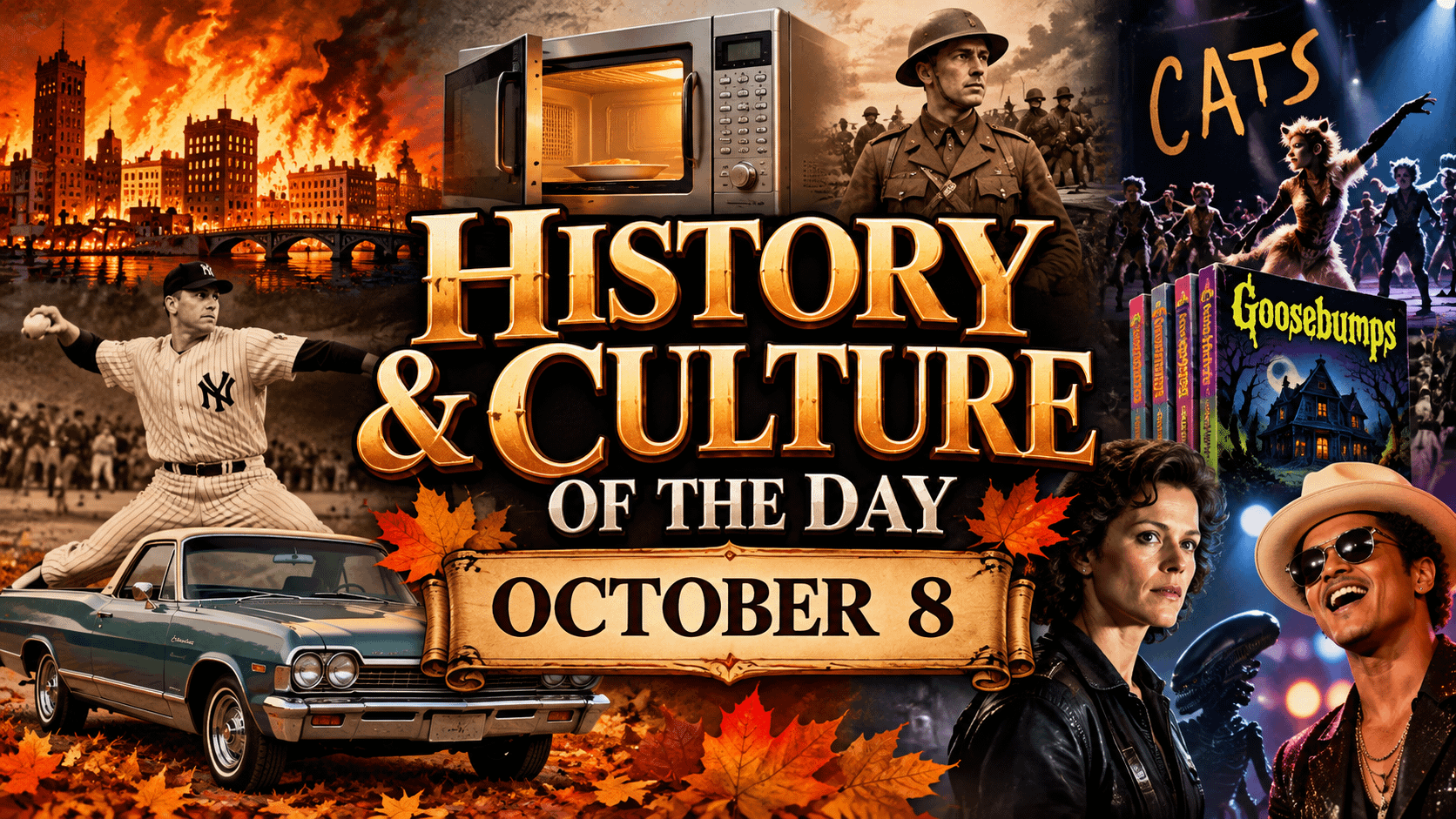
Every date on the calendar carries pieces of the human story, and October 8 is no exception. Across centuries, this day has been connected with exploration, innovation, entertainment, music, politics, and moments that changed how people understood the world around them.
From the Great Chicago Fire and the development of microwave cooking to groundbreaking achievements in baseball and memorable moments in popular culture, October 8 offers an interesting journey through history.
The Great Chicago Fire Begins — 1871
One of the most famous disasters in American history began on the evening of October 8, 1871, when a fire broke out in Chicago.
The blaze spread rapidly through a city filled with wooden buildings, sidewalks, and streets. Dry weather and strong winds helped turn what began as a relatively small fire into an enormous disaster.
The fire continued into October 10 and destroyed a large portion of Chicago. Hundreds of people died, thousands of buildings were destroyed, and roughly 100,000 residents were left without homes.
For generations, a popular story claimed that the fire began when a cow belonging to Catherine O’Leary kicked over a lantern in a barn. However, there is no reliable evidence proving that story, and the exact cause of the fire remains uncertain.
Despite the destruction, Chicago rebuilt remarkably quickly. The rebuilding effort eventually helped transform the city’s architecture and encouraged improvements in building practices and fire safety.
The Peshtigo Fire — 1871
While the Great Chicago Fire became internationally famous, an even deadlier fire occurred on the same night.
On October 8, 1871, a massive wildfire swept through northeastern Wisconsin, devastating communities around Peshtigo.
The Peshtigo Fire is considered one of the deadliest wildfires in recorded American history. Estimates vary, but more than 1,000 people—and possibly significantly more—were killed.
The tragedy is sometimes overshadowed by the Great Chicago Fire because both disasters occurred at nearly the same time.
Together, the fires serve as reminders of how vulnerable communities were to uncontrolled fires during the 19th century.
The Microwave Oven Is Patented — 1945
October 8 also has a fascinating connection to something found in kitchens around the world.
On October 8, 1945, inventor Percy Spencer filed a patent application connected with microwave cooking technology.
Spencer was working with radar equipment when he noticed that microwave energy could heat food. According to the famous account of his discovery, a candy bar in his pocket began melting while he was working near a magnetron.
Instead of dismissing what happened, Spencer experimented further.
His work helped lead to the development of the microwave oven.
Early microwave ovens were enormous and expensive compared with today’s appliances. Over time, however, the technology became smaller, more affordable, and increasingly common.
Today, the microwave represents something we often take for granted: technology developed for one purpose eventually transforming everyday life in an entirely different way.
Don Larsen Throws a Perfect Game in the World Series — 1956
Baseball history was made on October 8, 1956.
New York Yankees pitcher Don Larsen threw a perfect game against the Brooklyn Dodgers in Game 5 of the World Series.
A perfect game means no opposing batter reaches base—not through a hit, walk, error, or any other method.
Larsen retired all 27 batters he faced.
The Yankees won the game 2–0.
His performance became especially legendary because of the circumstances. Pitching a perfect game is extraordinarily rare under normal conditions, but Larsen accomplished it on baseball’s biggest stage.
It remains the only perfect game in World Series history.
The image of catcher Yogi Berra jumping into Larsen’s arms after the final strike became one of baseball’s most recognizable photographs.
Alvin C. York’s Famous World War I Action — 1918
During the final weeks of World War I, American soldier Alvin C. York participated in an extraordinary military action on October 8, 1918, during the Meuse-Argonne Offensive in France.
York and other soldiers encountered heavy German resistance. During the fighting, York was credited with helping capture a large number of German soldiers.
He later received the Medal of Honor for his actions.
York’s story became widely known in the United States, and his life was eventually portrayed in the 1941 movie Sergeant York, starring Gary Cooper.
His story also became part of a broader cultural conversation about military service, personal faith, duty, and the moral questions surrounding war.
Chevrolet El Camino Makes Its Debut — 1958
American automobile culture changed dramatically during the postwar decades, when manufacturers experimented with new designs and combinations of vehicle styles.
On October 8, 1958, Chevrolet introduced the El Camino for the 1959 model year.
The vehicle combined elements of a passenger car with the cargo bed of a pickup truck.
Its unusual design helped create a vehicle that could serve both practical and recreational purposes.
The El Camino disappeared after its initial production run but returned in the 1960s and eventually became an unmistakable part of American automotive culture.
Today, classic El Caminos remain popular among collectors and enthusiasts.
“Cats” Opens on Broadway — 1982
Theater history reached an important milestone on October 8, 1982, when Andrew Lloyd Webber’s Cats opened on Broadway at the Winter Garden Theatre.
Based on T. S. Eliot’s Old Possum’s Book of Practical Cats, the musical had already found success in London before arriving in New York.
Featuring elaborate costumes, memorable choreography, and songs including “Memory,” Cats became a massive theatrical phenomenon.
Its original Broadway production ran for nearly 18 years and became one of the longest-running shows in Broadway history.
Whether someone loves musicals or rarely attends the theater, Cats demonstrated the enormous cultural reach a Broadway production could achieve.
Franklin National Bank Collapses — 1974
On October 8, 1974, Franklin National Bank was declared insolvent.
At the time, its collapse represented one of the largest bank failures in American history.
The event became an important chapter in the history of banking regulation and financial oversight in the United States.
Financial crises often feel like modern problems, but history repeatedly shows that banking systems have faced periods of instability, excessive risk, poor management, and financial panic.
Events such as the Franklin National Bank collapse contributed to continuing debates about how financial institutions should be regulated and supervised.
R. L. Stine Was Born — 1943
Author R. L. Stine was born on October 8, 1943.
Millions of children who grew up during the 1990s and beyond know him as the author behind the enormously successful Goosebumps series.
Books featuring creepy masks, haunted houses, monsters, ghosts, and other supernatural adventures introduced generations of young readers to horror fiction.
The series became much more than books.
Goosebumps expanded into television, merchandise, video games, and eventually feature films.
Stine’s success demonstrated that scary stories could encourage children to become enthusiastic readers while still being playful and age-appropriate.
Bruno Mars Was Born — 1985
Singer, songwriter, musician, and performer Bruno Mars was born on October 8, 1985, in Honolulu, Hawaii.
Mars became one of the most successful pop performers of his generation, blending elements of pop, R&B, funk, soul, and rock.
Songs such as “Just the Way You Are,” “Grenade,” “Locked Out of Heaven,” “Uptown Funk,” and “That’s What I Like” became major international hits.
His performances frequently draw inspiration from earlier generations of funk, soul, and R&B performers while combining those influences with modern production.
His career is an example of how popular music constantly evolves by taking inspiration from what came before.
Sigourney Weaver Was Born — 1949
Actress Sigourney Weaver was born on October 8, 1949.
Her portrayal of Ellen Ripley in the Alien film franchise became one of science fiction cinema’s most recognizable characters.
When Alien was released in 1979, Ripley challenged many traditional Hollywood expectations surrounding female characters in action and science-fiction movies.
Weaver went on to appear in numerous successful films, including Ghostbusters, Gorillas in the Mist, Working Girl, and Avatar.
Her career has stretched across decades and multiple generations of movie audiences.
October 8 and the Changing Colors of Autumn
History isn’t only about wars, inventions, disasters, and famous people. Culture is also shaped by traditions and the changing seasons.
In much of the Northern Hemisphere, October represents the heart of autumn.
By early October, communities are often surrounded by traditions involving pumpkins, apples, harvest festivals, hayrides, corn mazes, football games, Halloween decorations, and changing leaves.
These traditions have evolved over generations.
Harvest celebrations once had an especially practical importance because agricultural communities depended on successful crops to survive the coming winter.
Modern fall festivals may be primarily recreational, but many retain pieces of those older agricultural traditions.
A trip to a pumpkin patch or apple orchard may seem like simple entertainment today, yet it also connects us to centuries of seasonal customs.
What October 8 Can Teach Us
Looking back at October 8 reveals something interesting about history.
Some events happen suddenly.
A fire can transform a city overnight.
A baseball player can create a moment remembered for generations.
An unexpected observation in a laboratory can eventually change kitchens around the world.
A book written for children can become part of an entire generation’s childhood.
A Broadway musical can become a global cultural phenomenon.
History isn’t created only by presidents, kings, generals, or governments. It is also created by inventors, athletes, writers, musicians, actors, workers, families, and ordinary people responding to extraordinary circumstances.
Sometimes history begins with a major decision.
Other times, it begins with something as simple as noticing that a candy bar unexpectedly melted.
Final Thoughts
October 8 is another reminder that every day carries stories worth remembering.
The tragedies of the Great Chicago and Peshtigo fires remind us how quickly communities can be changed and how people rebuild after disaster. Percy Spencer’s experiments show how curiosity can produce innovations that transform everyday life. Don Larsen’s perfect game demonstrates how one extraordinary performance can become part of sports history.
Meanwhile, figures such as R. L. Stine, Sigourney Weaver, and Bruno Mars remind us that culture is continually shaped by storytellers, artists, performers, and entertainers.
Tomorrow will create its own history.
But today, on October 8, we can look backward and remember the events, people, ideas, and cultural traditions that helped shape the world we inherited.
Which October 8 moment in history did you find the most interesting?
Leave a ReplyCancel reply