
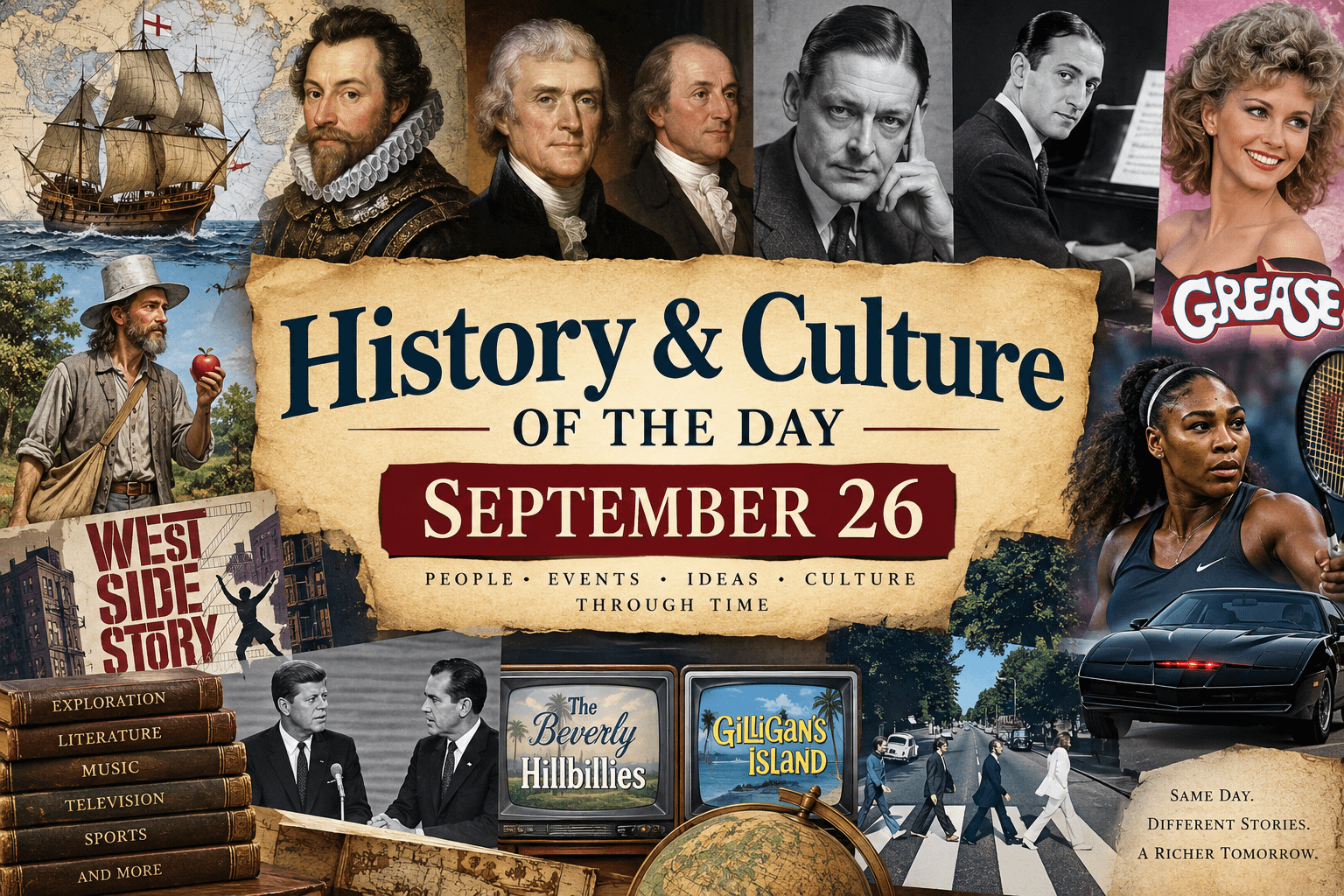
September 26 is a date filled with moments that have influenced politics, entertainment, music, literature, technology, and popular culture. Like every day on the calendar, its history is not defined by one event. Instead, it represents a collection of discoveries, milestones, famous births, cultural shifts, and memories that connect different generations.
From groundbreaking developments in science to television programs that became part of American culture, September 26 offers plenty to explore.
Here is a look at some of the history and culture connected to September 26.
1580 — Francis Drake Completes His Circumnavigation
One of the earliest major historical events associated with September 26 occurred in 1580, when English explorer Francis Drake returned to England after completing a voyage around the world.
Drake’s expedition had begun in 1577.
Although his journey included conflict, privateering, and actions that remain part of a complicated historical legacy, the voyage itself became a major achievement in European maritime history.
Drake became the first Englishman to complete a circumnavigation of the globe.
His expedition also demonstrated how rapidly European nations were expanding their knowledge of global geography, navigation, trade routes, and ocean travel during the 16th century.
The voyage occurred during an era when maritime exploration was dramatically changing international trade and relations between nations.
1774 — Johnny Appleseed Is Born
John Chapman, better known to generations of Americans as Johnny Appleseed, was born on September 26, 1774.
Over time, Chapman became one of America’s most recognizable folk figures.
The popular image of Johnny Appleseed depicts a wandering man traveling across the frontier and casually scattering apple seeds wherever he went.
The real story was somewhat different.
Chapman established apple nurseries in parts of Pennsylvania, Ohio, Indiana, Illinois, and other frontier areas. He planted seeds, cared for nurseries, and sold or transferred trees and land.
His life eventually became intertwined with American folklore.
Stories portrayed him as gentle, generous, deeply connected to nature, and committed to helping settlers.
The legend grew so powerful that Johnny Appleseed eventually became more than a historical person. He became a symbol of American frontier culture.
1789 — Thomas Jefferson Is Appointed Secretary of State
September 26 also played a role in the development of the young United States government.
In 1789, President George Washington appointed Thomas Jefferson as the nation’s first Secretary of State.
The newly created federal government was still determining how its departments would operate and how the United States would conduct relations with other nations.
Jefferson would become one of the most influential figures in early American political history.
His appointment helped establish a position that remains central to American foreign policy and diplomacy today.
1789 — John Jay Becomes the First Chief Justice
The same day also brought another important appointment.
George Washington nominated John Jay to become the first Chief Justice of the United States.
The Supreme Court was a new institution created under the Constitution, and its exact role within the federal government would continue evolving over the following decades.
Jay’s appointment placed him at the beginning of a judicial institution that would eventually become one of the most influential courts in the world.
September 26, 1789, therefore stands out as an important date in the formation of America’s early federal institutions.
1888 — T. S. Eliot Is Born
Poet, playwright, critic, and editor T. S. Eliot was born on September 26, 1888, in St. Louis, Missouri.
Eliot became one of the most influential literary figures of the 20th century.
His works included The Waste Land, The Love Song of J. Alfred Prufrock, Four Quartets, and Murder in the Cathedral.
His writing frequently explored themes involving isolation, spirituality, modern life, identity, memory, and the passage of time.
Eliot’s influence extended far beyond poetry.
His essays and literary criticism helped shape discussions about literature for generations of students, writers, and scholars.
In 1948, he received the Nobel Prize in Literature.
1898 — George Gershwin Is Born
September 26 also marks the birthday of one of America’s great composers.
George Gershwin was born in Brooklyn, New York, on September 26, 1898.
Gershwin became known for combining elements of classical music, jazz, popular music, and Broadway.
His compositions included “Rhapsody in Blue,” “An American in Paris,” and the opera “Porgy and Bess.”
Together with his brother Ira Gershwin, he also created songs that became standards of American popular music.
George Gershwin’s career was relatively short—he died in 1937 at only 38 years old—but his musical influence has lasted for generations.
His work remains an important bridge between American classical traditions and the emerging sounds of jazz and popular entertainment.
1948 — Olivia Newton-John Is Born
Singer and actress Olivia Newton-John was born on September 26, 1948.
Her career would eventually make her one of the most recognizable entertainers of the 1970s and 1980s.
For many people, she will forever be associated with the role of Sandy Olsson in the 1978 movie Grease, opposite John Travolta.
The movie became a cultural phenomenon.
Songs including “You’re the One That I Want,” “Summer Nights,” and “Hopelessly Devoted to You” became closely associated with the film and remain familiar decades later.
Newton-John also enjoyed enormous success as a recording artist.
Her 1981 song “Physical” became one of the defining pop hits of the early 1980s.
Later in life, she became known for advocacy connected to cancer research and wellness following her own experiences with breast cancer.
She died in 2022 at the age of 73.
1957 — West Side Story Opens on Broadway
One of the most influential musicals in American theater history opened on Broadway on September 26, 1957.
West Side Story transformed Shakespeare’s Romeo and Juliet into a story set in 1950s New York City.
The musical featured music by Leonard Bernstein, lyrics by Stephen Sondheim, choreography by Jerome Robbins, and a book by Arthur Laurents.
Songs including “Maria,” “Tonight,” “America,” and “Somewhere” became theater classics.
The musical also addressed serious social themes involving immigration, prejudice, neighborhood conflict, violence, identity, and young love.
A 1961 film adaptation became enormously successful and won 10 Academy Awards, including Best Picture.
Another film adaptation, directed by Steven Spielberg, was released in 2021.
More than half a century after its Broadway debut, West Side Story continues to be performed and studied around the world.
1960 — The First Televised U.S. Presidential Debate
September 26, 1960, became an important date in television and political history when John F. Kennedy and Richard Nixon participated in the first of their nationally televised general-election presidential debates.
Television had already become increasingly important in American homes, but the debate demonstrated just how influential the medium could become in national politics.
Millions of Americans watched.
The event helped establish televised debates as a major feature of modern presidential campaigns.
It also highlighted a broader cultural transformation.
Political communication was no longer shaped only by newspapers, radio broadcasts, speeches, and rallies. Television allowed voters to watch candidates respond to one another in real time.
Future campaigns would increasingly recognize that presentation, imagery, and television performance had become important components of political communication.
1962 — The Beverly Hillbillies Premieres
On September 26, 1962, American television audiences were introduced to the Clampett family when The Beverly Hillbillies premiered on CBS.
The show’s premise was simple.
A poor rural family discovers oil on its land, becomes incredibly wealthy, and moves to Beverly Hills.
The cultural differences between the Clampetts and their wealthy California neighbors created much of the show’s comedy.
Despite receiving mixed reactions from some critics, audiences embraced it.
The Beverly Hillbillies became one of the most popular television programs of the 1960s and remained on the air until 1971.
Its characters—including Jed Clampett, Granny, Elly May, and Jethro—became recognizable pieces of American television culture.
1964 — Gilligan’s Island Premieres
Two years later, September 26 brought another television premiere that would become part of pop-culture history.
Gilligan’s Island debuted on CBS on September 26, 1964.
The premise centered around seven people stranded on an island after what was supposed to be a short boat excursion.
The passengers and crew included Gilligan, the Skipper, a millionaire and his wife, a movie star, a professor, and Mary Ann.
Although the original series lasted only three seasons, something unusual happened afterward.
Reruns gave the show a second life.
Generations who weren’t alive during its original broadcast discovered Gilligan’s Island through syndicated television.
Its theme song became instantly recognizable, its characters became cultural stereotypes, and the show’s premise was repeatedly referenced and parodied in movies, television programs, cartoons, and comedy.
It demonstrates how a television show’s cultural impact isn’t always determined by the length of its original run.
1969 — The Beatles Release Abbey Road in the United Kingdom
September 26, 1969, brought one of the most famous albums in popular music history.
The Beatles released Abbey Road in the United Kingdom.
The album included songs such as “Come Together,” “Something,” “Here Comes the Sun,” and “Octopus’s Garden.”
Its second side became especially famous for a sequence of interconnected songs often referred to as the Abbey Road medley.
The album’s cover became almost as famous as the music.
John Lennon, Ringo Starr, Paul McCartney, and George Harrison were photographed walking across a pedestrian crossing outside Abbey Road Studios in London.
That simple photograph became one of the most recreated album covers ever made.
Fans continue visiting the location decades later.
Abbey Road arrived near the end of The Beatles’ time together and has become one of the defining recordings of their career.
1981 — Serena Williams Is Born
Tennis champion Serena Williams was born on September 26, 1981, in Saginaw, Michigan.
Along with her sister Venus Williams, Serena transformed women’s tennis and became one of the most prominent athletes of her generation.
During her career, Serena won 23 Grand Slam singles titles.
Her combination of power, athleticism, determination, and longevity helped reshape expectations in women’s tennis.
Her cultural influence also extended beyond sports.
Williams became involved in fashion, business, philanthropy, and discussions surrounding opportunities for women and athletes.
Her career introduced countless young people around the world to tennis and helped make the Williams family one of the most famous families in sports.
1982 — Knight Rider Premieres
September 26, 1982, introduced television audiences to a talking car that would become an unmistakable symbol of 1980s pop culture.
Knight Rider starred David Hasselhoff as Michael Knight.
But the show’s other star wasn’t human.
It was KITT—the Knight Industries Two Thousand—a technologically advanced Pontiac Trans Am equipped with artificial intelligence.
KITT could communicate with Michael, analyze situations, and perform extraordinary driving maneuvers.
At a time when home computers and emerging technologies were capturing the public imagination, the idea of an intelligent car felt futuristic.
Decades later, technologies such as voice assistants, navigation systems, driver-assistance features, and increasingly sophisticated automotive computers make parts of the show’s fictional technology seem surprisingly familiar.
September 26 and the Evolution of Entertainment
Looking across the history of September 26 reveals an interesting concentration of entertainment milestones.
George Gershwin helped define American music.
West Side Story changed musical theater.
The Beverly Hillbillies and Gilligan’s Island became television classics.
The Beatles released one of rock music’s most celebrated albums.
Knight Rider brought futuristic technology into living rooms.
Olivia Newton-John became part of multiple generations’ musical memories.
These events represent different eras, but together they illustrate how culture continuously evolves.
Broadway gave way to television as a dominant form of entertainment. Television existed alongside rock and pop music. Eventually, cable television, home video, computers, streaming services, smartphones, and social media would transform entertainment again.
Yet many of the cultural works created decades ago remain recognizable.
People still perform West Side Story.
People still listen to Abbey Road.
People still recognize the Gilligan’s Island theme song.
People still watch Grease.
Great entertainment has a way of surviving the technology that originally delivered it.
The Power of Popular Culture
History isn’t limited to wars, elections, laws, and political leaders.
Popular culture tells us something about the people living through a particular era.
The television shows people watched, songs they played, books they read, athletes they followed, and movies they loved become pieces of shared memory.
Sometimes a song instantly transports someone back decades.
A television theme can remind someone of sitting in a childhood living room.
An old movie can remind someone of a parent or grandparent.
A sporting event can remind an entire generation where they were when it happened.
That is why cultural history deserves to be remembered alongside traditional historical events.
Culture helps tell the human side of history.
A Day Connecting Different Generations
Perhaps the most interesting thing about September 26 is how many generations can find something familiar within its history.
Someone interested in early exploration might remember Francis Drake.
Those interested in American folklore can explore the real story behind Johnny Appleseed.
Literature lovers can celebrate T. S. Eliot.
Music lovers can remember George Gershwin or The Beatles.
Classic television fans have The Beverly Hillbillies and Gilligan’s Island.
Fans of 1980s television remember Knight Rider.
Sports fans can celebrate Serena Williams.
Movie fans may immediately think about Olivia Newton-John and Grease.
Each represents a different chapter of cultural history.
Final Thoughts
September 26 reminds us that history is happening constantly.
Some events immediately appear significant. Others only reveal their importance years later.
When Gilligan’s Island premiered, no one could have known that people would still recognize its characters generations later.
When The Beatles photographed themselves crossing Abbey Road, few could have predicted that fans would recreate the photograph more than half a century later.
When Serena Williams was born in 1981, no one knew that she would grow up to become one of the most celebrated tennis players in history.
That uncertainty is part of what makes exploring history so fascinating.
The ordinary day we are living through right now could eventually contain a moment future generations remember.
September 26 has given history explorers plenty to rediscover—from exploration and American folklore to literature, Broadway, television, music, sports, and changing technology.
Which September 26 moment brings back the strongest memory for you—or which piece of history did you just discover for the first time?
Leave a ReplyCancel reply