Category: History & Culture

  • This Day in American History – July 18

    This Day in American History – July 18

    Advertisements

    History is made one day at a time. July 18 has witnessed groundbreaking achievements in space exploration, scientific discovery, military history, and civil rights. From humanity taking one of its greatest steps toward the Moon to technological breakthroughs that transformed modern life, this date reminds us that innovation, courage, and determination have always shaped the American story.

    Here are some of the most notable events that occurred on July 18.


    1863 – The Battle of Fort Wagner Continues

    During the American Civil War, Union forces launched one of the most famous assaults against Fort Wagner near Charleston, South Carolina. The attack was led in part by the 54th Massachusetts Infantry Regiment, one of the first official African American regiments in the Union Army.

    Although the assault ended in heavy casualties, the extraordinary bravery displayed by the soldiers helped change public opinion about African American troops serving in the military. Their courage inspired thousands of others to enlist and strengthened the Union cause.

    Why It Matters

    The heroism of the 54th Massachusetts demonstrated that African American soldiers were willing and able to fight for freedom and equality, influencing both military policy and the broader fight against slavery.


    1925 – Adolf Hitler Publishes Mein Kampf (Historical Context)

    On July 18, 1925, the first volume of Adolf Hitler’s Mein Kampf was published in Germany.

    While this event occurred overseas, it would eventually have enormous consequences for the United States and the world. The extremist ideology promoted in the book foreshadowed World War II and the Holocaust, events that would draw America into one of the largest conflicts in human history.

    Why It Matters

    Remembering this publication serves as a reminder of the dangers of hatred, propaganda, and authoritarianism and reinforces the importance of protecting democracy and human rights.


    1947 – The National Security Act Is Signed

    President Harry S. Truman signed the National Security Act of 1947, one of the most significant reorganizations of the U.S. government after World War II.

    The legislation created:

    • The Department of Defense
    • The United States Air Force as its own military branch
    • The National Security Council (NSC)
    • The Central Intelligence Agency (CIA)

    Why It Matters

    These institutions continue to play central roles in America’s defense, intelligence gathering, and national security planning today.


    1968 – Intel Is Incorporated

    On July 18, 1968, Intel Corporation was officially incorporated by Robert Noyce and Gordon Moore.

    Initially focused on semiconductor memory, Intel soon revolutionized computing by developing the microprocessor, laying the foundation for personal computers, smartphones, and countless modern technologies.

    Why It Matters

    Nearly every modern electronic device traces part of its technological heritage back to Intel’s innovations, making this one of the most important business milestones in American history.


    1969 – Apollo 11 Nears the Moon

    Three days after launch, Apollo 11 continued its historic journey toward the Moon on July 18, 1969.

    Astronauts Neil Armstrong, Buzz Aldrin, and Michael Collins conducted system checks and prepared the Lunar Module for the landing that would occur just two days later.

    Millions of Americans followed the mission on television as excitement built across the country.

    Why It Matters

    Apollo 11 represented the culmination of years of scientific research, engineering excellence, and national determination during the Space Race.


    1976 – Nadia Comăneci Earns Another Perfect Olympic Score

    During the Montreal Olympics, Romanian gymnast Nadia Comăneci continued making history by earning additional perfect 10 scores.

    Although not an American athlete, her performances captivated audiences across the United States and inspired generations of young gymnasts.

    Why It Matters

    Her excellence helped elevate women’s gymnastics into one of America’s most popular Olympic sports.


    1984 – Beverly Burns Makes Aviation History

    Captain Beverly Burns became the first woman to command a Boeing 747 across the Atlantic Ocean.

    Her achievement marked another important milestone for women in aviation and demonstrated the growing opportunities for female pilots in commercial airlines.

    Why It Matters

    Her success encouraged more women to pursue careers in aviation and other traditionally male-dominated professions.


    1995 – The Walt Disney Company Announces Purchase of Capital Cities/ABC

    One of the largest entertainment mergers in history was announced on July 18, 1995, when The Walt Disney Company agreed to purchase Capital Cities/ABC.

    The acquisition expanded Disney into television broadcasting and news, helping create one of the world’s largest media companies.

    Why It Matters

    The merger reshaped the American entertainment industry and influenced how millions of people receive news, sports, and family entertainment.


    Famous Americans Born on July 18

    Several notable Americans celebrate birthdays on July 18, including:

    • Richard Branson (1950) – Entrepreneur and founder of the Virgin Group (British, but influential in American business)
    • Kristen Bell (1980) – Actress known for Frozen, Veronica Mars, and The Good Place.
    • Vin Diesel (1967) – Actor and producer best known for the Fast & Furious franchise.
    • Nelson Mandela Day is also observed internationally on July 18, honoring the legacy of the South African leader and humanitarian.

    July 18 Trivia

    • Apollo 11 was only two days away from its historic Moon landing.
    • Intel’s incorporation helped launch the computer revolution.
    • The National Security Act permanently reshaped America’s military and intelligence agencies.
    • The bravery of the 54th Massachusetts remains one of the Civil War’s most inspiring stories.
    • Major media consolidation changed the future of entertainment when Disney acquired ABC.

    Reflection

    July 18 reminds us that history is driven by vision, perseverance, and the courage to push beyond what once seemed impossible. Whether it was soldiers fighting for freedom during the Civil War, engineers preparing humanity’s first Moon landing, innovators launching companies that transformed technology, or leaders reshaping national security, each event left a lasting mark on America.

    Every July 18 offers an opportunity to remember those achievements, learn from the past, and appreciate how today’s decisions may become tomorrow’s history.

    Read More History & Culture

  • This Day in American History – July 17

    Advertisements

    July 17 has witnessed defining moments in American history that shaped politics, transportation, civil rights, science, and even the nation’s exploration of space. From tragedies that changed safety standards to remarkable achievements that inspired generations, this date reminds us that history is built from both triumph and hardship.

    Here’s a look back at some of the most significant events that happened on July 17.


    1862 – The Second Confiscation Act Is Signed

    During the American Civil War, President Abraham Lincoln signed the Second Confiscation Act, allowing Union forces to seize property belonging to Confederate supporters. More importantly, the law declared that enslaved people owned by Confederate supporters who reached Union lines would be forever free.

    Although it stopped short of ending slavery nationwide, the legislation became an important step toward the Emancipation Proclamation, issued later that year.

    Why It Matters

    The act weakened the Confederacy while laying important legal groundwork for the eventual abolition of slavery throughout the United States.


    1935 – The First Parking Meter Is Installed

    The world’s first parking meter, known as the Park-O-Meter No. 1, was installed in Oklahoma City, Oklahoma.

    At first, many drivers disliked paying to park on public streets, but city planners believed parking meters would improve traffic flow and create more available parking spaces for businesses.

    Today, paid parking is common in cities across America and around the world.


    1945 – Potsdam Conference Begins

    President Harry S. Truman, British Prime Minister Winston Churchill, and Soviet leader Joseph Stalin met in Germany for the Potsdam Conference, one of the final meetings of Allied leaders during World War II.

    The conference focused on:

    • Rebuilding Europe
    • The occupation of Germany
    • The future of Japan
    • Establishing post-war borders

    The discussions also marked the beginning of growing tensions between the United States and the Soviet Union that would later become the Cold War.


    1955 – Disneyland Opens to the Public

    One of America’s most beloved destinations officially opened its gates in Anaheim, California.

    Created by Walt Disney, Disneyland revolutionized the amusement park industry by combining storytelling, themed lands, and immersive attractions unlike anything visitors had experienced before.

    Opening Day was broadcast nationally on television and became one of the largest live television events of its time.

    Lasting Legacy

    Today Disneyland welcomes millions of visitors every year and helped inspire Disney theme parks around the globe.


    1975 – Apollo-Soyuz Mission Makes History

    The United States and the Soviet Union achieved a remarkable milestone when astronauts aboard Apollo docked with Soviet cosmonauts aboard Soyuz in Earth orbit.

    The famous handshake in space symbolized improving relations between the Cold War rivals.

    The mission also demonstrated international cooperation in space exploration and paved the way for future partnerships, including today’s International Space Station.


    1981 – The Hyatt Regency Walkway Collapse

    One of the deadliest structural engineering disasters in American history occurred at the Hyatt Regency Hotel in Kansas City, Missouri.

    Two suspended walkways collapsed during a crowded dance event.

    The Tragedy

    • 114 people lost their lives.
    • More than 200 were injured.

    Investigations revealed significant design and construction failures.

    Lasting Impact

    The disaster transformed engineering oversight and building inspection practices across the United States, leading to stricter standards for structural design and professional accountability.


    1996 – TWA Flight 800 Crash

    Trans World Airlines Flight 800 exploded shortly after taking off from New York’s John F. Kennedy International Airport on its way to Paris.

    All 230 people aboard lost their lives.

    After one of the most extensive aviation investigations ever conducted, investigators concluded that the likely cause was an explosion of fuel vapors inside the aircraft’s center fuel tank.

    Lasting Impact

    The tragedy led to major improvements in:

    • Aircraft fuel tank safety
    • Electrical wiring inspections
    • Airline maintenance standards
    • Aviation accident investigation procedures

    Other Notable July 17 Events

    1821 – Spain Cedes Florida

    Spain officially transferred Florida to the United States under the Adams–Onís Treaty, expanding American territory and strengthening the nation’s southeastern border.

    1944 – Port Chicago Explosion

    A massive ammunition explosion at the Port Chicago Naval Magazine in California killed 320 people, most of them African American sailors working under segregated conditions.

    The disaster highlighted racial inequality within the U.S. Navy and became an important milestone in the movement toward military desegregation.

    1976 – Opening of the Montreal Olympics

    American athletes competed in the Summer Olympic Games held in Montreal, where the United States earned numerous medals and showcased many future sports legends.


    Famous Birthdays – July 17

    Several notable Americans were born on this day:

    • John Jacob Astor (1763) – Businessman and America’s first multimillionaire
    • James Cagney (1899) – Academy Award-winning actor
    • Donald Sutherland (1935) – Acclaimed actor known for decades of memorable performances
    • David Hasselhoff (1952) – Actor and singer

    Quote for Today

    “History is not just about the victories we celebrate, but also the lessons we refuse to forget.”


    Why July 17 Still Matters

    July 17 reflects the remarkable range of American history. It is a day marked by innovation, courage, cooperation, tragedy, and progress. From the opening of Disneyland and historic achievements in space to aviation safety reforms and advances in civil rights, the events of this day continue to influence everyday life in America.

    Studying these moments reminds us that history is more than dates on a calendar—it is a story of people whose decisions, sacrifices, and dreams continue to shape our nation today.

    Whether remembering lives lost, celebrating milestones, or learning from past challenges, July 17 serves as another chapter in the ongoing story of the United States.

    Read More History & Culture

  • This Day in American History – July 16

    Advertisements

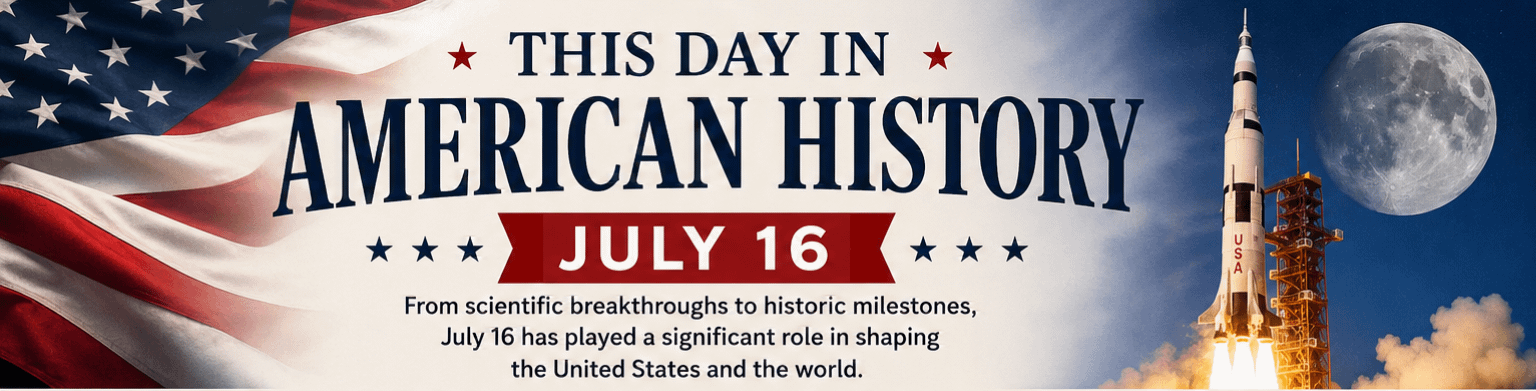
    July 16 has been a day marked by scientific breakthroughs, political milestones, exploration, and defining moments that changed the course of American history. From the dawn of the atomic age to humanity’s journey to the Moon, this date reminds us of the innovation, courage, and determination that have shaped the United States.

    Let’s look back at some of the most significant events that occurred on July 16.


    1. The First Atomic Bomb Test – 1945

    The most significant event associated with July 16 is undoubtedly the Trinity Test, the world’s first successful detonation of a nuclear weapon.

    At 5:29 a.m. near Alamogordo, New Mexico, scientists working on the Manhattan Project witnessed history as the first atomic bomb exploded.

    Led by physicist J. Robert Oppenheimer, thousands of scientists and military personnel had spent years secretly developing the weapon during World War II.

    The explosion produced a blinding flash visible for hundreds of miles and forever changed military history.

    The success of the Trinity Test paved the way for the atomic bombings of Hiroshima and Nagasaki just weeks later, ultimately contributing to the end of World War II while ushering in the beginning of the nuclear age.


    2. Apollo 11 Launches to the Moon – 1969

    On July 16, 1969, millions of Americans watched as the massive Saturn V rocket lifted off from Kennedy Space Center in Florida.

    Aboard were three astronauts:

    • Neil Armstrong
    • Buzz Aldrin
    • Michael Collins

    The mission was Apollo 11, America’s historic first attempt to land humans on the Moon.

    Four days later, Armstrong would step onto the lunar surface and speak the famous words:

    “That’s one small step for man, one giant leap for mankind.”

    The successful mission fulfilled President John F. Kennedy’s ambitious goal of landing a man on the Moon before the end of the 1960s and remains one of humanity’s greatest achievements.


    3. The District of Columbia Gains Home Rule – 1973

    On July 16, 1973, the District of Columbia Self-Government and Governmental Reorganization Act, commonly known as the Home Rule Act, was signed into law.

    The legislation allowed residents of Washington, D.C. to elect their own mayor and city council instead of having Congress directly manage local affairs.

    Although Congress still maintains oversight over the District, the Home Rule Act represented an important expansion of local self-government for the nation’s capital.


    4. Babe Ruth’s Final Major League Appearance as a Player – 1935

    Baseball legend Babe Ruth made one of the final appearances of his remarkable playing career during July 1935.

    Although injuries and age had slowed him, Ruth remained one of America’s most beloved sports figures.

    His incredible career included:

    • 714 home runs
    • Seven World Series championships
    • A transformation of baseball into America’s favorite pastime

    Even decades later, Ruth remains one of the most recognizable names in sports history.


    5. The Manhattan Project Changes History

    Although the Trinity Test is the event most remembered on July 16, it also symbolizes the enormous scientific effort known as the Manhattan Project.

    More than 130,000 people worked in secrecy across the United States.

    Facilities stretched across:

    • Los Alamos, New Mexico
    • Oak Ridge, Tennessee
    • Hanford, Washington

    The project represented one of the largest scientific collaborations ever undertaken and forever changed global politics, military strategy, and international diplomacy.


    6. America Continues Exploring Space

    July 16 has become closely associated with American space exploration.

    Following Apollo 11, several later NASA missions also launched during mid-July, continuing America’s commitment to scientific discovery and human exploration beyond Earth.

    The achievements of NASA inspired generations of scientists, engineers, astronauts, and students around the world.


    Famous Americans Born on July 16

    Several notable Americans celebrate birthdays on July 16, including:

    • Will Ferrell (1967) – Actor and comedian
    • Phoebe Cates (1963) – Actress
    • Corey Feldman (1971) – Actor and musician

    Their contributions to film and entertainment have made them familiar faces in American popular culture.


    Why July 16 Matters

    Few dates combine scientific achievement, exploration, and historical significance quite like July 16.

    It represents:

    • Scientific innovation
    • Courage under uncertainty
    • American leadership in space exploration
    • Technological advancement
    • The pursuit of ambitious goals

    From unlocking the power of the atom to reaching for the Moon, July 16 showcases both the incredible possibilities and profound responsibilities that accompany human progress.


    Looking Back While Looking Forward

    History is filled with moments that redefine what is possible. July 16 reminds us that determination, innovation, and teamwork can accomplish extraordinary feats.

    Whether reflecting on the Trinity Test’s sobering legacy or celebrating Apollo 11’s inspiring journey to the Moon, this day encourages us to learn from the past while continuing to pursue discoveries that improve the future.

    As we remember July 16, we honor the scientists, explorers, leaders, and everyday Americans whose work helped shape the nation and left a lasting impact on the world.

  • This Day in American History – July 15

    Advertisements

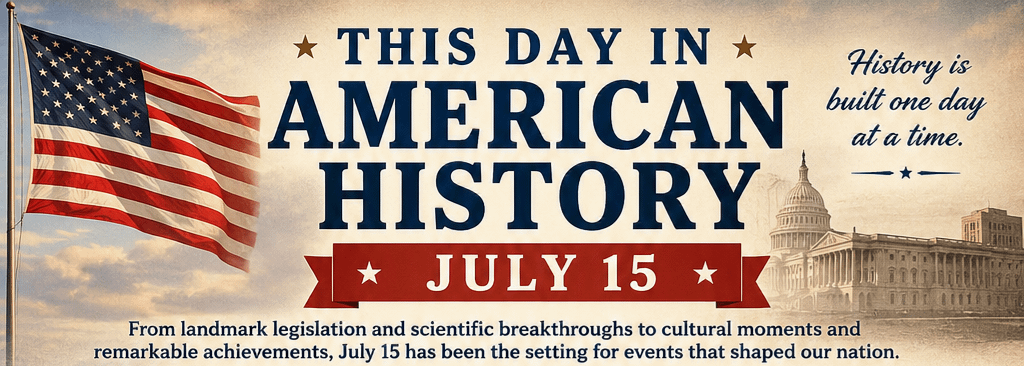
    July 15 has been the setting for defining moments in American history, from military triumphs and scientific discoveries to social change and remarkable achievements. Looking back at the events of this day reminds us that history is built one day at a time, with each generation leaving its mark on the nation.

    Here are some of the most significant events that occurred on July 15 throughout American history.


    1838 – Ralph Waldo Emerson Delivers the “Divinity School Address”

    On July 15, 1838, Ralph Waldo Emerson delivered his famous Divinity School Address at Harvard University.

    The speech challenged traditional religious thinking and encouraged people to seek a personal relationship with God rather than relying solely on established institutions. Although controversial at the time, Emerson’s ideas helped shape the American Transcendentalist movement and influenced generations of writers, philosophers, and civil rights leaders.

    His message continues to inspire those who value independent thought and personal freedom.


    1862 – President Lincoln Signs the Pacific Railroad Act

    During the Civil War, President Abraham Lincoln signed the Pacific Railroad Act on July 15, 1862.

    The legislation authorized construction of the nation’s first transcontinental railroad, connecting the eastern United States with the Pacific Coast. The project transformed commerce, travel, communication, and westward expansion.

    When completed in 1869, Americans could travel across the continent in days instead of months.

    The railroad became one of the greatest engineering achievements in American history.


    1916 – Boeing Is Founded

    On July 15, 1916, William Boeing founded what would become The Boeing Company in Seattle, Washington.

    Originally called Pacific Aero Products Co., the company soon became one of the world’s leading aerospace manufacturers.

    Over the next century Boeing would help shape aviation by producing military aircraft, commercial airliners, spacecraft, satellites, and technologies that expanded both national defense and civilian air travel.


    1948 – The First Flight Around the World by a Single Military Aircraft Is Completed

    On July 15, 1948, the U.S. Air Force completed Operation Around the World, demonstrating America’s growing aviation capabilities following World War II.

    The successful mission highlighted advances in aircraft technology, navigation, and aerial refueling that would become increasingly important during the Cold War.


    1965 – Mariner 4 Sends Back the First Close-Up Images of Mars

    On July 15, 1965, NASA’s Mariner 4 spacecraft transmitted humanity’s first close-up photographs of Mars.

    The flyby revealed a cratered landscape unlike the lush world many scientists had imagined.

    These groundbreaking images marked the beginning of detailed exploration of the Red Planet and laid the foundation for decades of American space exploration, eventually leading to today’s Mars rovers and future human exploration plans.


    1975 – Apollo-Soyuz Test Project Launches

    On July 15, 1975, NASA launched Apollo on a historic mission that would dock with a Soviet Soyuz spacecraft two days later.

    Known as the Apollo-Soyuz Test Project, it marked the first international human spaceflight mission and symbolized improving relations between the United States and the Soviet Union during the Cold War.

    The famous handshake in space demonstrated that even rival nations could work together in scientific exploration.

    The mission paved the way for future international cooperation aboard the International Space Station.


    1978 – The World Watches “Animal House”

    On July 15, 1978, National Lampoon’s Animal House became one of the year’s biggest box-office successes.

    The comedy transformed American filmmaking and college comedy for decades to come, launching careers and influencing countless movies that followed.

    Its cultural impact remains visible in comedy films today.


    1997 – Gianni Versace Is Murdered in Miami Beach

    On July 15, 1997, internationally renowned fashion designer Gianni Versace was murdered outside his Miami Beach home.

    Although an international event, the tragedy captivated the United States and sparked one of the nation’s largest manhunts, eventually leading to the death of suspect Andrew Cunanan.

    The case remains one of the most discussed criminal investigations of the late 20th century.


    Americans Born on July 15

    Several notable Americans celebrate birthdays on July 15, including:

    • Linda Ronstadt (1946) – Award-winning singer whose music spans rock, country, folk, and Latin genres.
    • Forest Whitaker (1961) – Academy Award-winning actor and filmmaker.
    • Diane Kruger (1976) – Actress known for numerous Hollywood films.

    Why July 15 Matters

    July 15 showcases the spirit of innovation, exploration, and determination that has helped shape America.

    From building railroads that united the country to pioneering aviation, reaching toward Mars, and fostering international cooperation in space, this day highlights how bold ideas can change history.

    It also reminds us that history is made not only through great achievements but through individuals willing to challenge convention, pursue discovery, and inspire future generations.

    Every date on the calendar holds stories worth remembering, and July 15 is filled with moments that continue to influence the United States today.


    Final Thoughts

    History connects us to the people and events that built the nation we know today. Whether through groundbreaking technology, courageous leadership, artistic influence, or scientific discovery, July 15 reminds us that progress is driven by vision, perseverance, and the willingness to explore new frontiers.

    As we reflect on this day in American history, we celebrate those whose achievements continue to shape our future while honoring the lessons left behind for generations to come.

    Read More History & Culture

  • This Day in American History – July 14

    Advertisements

    Moments That Helped Shape the United States

    Every day in American history tells a story of courage, innovation, sacrifice, and progress. July 14 is no exception. While the date is often associated with Bastille Day in France, it also marks several important moments that influenced the history of the United States—from the expansion of the nation to military victories, technological breakthroughs, and unforgettable achievements in sports and science.

    Let’s take a look at some of the most notable events that happened on July 14.


    1798 – The Sedition Act Becomes Law

    One of the most controversial laws in early American history, the Sedition Act of 1798, was signed into law by President John Adams. It made it illegal to publish “false, scandalous, and malicious” statements against the federal government.

    The law was passed during a period of growing tensions with France, but many believed it violated the First Amendment’s protection of free speech and freedom of the press.

    Although the act expired in 1801, it remains an important reminder of the ongoing balance between national security and constitutional rights.

    Why It Matters

    • Sparked debates over free speech.
    • Influenced future interpretations of the First Amendment.
    • Helped shape American civil liberties.

    1865 – The Matterhorn Is First Climbed by an American Expedition Member

    On July 14, 1865, the famous Matterhorn in the Swiss Alps was successfully climbed for the first time.

    Among the climbers was American artist Francis Douglas, making the expedition significant in the history of American mountaineering.

    Although tragedy struck during the descent when several climbers fell to their deaths, the successful ascent became one of the greatest achievements in exploration during the nineteenth century.


    1881 – Billy the Kid Is Killed

    Legendary outlaw Billy the Kid was shot and killed by Sheriff Pat Garrett on July 14, 1881, in Fort Sumner, New Mexico Territory.

    Although much of Billy the Kid’s life has become myth and folklore, his story became one of the defining legends of the American Old West.

    His life inspired countless books, movies, television shows, and songs that continue to shape America’s fascination with frontier history.


    1933 – The First All-Star Game Inspires a Tradition

    Major League Baseball’s first All-Star Game had taken place just days earlier, and by July 14, excitement across America was still growing around what would become one of baseball’s greatest annual traditions.

    The event united the biggest stars from both leagues and became a showcase of America’s favorite pastime for generations.

    Today, the MLB All-Star Game remains one of the most celebrated events in professional sports.


    1942 – American Forces Continue the Fight During World War II

    Throughout July 1942, American troops were actively preparing for and participating in major operations across Europe and the Pacific during World War II.

    On July 14, military planning intensified as the United States continued building the forces that would eventually help secure Allied victory.

    American factories were operating around the clock, producing ships, aircraft, tanks, and supplies at unprecedented levels.

    This remarkable industrial effort earned the United States the nickname:

    “The Arsenal of Democracy.”


    1958 – NASA Continues Taking Shape

    During the summer of 1958, Congress continued advancing legislation that would soon create the National Aeronautics and Space Administration (NASA).

    July 14 marked another important period in America’s growing commitment to space exploration as lawmakers finalized details that would officially establish NASA later that month.

    This effort would eventually lead to:

    • Project Mercury
    • Gemini missions
    • Apollo moon landings
    • The Space Shuttle program
    • The International Space Station
    • Artemis missions

    America’s leadership in space exploration began taking shape during this remarkable summer.


    1965 – Mariner 4 Sends Historic Images from Mars

    One of the greatest achievements in American space exploration occurred on July 14, 1965, when NASA’s Mariner 4 spacecraft transmitted the first close-up photographs ever taken of Mars.

    The images stunned scientists around the world.

    Instead of canals or signs of civilization that many had imagined, Mariner 4 revealed a cold, cratered world unlike anything previously seen.

    The mission forever changed humanity’s understanding of the Red Planet and opened the door to future Mars exploration.


    1976 – Jimmy Carter Builds Momentum

    Following his victory in the Democratic primaries, Jimmy Carter continued building momentum toward winning the presidency during the summer of 1976.

    By mid-July, Carter had firmly established himself as the Democratic Party’s nominee heading into the general election.

    His election later that year reflected Americans’ desire for honesty and renewed trust in government following the Watergate scandal.


    2003 – The Nation Remembers the Northeast Blackout Preparations

    In the weeks leading up to the massive 2003 Northeast Blackout, government agencies were working to improve electrical reliability across the country.

    Although the blackout itself would occur one month later, July serves as a reminder of the importance of maintaining America’s electrical infrastructure and preparing for emergencies.

    The event ultimately affected more than 50 million people across the United States and Canada.


    Famous Americans Born on July 14

    Several notable Americans celebrate birthdays on July 14, including:

    • Gerald Ford (1913) – 38th President of the United States
    • Jane Lynch (1960) – Emmy Award-winning actress and comedian
    • Matthew Fox (1966) – Actor known for Lost
    • Dan Reynolds (1987) – Lead singer of Imagine Dragons

    July 14 in Military History

    America’s military legacy is also reflected on this date through:

    • Continued World War II operations.
    • Cold War defense planning.
    • Advancements in aviation and aerospace.
    • Ongoing support for military innovation and national defense.

    These efforts helped secure America’s place as a global leader throughout the twentieth century.


    Why July 14 Matters

    History is built one day at a time. July 14 reminds us that America’s story is shaped not only by wars and elections but also by scientific discoveries, technological breakthroughs, acts of courage, and the individuals whose achievements continue to inspire future generations.

    From defending constitutional freedoms and exploring distant planets to celebrating sports traditions and honoring remarkable leaders, July 14 reflects the determination, resilience, and innovation that define the American spirit.

    As we look back on this day, we gain a deeper appreciation for the events and people who helped shape the nation we know today.

  • This Day in American History – July 13

    Advertisements

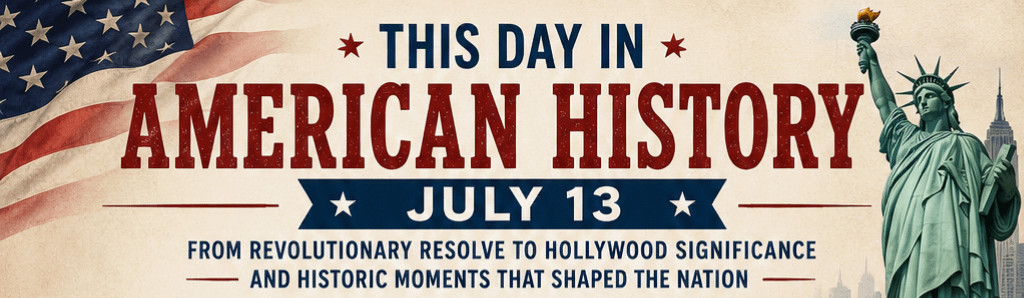
    From Revolutionary Resolve to Hollywood Significance and Historic Moments That Shaped the Nation

    Every day in American history carries stories of courage, innovation, conflict, and progress. July 13 is no exception. From the earliest days of the American Revolution to major milestones in transportation, entertainment, and sports, this date has witnessed events that helped define the United States.

    Let’s look back at some of the most significant moments that occurred on July 13.


    1787 – The Northwest Ordinance Is Enacted

    One of the most important laws in early American history was passed on July 13, 1787, when the Confederation Congress approved the Northwest Ordinance.

    The ordinance established how the Northwest Territory—which included present-day Ohio, Indiana, Illinois, Michigan, Wisconsin, and part of Minnesota—would be governed and eventually admitted to the Union.

    Its lasting impact included:

    • Creating a process for territories to become states.
    • Guaranteeing civil liberties such as freedom of religion and trial by jury.
    • Prohibiting slavery in the Northwest Territory.
    • Encouraging public education through land grants.

    The Northwest Ordinance became one of the foundational documents that guided America’s westward expansion while setting important precedents for future statehood.


    1863 – New York City Draft Riots Continue

    During the Civil War, the New York City Draft Riots reached their most violent point on July 13, 1863.

    The riots erupted after the federal government instituted military conscription. Many working-class citizens believed the draft unfairly favored wealthier Americans who could pay to avoid military service.

    Unfortunately, the protests quickly turned into widespread violence and racial attacks, particularly against African Americans.

    The riots lasted several days and remain among the deadliest episodes of civil unrest in American history, highlighting the deep social divisions that existed during the Civil War.


    1923 – The Hollywood Sign Is Dedicated

    One of America’s most recognizable landmarks made its debut on July 13, 1923.

    Originally reading “HOLLYWOODLAND,” the famous sign was erected as a temporary advertisement for a real estate development overlooking Los Angeles.

    The original plan was for the sign to remain for only about eighteen months. Instead, it became one of the world’s most iconic symbols of:

    • The American film industry
    • Entertainment
    • Dreams of success
    • Popular culture

    In 1949, the last four letters were removed, creating the famous HOLLYWOOD sign recognized around the globe today.


    1930 – The First FIFA World Cup Begins

    Although hosted in Uruguay, July 13, 1930, marked the beginning of the first FIFA World Cup, introducing what would become the world’s most popular sporting event.

    While soccer was not yet a major American sport, the tournament would eventually help grow interest in the game across the United States, culminating decades later with the successful hosting of the 1994 FIFA World Cup and the continued expansion of professional soccer in America.


    1960 – John F. Kennedy Receives the Democratic Nomination

    On July 13, 1960, Senator John F. Kennedy secured the Democratic nomination for President at the Democratic National Convention in Los Angeles.

    At only 43 years old, Kennedy represented a new generation of American leadership.

    His campaign inspired millions with themes of:

    • Public service
    • National strength
    • Scientific advancement
    • International leadership

    Kennedy would go on to win the presidency later that year and become one of America’s most remembered presidents.


    1977 – The New York City Blackout

    On July 13, 1977, lightning strikes caused a massive electrical failure that plunged New York City into darkness.

    The blackout lasted more than 24 hours and affected millions of residents.

    While many communities worked together during the outage, parts of the city experienced widespread looting, fires, and unrest.

    The event prompted significant improvements in:

    • Emergency preparedness
    • Utility infrastructure
    • Disaster response planning
    • Power grid reliability

    The blackout remains one of the most studied infrastructure failures in American history.


    1985 – Live Aid Unites America and the World

    On July 13, 1985, millions of Americans tuned in to watch Live Aid, one of the largest benefit concerts ever organized.

    Broadcast worldwide, the concert featured legendary performers including:

    • Queen
    • U2
    • David Bowie
    • Elton John
    • Madonna
    • Phil Collins
    • Led Zeppelin

    The event raised millions of dollars for famine relief in Ethiopia while demonstrating the power of music to unite people across national borders.

    American audiences played a major role in making the broadcast one of television’s largest global events.


    2016 – Tim Duncan Announces His Retirement

    Basketball legend Tim Duncan announced his retirement from the NBA on July 13, 2016.

    After spending his entire 19-year career with the San Antonio Spurs, Duncan retired as:

    • Five-time NBA Champion
    • Two-time NBA MVP
    • Fifteen-time NBA All-Star
    • Widely regarded as one of the greatest power forwards in basketball history

    His leadership, consistency, and humility made him one of the most respected athletes in American sports.


    Why July 13 Matters

    July 13 reflects many of the themes woven throughout American history:

    • Building a nation through visionary legislation.
    • Facing difficult challenges during times of war.
    • Celebrating innovation, entertainment, and culture.
    • Advancing sports and international influence.
    • Learning from moments of crisis and resilience.

    From the Northwest Ordinance helping shape America’s expansion to the Hollywood Sign becoming an international icon, the events of July 13 demonstrate how individual moments can leave lasting marks on history.

    History reminds us that every generation contributes another chapter to the American story. The decisions made yesterday continue to influence the freedoms, opportunities, and culture we experience today.

    Read More History & Culture

  • This Day in American History – July 12

    Advertisements

    Every day in American history tells a story of courage, innovation, sacrifice, and transformation. July 12 has witnessed defining moments that influenced the nation’s military, legal system, politics, entertainment, and scientific achievements. From the birth of one of America’s greatest military leaders to milestones in civil rights and space exploration, July 12 serves as a reminder that history is built one day at a time.

    Let’s take a journey through the most significant events that occurred on this day.


    1804 – Alexander Hamilton Dies After His Duel with Aaron Burr

    One of the most dramatic moments in early American history reached its conclusion on July 12, 1804, when Alexander Hamilton died from wounds sustained during his famous duel with Aaron Burr.

    The duel took place the previous morning in Weehawken, New Jersey. Hamilton, America’s first Secretary of the Treasury and one of the nation’s Founding Fathers, had long been a political rival of Burr.

    Hamilton’s death shocked the young nation and forever changed American politics. Burr’s reputation never recovered, while Hamilton’s legacy continued to grow through his contributions to the U.S. financial system, including:

    • Establishing the national bank
    • Creating a stable national credit system
    • Developing the U.S. Mint
    • Laying the groundwork for modern American finance

    More than two centuries later, Hamilton’s life gained renewed attention through the award-winning Broadway musical bearing his name.


    1817 – Henry David Thoreau Is Born

    On July 12, 1817, American philosopher, writer, and naturalist Henry David Thoreau was born in Concord, Massachusetts.

    Thoreau became one of America’s most influential thinkers through works such as:

    • Walden
    • Civil Disobedience

    His writings promoted:

    • Simplicity
    • Individual freedom
    • Respect for nature
    • Peaceful resistance against unjust laws

    His philosophy later inspired leaders including Mahatma Gandhi and Martin Luther King Jr..


    1862 – The Medal of Honor Is Authorized

    During the Civil War, Congress authorized what would become America’s highest military decoration.

    On July 12, 1862, legislation expanded the Medal of Honor to include Army personnel after initially being established for the Navy.

    Today, the Medal of Honor recognizes extraordinary acts of valor above and beyond the call of duty.

    Recipients have represented every major American conflict, from the Civil War through modern military operations.


    1865 – George Washington Carver Is Born (Traditionally Observed)

    Although historians continue to debate the exact date of his birth, July 12 is widely observed as the birthday of George Washington Carver.

    Born into slavery, Carver overcame enormous obstacles to become one of America’s greatest agricultural scientists.

    His work revolutionized Southern farming by promoting crop rotation and developing hundreds of practical uses for crops such as:

    • Peanuts
    • Sweet potatoes
    • Soybeans
    • Pecans

    Carver’s research improved the lives of countless American farmers while helping restore depleted farmland.


    1917 – The Bisbee Deportation

    One of the darkest chapters in American labor history occurred on July 12, 1917.

    More than 1,000 striking copper miners in Bisbee, Arizona, were rounded up by armed deputies, loaded onto cattle cars, and abandoned in the New Mexico desert.

    Known as the Bisbee Deportation, the event highlighted tensions between labor unions, mining companies, and local governments during World War I.

    It remains one of the most controversial labor disputes in American history.


    1962 – The Rolling Stones Perform Their First Concert

    Although British, the first performance of The Rolling Stones on July 12, 1962, would profoundly influence American music.

    The band’s blend of blues and rock helped reshape the American music scene throughout the 1960s and beyond.

    Their success fueled the British Invasion, forever changing rock and roll in the United States.


    1979 – “Disco Demolition Night”

    One of baseball’s most infamous promotions took place on July 12, 1979, at Comiskey Park.

    Fans were encouraged to bring disco records that would be blown up between games of a doubleheader.

    The promotion spiraled into chaos as thousands of fans rushed the field, forcing officials to cancel the second game.

    The event became symbolic of the backlash against disco music and remains one of the most memorable nights in sports history.


    1984 – Geraldine Ferraro Makes History

    On July 12, 1984, Geraldine Ferraro became the first woman nominated for Vice President of the United States by a major political party.

    Chosen by Democratic presidential nominee Walter Mondale, Ferraro’s historic nomination inspired generations of women interested in public service and politics.

    Although the ticket lost the general election, her achievement marked a significant milestone in American political history.


    1993 – Missouri Floods Intensify

    During the historic Great Flood of 1993, rivers throughout the Midwest continued rising dramatically on July 12.

    Entire communities faced evacuation as the Mississippi and Missouri Rivers overflowed their banks.

    The floods caused:

    • Billions of dollars in damages
    • Massive crop losses
    • Thousands of displaced residents
    • Long-term changes in flood management

    It remains one of the worst natural disasters in modern American history.


    Notable Birthdays on July 12

    Several influential Americans celebrate birthdays on this day:

    • Henry David Thoreau (1817)
    • George Washington Carver (traditionally observed, c. 1864)
    • Bill Cosby (1937)
    • Cheryl Ladd (1951)
    • Kristen Connolly (1980)

    Why July 12 Matters

    July 12 reminds us that American history is shaped by remarkable individuals and defining moments.

    It is a day that reflects:

    • The sacrifices of the nation’s founders.
    • The courage of military heroes.
    • The pursuit of justice by workers and reformers.
    • Scientific innovation that changed agriculture.
    • Political breakthroughs that expanded opportunity.
    • Cultural moments that transformed music and entertainment.

    Each event contributes another chapter to America’s ongoing story.


    Final Thoughts

    History is more than a collection of dates—it is a record of the people whose choices shaped the nation we know today. July 12 highlights stories of leadership, perseverance, innovation, and change, from the tragic death of Alexander Hamilton to Geraldine Ferraro’s groundbreaking nomination and beyond.

    Reflecting on these moments helps us better understand the challenges and triumphs that have defined the United States across generations. Whether through sacrifice, discovery, public service, or cultural influence, the events of July 12 continue to leave a lasting imprint on American history.

  • This Day in American History – July 11

    Advertisements

    Every day in American history tells a story of courage, innovation, sacrifice, and change. July 11 has witnessed moments that shaped the nation’s military, political, cultural, and technological landscape. From historic duels and military victories to groundbreaking achievements in space exploration and sports, this date reflects the diverse events that continue to influence the United States.

    Let’s take a journey through some of the most notable events that occurred on July 11.


    1804 – Alexander Hamilton Is Mortally Wounded in a Duel

    One of the most famous and tragic events in American political history occurred on July 11, 1804, when former U.S. Treasury Secretary Alexander Hamilton was shot during a duel with Vice President Aaron Burr in Weehawken, New Jersey.

    The bitter rivalry between the two men had simmered for years due to political disagreements and personal insults. During the duel, Hamilton was struck by Burr’s pistol shot and died the following day.

    Hamilton’s death shocked the young nation. As one of the Founding Fathers, he had played a pivotal role in creating America’s financial system, establishing the First Bank of the United States, and helping draft the Federalist Papers. Burr’s political career never recovered from the incident, and the duel remains one of the most infamous moments in U.S. history.


    1864 – Confederate Forces Repelled During the Atlanta Campaign

    During the American Civil War, Union forces under General William T. Sherman continued their advance toward Atlanta.

    On July 11, Confederate General Jubal Early also threatened Washington, D.C., as part of a campaign designed to divert Union troops from Georgia. The tension surrounding the nation’s capital reminded Americans that the Civil War reached far beyond the battlefields of the South.

    Sherman’s relentless campaign eventually led to the capture of Atlanta later that year, a turning point that greatly boosted Northern morale and helped secure President Abraham Lincoln’s re-election.


    1914 – Babe Ruth Makes His Professional Baseball Debut

    Before becoming the “Sultan of Swat,” Babe Ruth made his professional baseball debut on July 11, 1914, pitching for the Baltimore Orioles of the International League.

    Although he would soon become the greatest home-run hitter of his generation with the Boston Red Sox and later the New York Yankees, Ruth first entered professional baseball as a talented left-handed pitcher.

    His remarkable career transformed baseball into America’s pastime and changed how the game was played, emphasizing power hitting over small-ball strategies.


    1936 – The Triborough Bridge Opens in New York

    On July 11, 1936, the Triborough Bridge officially opened, connecting Manhattan, Queens, and the Bronx.

    The massive infrastructure project became one of the greatest engineering achievements of its era. Overseen by Robert Moses, the bridge dramatically improved transportation throughout New York City and remains a vital artery for millions of commuters each year.

    The bridge symbolizes America’s rapid growth during the early twentieth century and the importance of public works in strengthening the nation’s economy.


    1960 – Harper Lee’s To Kill a Mockingbird Is Published

    Although primarily remembered as a literary milestone, July 11, 1960, marked the publication of Harper Lee’s To Kill a Mockingbird.

    The novel quickly became one of America’s most influential books, exploring themes of racial injustice, morality, compassion, and courage through the eyes of young Scout Finch in Depression-era Alabama.

    The story continues to be required reading in schools across the country and has inspired generations to pursue equality and justice.


    1969 – Apollo 11 Begins Final Preparations

    Just five days before launch, NASA completed final preparations for the historic Apollo 11 Moon mission.

    Across America, anticipation reached extraordinary levels as astronauts Neil Armstrong, Buzz Aldrin, and Michael Collins prepared for humanity’s first attempt to land on the Moon.

    The excitement reflected America’s leadership during the Space Race and demonstrated the nation’s remarkable scientific and engineering capabilities.


    1979 – Skylab Reenters Earth’s Atmosphere

    America’s first space station, Skylab, reentered Earth’s atmosphere on July 11, 1979.

    Launched in 1973, Skylab hosted astronauts who conducted groundbreaking scientific experiments in medicine, astronomy, and Earth observation.

    Although portions of the station fell into the Indian Ocean and sparsely populated areas of Western Australia, the event captivated millions around the world and highlighted both the promise and challenges of space exploration.

    Skylab paved the way for future missions aboard the Space Shuttle and ultimately contributed to the creation of the International Space Station.


    1987 – Population Day Momentum Begins

    Growing concerns about world population growth led to increased international awareness around this period, eventually inspiring what would become World Population Day, officially observed beginning in 1989.

    The discussions taking place during July 11 emphasized sustainable development, healthcare, education, and responsible resource management—issues that continue to influence American public policy today.


    2021 – Richard Branson Reaches Space

    On July 11, 2021, entrepreneur Richard Branson flew aboard Virgin Galactic’s VSS Unity, becoming one of the first company founders to travel to the edge of space aboard his own spacecraft.

    The successful mission represented a major milestone for commercial spaceflight and demonstrated the growing role of private American companies in expanding access to space.

    The achievement marked the beginning of a new era in aerospace innovation and inspired renewed interest in scientific exploration and commercial space travel.


    Other Notable July 11 Events

    • 1798: The United States Marine Corps is formally re-established by Congress during a period of increasing international tensions.
    • 1804: Public reaction to the Hamilton-Burr duel reshapes political discourse in the young republic.
    • 1930s: New Deal-era infrastructure projects continue transforming cities and transportation across America.
    • 1962: NASA continues testing technologies that will ultimately make the Moon landing possible.
    • 1995: The Chicago heat wave intensifies, becoming one of the deadliest weather disasters in modern U.S. history over the following days.

    Why July 11 Matters

    History is more than a collection of dates—it is the story of people whose decisions continue to shape our lives. July 11 reminds us of:

    • The importance of leadership and integrity in public service.
    • The lasting consequences of personal conflict.
    • America’s drive for scientific discovery and innovation.
    • The transformative power of literature and education.
    • The role of infrastructure in building a stronger nation.
    • Humanity’s continuing desire to explore beyond Earth.

    Each July 11 serves as a reminder that today’s actions may become tomorrow’s history.


    Looking Back to Move Forward

    From the tragic duel that claimed Alexander Hamilton’s life to the launch of the commercial space age, July 11 illustrates the remarkable breadth of American history. It is a day filled with stories of ambition, sacrifice, innovation, and perseverance.

    Remembering these milestones helps us better appreciate the challenges overcome by previous generations and inspires us to contribute positively to the chapters of history still being written.

    Whether through public service, scientific discovery, literature, or everyday acts of courage, each generation has the opportunity to leave its own lasting mark on America.

    History isn’t just about the past—it is a guide for building a better future.

    Read More History & Culture

  • This Day in American History – July 10

    Advertisements

    Looking Back at the Events That Helped Shape the United States

    Every day in American history tells a story of courage, innovation, leadership, and perseverance. July 10 is no exception. From the birth of one of America’s greatest inventors to significant military victories and groundbreaking scientific achievements, this date has witnessed moments that continue to influence the nation today.

    Let’s take a journey through some of the most notable events that occurred on July 10.


    1856 – Nikola Tesla Is Born

    Although born in the village of Smiljan, in what is now Croatia, Nikola Tesla would later become one of America’s most influential inventors after immigrating to the United States in 1884.

    Working alongside and later competing with Thomas Edison, Tesla revolutionized electrical engineering by developing the alternating current (AC) electrical system, which became the standard for delivering electricity across long distances. His inventions also contributed to radio technology, wireless communication, electric motors, and remote control devices.

    Many of Tesla’s groundbreaking ideas were decades ahead of their time. Today, he is celebrated as one of history’s greatest innovators, and his work continues to impact nearly every aspect of modern life.

    Why it matters: America’s rise as an industrial and technological powerhouse owes much to Tesla’s brilliant inventions and vision.


    1778 – France Officially Enters the American Revolution

    During the Revolutionary War, French forces began active military operations against Great Britain following the alliance formed earlier that year with the United States.

    France’s decision to support the American colonies dramatically changed the course of the war. French military assistance, naval power, financial aid, and supplies helped the Continental Army survive some of its darkest moments.

    Without French involvement, historians believe American independence would have been far more difficult to achieve.

    Why it matters: International alliances proved crucial to securing American freedom.


    1890 – Wyoming Becomes the 44th State

    On July 10, 1890, Wyoming officially entered the Union as the 44th state.

    Wyoming quickly earned the nickname “The Equality State” because it had granted women the right to vote in 1869 while still a territory—making it the first U.S. territory or state to do so.

    The state’s commitment to equal voting rights became an important milestone in the long struggle for women’s suffrage across America.

    Wyoming is also famous for:

    • Yellowstone National Park
    • Grand Teton National Park
    • Devils Tower National Monument
    • Vast ranchlands and western heritage

    Why it matters: Wyoming helped pave the way for equal voting rights in the United States.


    1925 – The Scopes “Monkey Trial” Begins

    One of America’s most famous courtroom battles began on July 10, 1925, in Dayton, Tennessee.

    High school teacher John T. Scopes was accused of violating state law by teaching Charles Darwin’s theory of evolution in a public school.

    The trial became a national media sensation.

    Representing the defense was legendary attorney Clarence Darrow, while three-time presidential candidate William Jennings Bryan argued for the prosecution.

    Although Scopes was found guilty and fined, the trial sparked a nationwide debate about education, religion, science, and academic freedom that continues in various forms today.

    Why it matters: The Scopes Trial became one of the most influential legal cases involving education and freedom of thought.


    1940 – The Battle of Britain Begins

    While primarily a European conflict during World War II, the Battle of Britain officially began on July 10, 1940.

    Although the United States had not yet entered the war, Americans closely followed the conflict as Britain defended itself against massive German air attacks.

    The battle demonstrated the importance of air power and radar technology and influenced America’s growing support for Allied nations before officially entering the war after the attack on Pearl Harbor.

    Why it matters: The Battle of Britain marked a turning point in World War II and shaped future American military strategy.


    1962 – Telstar Launches Into Space

    On July 10, 1962, Telstar 1, the world’s first active communications satellite capable of relaying television signals, telephone calls, and data, was launched into orbit.

    Developed through collaboration involving American engineers and communications companies, Telstar transformed global communications.

    For the first time, live television broadcasts crossed the Atlantic Ocean.

    The satellite ushered in the modern era of worldwide broadcasting, satellite television, and eventually the global communications network that supports today’s internet infrastructure.

    Why it matters: Telstar helped connect the world and laid the foundation for modern global communications.


    1973 – The Bahamas Gains Independence

    Although not an American event, the independence of The Bahamas from the United Kingdom strengthened diplomatic and economic relationships throughout the Western Hemisphere.

    The United States has maintained close ties with the island nation through tourism, trade, security cooperation, and disaster relief efforts.

    Why it matters: Strong relationships with neighboring nations remain an important part of American foreign policy.


    1985 – Greenpeace’s Rainbow Warrior Is Sunk

    On July 10, 1985, the environmental organization’s ship Rainbow Warrior was bombed in New Zealand by agents of the French intelligence service.

    The incident shocked the international community and drew widespread attention to environmental activism, nuclear testing, and international law.

    Americans followed the story closely, and it contributed to growing public discussions about environmental protection and government accountability.

    Why it matters: The event highlighted the global influence of environmental movements and international diplomacy.


    Notable Birthdays – July 10

    Nikola Tesla (1856–1943)

    One of history’s greatest inventors and a pioneer of modern electrical systems.

    Alice Munro (1931–2024)

    The Nobel Prize-winning author, widely admired by American readers for her masterful short stories exploring everyday life and human relationships.

    Arlo Guthrie (Born 1947)

    American folk singer and songwriter known for carrying on the musical legacy of his father, Woody Guthrie. His songs have become part of America’s folk music tradition.

    Jessica Simpson (Born 1980)

    American singer, actress, entrepreneur, and television personality who rose to fame in the late 1990s and built a successful fashion business.


    Why July 10 Matters

    History is built from countless moments—some celebrated around the world, others remembered quietly by those whose lives they changed. July 10 reflects America’s ongoing story of innovation, freedom, justice, scientific progress, and cultural influence.

    From Nikola Tesla’s revolutionary inventions to Wyoming’s leadership in women’s voting rights, from courtroom debates over education to the launch of the satellite age, this date reminds us that progress often comes through bold ideas and courageous decisions.

    Each July 10 offers an opportunity to appreciate the people who challenged convention, advanced knowledge, defended liberty, and helped shape the nation we know today.

    As we reflect on this day in American history, we are reminded that tomorrow’s history is being written by the choices we make today.

    Read More History & Culture

  • This Day in American History – July 9

    Advertisements

    Every day in American history tells a story of courage, innovation, conflict, and progress. July 9 is no exception. From pivotal moments during the American Revolution to groundbreaking achievements in aviation and space exploration, this date has witnessed events that helped shape the United States into the nation it is today.

    Let’s take a look back at some of the most significant events that occurred on July 9 throughout American history.


    1755 – General Braddock Is Defeated During the French and Indian War

    One of the earliest major military events connected to America’s colonial history occurred on July 9, 1755, during the French and Indian War. British General Edward Braddock led nearly 1,500 troops toward Fort Duquesne, located where Pittsburgh, Pennsylvania, now stands.

    Instead of securing a decisive victory, Braddock’s forces were ambushed by French soldiers and their Native American allies. The British suffered heavy losses, and General Braddock was mortally wounded during the battle.

    Among Braddock’s officers was a young George Washington, whose bravery while organizing the retreat gained him widespread recognition. The experience helped shape Washington’s military leadership years before he would command the Continental Army during the American Revolution.


    1776 – The Declaration of Independence Is Read Publicly in New York City

    Only a few days after Congress officially adopted the Declaration of Independence, General George Washington ordered it to be read aloud to his troops and citizens gathered in New York City on July 9, 1776.

    The public reading energized American soldiers and strengthened support for independence from Great Britain. Following the reading, an enthusiastic crowd tore down the massive statue of King George III that stood in Bowling Green. Much of the lead from the statue was later melted down and turned into musket balls for the Continental Army.

    This symbolic act represented America’s commitment to breaking free from British rule and beginning a new chapter as an independent nation.


    1816 – Argentina Declares Independence

    While not an American event directly, July 9 marks Argentina’s declaration of independence from Spain. The occasion reminds us that the early nineteenth century was a period of democratic revolutions throughout the Americas, inspired in part by the success of the United States in achieving independence decades earlier.

    The American Revolution demonstrated that colonial governments could successfully challenge European powers, influencing independence movements across the Western Hemisphere.


    1868 – The Fourteenth Amendment Is Ratified

    On July 9, 1868, the necessary number of states ratified the Fourteenth Amendment to the United States Constitution, although certification followed later that month.

    The amendment became one of the most significant constitutional changes in American history. It established that anyone born or naturalized in the United States is a citizen and guaranteed equal protection under the law and due process for all citizens.

    The Fourteenth Amendment has served as the foundation for countless landmark Supreme Court decisions involving civil rights, equal opportunity, voting rights, education, and personal freedoms.

    Its influence continues to shape American law and society more than 150 years later.


    1896 – William Jennings Bryan Delivers the “Cross of Gold” Speech

    During the Democratic National Convention in Chicago, William Jennings Bryan delivered one of the most famous political speeches in American history.

    His passionate “Cross of Gold” speech argued against the gold standard and called for the free coinage of silver to help struggling farmers and working-class Americans.

    The speech electrified delegates and immediately secured Bryan the Democratic nomination for president. Even today, historians consider it one of the greatest speeches ever delivered at an American political convention.


    1918 – A Turning Point During World War I

    American forces continued fighting alongside Allied troops during the Second Battle of the Marne, one of the most important campaigns involving U.S. soldiers during World War I.

    The increasing effectiveness of American troops demonstrated that the United States had become a major military force capable of influencing the outcome of global conflicts.

    The contributions made during this period helped bring the war closer to its conclusion later that year.


    1955 – The Russell-Einstein Manifesto Is Released

    On July 9, 1955, philosopher Bertrand Russell released a statement co-authored by Albert Einstein just days before Einstein’s death. Although international in scope, the manifesto greatly influenced American scientific policy and public discussion during the Cold War.

    The document urged world leaders to avoid nuclear war and pursue peaceful cooperation. It later inspired international scientific conferences dedicated to reducing the threat of nuclear conflict.


    1962 – The United States Enters the Satellite Communications Age

    One day before the launch of Telstar, preparations reached their final stages for what would become a revolution in communications.

    The successful launch would soon allow television signals to cross the Atlantic via satellite for the first time, ushering in a new era of global broadcasting and modern telecommunications.

    American engineers and scientists played a leading role in developing the technology that transformed worldwide communication.


    1974 – Richard Nixon Faces Increasing Pressure

    As the Watergate scandal intensified during the summer of 1974, July 9 marked another day of mounting political pressure on President Richard Nixon.

    Congressional investigations continued gathering evidence related to the Watergate break-in and the subsequent cover-up. Public confidence in the presidency continued to decline, setting the stage for Nixon’s resignation exactly one month later on August 9, 1974—the first resignation by a U.S. president.

    The Watergate scandal permanently changed expectations regarding government transparency and accountability.


    1982 – The Pan Am Flight Attendant Strike Ends

    One of the largest labor disputes involving the airline industry concluded on July 9, 1982.

    The strike highlighted ongoing challenges facing commercial aviation during a period of economic uncertainty and industry transformation. Labor negotiations throughout the airline industry helped shape employee protections and workplace standards that continue today.


    Famous Americans Born on July 9

    Several notable Americans celebrate birthdays on July 9:

    • Tom Hanks (1956), Academy Award-winning actor known for films including Forrest Gump, Apollo 13, Saving Private Ryan, and Cast Away.
    • Courtney Love (1964), musician, songwriter, and actress.
    • Fred Savage (1976), actor and director best known for The Wonder Years.

    Their contributions have influenced American entertainment and popular culture for decades.


    Why July 9 Matters

    History is more than a collection of dates—it is the story of people making decisions that shaped future generations.

    July 9 reminds us of:

    • America’s continued journey toward independence.
    • Constitutional protections that expanded civil rights.
    • Advances in communication and technology.
    • Political accountability and democratic principles.
    • Leadership displayed during times of conflict and change.

    Every generation builds upon the accomplishments and lessons of those who came before. By remembering these events, we gain a greater appreciation for the freedoms, innovations, and institutions that continue to define the United States.

    Final Thoughts

    From the public reading of the Declaration of Independence in 1776 to the ratification of the Fourteenth Amendment and major moments in politics, science, and culture, July 9 has earned its place in American history.

    These milestones remind us that history is created one day at a time. The events of July 9 continue to influence the nation through the principles of liberty, equality, innovation, and perseverance that remain at the heart of the American story.

    Read More History & Culture

Exit mobile version