
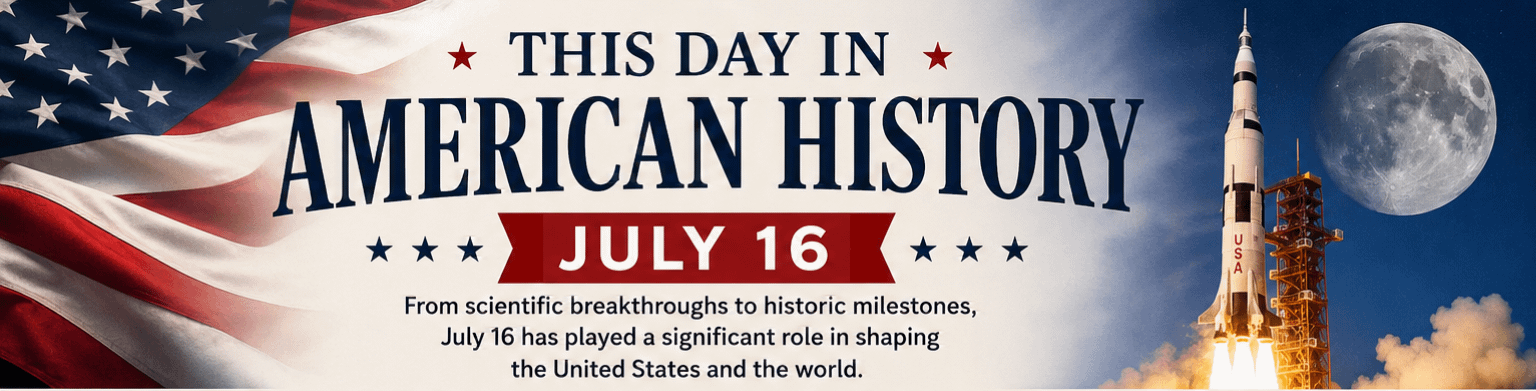
July 16 has been a day marked by scientific breakthroughs, political milestones, exploration, and defining moments that changed the course of American history. From the dawn of the atomic age to humanity’s journey to the Moon, this date reminds us of the innovation, courage, and determination that have shaped the United States.
Let’s look back at some of the most significant events that occurred on July 16.
1. The First Atomic Bomb Test – 1945
The most significant event associated with July 16 is undoubtedly the Trinity Test, the world’s first successful detonation of a nuclear weapon.
At 5:29 a.m. near Alamogordo, New Mexico, scientists working on the Manhattan Project witnessed history as the first atomic bomb exploded.
Led by physicist J. Robert Oppenheimer, thousands of scientists and military personnel had spent years secretly developing the weapon during World War II.
The explosion produced a blinding flash visible for hundreds of miles and forever changed military history.
The success of the Trinity Test paved the way for the atomic bombings of Hiroshima and Nagasaki just weeks later, ultimately contributing to the end of World War II while ushering in the beginning of the nuclear age.
2. Apollo 11 Launches to the Moon – 1969
On July 16, 1969, millions of Americans watched as the massive Saturn V rocket lifted off from Kennedy Space Center in Florida.
Aboard were three astronauts:
- Neil Armstrong
- Buzz Aldrin
- Michael Collins
The mission was Apollo 11, America’s historic first attempt to land humans on the Moon.
Four days later, Armstrong would step onto the lunar surface and speak the famous words:
“That’s one small step for man, one giant leap for mankind.”
The successful mission fulfilled President John F. Kennedy’s ambitious goal of landing a man on the Moon before the end of the 1960s and remains one of humanity’s greatest achievements.
3. The District of Columbia Gains Home Rule – 1973
On July 16, 1973, the District of Columbia Self-Government and Governmental Reorganization Act, commonly known as the Home Rule Act, was signed into law.
The legislation allowed residents of Washington, D.C. to elect their own mayor and city council instead of having Congress directly manage local affairs.
Although Congress still maintains oversight over the District, the Home Rule Act represented an important expansion of local self-government for the nation’s capital.
4. Babe Ruth’s Final Major League Appearance as a Player – 1935
Baseball legend Babe Ruth made one of the final appearances of his remarkable playing career during July 1935.
Although injuries and age had slowed him, Ruth remained one of America’s most beloved sports figures.
His incredible career included:
- 714 home runs
- Seven World Series championships
- A transformation of baseball into America’s favorite pastime
Even decades later, Ruth remains one of the most recognizable names in sports history.
5. The Manhattan Project Changes History
Although the Trinity Test is the event most remembered on July 16, it also symbolizes the enormous scientific effort known as the Manhattan Project.
More than 130,000 people worked in secrecy across the United States.
Facilities stretched across:
- Los Alamos, New Mexico
- Oak Ridge, Tennessee
- Hanford, Washington
The project represented one of the largest scientific collaborations ever undertaken and forever changed global politics, military strategy, and international diplomacy.
6. America Continues Exploring Space
July 16 has become closely associated with American space exploration.
Following Apollo 11, several later NASA missions also launched during mid-July, continuing America’s commitment to scientific discovery and human exploration beyond Earth.
The achievements of NASA inspired generations of scientists, engineers, astronauts, and students around the world.
Famous Americans Born on July 16
Several notable Americans celebrate birthdays on July 16, including:
- Will Ferrell (1967) – Actor and comedian
- Phoebe Cates (1963) – Actress
- Corey Feldman (1971) – Actor and musician
Their contributions to film and entertainment have made them familiar faces in American popular culture.
Why July 16 Matters
Few dates combine scientific achievement, exploration, and historical significance quite like July 16.
It represents:
- Scientific innovation
- Courage under uncertainty
- American leadership in space exploration
- Technological advancement
- The pursuit of ambitious goals
From unlocking the power of the atom to reaching for the Moon, July 16 showcases both the incredible possibilities and profound responsibilities that accompany human progress.
Looking Back While Looking Forward
History is filled with moments that redefine what is possible. July 16 reminds us that determination, innovation, and teamwork can accomplish extraordinary feats.
Whether reflecting on the Trinity Test’s sobering legacy or celebrating Apollo 11’s inspiring journey to the Moon, this day encourages us to learn from the past while continuing to pursue discoveries that improve the future.
As we remember July 16, we honor the scientists, explorers, leaders, and everyday Americans whose work helped shape the nation and left a lasting impact on the world.
Share this:
- Share on X (Opens in new window) X
- Share on Facebook (Opens in new window) Facebook
- Share on LinkedIn (Opens in new window) LinkedIn
- Share on Reddit (Opens in new window) Reddit
- Share on Tumblr (Opens in new window) Tumblr
- Share on Pinterest (Opens in new window) Pinterest
- Share on Telegram (Opens in new window) Telegram
- Share on Threads (Opens in new window) Threads
- Share on Bluesky (Opens in new window) Bluesky
Leave a ReplyCancel reply