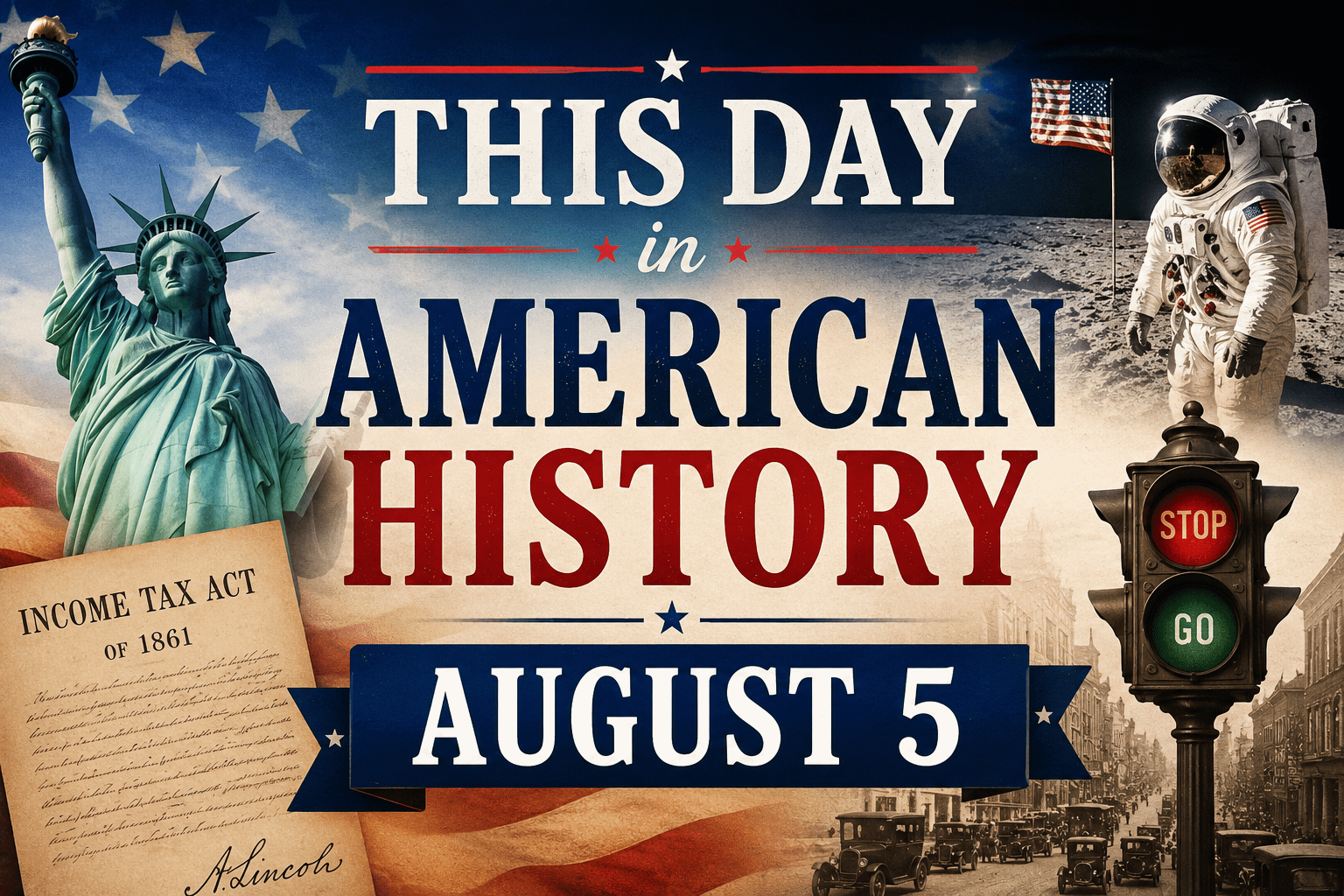
History is more than a collection of names and dates—it is the story of the people, ideas, and events that shaped the United States into the nation it is today. Every day on the calendar offers an opportunity to reflect on moments that influenced American government, innovation, culture, and society. August 5 is no exception.
From the introduction of the nation’s first federal income tax during the Civil War to the birth of the first person to walk on the Moon, August 5 highlights America’s willingness to adapt, innovate, and dream beyond what once seemed possible. It is also a day that reminds us of the country’s cultural influence through the lives of iconic figures and its role in promoting peace during the Cold War.
Let’s explore some of the most significant moments that occurred on this day in American history.
August 5, 1861 – America Introduces Its First Federal Income Tax
As the Civil War intensified, the United States government faced an enormous financial challenge. Funding the Union Army required unprecedented amounts of money for weapons, supplies, transportation, medical care, and soldier salaries.
On August 5, 1861, President Abraham Lincoln signed the Revenue Act of 1861 into law, creating the nation’s first federal income tax. The law imposed a 3 percent tax on annual incomes over $800—a substantial income at the time.
Before this legislation, the federal government relied primarily on tariffs and excise taxes to generate revenue. However, the Civil War demanded new financial solutions.
Although this first income tax proved difficult to administer and was eventually replaced by later tax laws, it marked a turning point in American fiscal policy. It demonstrated that the federal government could raise revenue directly from citizens when facing extraordinary national challenges.
More than fifty years later, the ratification of the Sixteenth Amendment in 1913 permanently established the federal income tax system that continues today.
Why This Matters
The Revenue Act of 1861 represented far more than a tax law. It reflected the nation’s determination to preserve the Union, even if it meant changing long-standing approaches to government finance.
Today, virtually every American who earns an income experiences the lasting legacy of this historic legislation.
August 5, 1884 – Construction Advances on the Statue of Liberty
Few symbols represent the American dream as powerfully as the Statue of Liberty.
On August 5, 1884, workers laid the cornerstone for the statue’s pedestal on Bedloe’s Island in New York Harbor, marking a significant milestone in preparing for one of America’s greatest landmarks.
The statue itself had been designed by French sculptor Frédéric Auguste Bartholdi and was a gift from the people of France to celebrate the friendship between the two nations and the ideals of liberty and democracy born during the American Revolution.
While France funded the construction of the statue itself, Americans raised money for the pedestal through public donations. Newspaper publisher Joseph Pulitzer played a major role by encouraging ordinary citizens to contribute, regardless of the amount.
When completed in 1886, the Statue of Liberty quickly became an international symbol of hope.
For millions of immigrants arriving through nearby Ellis Island, Lady Liberty was often the first sight of America.
She represented opportunity.
She represented freedom.
She represented a fresh beginning.
Lasting Legacy
Today, the Statue of Liberty welcomes millions of visitors every year and remains one of the most recognized monuments in the world.
Its message—that freedom and opportunity belong to everyone—continues to inspire people across generations.
August 5, 1914 – The World’s First Electric Traffic Signal Changes Transportation Forever
Modern drivers rarely think about traffic lights until they are forced to wait at one.
Yet one of the most important developments in road safety occurred on August 5, 1914, when the world’s first electric traffic signal began operating at the intersection of East 105th Street and Euclid Avenue in Cleveland, Ohio.
As automobiles became increasingly common during the early twentieth century, streets grew more dangerous. Horse-drawn wagons, pedestrians, bicycles, streetcars, and automobiles all competed for limited road space.
Traffic congestion and accidents increased rapidly.
The new electric signal introduced an organized system for controlling intersections.
Unlike today’s familiar red-yellow-green lights, the original version featured only red and green signals and included a warning buzzer before the light changed.
The idea proved remarkably successful.
Cities across America soon adopted similar systems, eventually leading to the standardized traffic lights used worldwide today.
Why It Changed America
Electric traffic signals improved:
- Public safety
- Traffic efficiency
- Urban planning
- Emergency vehicle movement
- Economic productivity
Every driver who stops at a red light today is benefiting from an invention first introduced more than a century ago.
August 5, 1930 – Neil Armstrong Is Born
Some individuals forever change the course of history.
Neil Armstrong was one of them.
Born on August 5, 1930, in Wapakoneta, Ohio, Armstrong developed a fascination with aviation at an early age.
He earned his pilot’s license before he was old enough to drive a car.
After serving as a naval aviator during the Korean War, Armstrong became a test pilot and eventually joined NASA’s astronaut program.
His calm personality, engineering expertise, and exceptional flying skills made him an ideal candidate for some of America’s most challenging space missions.
Everything culminated on July 20, 1969.
As commander of Apollo 11, Armstrong descended the ladder of the Lunar Module Eagle and became the first human being to set foot on the Moon.
His famous words became one of the most quoted statements in history:
“That’s one small step for man, one giant leap for mankind.”
A Lasting Inspiration
Armstrong’s achievement represented more than an American victory during the Space Race.
It demonstrated what humanity could accomplish through science, education, teamwork, and perseverance.
More than fifty years later, his accomplishment continues to inspire astronauts, engineers, scientists, and dreamers around the world.
August 5, 1962 – Remembering Marilyn Monroe
On August 5, 1962, America lost one of its most recognizable cultural icons.
Marilyn Monroe had become synonymous with Hollywood glamour during the 1950s and early 1960s.
Behind the fame, however, was a woman whose life included significant personal struggles.
Her performances in films such as Gentlemen Prefer Blondes, The Seven Year Itch, and Some Like It Hot helped redefine the image of the modern movie star.
Even decades after her passing, Monroe remains one of the most photographed, discussed, and admired figures in entertainment history.
Her influence extends beyond film into fashion, photography, advertising, and American popular culture.
August 5, 1963 – A Step Toward Peace During the Cold War
The early 1960s were among the most dangerous years in world history.
Following the Cuban Missile Crisis, the threat of nuclear war remained a constant concern.
Recognizing the dangers posed by atmospheric nuclear testing, the United States joined the United Kingdom and the Soviet Union in signing the Partial Nuclear Test Ban Treaty on August 5, 1963.
The treaty prohibited nuclear weapons testing:
- In the atmosphere
- Underwater
- In outer space
Although underground testing continued, the agreement significantly reduced radioactive fallout while opening the door for future arms-control negotiations.
Why This Treaty Matters
The agreement demonstrated that even bitter rivals could cooperate when the future of humanity was at stake.
It remains an important milestone in the history of international diplomacy and nuclear non-proliferation.
Other Notable August 5 Birthdays
Several influential Americans were born on August 5, including:
- Neil Armstrong (1930) – Astronaut and first person to walk on the Moon.
- John Huston (1906) – Academy Award-winning director of The Treasure of the Sierra Madre.
- John Saxon (1936) – Acclaimed actor known for his work in film and television.
These individuals each contributed to American culture in unique and lasting ways.
How August 5 Reflects the American Spirit
Looking across these historical events reveals several themes that continue to define the United States.
Innovation
From electric traffic signals to lunar exploration, Americans have continually sought new ways to solve problems and push the boundaries of what is possible.
Freedom
The construction of the Statue of Liberty reinforced America’s identity as a nation built on liberty and opportunity.
Leadership
Whether preserving the Union during the Civil War or helping negotiate international treaties during the Cold War, American leaders have faced extraordinary challenges with decisions that shaped history.
Culture
Figures like Marilyn Monroe remind us that America’s influence extends beyond politics and technology into entertainment, fashion, and the arts.
Determination
Neil Armstrong’s journey from a small Ohio town to the surface of the Moon illustrates how perseverance, education, and courage can lead to achievements once thought impossible.
Lessons We Can Learn from August 5
History is valuable because it teaches us lessons that remain relevant today.
The events of August 5 remind us that:
- Great achievements begin with bold ideas.
- Innovation improves everyday life.
- Freedom requires commitment and sacrifice.
- Peace often depends on diplomacy.
- Individual determination can inspire generations.
Every generation writes the next chapter of American history.
The decisions we make today may one day become the milestones remembered by future generations.
Final Thoughts
August 5 is a day that showcases the remarkable diversity of American history. It reminds us that history is not made only on battlefields or in government buildings. It is also shaped in laboratories, movie studios, city streets, construction sites, and even on the surface of the Moon.
From the financial decisions that helped preserve the Union to the construction of one of the world’s greatest symbols of freedom, from innovations that made everyday travel safer to achievements that carried humanity beyond Earth, August 5 reflects the resilience, creativity, and ambition that have long defined the American story.
As we remember these milestones, we are reminded that history is an ongoing journey. Every generation has the opportunity to build upon the accomplishments of those who came before, creating a brighter future while honoring the lessons of the past.
Leave a Reply