
Every day has a history.
Behind an ordinary date on the calendar are stories of people who made difficult decisions, inventions that changed everyday life, political victories and scandals, wars that altered the direction of nations, and moments that became permanently connected to American culture.
August 8 is one of those dates.
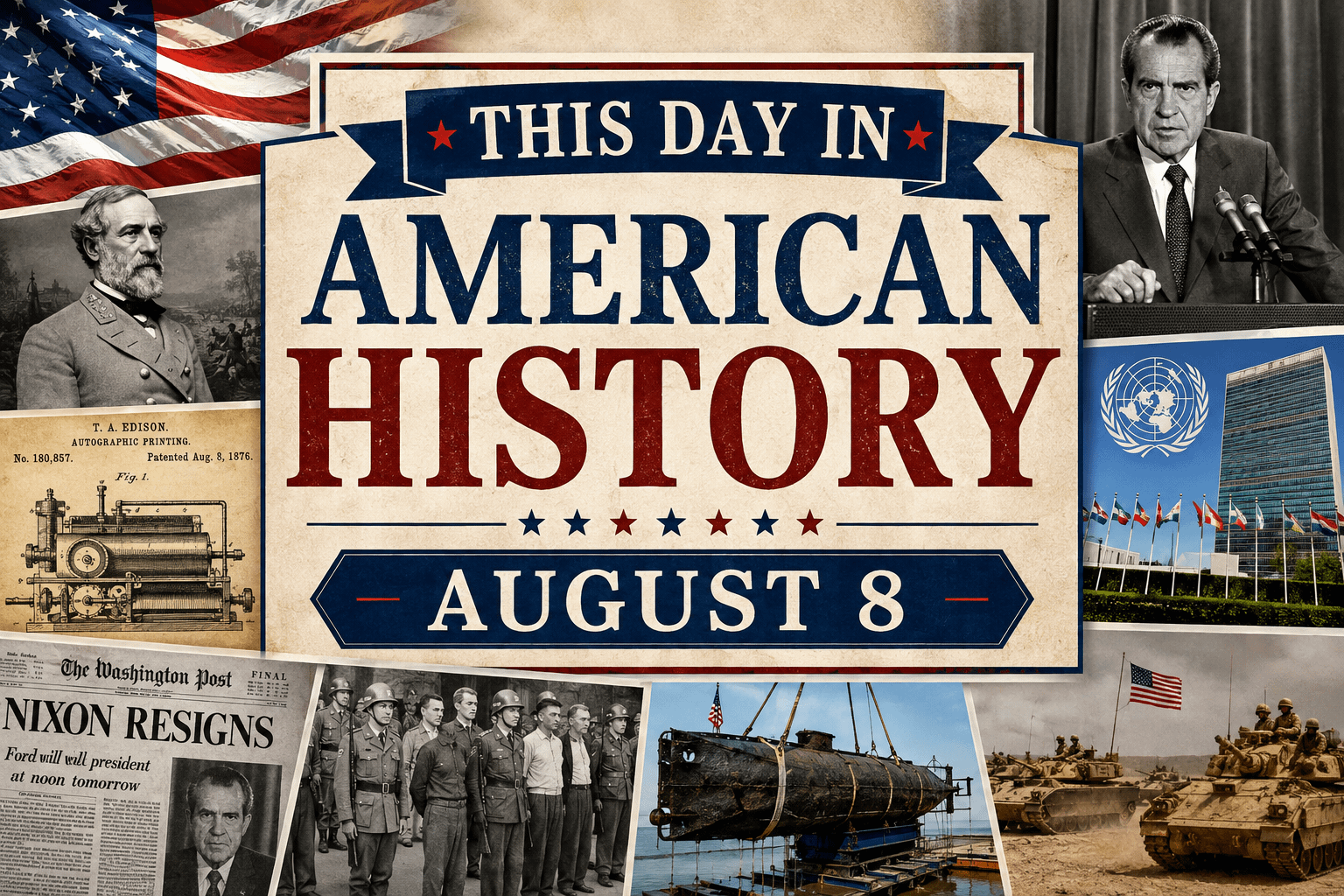
Throughout American history, August 8 has been associated with developments involving the Civil War, Thomas Edison, the United States Congress, World War II, the United Nations, Richard Nixon, the Gulf War, Civil War archaeology, and other memorable events.
Perhaps no American political figure is more closely connected with August 8 than Richard Nixon.
On August 8, 1968, Nixon accepted the Republican presidential nomination as he attempted one of the greatest political comebacks in American history.
Exactly six years later, on August 8, 1974, Nixon appeared before the nation and announced that he would resign the presidency because of the Watergate scandal.
The same calendar date captured both his political rise and his historic downfall.
But Nixon’s story is only one chapter.
Let’s travel through history and explore some of the people, events, discoveries, and turning points connected with August 8 in American history.
August 8, 1815 – Napoleon Bonaparte Begins His Journey Into Final Exile
Although Napoleon Bonaparte was a European leader, the Napoleonic era had enormous consequences for the young United States.
On August 8, 1815, Napoleon departed aboard the British warship HMS Northumberland for the remote island of St. Helena in the South Atlantic.
His defeat ended one of the most turbulent periods in European history.
But why does Napoleon matter when discussing American history?
Because his ambitions helped reshape North America.
In the early 1800s, Napoleon controlled Louisiana, an enormous territory stretching across much of the central portion of North America.
France’s plans for rebuilding its colonial empire became increasingly difficult because of war, financial pressures, and events in the Caribbean.
Napoleon ultimately agreed to sell the Louisiana Territory to the United States.
The result was the Louisiana Purchase of 1803.
For approximately $15 million, the United States acquired around 828,000 square miles of territory.
The acquisition dramatically expanded the country’s geographic reach and opened the way for generations of westward expansion.
By the time Napoleon sailed toward his final exile in 1815, the United States had already benefited enormously from the geopolitical struggles surrounding his empire.
August 8, 1863 – Robert E. Lee Offers to Resign After Gettysburg
The summer of 1863 represented one of the most important turning points of the American Civil War.
In early July, Union and Confederate forces fought the enormous Battle of Gettysburg in Pennsylvania.
The battle lasted from July 1 through July 3 and resulted in tens of thousands of casualties.
Confederate General Robert E. Lee had hoped his invasion of the North might change the direction of the war.
Instead, his army suffered a devastating defeat.
After retreating back toward Virginia, Lee accepted responsibility for what had happened.
On August 8, 1863, he wrote to Confederate President Jefferson Davis and offered to resign his command.
Lee expressed concerns about his ability to continue leading the army and believed another commander might be better suited for the responsibility.
Davis rejected the resignation.
Lee therefore continued commanding the Army of Northern Virginia.
The moment reveals something important about the aftermath of Gettysburg.
The battle wasn’t simply another military engagement. It represented a serious psychological and strategic blow to the Confederacy.
Lee’s army would continue fighting for nearly two more years, but the Confederacy would never again launch an invasion of the North on the same scale.
The Civil War Was Entering a New Phase
Gettysburg wasn’t the only major Union victory during the summer of 1863.
On July 4, Confederate forces surrendered Vicksburg, Mississippi, to Union General Ulysses S. Grant.
That victory gave the Union control of the Mississippi River and effectively divided the Confederacy.
Within days of each other, Gettysburg and Vicksburg changed the momentum of the war.
By August 1863, both sides understood that the conflict had entered another phase.
The war would continue until 1865, but Confederate hopes of achieving independence were becoming increasingly difficult to sustain.
Lee’s August 8 resignation offer reflected the tremendous pressure surrounding Confederate leadership following those defeats.
August 8, 1876 – Thomas Edison Receives a Patent for Autographic Printing
The late 19th century was an extraordinary period of American invention.
Few inventors became more famous than Thomas Edison.
On August 8, 1876, Edison received U.S. Patent No. 180,857 for an “Improvement in Autographic Printing.”
The process helped contribute to the development of technologies associated with the mimeograph.
Today, copying information is almost effortless.
We can print hundreds of pages, scan documents, duplicate files, send emails, upload photographs, and share information around the world almost instantly.
The world of the 1870s was very different.
Producing multiple copies of a document could require significant time and labor.
Duplicating technologies helped businesses, schools, churches, organizations, and government offices distribute information more efficiently.
Eventually, mimeograph machines became familiar equipment throughout American offices and classrooms.
For generations of students and office workers, mimeographed pages were simply part of everyday life.
Thomas Edison and America’s Age of Invention
Edison’s work on document duplication represented only a small portion of his enormous career.
He became associated with inventions and developments involving the phonograph, electric lighting, motion pictures, electrical power distribution, telecommunications, and sound recording.
Edison eventually accumulated more than a thousand U.S. patents.
His career represented the rapid technological transformation occurring in America during the late 1800s and early 1900s.
Factories expanded.
Cities grew.
Electricity transformed homes and businesses.
Communication became faster.
Transportation improved.
Mass-produced goods became increasingly common.
America was moving toward becoming one of the world’s leading industrial powers.
August 8, 1911 – The House of Representatives Is Set at 435 Members
The United States Constitution created a House of Representatives whose membership would be based on population.
As America’s population grew, the House grew as well.
By the early 20th century, lawmakers were confronting an important question:
How large should the House of Representatives become?
On August 8, 1911, President William Howard Taft signed the Apportionment Act of 1911.
The legislation established a House consisting of 435 members, based on the results of the 1910 census.
The number temporarily increased after Arizona and New Mexico became states, but subsequent legislation eventually fixed the House at 435 voting members.
More than a century later, the number remains 435.
Why Congressional Apportionment Matters
Every ten years, the United States conducts a national census.
The population totals are then used to determine how the 435 House seats are divided among the states.
Every state receives at least one representative.
States with larger populations receive more.
Because America’s population constantly changes, congressional representation shifts over time.
Some states gain seats.
Others lose them.
The process affects political influence, congressional districts, presidential elections, and the Electoral College.
A law signed on August 8, 1911 therefore remains connected to the structure of American democracy today.
August 8, 1942 – Six German Saboteurs Are Executed
World War II wasn’t fought only on distant battlefields.
Americans also feared enemy espionage and sabotage inside the United States.
In June 1942, eight German agents secretly entered the country as part of a Nazi mission known as Operation Pastorius.
They landed in two groups.
One group came ashore on Long Island, New York.
Another landed in Florida.
Their mission was to sabotage strategically important American infrastructure and industrial facilities.
Potential targets included transportation networks, factories, power facilities, and other locations important to America’s war effort.
The operation collapsed before the planned attacks were carried out.
One of the agents, George John Dasch, contacted American authorities and revealed the plot.
All eight men were eventually arrested.
The Military Tribunal
President Franklin D. Roosevelt ordered the captured saboteurs tried before a military commission rather than an ordinary civilian court.
The case raised important constitutional questions about wartime powers and the legal rights of enemy agents.
Six of the men received death sentences.
On August 8, 1942, they were executed in Washington, D.C.
Dasch and another conspirator who cooperated with authorities received prison sentences instead.
The case remains an important chapter in the history of national security, military tribunals, presidential wartime authority, and constitutional law.
August 8, 1945 – America Moves Toward the United Nations
World War II had devastated much of Europe and Asia.
Millions of people had died.
Cities had been destroyed.
Entire populations had been displaced.
World leaders increasingly understood that another global conflict of the same magnitude could be catastrophic.
The United Nations was created in response to that reality.
Representatives from nations around the world gathered in San Francisco in 1945 to develop the United Nations Charter.
The U.S. Senate overwhelmingly approved American participation.
On August 8, 1945, President Harry S. Truman signed the instrument of ratification for the United Nations Charter.
The United States became one of the organization’s founding members.
America’s Changing Role in the World
The creation of the United Nations represented a significant change in American foreign policy.
After World War I, the United States had declined to join the League of Nations.
After World War II, American leaders took a much more active role in building international institutions.
The United States became one of the five permanent members of the United Nations Security Council.
The other permanent members were China, France, the Soviet Union—whose seat is now held by Russia—and the United Kingdom.
The United Nations officially came into existence on October 24, 1945.
America’s participation demonstrated that the United States had emerged from World War II as one of the world’s leading powers.
August 8, 1968 – Richard Nixon Accepts the Republican Presidential Nomination
The United States was experiencing tremendous turmoil in 1968.
The Vietnam War was dividing the country.
Civil rights struggles continued.
Protests were occurring across the nation.
Martin Luther King Jr. had been assassinated in April.
Senator Robert F. Kennedy was assassinated in June.
Riots and civil unrest affected numerous American cities.
Against this backdrop, Republicans gathered in Miami Beach, Florida, for their national convention.
On August 8, Richard Nixon accepted the Republican nomination for president.
Richard Nixon’s Political Comeback
Nixon’s nomination represented a remarkable political comeback.
He had served as vice president under President Dwight D. Eisenhower from 1953 until 1961.
Nixon then ran for president in 1960 but narrowly lost to John F. Kennedy.
Two years later, he lost the California governor’s race.
Many observers believed Nixon’s political career was finished.
They were wrong.
By 1968, Nixon had rebuilt his political standing and secured the Republican presidential nomination.
He went on to defeat Democratic nominee Hubert Humphrey and third-party candidate George Wallace.
Nixon became the 37th president of the United States on January 20, 1969.
August 8, 1974 – Richard Nixon Announces His Resignation
Exactly six years after accepting his party’s presidential nomination, Nixon experienced one of the most dramatic falls in American political history.
On the evening of August 8, 1974, President Richard Nixon addressed the American people from the White House.
He announced that he would resign the presidency.
The resignation became effective at noon on August 9.
Vice President Gerald Ford then became president.
Nixon remains the only president in United States history to resign from office.
What Was Watergate?
The Watergate scandal began with a burglary.
On June 17, 1972, five men were arrested after breaking into the Democratic National Committee headquarters at the Watergate complex in Washington, D.C.
Investigators eventually uncovered connections between the burglars and Nixon’s reelection campaign.
But the scandal became much larger than the original break-in.
Questions emerged involving political espionage, campaign activities, obstruction of justice, abuse of presidential power, and attempts to conceal information.
Journalists, congressional investigators, prosecutors, judges, and eventually the Supreme Court all became involved.
The White House Tapes
One of the most important developments was the discovery that Nixon had secretly recorded conversations inside the White House.
Investigators wanted access to those recordings.
Nixon resisted.
The dispute eventually reached the U.S. Supreme Court.
In United States v. Nixon, the Court unanimously ruled that the president had to turn over the requested recordings.
One recording became particularly damaging because it indicated that Nixon had participated in efforts to interfere with the Watergate investigation shortly after the burglary.
Political support for the president collapsed.
Facing almost certain impeachment in the House and the possibility of conviction in the Senate, Nixon decided to resign.
One Date, Two Very Different Nixon Moments
The coincidence is extraordinary.
August 8, 1968: Richard Nixon accepts the Republican nomination for president.
August 8, 1974: Richard Nixon announces his resignation from the presidency.
Exactly six years separated those moments.
One represented political rebirth.
The other represented political collapse.
Few dates in American history illustrate the rise and fall of a political leader so dramatically.
August 8, 1990 – President George H. W. Bush Addresses the Nation About Iraq
On August 2, 1990, Iraqi forces under Saddam Hussein invaded neighboring Kuwait.
The invasion created an international crisis.
There were immediate concerns that Iraqi forces might continue south toward Saudi Arabia.
The United States responded by deploying military forces to the region as part of Operation Desert Shield.
On August 8, 1990, President George H. W. Bush addressed the American people and explained the deployment.
Bush outlined several objectives, including the withdrawal of Iraqi forces from Kuwait and the protection of Saudi Arabia.
From Desert Shield to Desert Storm
Over the following months, the United States helped assemble a large international coalition.
Diplomatic pressure and economic sanctions failed to convince Saddam Hussein to withdraw from Kuwait.
In January 1991, coalition military operations began.
Operation Desert Shield transitioned into Operation Desert Storm.
A massive air campaign was followed by a short ground offensive.
Coalition forces liberated Kuwait.
The Gulf War became one of the defining international events of the early 1990s and demonstrated the enormous military capabilities the United States possessed following the Cold War.
August 8, 2000 – The H. L. Hunley Is Raised From the Ocean
More than 130 years after disappearing during the Civil War, one of America’s most fascinating historical artifacts returned to the surface.
The H. L. Hunley was a Confederate submarine.
On February 17, 1864, the Hunley attacked the Union warship USS Housatonic outside Charleston Harbor.
The submarine successfully sank the ship.
It was an extraordinary technological achievement.
The Hunley became the first combat submarine in history to sink an enemy warship.
But the submarine never returned from the mission.
Its eight-man crew disappeared with it.
Finding the Hunley
For generations, historians searched for the submarine.
Its wreck was eventually located off the South Carolina coast.
Recovering the vessel required years of planning because archaeologists wanted to preserve both the submarine and the historical evidence contained inside it.
On August 8, 2000, the Hunley was carefully raised from the ocean.
The recovery became a major archaeological event.
Researchers were able to examine the submarine, study its crew, investigate its construction, and continue searching for answers about why it sank.
The Hunley remains an extraordinary reminder that archaeology can reveal new information about events that happened generations ago.
A Quick August 8 American History Timeline
Here are some of the notable events connected with August 8:
1815 – Napoleon Bonaparte departs aboard HMS Northumberland for his final exile on St. Helena.
1863 – Confederate General Robert E. Lee offers his resignation following the defeat at Gettysburg.
1876 – Thomas Edison receives a patent for an autographic printing process that contributed to later document-duplicating technology.
1911 – President William Howard Taft signs legislation establishing 435 seats in the U.S. House of Representatives.
1942 – Six German saboteurs captured during Operation Pastorius are executed in Washington, D.C.
1945 – President Harry S. Truman signs the United States’ instrument of ratification for the United Nations Charter.
1968 – Richard Nixon accepts the Republican presidential nomination.
1974 – President Richard Nixon announces that he will resign because of the Watergate scandal.
1990 – President George H. W. Bush addresses the nation regarding Iraq’s invasion of Kuwait and the deployment of American forces to Saudi Arabia.
2000 – The Confederate submarine H. L. Hunley is raised from the waters off South Carolina.
Notable Americans Born on August 8
August 8 is also the birthday of several people who became part of American entertainment, sports, and cultural history.
Esther Williams – Born August 8, 1921
Esther Williams became one of Hollywood’s most distinctive stars.
A competitive swimmer before entering the movie industry, Williams became famous for elaborate aquatic musical productions during Hollywood’s Golden Age.
Her films combined swimming, choreography, music, romance, and spectacular water sequences.
She became one of the era’s most recognizable performers.
Dustin Hoffman – Born August 8, 1937
Actor Dustin Hoffman was born on August 8, 1937.
His long career has included performances in some of America’s most memorable films, including The Graduate, Midnight Cowboy, Kramer vs. Kramer, Tootsie, and Rain Man.
Hoffman became known for taking on complex and unconventional roles and emerged as one of the most influential American actors of his generation.
Connie Stevens – Born August 8, 1938
Actress and singer Connie Stevens was born on August 8, 1938.
She became particularly popular during the late 1950s and 1960s through television, movies, and music.
Her career reflected the rapidly expanding influence of television and youth-oriented popular entertainment in postwar America.
August 8 and the Larger American Story
When we examine all these events together, August 8 becomes more than another date.
It connects several major themes in American history.
Leadership
Robert E. Lee’s resignation offer, Richard Nixon’s nomination and resignation, and presidential decisions during international crises demonstrate the enormous pressures placed on national leaders.
Innovation
Thomas Edison’s printing technology represents America’s long history of experimentation and invention.
Democracy
The Apportionment Act demonstrates how America’s political institutions have evolved as the population has grown.
War and National Security
The Civil War, World War II, and Gulf War events connected with August 8 remind us how military conflict has repeatedly shaped American society.
International Leadership
America’s participation in the United Nations reflected the country’s transformation into a global power following World War II.
Preserving History
The recovery of the H. L. Hunley demonstrates how historians, archaeologists, scientists, and preservationists continue discovering new information about America’s past.
Why Studying American History Matters
History isn’t simply a collection of dates.
It is the story of decisions and consequences.
Political leaders make choices.
Inventors experiment with new ideas.
Soldiers fight wars.
Citizens demand change.
Journalists uncover wrongdoing.
Scientists and archaeologists discover evidence.
Communities grow.
Institutions evolve.
Each generation inherits the consequences of what previous generations decided to do.
Understanding those events helps us understand why America looks the way it does today.
History Can Also Serve as a Warning
The Watergate scandal is one example.
It demonstrates the importance of accountability and checks and balances within government.
The Operation Pastorius case raises continuing questions about how democracies balance constitutional protections with national security during wartime.
The Civil War demonstrates the catastrophic consequences of national division over slavery and the future of the country.
World War II demonstrates the consequences of global aggression and the importance of international cooperation.
History does not always provide simple answers.
But it often provides important lessons.
History Is Still Being Written
One fascinating thing about studying history is realizing that people living through historic moments don’t always know how important those moments will become.
Someone reading a newspaper in August 1876 might have barely noticed another Thomas Edison patent.
Few could have imagined how dramatically technology would transform communication during the next century.
Americans watching Richard Nixon accept the Republican nomination on August 8, 1968 could not have known that exactly six years later they would watch him announce his resignation.
People watching the H. L. Hunley disappear in 1864 could never have imagined that 136 years later the submarine would be lifted from the ocean and studied using modern scientific technology.
History changes how we understand the past because new information, new evidence, and new perspectives continue emerging.
Final Thoughts: Remembering August 8 in American History
August 8 has witnessed moments of war, innovation, political ambition, presidential scandal, international diplomacy, archaeology, entertainment, and technological progress.
It reminds us that America’s story isn’t defined by a single person or event.
It is built from millions of individual stories connected across generations.
Thomas Edison was experimenting with technology.
Robert E. Lee was confronting the consequences of Gettysburg.
American officials were dealing with enemy sabotage during World War II.
Harry Truman was helping establish a new international order.
Richard Nixon experienced both political triumph and historic disgrace on the same calendar date.
George H. W. Bush prepared the country for another major international confrontation.
And generations after the Civil War, researchers raised the H. L. Hunley from the ocean and brought a piece of America’s past back into the light.
Each event represents another chapter in the complicated, fascinating, and continuing story of the United States.
Tomorrow will bring another date.
Another collection of stories.
Another opportunity to remember where America has been, recognize the people who helped shape it, learn from its successes and failures, and understand how the past continues to influence the country today.
Because history isn’t only about what happened yesterday.
History helps us understand the America we live in today.
Leave a ReplyCancel reply