
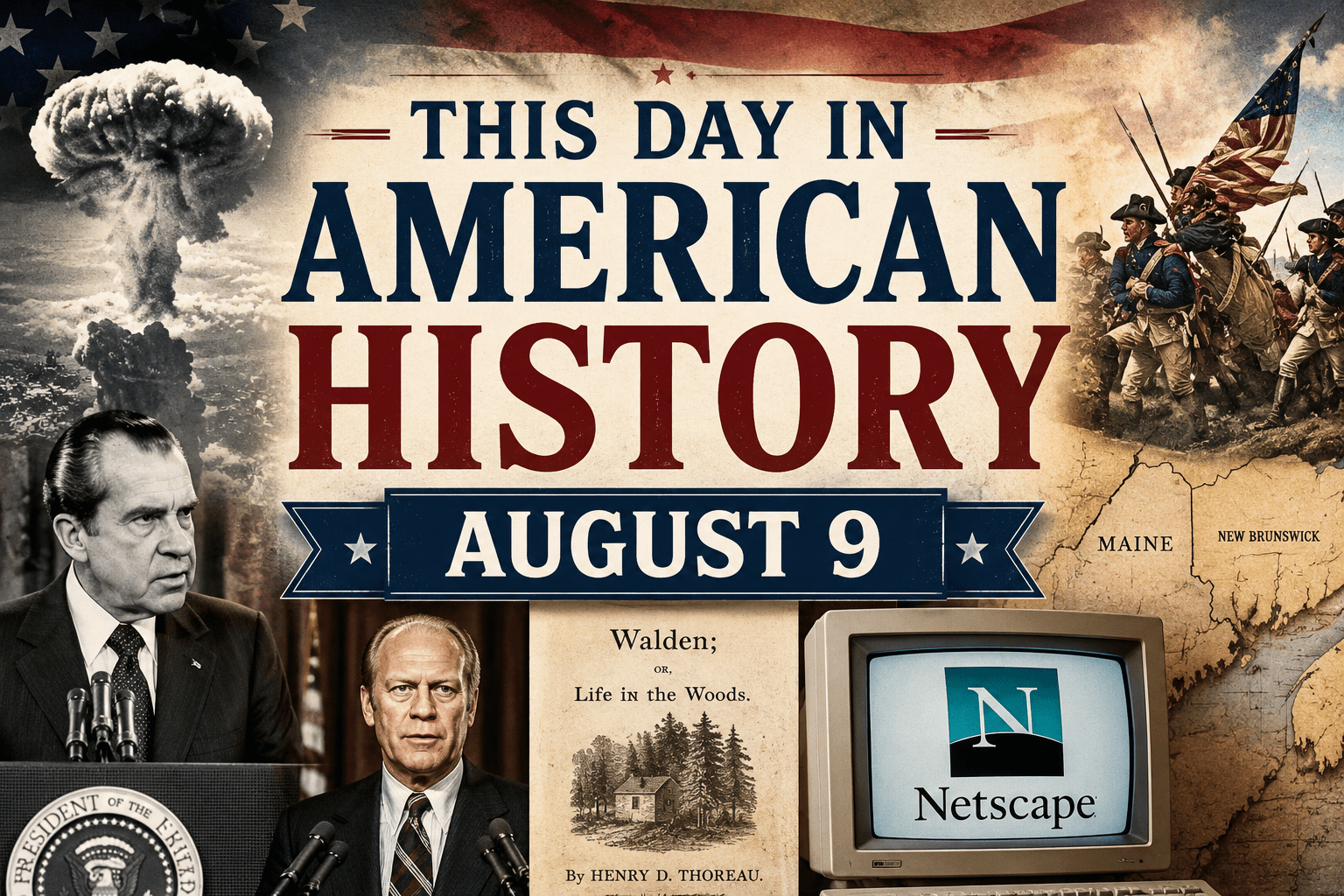
Every day carries a piece of America’s story. Some dates are remembered for a single defining event, while others connect several moments that reveal how the United States has changed politically, socially, culturally, and technologically.
August 9 is one of those dates.
Across different generations, August 9 has been associated with the American Revolution, an important diplomatic agreement with Great Britain, one of the great works of American literature, the final days of World War II, one of the country’s most infamous crimes, the resignation of a president, the peaceful transfer of presidential power, and the beginning of the commercial internet era.
Some of these moments deserve celebration. Others require reflection and remembrance. Together, however, they show why studying history is about much more than memorizing names and dates.
History helps us understand how decisions create consequences that can continue for decades—or even centuries.
Here is a deeper look at what happened on August 9 in American history.
1778 – American Forces Move Against the British in Rhode Island
During the summer of 1778, the American Revolution was entering a new and important phase.
The war had begun more than three years earlier, and the Continental Army was still fighting to secure American independence from Great Britain.
But the international situation had changed.
Following the American victory at Saratoga in 1777, France formally entered the war as an ally of the United States in 1778.
French participation dramatically changed the conflict.
Great Britain was no longer fighting only rebellious colonies. It was now involved in a broader international war against one of Europe’s major powers.
One of the earliest attempts at major military cooperation between American and French forces took place around Newport, Rhode Island.
British troops had occupied Newport since 1776, making the city an important British military position.
American leaders wanted it back.
Major General John Sullivan commanded American forces preparing to attack the British position, while French naval and military forces were expected to provide support.
On August 9, 1778, American troops crossed onto Aquidneck Island as the operation moved forward.
The campaign did not unfold as planned.
Communication problems, severe weather, changing military circumstances, and disagreements complicated cooperation between the American and French forces.
The campaign eventually culminated in the Battle of Rhode Island on August 29, 1778.
Although American forces failed to capture Newport, the campaign became an important learning experience for the young Franco-American alliance.
That alliance would later prove essential.
Three years later, French troops and naval forces played a crucial role in the American victory at Yorktown in 1781, helping force the surrender of British General Charles Cornwallis.
The events surrounding Rhode Island therefore represent more than an unsuccessful military operation.
They were part of the development of an international partnership that helped make American independence possible.
1842 – The Webster-Ashburton Treaty Resolves a Dangerous Border Dispute
Not every important moment in American history happened on a battlefield.
Sometimes diplomacy changed the country’s future just as dramatically.
On August 9, 1842, representatives of the United States and Great Britain signed the Webster-Ashburton Treaty.
The agreement addressed several disputes between the two countries, including disagreements concerning portions of the border between the United States and British North America.
One particularly contentious area involved the boundary between Maine and what is now the Canadian province of New Brunswick.
Tensions had become serious enough that the dispute contributed to a confrontation known as the Aroostook War.
Despite the dramatic name, it was largely a bloodless boundary dispute rather than a conventional war.
Still, the possibility of a larger conflict between the United States and Britain was real enough to make a diplomatic settlement important.
U.S. Secretary of State Daniel Webster negotiated with British diplomat Lord Ashburton, Alexander Baring.
Their negotiations produced a compromise.
The treaty helped establish portions of the modern U.S.-Canada border and settled several other disagreements between the two nations.
The Webster-Ashburton Treaty offers an important lesson from American history:
Not every national conflict has to end through military force.
Negotiation and compromise can sometimes accomplish what armies cannot.
1854 – Henry David Thoreau Publishes Walden
On August 9, 1854, one of the most influential books in American literature was published.
Henry David Thoreau released:
Walden; or, Life in the Woods.
The book grew out of Thoreau’s experience living near Walden Pond outside Concord, Massachusetts.
Beginning in 1845, Thoreau spent more than two years living in a small cabin he constructed near the pond.
His goal was not simply to escape civilization.
He wanted to experiment with a simpler way of living.
Thoreau questioned whether people were spending too much of their lives pursuing money, possessions, status, and unnecessary comforts.
He wanted to examine what a person actually needed to live a meaningful life.
That idea became one of the central themes of Walden.
Thoreau encouraged readers to examine their priorities, appreciate nature, think independently, and live deliberately rather than simply following society’s expectations.
His observations became part philosophy, part autobiography, part social criticism, and part celebration of the natural world.
Although Walden was not an immediate blockbuster by modern standards, its influence grew tremendously over time.
Today, Thoreau is considered one of America’s most important writers and thinkers.
His broader writings about individual conscience and civil disobedience also influenced future political and social movements.
The publication of Walden on August 9 reminds us that American history is not only created by presidents, generals, and politicians.
Writers and thinkers can change a nation too.
1945 – The Atomic Bombing of Nagasaki
One of the darkest and most consequential events connected with August 9 occurred during the closing days of World War II.
By the summer of 1945, Nazi Germany had already surrendered.
The war in Europe was over.
But fighting continued in the Pacific.
American and Allied forces had spent years advancing across the Pacific toward Japan, often experiencing extremely intense combat.
Battles such as Iwo Jima and Okinawa demonstrated just how costly an invasion of the Japanese home islands could potentially become.
Meanwhile, the United States had secretly developed a new weapon through the Manhattan Project.
The atomic bomb represented a destructive power unlike anything previously used in warfare.
On August 6, 1945, the United States dropped an atomic bomb nicknamed “Little Boy” on Hiroshima.
Three days later, on August 9, 1945, another American B-29 bomber, Bockscar, carried a plutonium bomb nicknamed “Fat Man.”
The original primary target was Kokura, but conditions prevented the bombing there.
The aircraft proceeded to Nagasaki.
The bomb exploded over the city.
The destruction was enormous.
Tens of thousands of people were killed, and many others suffered burns, injuries, radiation exposure, and long-term health consequences.
Families disappeared.
Neighborhoods were destroyed.
Survivors lived with physical and emotional consequences for decades.
The Soviet Union had also entered the war against Japan, adding further pressure on the Japanese government.
Within days, Japan announced its intention to surrender.
World War II was coming to an end.
The Debate Over the Atomic Bombings Continues
Few decisions in American military history have generated more debate than the atomic bombings of Hiroshima and Nagasaki.
Supporters of President Harry Truman’s decision have argued that using the bombs accelerated Japan’s surrender and prevented a costly Allied invasion of the Japanese home islands.
American military planners expected that an invasion could produce enormous casualties.
From this perspective, the bombings helped end a brutal global war that had already killed millions.
Critics have raised different questions.
Was Japan already approaching surrender?
Could the bomb have been demonstrated somewhere unpopulated?
Was the second bombing necessary?
How should civilian casualties be weighed against military objectives?
Historians continue debating these questions.
What cannot be debated is the enormous human cost.
August 9 therefore serves as both a historical milestone and a day of remembrance.
The atomic age changed warfare forever.
For the first time, humanity possessed weapons capable of destroying cities almost instantly.
That reality continues to influence international diplomacy and military strategy today.
1969 – The Tate Murders Shock Los Angeles and America
The morning of August 9, 1969, brought news of a horrifying crime in Los Angeles.
Members of the group associated with Charles Manson murdered five people at a home on Cielo Drive.
The victims included:
- Actress Sharon Tate, who was pregnant
- Celebrity hairstylist Jay Sebring
- Coffee heiress Abigail Folger
- Writer Wojciech Frykowski
- Steven Parent, who had been visiting the property’s caretaker
The brutality of the killings stunned the country.
Another set of murders followed the next night when Leno and Rosemary LaBianca were killed.
Investigators eventually connected the crimes to members of Manson’s group.
The resulting investigation and trials became a national media spectacle.
Charles Manson became one of the most infamous criminals in American history, even though he did not personally carry out the Tate murders.
The crimes became culturally significant for another reason.
For some Americans, they symbolized the darker side of the late 1960s.
The decade had been associated with enormous cultural change, youth movements, antiwar activism, civil rights struggles, experimentation, and the counterculture.
The Manson murders became part of a broader sense that the optimism associated with parts of that era had begun to disappear.
1974 – Richard Nixon Leaves the Presidency
Few dates in American political history compare with August 9, 1974.
That morning, Richard Nixon prepared to leave the White House.
The Watergate scandal had consumed his administration.
What began with a burglary at Democratic National Committee headquarters in Washington’s Watergate complex eventually developed into a national crisis involving political espionage, obstruction, abuse of power, secret recordings, congressional investigations, court battles, and questions about presidential accountability.
The break-in occurred on June 17, 1972.
Five men were arrested inside Democratic headquarters.
Initially, the White House attempted to distance itself from the incident.
But journalists, investigators, prosecutors, congressional committees, and courts continued examining what had happened.
Slowly, the scandal moved closer to the president.
One of the biggest revelations came when investigators learned that Nixon had secretly recorded conversations in the White House.
Those recordings became crucial evidence.
The Supreme Court eventually ruled in United States v. Nixon that the president had to turn over subpoenaed recordings.
A recording known as the “smoking gun” tape seriously damaged Nixon’s remaining political support.
Impeachment appeared increasingly unavoidable.
On the evening of August 8, Nixon addressed the nation and announced that he would resign.
His resignation became effective at noon on August 9, 1974.
Richard Nixon became the first president in American history to resign from office.
To this day, he remains the only U.S. president to have done so.
Nixon’s Final Departure From the White House
Before leaving Washington, Nixon gave an emotional farewell to members of his administration and staff.
He then walked with his family toward the presidential helicopter.
Photographs and television footage captured Nixon turning and raising his arms with his familiar victory gesture before boarding.
Marine One carried him away from the White House.
It was an extraordinary image.
A man who had won reelection in 1972 by one of the largest Electoral College landslides in American history was leaving office less than two years later.
Watergate permanently changed how many Americans viewed the presidency.
It strengthened public skepticism toward government and produced renewed debates about executive power, campaign practices, government transparency, journalism, and political accountability.
The scandal also reinforced an important constitutional principle:
No president is supposed to be above the law.
1974 – Gerald Ford Becomes the 38th President
As one presidency ended, another began.
At noon on August 9, 1974, Vice President Gerald Rudolph Ford became the 38th president of the United States.
Chief Justice Warren Burger administered the presidential oath of office in the East Room of the White House.
Ford then addressed the American people.
His speech contained one of the most memorable statements ever delivered by an incoming president:
“Our long national nightmare is over.”
The words captured the exhaustion many Americans felt after years of Watergate investigations and political conflict.
Ford faced an unusual situation.
He had never been elected president.
He had never even been elected vice president.
How Gerald Ford Reached the White House
Ford’s path to the presidency was unlike that of any previous American president.
In October 1973, Vice President Spiro Agnew resigned amid a corruption investigation unrelated to Watergate.
Under the 25th Amendment, President Nixon nominated Gerald Ford to become the new vice president.
Congress confirmed him.
Then Nixon resigned.
That meant Ford became president without having been elected nationally to either the presidency or vice presidency.
His rise demonstrated the importance of the 25th Amendment, which had been ratified only a few years earlier in 1967.
The amendment established procedures for dealing with presidential disability and vacancies in the office of vice president.
The constitutional system was tested.
It worked.
A Peaceful Transfer During a Constitutional Crisis
The transfer of power on August 9, 1974, deserves attention beyond the personalities involved.
The United States had experienced an unprecedented presidential crisis.
A sitting president was leaving office under the threat of impeachment and possible removal.
Yet the constitutional transition happened peacefully.
Government agencies continued operating.
The military remained under civilian command.
The courts continued functioning.
Congress continued meeting.
The vice president took the presidential oath.
The country moved forward.
The moment demonstrated one of the central principles of American government:
The office of the presidency is greater than the individual occupying it.
Presidents come and go.
The constitutional system is designed to continue.
1995 – Netscape’s IPO Helps Launch the Internet Boom
August 9 is also connected to a completely different type of American revolution.
A technological one.
On August 9, 1995, Netscape Communications held its initial public offering.
Netscape was closely associated with one of the most important technologies of the early World Wide Web: the web browser.
Its Netscape Navigator browser helped make the internet accessible to millions of ordinary computer users.
Before browsers became easy to use, navigating the internet could require specialized technical knowledge.
Graphical web browsers changed that.
People could click links, view images, explore websites, and move from page to page with relative ease.
Netscape became one of the most recognizable names of the early internet era.
Its stock market debut attracted enormous attention and became a symbol of investor excitement surrounding internet companies.
The IPO is often remembered as an important moment in the beginning of the dot-com boom.
How the Internet Changed American Life
The significance of Netscape becomes clearer when we consider what followed.
Within a generation, the internet transformed nearly every part of American life.
People began using the web to:
communicate with friends and family,
read news,
shop,
manage finances,
watch videos,
listen to music,
find jobs,
operate businesses,
attend classes,
publish their own writing,
share photographs,
and communicate instantly with people around the world.
Entire industries were created.
Others were disrupted or transformed.
The modern world of social media, streaming entertainment, e-commerce, smartphones, online publishing, remote work, and digital entrepreneurship grew from the technological transformation occurring during this period.
Netscape itself would eventually decline as Microsoft’s Internet Explorer became dominant during the browser wars.
But Netscape’s place in internet history remains important.
Its August 9, 1995 IPO symbolized the moment when Wall Street—and much of America—began recognizing that the World Wide Web could become an enormous economic and cultural force.
2001 – President George W. Bush Announces a Stem Cell Research Policy
On August 9, 2001, President George W. Bush addressed the nation about one of the most complicated scientific and ethical debates of the period: embryonic stem cell research.
Stem cells attracted enormous interest because of their potential usefulness in understanding and potentially treating serious diseases and injuries.
Researchers believed stem cell science might someday contribute to treatments for conditions affecting the nervous system, heart, pancreas, and other parts of the human body.
But embryonic stem cell research also raised significant ethical questions because obtaining certain cells involved human embryos.
The debate therefore involved science, medicine, religion, ethics, politics, and public policy.
Bush announced that federal funding would be available for research using certain existing embryonic stem cell lines but restricted funding involving newly created ones under the policy.
The decision did not end the debate.
Instead, stem cell research remained an important political and scientific issue throughout the following years.
The August 9 announcement demonstrates another recurring theme in American history:
Technological and scientific progress often creates ethical questions that society must decide how to address.
August 9 Shows the Many Sides of American History
Looking across these events reveals just how broad the American story really is.
August 9 takes us from the battlefields of the Revolution to diplomatic negotiations along the northern border.
It takes us into the woods with Henry David Thoreau.
It takes us into the devastating final days of World War II.
It brings us to a horrifying crime scene in 1969 Los Angeles.
It places us inside the White House as one president resigns and another takes office.
And it brings us to Silicon Valley at the beginning of an internet revolution that would eventually transform the world.
These events may seem unrelated.
In many ways, they are.
But together they reveal several recurring themes throughout American history:
Freedom.
Power.
War.
Accountability.
Innovation.
Diplomacy.
Individual thought.
Constitutional government.
Technological change.
And perhaps most importantly, consequences.
What Can We Learn From August 9?
History becomes more meaningful when we move beyond asking, “What happened?”
We should also ask:
Why did it happen?
What changed because of it?
What can we learn from it today?
The Revolutionary War reminds us that American independence required international alliances as well as courage on the battlefield.
The Webster-Ashburton Treaty reminds us that diplomacy can prevent conflict.
Henry David Thoreau reminds us that ideas can survive long after the person who first expressed them is gone.
Nagasaki reminds us of the devastating human consequences of war and the enormous responsibility that comes with technological power.
Watergate reminds us why government accountability matters.
Gerald Ford’s inauguration reminds us of the importance of peaceful constitutional succession.
Netscape reminds us that technologies that appear new or experimental can eventually transform everyday life.
The stem cell debate reminds us that scientific possibilities often arrive faster than society can answer the ethical questions surrounding them.
History Is More Than the Past
One of the greatest mistakes we can make is thinking history is finished.
It isn’t.
The people who lived through August 9, 1778, did not know exactly how the American Revolution would end.
People reading Walden in 1854 could not know how influential Thoreau’s ideas would eventually become.
The crew flying toward Japan in 1945 was participating in the beginning of an entirely new era of warfare.
Americans watching Richard Nixon leave Washington in 1974 were witnessing something that had never happened before.
Investors buying Netscape shares in 1995 could not fully imagine a future in which billions of people would carry internet-connected computers in their pockets.
People rarely know when they are living through history.
Usually, they are simply living through another day.
Only later do we recognize the moments that changed everything.
Remembering August 9 in American History
August 9 reminds us that America’s history is not one simple story.
It contains courage and controversy.
Triumph and tragedy.
Leadership and failure.
War and diplomacy.
Crime and justice.
Innovation and uncertainty.
Some historical events make us proud.
Others make us uncomfortable.
Some require celebration.
Others demand remembrance.
But all of them can teach us something.
Understanding American history does not require pretending the past was perfect. It requires examining what happened, understanding the people and circumstances involved, and learning from both the nation’s accomplishments and its failures.
From the American Revolution to Watergate and from Walden to the birth of the internet age, August 9 has witnessed events whose effects reached far beyond a single day.
Tomorrow will bring another date.
Another collection of stories.
Another opportunity to look backward so we can better understand the world we live in today.
Because American history isn’t simply something that happened long ago.
Its consequences surround us every day.
And right now, somewhere in America, another chapter is already being written.
Leave a ReplyCancel reply