
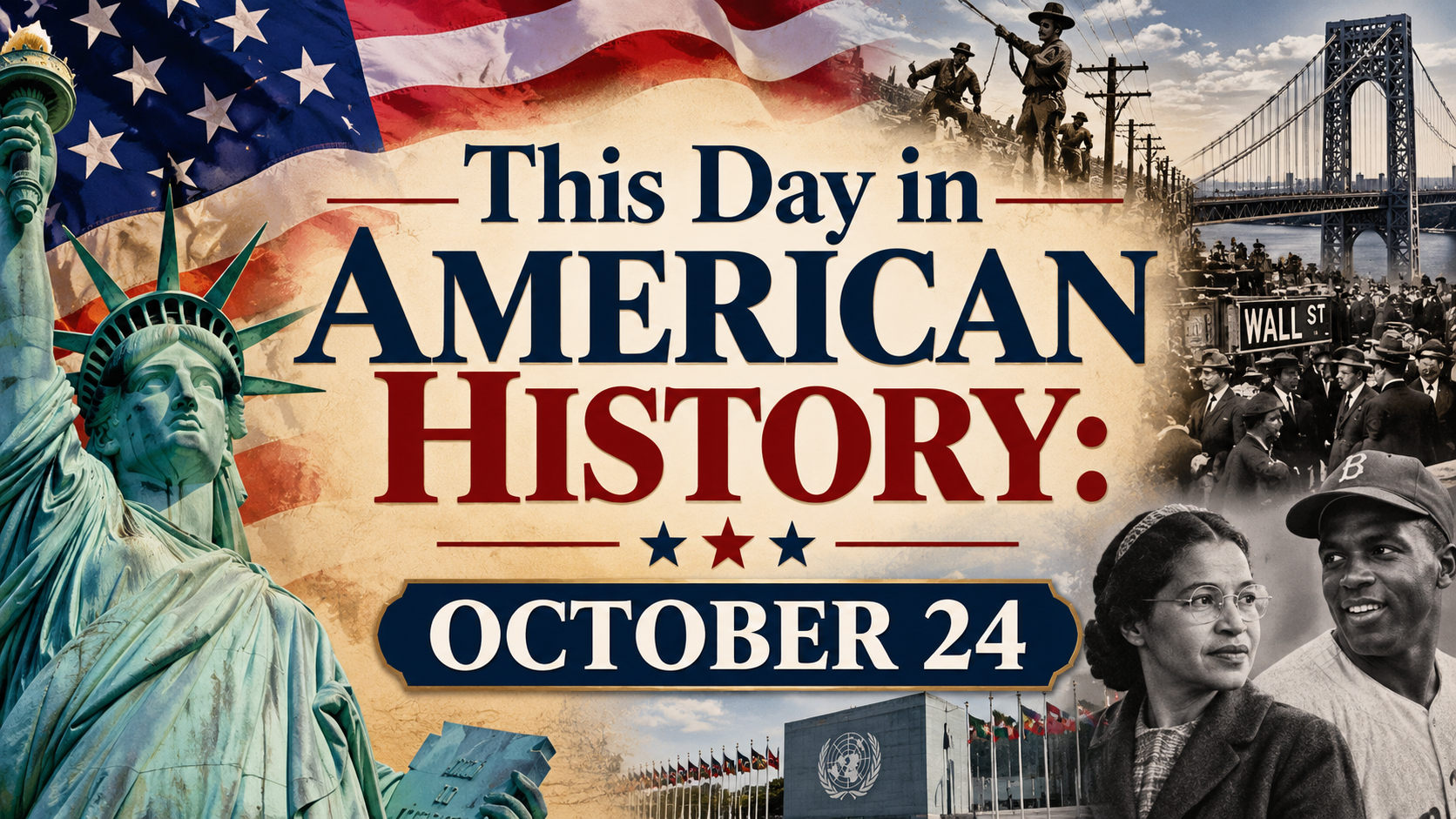
October 24 has witnessed several moments that helped shape the United States—from a communications breakthrough that connected the country coast to coast to the creation of an international organization in which America played a central role.
It is also a date connected to the stock market crash of 1929, the opening of one of America’s most famous bridges, civil rights history, sports history, and the changing role of the United States in the world.
Here is a look back at some of the most important events connected to October 24 in American history.
1861 — The First Transcontinental Telegraph Is Completed
One of the most important technological achievements of 19th-century America occurred on October 24, 1861, when the first transcontinental telegraph system was completed.
The telegraph connected the eastern and western portions of the United States, dramatically changing how quickly information could travel across the country.
Before the telegraph, sending information from one side of the country to the other could take days or even weeks.
The Pony Express had become famous for carrying mail across the West using a relay system of riders and horses. Although incredibly fast for its time, it could not compete with messages traveling electronically over telegraph wires.
According to the Library of Congress, completion of the transcontinental telegraph on October 24 helped bring about the end of the Pony Express, which officially ceased operations shortly afterward.
The timing was especially important because America was in the opening year of the Civil War.
California and the West were physically separated from Washington by enormous distances. The new telegraph connection allowed the federal government and western states to communicate much more rapidly.
California Supreme Court Chief Justice Stephen J. Field sent a message to President Abraham Lincoln celebrating completion of the line and expressing California’s loyalty to the Union.
Today, sending a message across the country takes seconds and barely receives a second thought.
In 1861, the ability to communicate almost instantly from coast to coast was revolutionary.
It was one of America’s early steps toward becoming a truly interconnected nation.
The End of the Pony Express Era
The completion of the telegraph also represents an interesting lesson about technological change.
The Pony Express has become one of the great symbols of the American West.
Its riders traveled through difficult terrain, harsh weather and dangerous conditions to deliver messages and mail.
Yet the service operated for only a relatively short period.
Once the transcontinental telegraph became operational, sending important information by horseback no longer made economic or practical sense.
The Library of Congress notes that the Pony Express officially closed just two days after completion of the telegraph, on October 26, 1861.
Technology had changed communication almost overnight.
The same pattern would repeat throughout American history.
The telegraph would eventually face competition from the telephone.
Radio and television would transform mass communication.
Computers would change how information was stored and transmitted.
And eventually, the internet and smartphones would allow people to communicate with almost anyone in the world instantly.
In that sense, the events of October 24, 1861, were part of a technological transformation that continues today.
1901 — Annie Edson Taylor Survives Niagara Falls in a Barrel
October 24 also became part of American popular history in 1901 when Annie Edson Taylor became the first known person to survive going over Niagara Falls in a barrel.
Even more remarkably, she performed the stunt on her 63rd birthday.
Taylor was a schoolteacher who hoped the dangerous stunt would bring fame and financial security.
She climbed into a specially constructed barrel before being sent toward the enormous drop at Horseshoe Falls.
Against the odds, she survived.
The stunt turned Taylor into a celebrity, although the financial success she hoped for never fully materialized.
Her story became part of the long history of daredevils associated with Niagara Falls.
It also demonstrates something deeply familiar in American culture—the willingness of people to take extraordinary risks in pursuit of fame, opportunity or a better future.
1929 — Black Thursday Shakes Wall Street
One of the darkest economic moments associated with October 24 came in 1929.
The day became known as Black Thursday.
After years of rising stock prices and intense speculation, panic struck Wall Street.
Investors began selling enormous numbers of shares.
The market experienced tremendous volatility as fear spread among investors.
Black Thursday did not by itself create the Great Depression, and the market experienced additional devastating declines in the following days. However, October 24 became one of the defining dates associated with the Wall Street Crash of 1929.
The crash exposed weaknesses within the American financial system and helped destroy confidence in the economy.
Banks eventually failed.
Businesses closed.
Unemployment soared.
Families lost savings, homes and livelihoods.
The economic crisis helped define the presidency of Herbert Hoover and later contributed to the election of Franklin D. Roosevelt.
Roosevelt’s administration responded with the New Deal, an enormous collection of programs and reforms designed to provide relief, encourage economic recovery and reform parts of the financial system.
Black Thursday therefore represents much more than a bad day on Wall Street.
It became part of a chain of events that fundamentally changed the relationship between Americans, financial institutions and the federal government.
1931 — The George Washington Bridge Is Dedicated
Another major American achievement associated with October 24 came in 1931.
The George Washington Bridge, connecting New Jersey and New York across the Hudson River, was dedicated.
At the time, it was an extraordinary engineering accomplishment.
New York Governor Franklin D. Roosevelt participated in the dedication ceremony before becoming president of the United States.
The bridge would become one of the country’s most important transportation links, helping move millions of people and enormous amounts of commerce through the New York metropolitan area.
Its construction occurred during an era when American cities were rapidly expanding and automobiles were becoming increasingly important.
Bridges, highways, tunnels and other infrastructure would transform where Americans lived and worked.
The George Washington Bridge became one of the most recognizable examples of that transformation.
1945 — The United Nations Officially Comes Into Existence
Perhaps the most globally significant event associated with October 24 occurred in 1945.
On that day, the United Nations officially came into existence.
World War II had devastated countries across Europe and Asia.
Tens of millions of people had died.
Cities had been destroyed.
The Holocaust had revealed horrifying crimes against humanity.
And the atomic bomb had demonstrated that future wars could potentially become even more destructive.
World leaders faced an enormous question:
Could nations create an international organization capable of preventing another global catastrophe?
Representatives from 50 countries gathered in San Francisco between April and June 1945 to develop the United Nations Charter.
The Charter was signed on June 26.
It officially took effect on October 24, 1945, after the required nations—including the United States—ratified it.
That is why October 24 is recognized internationally as United Nations Day.
America’s Role in Creating the United Nations
The creation of the United Nations represented an important shift in American foreign policy.
After World War I, President Woodrow Wilson had strongly supported the creation of the League of Nations.
Ironically, the United States never joined the organization Wilson had helped inspire.
By the end of World War II, American leaders were determined not to repeat that experience.
The United States became one of the founding members of the United Nations and one of the five permanent members of the United Nations Security Council.
The others were China, France, the Soviet Union and the United Kingdom.
The organization was designed to give countries a place to discuss international disputes, promote cooperation and attempt to prevent conflicts from escalating into larger wars.
Its history has certainly included successes, failures and controversy.
But the United Nations remains one of the central international organizations created in the aftermath of World War II.
And its official beginning occurred on October 24.
1951 — President Truman Declares America’s War With Germany Officially Over
World War II fighting in Europe ended in 1945, but technically ending wartime legal conditions took longer.
On October 24, 1951, President Harry S. Truman issued a proclamation formally ending the state of war between the United States and Germany.
For most Americans, the war had effectively ended years earlier.
Germany had surrendered in May 1945.
American troops returned home.
Families celebrated victory.
But the legal consequences of war required additional governmental action.
Truman’s proclamation therefore represented another formal step away from World War II and toward the new Cold War era.
By 1951, America’s attention had already shifted dramatically.
The Soviet Union had become the country’s primary geopolitical rival.
Germany itself had been divided into East and West.
American forces were fighting in Korea.
The world had changed remarkably quickly.
1962 — James Brown Records Live at the Apollo
American history is not only political or military history.
Music has played an enormous role in shaping American culture.
On October 24, 1962, James Brown performed at the Apollo Theater in Harlem during a concert that was recorded for what became the legendary album Live at the Apollo.
Brown was already developing a reputation as an extraordinary performer, but the recording helped push his career to another level.
The album became an important part of American popular music history and helped establish Brown as one of the most influential performers of his generation.
His influence would eventually extend far beyond soul and R&B.
Elements of Brown’s music became foundational to funk and later heavily influenced hip-hop.
It is another reminder that American history can be found not only in the White House and on battlefields but also inside theaters, recording studios and music halls.
1972 — Jackie Robinson Dies
October 24 is also a significant date in American sports and civil rights history.
Jackie Robinson died on October 24, 1972.
Robinson’s importance extended far beyond baseball.
In 1947, he broke Major League Baseball’s modern color barrier when he joined the Brooklyn Dodgers.
Robinson faced racism from fans, opposing players and others around the sport.
Yet he became one of baseball’s greatest players while helping challenge segregation in one of America’s most visible institutions.
His career demonstrated the power sports could have in changing American culture.
Robinson later continued speaking about civil rights and racial equality.
When he died at just 53 years old, America lost someone whose impact reached far beyond the baseball diamond.
Today, Robinson’s number 42 has been retired throughout Major League Baseball, one of the greatest honors ever given to an American athlete.
2005 — Rosa Parks Dies
Another towering figure in American civil rights history died on October 24.
Rosa Parks died on October 24, 2005, at the age of 92.
Nearly 50 years earlier, Parks had refused to surrender her seat to a white passenger on a segregated bus in Montgomery, Alabama.
Her arrest helped spark the Montgomery Bus Boycott, one of the pivotal events of the modern Civil Rights Movement.
The boycott lasted more than a year and helped bring national attention to a young minister named Martin Luther King Jr.
Parks’ decision is sometimes portrayed as a spontaneous act by someone who was simply physically tired.
Her story was much deeper.
She had already been involved in civil rights work, and her resistance became part of a larger organized struggle against racial segregation.
Her death on October 24, 2005, gave Americans another opportunity to reflect on how much the country had changed—and how much work remained.
October 24 Connects Several Different Chapters of America
Looking across the events associated with October 24 reveals something fascinating.
There is no single theme.
Instead, the date connects several different parts of the American story.
Technology: The transcontinental telegraph transformed communication.
Economic history: Black Thursday became one of the defining moments of the 1929 stock market crash.
Infrastructure: The George Washington Bridge represented American engineering and expansion.
World affairs: The creation of the United Nations reflected America’s growing international role after World War II.
Music: James Brown’s Apollo performance became part of American cultural history.
Civil rights: Jackie Robinson and Rosa Parks helped challenge racial barriers and change the nation.
Together, these events demonstrate why studying history day by day can be so interesting.
A single date can connect stories separated by generations.
Why October 24, 1861, Still Matters Today
Of all the American events associated with this date, completion of the transcontinental telegraph may be one of the easiest to overlook.
Yet its impact was enormous.
Imagine living in California during the Civil War.
Washington, D.C., was thousands of miles away.
News from the East could arrive long after events occurred.
Political decisions, military developments and personal messages all faced the limitations of distance.
Then suddenly electrical signals could carry information across the continent.
The physical distance remained the same.
The informational distance collapsed.
That same transformation has continued throughout American history.
Telegraph.
Telephone.
Radio.
Television.
Satellites.
Internet.
Smartphones.
Each generation has discovered faster ways to communicate.
October 24, 1861, represents one of the earliest great leaps in that journey.
History Is More Than Dates
When we study American history, it is easy to focus only on dates.
But dates matter because of the people behind them.
Someone had to build the telegraph lines across thousands of miles.
Investors experienced fear and financial devastation during the market crash.
Workers constructed massive bridges.
Diplomats attempted to design an international organization after the destruction of a world war.
Musicians transformed American culture.
Athletes challenged barriers.
Civil rights activists risked their safety and freedom to demand equality.
History becomes meaningful when we remember the human experiences behind the events.
Final Thoughts
October 24 holds an important place in American history.
On this date in 1861, the transcontinental telegraph connected the nation in a revolutionary new way.
In 1929, Black Thursday became one of the defining moments of the Wall Street crash.
In 1931, the George Washington Bridge represented a new era of American transportation and engineering.
In 1945, the United Nations officially came into existence with the United States playing a major role in its creation.
And October 24 would later become connected to two giants of American civil rights history through the deaths of Jackie Robinson and Rosa Parks.
Some historical dates are remembered because of one enormous event.
October 24 is different.
It reminds us that America’s story is built from thousands of moments—technological breakthroughs, economic crises, cultural achievements, struggles for equality and decisions that changed America’s relationship with the rest of the world.
Every generation adds another chapter.
And when we look back at October 24, we can see just how much the United States has changed—and how events from decades or even centuries ago continue to influence the America we know today.
Which October 24 event do you believe had the greatest impact on American history: the transcontinental telegraph, Black Thursday, the creation of the United Nations, or something else?




Leave a ReplyCancel reply