
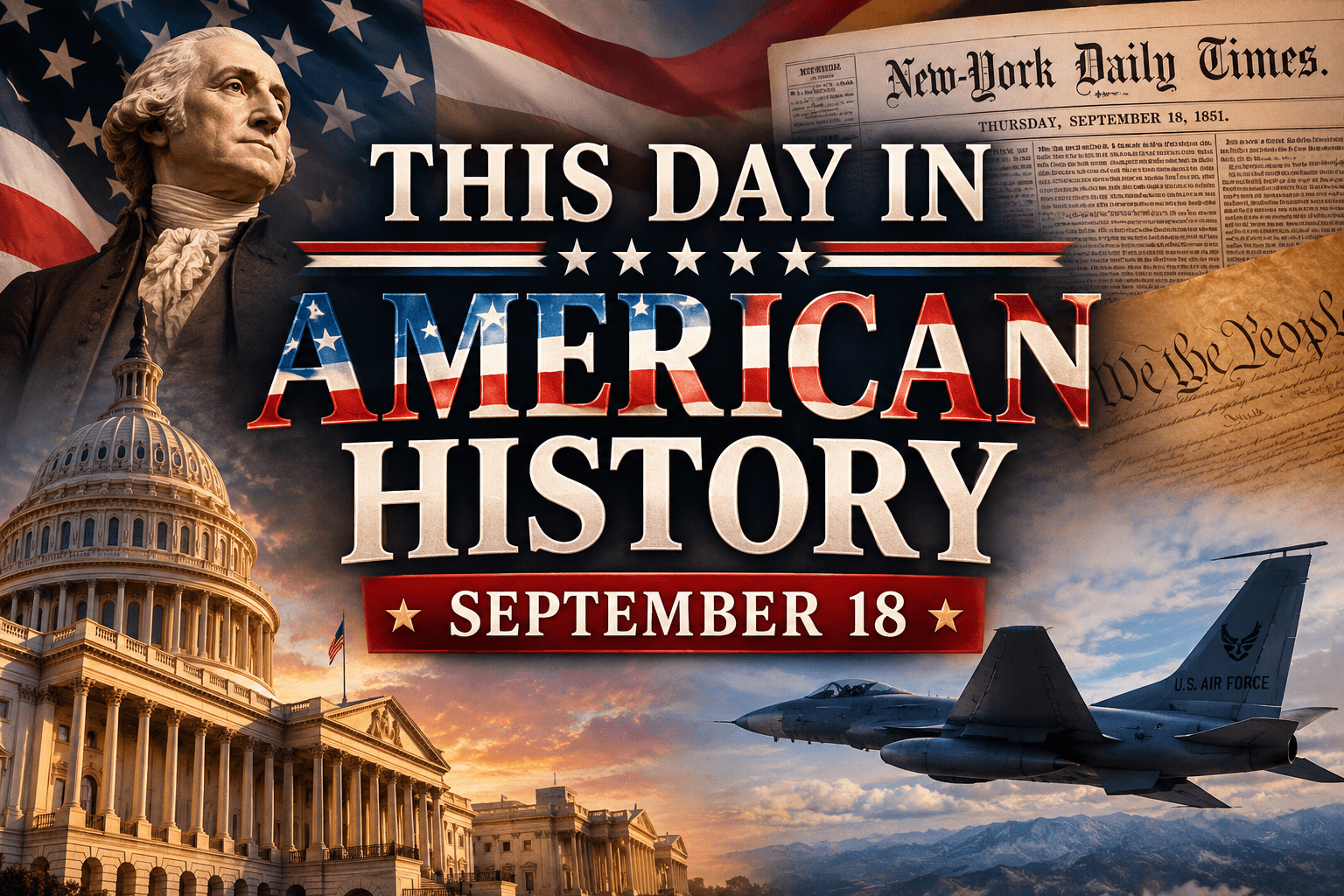
September 18 has witnessed events that helped shape the government, laws, military, culture, and identity of the United States. From George Washington laying the cornerstone of the U.S. Capitol to the creation of the United States Air Force, this date connects some of the earliest years of the republic with the emergence of modern America.
It is also a date that reminds us that American history contains both moments of achievement and painful chapters that should never be forgotten.
Here is a look back at some of the important events connected to September 18 in American history.
1793 – George Washington Lays the Cornerstone of the U.S. Capitol
One of the most symbolic events associated with September 18 occurred in 1793, when President George Washington laid the cornerstone of the United States Capitol.
The federal government was still young, and Washington, D.C., was only beginning to take shape as the permanent capital of the nation.
The Capitol was intended to become much more than another government building. It would become the home of the United States Congress and one of the country’s most recognizable symbols of representative government.
On September 18, Washington participated in a large procession to the Capitol construction site. The ceremony included military participants, musicians, spectators, and members of Masonic lodges.
Washington placed the cornerstone during a Masonic ceremony, marking an important milestone in the construction of the new nation’s seat of legislative government.
The Capitol would not be ready immediately. Construction continued for years, and when Congress moved to Washington in 1800, portions of the building were still unfinished.
Over the centuries, the Capitol would be expanded, damaged, rebuilt, renovated, and transformed.
Yet September 18, 1793, remains one of the defining dates in its history.
A Building That Became a National Symbol
Few buildings are as closely associated with the American government as the Capitol.
Presidents have been inaugurated there. Historic legislation has been debated within its chambers. Members of Congress have gathered there during wars, economic crises, political conflicts, and moments of national celebration.
The building Washington helped begin in 1793 eventually became one of the most recognizable symbols of the United States.
Interestingly, the exact location of Washington’s original cornerstone remains uncertain. More than two centuries after the ceremony, historians and officials have continued trying to determine precisely where it was placed.
That mystery adds another fascinating layer to the story of September 18.
1850 – The Fugitive Slave Act Is Approved
September 18 also marks one of the darker chapters in American history.
On September 18, 1850, President Millard Fillmore approved the Fugitive Slave Act of 1850.
The law was part of the larger Compromise of 1850, a collection of measures intended to address growing tensions between free states and slave states as the nation expanded westward.
Rather than resolving the conflict over slavery, however, the Fugitive Slave Act intensified it.
The law strengthened the federal system for capturing people who had escaped slavery and returning them to those claiming ownership over them.
Its reach extended into free states, meaning that escaping slavery did not necessarily guarantee freedom.
The law also placed free Black Americans at increased risk of kidnapping and wrongful seizure.
For many people in the North who had previously viewed slavery primarily as a Southern institution, the law made the issue much more immediate.
Citizens were forced to confront a difficult question: Would they cooperate with a system designed to return human beings to slavery?
Many refused.
Growing Resistance to Slavery
Resistance to the Fugitive Slave Act became part of the growing abolitionist movement.
Networks of activists helped people escaping slavery find shelter, transportation, food, and routes toward safer destinations. Communities sometimes resisted attempts by authorities and slave catchers to seize alleged fugitives.
The controversy surrounding the law demonstrated just how deeply divided the United States had become.
Instead of creating lasting peace between North and South, the political compromises of 1850 largely postponed a confrontation that was becoming increasingly difficult to avoid.
Eleven years later, the Civil War began.
The events surrounding September 18, 1850, remind us that history is not only about celebrating national accomplishments. It also requires confronting injustice and understanding how laws and institutions can profoundly affect human lives.
1851 – The New York Times Begins Publication
September 18 also has an important connection to the history of American journalism.
On September 18, 1851, the newspaper that would eventually become known as The New York Times published its first edition.
Originally called the New-York Daily Times, the newspaper was founded by journalist Henry Jarvis Raymond and banker George Jones.
The newspaper entered a rapidly changing American media landscape.
During the nineteenth century, newspapers were becoming increasingly influential. Improvements in printing, transportation, and communication allowed information to travel farther and faster than ever before.
Newspapers informed Americans about elections, wars, business, crime, international affairs, and everyday community life.
Over the following decades, The New York Times grew into one of the country’s most influential newspapers.
Its September 18 beginning therefore represents an important milestone in the development of American journalism.
1947 – The United States Air Force Becomes an Independent Military Service
Another major milestone occurred on September 18, 1947, when the United States Air Force began its existence as an independent military service.
Before that time, America’s military aviation forces had operated under the Army.
Aviation had changed dramatically during the first half of the twentieth century.
When airplanes first appeared, their potential military importance was uncertain. World War I demonstrated that aircraft could play an important role in reconnaissance and combat.
By World War II, aviation had become essential.
Bombers could strike targets hundreds or thousands of miles away. Fighters battled for control of the skies. Transport aircraft moved troops and supplies across enormous distances.
The Army Air Forces became a massive military organization during World War II.
After the war, American leaders recognized that airpower had become important enough to justify an independent military branch.
President Harry S. Truman signed the National Security Act of 1947 on July 26. The legislation created the Department of the Air Force and established the United States Air Force under it. On September 18, W. Stuart Symington was sworn in as the first Secretary of the Air Force, marking the department’s formal establishment.
A New Era of American Defense
The creation of the Air Force came at an important moment.
World War II had ended only two years earlier, but tensions between the United States and Soviet Union were rapidly increasing.
The Cold War was beginning.
Aircraft—and eventually missiles, satellites, advanced surveillance systems, and other technologies—would become central to America’s national defense strategy.
The Air Force would play major roles in the Berlin Airlift, Korean War, Vietnam War, Persian Gulf War, Afghanistan, Iraq, and numerous other American military operations.
September 18 therefore became recognized as the birthday of the United States Air Force.
From early propeller-driven military aircraft to supersonic jets and advanced aerospace technology, the history of the Air Force reflects the extraordinary transformation of aviation during the twentieth and twenty-first centuries.
September 18 and the Evolution of America
Looking at these events together reveals something interesting about September 18.
Each represents a different part of America’s development.
1793 represented the construction of American democracy.
George Washington laying the Capitol cornerstone symbolized the physical creation of the new federal government.
1850 represented America’s struggle over slavery.
The Fugitive Slave Act exposed the moral and political divisions that would eventually contribute to the Civil War.
1851 represented the growing influence of American journalism.
The emergence of major newspapers reflected a nation becoming more connected and increasingly dependent on rapidly distributed information.
1947 represented America’s emergence as a modern military and global power.
The establishment of the Air Force demonstrated how dramatically warfare and technology had changed.
Together, these events span more than 150 years of American development.
History Is More Than Dates
It is easy to think of history as a collection of names, dates, wars, presidents, and laws.
But history becomes much more meaningful when we consider the people who lived through these events.
Imagine standing in the unfinished federal city in 1793 as George Washington participated in the Capitol cornerstone ceremony.
The United States Constitution had been in operation for only a few years. No one standing there could know whether the young American experiment would survive.
Imagine living in 1850 and watching the national argument over slavery grow more intense.
For someone escaping slavery, the passage of the Fugitive Slave Act was not simply a political event. It could mean the difference between freedom and being forced back into bondage.
Imagine picking up the first edition of a new newspaper in New York City in 1851 without knowing that it would continue publishing generations later.
Or imagine serving in the Army Air Forces during World War II and discovering just two years after the war that military aviation would become its own independent service.
People living through history rarely know which moments future generations will consider important.
They are simply living their lives.
Only later do we understand how those moments fit into the larger American story.
Remembering September 18
September 18 offers an opportunity to reflect on how dramatically the United States has changed since its earliest years.
The America of George Washington was a young republic still constructing its capital.
The America of 1850 was increasingly divided over whether slavery would continue expanding.
The America of the late nineteenth and early twentieth centuries experienced enormous growth in journalism, industry, transportation, immigration, and technology.
By 1947, the United States had emerged from World War II as one of the world’s leading military and economic powers.
Each generation inherited a different America.
And each generation helped shape what came next.
That is one of the most important lessons history can teach us.
The country we know today was not created during a single moment. It developed through millions of decisions, conflicts, sacrifices, inventions, failures, achievements, and acts of courage stretching across generations.
Final Thoughts
September 18 is a remarkable date in American history.
It marks the day George Washington laid the cornerstone of the U.S. Capitol, beginning another chapter in the construction of the young nation’s government.
It marks the approval of the Fugitive Slave Act of 1850, a painful reminder of slavery’s reach and the growing divisions that pushed the country toward Civil War.
It marks an important date in the development of American journalism.
And it marks the establishment of the United States Air Force as an independent military service, opening a new chapter in American defense and aviation history.
Some events deserve celebration.
Others demand reflection.
Both deserve to be remembered.
Because understanding American history means recognizing the country’s greatest achievements while also acknowledging its darkest chapters.
Every date on the calendar holds stories.
And on September 18, those stories stretch from the foundations of the U.S. Capitol to the skies above America.
Which September 18 event do you think had the greatest impact on the course of American history?
Leave a ReplyCancel reply