
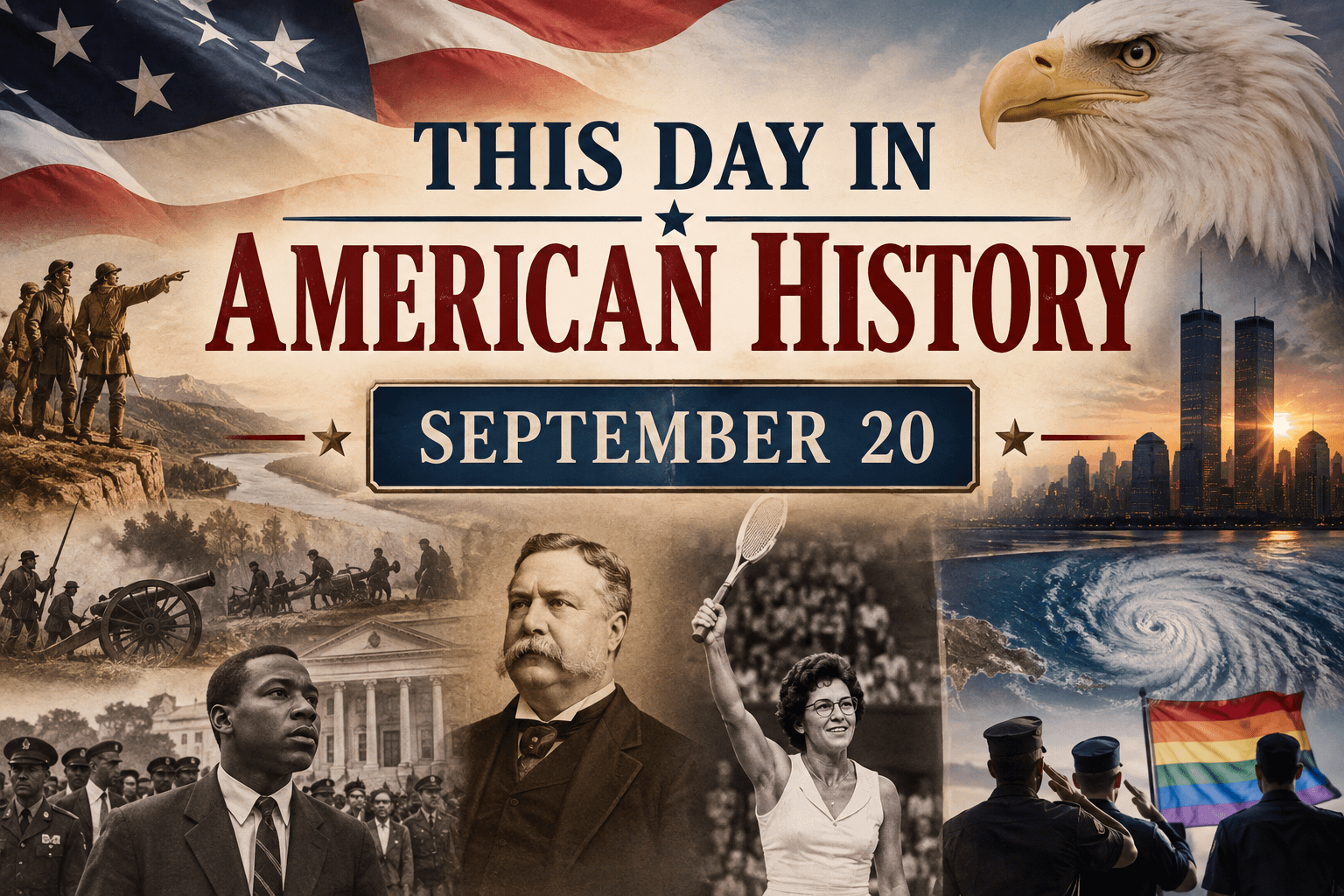
September 20 has witnessed moments that changed American politics, exploration, literature, civil rights, sports, national security, and the continuing struggle for equality. From the return of Lewis and Clark to the presidency of Chester A. Arthur, from Billie Jean King’s historic tennis victory to the national response following September 11, this date offers a fascinating look at the many forces that have shaped the United States.
Here are some of the most significant events connected to September 20 in American history.
1806 – Lewis and Clark Near the End of Their Historic Expedition
On September 20, 1806, Meriwether Lewis, William Clark, and the Corps of Discovery reached La Charrette, a small settlement along the Missouri River.
It was an emotional milestone.
For more than two years, the expedition had traveled through enormous stretches of territory largely unfamiliar to Americans of European descent. The explorers had crossed mountains, followed rivers, encountered numerous Native American nations, endured brutal weather, faced shortages of food and supplies, and finally reached the Pacific Ocean.
Now they were approaching civilization again.
La Charrette was the first permanent settlement the expedition had encountered on its return journey after spending months in the wilderness.
Three days later, on September 23, Lewis and Clark arrived back in St. Louis.
Their return completed one of the most famous exploratory journeys in American history.
The expedition dramatically expanded American geographic knowledge of the West. Its members documented plants, animals, rivers, mountains, landscapes, and Native American communities while searching for practical transportation routes across the continent.
Their journals eventually became an invaluable historical record of early 19th-century North America.
The expedition also became closely associated with the nation’s westward expansion—a process that brought enormous changes and severe consequences for the Indigenous peoples who had inhabited these lands for generations.
September 20 therefore represents one of the final chapters of a journey that would profoundly influence America’s understanding of the continent.
1863 – The Battle of Chickamauga Ends
September 20, 1863, marked the second and final day of the Battle of Chickamauga during the American Civil War.
The battle was fought in northern Georgia between Confederate forces under General Braxton Bragg and Union forces commanded by Major General William Rosecrans.
It became one of the bloodiest battles of the entire Civil War.
During the fighting on September 20, a mistaken Union troop movement created a dangerous opening in the Federal lines. Confederate forces under Lieutenant General James Longstreet exploited the gap and launched a powerful assault.
Part of the Union army collapsed and retreated toward Chattanooga.
However, Union General George H. Thomas organized a determined defense that helped prevent the retreat from becoming an even greater disaster.
His stand earned him the famous nickname:
“The Rock of Chickamauga.”
The Confederacy had achieved an important battlefield victory, but it was unable to turn Chickamauga into a decisive strategic triumph.
Union forces eventually maintained control of Chattanooga, which became an important base for later campaigns into the Deep South.
The Battle of Chickamauga demonstrated once again the extraordinary human cost of the Civil War and the difficulty either side faced in achieving a decisive victory.
1878 – Upton Sinclair Is Born
Upton Sinclair was born in Baltimore, Maryland, on September 20, 1878.
He would become one of America’s most famous investigative writers and social reformers.
Sinclair wrote dozens of books, but none became more influential than his 1906 novel The Jungle.
The novel focused on immigrant workers and the brutal working conditions they faced in Chicago’s meatpacking industry.
Sinclair intended the book largely as a criticism of worker exploitation and economic inequality.
Instead, many readers became particularly horrified by his descriptions of unsanitary conditions in food production.
Public reaction helped increase pressure for federal regulation of the food and meat industries.
In 1906, President Theodore Roosevelt signed the Meat Inspection Act and the Pure Food and Drug Act.
Sinclair continued writing about political corruption, economic inequality, labor conditions, and social reform throughout his long career.
His work demonstrated something that remains true today:
Writing can do more than entertain.
It can expose problems, influence public opinion, and sometimes help change laws.
1881 – Chester A. Arthur Becomes President
One of the most unusual presidential transitions in American history occurred during the early morning hours of September 20, 1881.
Vice President Chester A. Arthur took the presidential oath of office following the death of President James A. Garfield.
Garfield had been shot on July 2, 1881, by Charles Guiteau at a railroad station in Washington, D.C.
He survived for more than two months before dying on September 19.
News of Garfield’s death reached Arthur in New York.
At approximately 2:15 a.m. on September 20, Arthur took the oath of office inside his New York City home.
New York Supreme Court Judge John R. Brady administered the oath.
Arthur later took the oath again publicly in Washington.
He became the 21st president of the United States.
Arthur’s rise to the presidency surprised many Americans.
He had been closely associated with New York’s political machine and the patronage system, in which government positions were frequently awarded based on political loyalty rather than qualifications.
Yet as president, Arthur became associated with an important reform of that very system.
In 1883, he signed the Pendleton Civil Service Reform Act, which helped establish a merit-based system for certain federal government jobs.
Arthur’s presidency is an interesting reminder that political leaders do not always govern exactly as people expect them to.
1962 – James Meredith Is Blocked From the University of Mississippi
September 20, 1962, became another important date in the struggle to desegregate American higher education.
James Meredith, a Black Air Force veteran, had been attempting to enroll at the University of Mississippi.
Despite federal court orders supporting his admission, Mississippi officials resisted integration.
On September 20, Meredith was prevented from completing his enrollment.
The confrontation became part of a much larger constitutional struggle between federal authority and state resistance to desegregation.
President John F. Kennedy’s administration eventually intervened.
Federal marshals were sent to protect Meredith, and violent riots erupted on the university campus.
Two people were killed and many others were injured.
On October 1, 1962, James Meredith finally registered for classes.
His enrollment became an important milestone in the American civil rights movement.
The confrontation demonstrated that court decisions alone could not instantly dismantle segregation. Enforcing constitutional rights sometimes required direct federal intervention against determined resistance.
1973 – Billie Jean King Wins the “Battle of the Sexes”
One of the most famous sporting events in American history took place on September 20, 1973.
Tennis champion Billie Jean King faced former men’s champion Bobby Riggs at the Houston Astrodome.
The event was promoted as the “Battle of the Sexes.”
Riggs had publicly claimed that even at age 55 he could defeat leading female tennis players.
King understood that the match had become about much more than tennis.
At a time when women were fighting for greater opportunities, recognition, and equal treatment in American society, millions viewed the contest as a symbolic test of women’s athletic abilities.
The spectacle attracted an enormous audience.
More than 30,000 spectators packed the Astrodome, while tens of millions watched on television.
Then King took control.
She defeated Riggs in straight sets:
6–4, 6–3, 6–3.
Her victory became one of the defining moments in women’s sports.
King was already advocating for equal treatment and greater prize money for female athletes, but the enormous publicity surrounding the match gave those efforts an even larger national platform.
The contest took place during a period of rapid change in American sports and society, shortly after the passage of Title IX in 1972.
King’s victory did not create equality by itself.
But it became a powerful symbol of a much larger movement.
2001 – President George W. Bush Addresses Congress After September 11
Only nine days after the terrorist attacks of September 11, 2001, President George W. Bush addressed a joint session of Congress on September 20.
The country was still grieving.
Nearly 3,000 people had been killed after hijacked commercial airplanes struck the World Trade Center in New York and the Pentagon outside Washington, while another hijacked aircraft crashed in Pennsylvania after passengers and crew members resisted the attackers.
Americans were looking for answers about who was responsible and what would happen next.
President Bush used the September 20 address to explain the government’s response and prepare the nation for what would become known as the War on Terror.
He honored victims, passengers, rescuers, and ordinary Americans who had responded to the attacks.
The speech also made clear that the United States intended to pursue those responsible for the attacks and those who supported them.
The decisions that followed would reshape American foreign policy for decades.
The United States invaded Afghanistan in October 2001 with the objective of dismantling al-Qaeda and removing the Taliban government that had provided sanctuary to the organization.
The broader response to September 11 also transformed airport security, intelligence operations, military policy, surveillance laws, immigration procedures, and America’s relationships with countries around the world.
Looking back, September 20, 2001, stands as one of the defining political moments of the early 21st century.
2011 – “Don’t Ask, Don’t Tell” Officially Ends
Another significant change in American military policy occurred on September 20, 2011.
The military’s “Don’t Ask, Don’t Tell” policy officially ended.
The policy had been implemented during the Clinton administration in the 1990s.
It allowed gay and lesbian Americans to serve in the military only if they did not openly disclose their sexual orientation.
Service members could still be discharged for openly identifying as gay or lesbian.
After years of political debate, Congress voted to repeal the policy in December 2010.
The repeal officially took effect on September 20, 2011.
Its end represented a major change in U.S. military policy and an important milestone in the broader history of LGBTQ rights in America.
2017 – Hurricane Maria Devastates Puerto Rico
On September 20, 2017, Hurricane Maria made landfall in Puerto Rico.
The Category 4 hurricane brought catastrophic winds and rainfall.
Communities across the island experienced severe flooding, destroyed homes, damaged roads, collapsed communications networks, and widespread power outages.
Puerto Rico’s electrical system suffered catastrophic damage.
Some communities remained without electricity for months.
The disaster also created a humanitarian crisis involving shortages of clean water, medical care, fuel, transportation, and other essential services.
The official death toll was eventually revised dramatically upward as researchers examined deaths associated with the storm and its aftermath.
Maria became one of the deadliest natural disasters in modern American history.
The hurricane also sparked major debates over infrastructure, emergency preparedness, federal disaster response, Puerto Rico’s political status, and the responsibilities of the federal government toward U.S. citizens living in the territory.
Years later, the effects of Hurricane Maria remain an important part of Puerto Rico’s modern history.
September 20 Through the Years
Few dates demonstrate the range of American history as clearly as September 20.
On this date, explorers neared the end of an extraordinary continental journey.
Soldiers fought one of the Civil War’s bloodiest battles.
A future investigative journalist was born.
A vice president unexpectedly became president.
A Black veteran challenged segregation at one of America’s major universities.
A female tennis champion stepped onto a court carrying the expectations of millions.
A president addressed a frightened nation following one of the deadliest attacks in American history.
A discriminatory military policy officially ended.
And millions of Americans in Puerto Rico endured one of the most destructive hurricanes in the island’s history.
These events may seem unrelated, but together they reveal something important about studying history.
American history is not one story.
It is thousands of stories overlapping one another—stories of exploration, war, leadership, injustice, courage, reform, disaster, resistance, equality, and change.
Why September 20 Matters
History becomes more meaningful when we look beyond dates and ask what those events changed.
Lewis and Clark’s expedition influenced America’s understanding and expansion into the West.
Chickamauga showed the terrible price Americans paid during the Civil War.
Upton Sinclair demonstrated the power of journalism and literature to expose injustice.
Chester A. Arthur’s unexpected presidency contributed to civil service reform.
James Meredith challenged institutional segregation.
Billie Jean King used sports as a platform for equality.
The events following September 11 transformed American national security and foreign policy.
The repeal of “Don’t Ask, Don’t Tell” reflected changing attitudes toward who could openly serve in the U.S. military.
Hurricane Maria exposed the vulnerability of infrastructure and raised difficult questions about disaster preparedness and recovery.
That is what makes looking back at a single day so fascinating.
A date on the calendar can contain centuries of human experience.
Remembering September 20
When we study September 20, we are not simply memorizing names and dates.
We are remembering people who explored unknown territory, soldiers who endured battle, writers who challenged powerful institutions, citizens who fought discrimination, athletes who broke barriers, leaders who faced national crises, and communities that survived unimaginable destruction.
Every generation inherits the consequences of decisions made by the generations before it.
Understanding those decisions helps us better understand the country we live in today.
History reminds us where America has succeeded.
It reminds us where America has failed.
And perhaps most importantly, it reminds us that the American story is still being written.
Which event from September 20 do you think had the greatest impact on American history?
Leave a ReplyCancel reply