
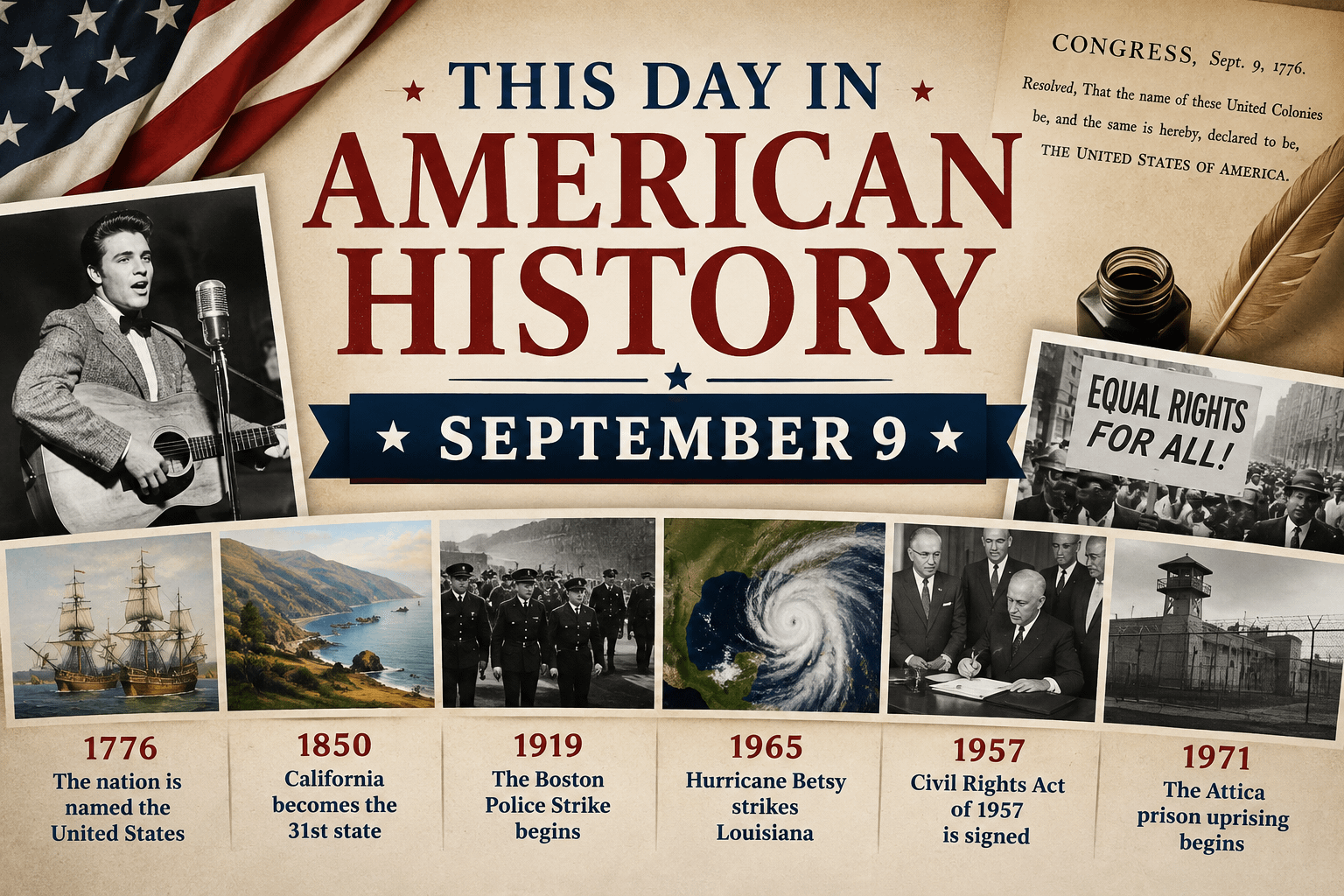
September 9 has witnessed moments that helped define the United States politically, culturally, and socially. From the young nation officially adopting the name “United States” during the American Revolution to California becoming the 31st state, Elvis Presley transforming popular culture on national television, landmark civil rights legislation, and the beginning of the Attica prison uprising, this date offers a fascinating look at the forces that have shaped America.
History is more than a collection of dates. Each event represents people making decisions, confronting challenges, and sometimes changing the direction of the country. On September 9, those changes have ranged from the very name Americans use for their nation to the music they listen to and the laws designed to protect their rights.
1776 – The Nation Becomes the “United States”
One of the most important September 9 events occurred during the American Revolution.
On September 9, 1776, the Continental Congress formally changed the terminology used to describe the newly independent nation. Instead of referring to the former British colonies collectively as the “United Colonies,” Congress directed that official documents use the name “United States.”
The change came only a little more than two months after the Declaration of Independence had been adopted on July 4, 1776.
The colonies were no longer simply British territories cooperating in a rebellion. They were attempting to establish themselves as independent states joined together in a new political experiment.
The new name reflected that transformation.
The words United States of America would eventually become recognized around the world, but in September 1776, the country bearing that name was still fighting for its survival.
George Washington and the Continental Army faced one of the world’s strongest military powers. Independence had been declared, but victory was far from guaranteed.
That makes the September 9 decision especially meaningful. America’s founders were not waiting until the war was won to begin defining their new country. They were already building the identity of the nation they hoped would survive.
Today, the name seems permanent and inevitable. In 1776, however, it represented an extraordinary declaration of confidence in America’s future.
1850 – California Becomes the 31st State
Another defining moment occurred on September 9, 1850, when California officially entered the Union as the 31st state.
California’s admission was part of the broader Compromise of 1850, a collection of measures designed to address growing national disagreements over slavery and the status of territories acquired after the Mexican-American War.
California entered the Union as a free state, meaning slavery would not be permitted there.
The decision had national consequences because the balance between free states and slave states was one of the most politically explosive issues of the era.
California itself was also undergoing an extraordinary transformation.
The discovery of gold at Sutter’s Mill in 1848 triggered the California Gold Rush. Thousands of people traveled west hoping to find wealth and opportunity.
Communities expanded rapidly. San Francisco grew dramatically, businesses appeared to serve miners and settlers, and people arrived from across the United States and around the world.
The population increase accelerated California’s path toward statehood.
California would eventually become America’s most populous state and one of the world’s largest economic centers, playing major roles in agriculture, entertainment, technology, aerospace, international trade, and countless other industries.
Yet its official journey as a state began on September 9, 1850.
1919 – The Boston Police Strike Begins
On September 9, 1919, most members of the Boston Police Department went on strike.
Police officers had been seeking improvements in wages and working conditions and wanted greater freedom to organize.
When hundreds of officers walked off the job, Boston suddenly faced a serious public safety crisis.
Looting and disorder occurred in parts of the city, and Massachusetts Governor Calvin Coolidge eventually called in the state militia.
Coolidge’s response gained national attention.
The controversy surrounding the strike helped establish his reputation as a politician willing to take a firm position during a public emergency. His growing national profile contributed to his selection as Warren G. Harding’s running mate in the 1920 presidential election.
Coolidge became vice president and later became president following Harding’s death in 1923.
The Boston Police Strike became part of the broader labor struggles occurring throughout the United States after World War I.
The country was experiencing economic uncertainty, inflation, labor disputes, political tensions, and fears surrounding radical political movements.
September 9, 1919, therefore represents more than a dispute involving one city’s police department. It reflects a period when Americans were debating the power of organized labor and the responsibilities of public employees.
1942 – A Japanese Aircraft Bombs the Continental United States
World War II brought another unusual chapter to September 9 history.
On September 9, 1942, a Japanese aircraft launched from a submarine attempted to start forest fires in Oregon.
The attack became notable because it represented one of the rare occasions during World War II when the continental United States was bombed by an enemy aircraft.
Japan hoped incendiary bombs dropped over forests could ignite large fires that would consume resources and create fear.
The attack caused limited damage and failed to produce the devastating fires planners had hoped for.
Nevertheless, it demonstrated that the Pacific War could occasionally reach the American mainland.
For Americans living along the West Coast during World War II, the possibility of attack was a genuine concern. Coastal communities maintained blackouts and other defensive measures while military officials prepared for the possibility of further attacks.
1956 – Elvis Presley Takes Over American Television
American history isn’t shaped only by presidents, wars, and legislation. Culture can transform a country too.
On September 9, 1956, 21-year-old Elvis Presley made his first appearance on The Ed Sullivan Show.
It became one of the most famous television appearances in American popular culture.
An estimated 60 million viewers watched the broadcast, giving Presley exposure to an enormous national audience.
Interestingly, Ed Sullivan himself wasn’t there.
Sullivan was recovering from injuries suffered in a serious automobile accident, so actor Charles Laughton served as guest host.
Presley performed remotely from Los Angeles, where he was working on his first movie, Love Me Tender.
During the program, Elvis performed songs including “Don’t Be Cruel,” “Ready Teddy,” “Love Me Tender,” and “Hound Dog.”
His energetic performance style fascinated younger viewers while alarming some older Americans.
Rock and roll represented something different.
It was louder, more energetic, and more rebellious than much of the mainstream popular music that had dominated American entertainment.
Elvis became one of the performers who brought that cultural transformation directly into millions of American homes.
His September 9 appearance wasn’t the beginning of his career, but it dramatically expanded his national visibility.
Elvis would become one of the most recognizable entertainers in American history, and rock and roll would permanently transform popular music.
1957 – Eisenhower Signs the Civil Rights Act of 1957
Exactly one year after Elvis Presley’s historic television appearance, September 9 witnessed an important moment in the American civil rights movement.
On September 9, 1957, President Dwight D. Eisenhower signed the Civil Rights Act of 1957.
It was the first major federal civil rights legislation enacted since Reconstruction.
The legislation focused heavily on protecting voting rights.
African Americans, particularly in the South, faced numerous barriers designed to prevent them from registering and voting. These could include literacy tests, intimidation, discriminatory registration practices, economic retaliation, and violence.
The Civil Rights Act of 1957 created a Civil Rights Division within the Department of Justice and represented renewed federal involvement in protecting civil rights.
The law was limited compared with the sweeping legislation that would follow during the 1960s.
However, its importance was partly symbolic.
After decades in which the federal government had largely failed to confront systematic discrimination, Congress had again passed major civil rights legislation.
The struggle continued.
The Civil Rights Act of 1964 and Voting Rights Act of 1965 would later become far stronger tools for combating racial discrimination and protecting voting rights.
The legislation signed on September 9, 1957, helped establish momentum toward those future changes.
1965 – The Department of Housing and Urban Development Is Established
September 9 also played a role in the expansion of America’s federal government during the 1960s.
In 1965, the United States established the Department of Housing and Urban Development, commonly known as HUD.
Its creation came during President Lyndon B. Johnson’s administration and his broader Great Society agenda.
American cities were changing rapidly.
Urban poverty, housing discrimination, deteriorating neighborhoods, transportation problems, and suburban expansion were becoming major political issues.
Creating a cabinet-level department focused on housing and urban development reflected the federal government’s increasing involvement in addressing those challenges.
HUD would eventually oversee programs involving affordable housing, community development, housing assistance, and fair housing protections.
1965 – Hurricane Betsy Strikes Louisiana
September 9, 1965, also brought tragedy to the Gulf Coast.
Hurricane Betsy made landfall near New Orleans as a powerful hurricane, producing devastating winds, flooding, and storm surge.
The storm became historically significant for the enormous economic destruction it caused.
Betsy became the first hurricane in United States history to cause more than $1 billion in damage without adjusting for inflation, earning it the nickname “Billion-Dollar Betsy.”
Large sections of New Orleans flooded after levees failed or were overtopped.
Thousands of homes were damaged or destroyed, and communities across Louisiana faced a long recovery.
Hurricane Betsy became an important event in the history of American disaster response and Gulf Coast hurricane preparedness.
Four decades later, Hurricane Katrina would once again demonstrate the extraordinary vulnerability of New Orleans and surrounding communities to powerful storms.
1966 – A Major Step Toward Safer American Cars
On September 9, 1966, President Lyndon B. Johnson signed the National Traffic and Motor Vehicle Safety Act.
The legislation represented a major change in America’s approach to automobile safety.
By the 1960s, cars had become essential to American life. Interstate highways expanded, suburban communities grew, and millions of Americans depended on automobiles every day.
But traffic deaths were also a serious national problem.
The new legislation gave the federal government greater authority to establish vehicle safety standards.
Over time, federal safety requirements helped influence the development and widespread adoption of features designed to protect drivers and passengers.
Automobile safety continued evolving through improvements involving seat belts, crash protection, airbags, braking systems, child restraints, vehicle construction, and other technologies.
The law signed in 1966 helped establish the principle that automobile manufacturers had an obligation to meet national safety standards.
1971 – The Attica Prison Uprising Begins
One of the darkest events associated with September 9 began in 1971 at Attica Correctional Facility in New York.
Prisoners took control of significant portions of the maximum-security prison and held 42 staff members hostage while demanding improvements in prison conditions and treatment.
The uprising developed amid longstanding complaints involving living conditions, racial tensions, medical treatment, religious freedom, and prisoners’ rights.
Negotiations continued for several days.
On September 13, New York authorities ordered the prison retaken.
The operation ended catastrophically.
Thirty-nine people were killed during the retaking of the prison, including prisoners and hostages.
Attica became one of the most controversial episodes in the history of the American prison system.
The words “Attica” and “Remember Attica” eventually became cultural references associated with prisoners’ rights, government authority, and demands for criminal justice reform.
More than five decades later, the uprising remains an important part of discussions surrounding incarceration and prison conditions in the United States.
September 9 and the Changing Story of America
Few dates demonstrate the diversity of American history quite like September 9.
The events associated with this date reach into politics, geography, entertainment, civil rights, transportation, natural disasters, labor relations, and criminal justice.
In 1776, Americans officially began calling their new nation the United States.
In 1850, California became the 31st state.
In 1919, the Boston Police Strike became a national controversy surrounding labor and public safety.
In 1956, Elvis Presley entered millions of American living rooms and helped accelerate a cultural revolution.
In 1957, the federal government took an important step toward renewed civil rights enforcement.
During the 1960s, Americans confronted questions involving housing, urban development, automobile safety, and natural disasters.
And in 1971, the Attica prison uprising forced the nation to confront difficult questions about incarceration, authority, and prisoners’ rights.
These events might appear unrelated, but together they demonstrate how American history develops.
Some changes happen through laws.
Others happen through war, migration, protest, tragedy, technology, or culture.
Sometimes a decision made in a government chamber changes the country. Other times, a young singer standing in front of a television camera changes it.
Why September 9 Matters
Perhaps the most fitting event associated with September 9 is the one that happened first.
On September 9, 1776, Americans officially began using the words “United States” to describe their new nation.
At that moment, no one could have known exactly what those United States would become.
The country would expand across a continent. New states such as California would join the Union. Americans would endure civil war, economic crises, social movements, natural disasters, political conflict, and dramatic cultural transformations.
Generations would continually debate what America’s founding ideals should mean and who should fully benefit from them.
That story continues today.
September 9 reminds us that the United States has never been a finished project. American history is a continuing story shaped by people who challenged existing systems, created new ideas, demanded change, entertained millions, survived disasters, and attempted to build something better for the generations that followed.
History allows us to see not only where America has been, but how decisions made decades or centuries ago continue to influence the country today.
Which September 9 moment do you think had the greatest impact on the course of American history?
Leave a ReplyCancel reply