
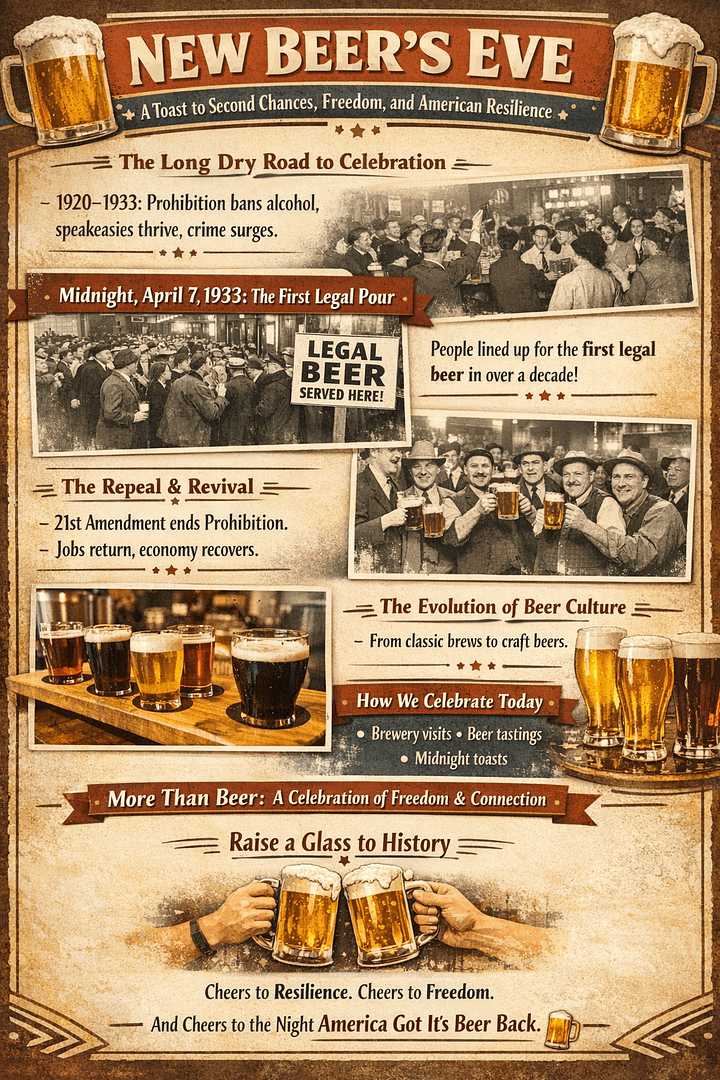
Every year on April 6th, a unique and often overlooked celebration quietly comes to life across the United States. Known as New Beer’s Eve, this unofficial holiday honors a powerful moment in American history—when a nation stepped out from the shadow of restriction and raised a glass to freedom once more.
But New Beer’s Eve is more than just a prelude to a drink. It is a story of perseverance, cultural identity, economic revival, and the undeniable human desire for connection.
📜 The Long Dry Road to Celebration
To truly understand New Beer’s Eve, we have to go back to one of the most controversial chapters in American history: Prohibition.
In 1920, the ratification of the 18th Amendment made the production, sale, and transportation of alcohol illegal across the country. What began as a movement rooted in temperance and moral reform quickly turned into a nationwide experiment with unintended consequences.
Instead of eliminating alcohol consumption, Prohibition drove it underground.
Speakeasies—hidden, illegal bars—began popping up in cities and small towns alike
Bootleggers and organized crime networks thrived
Law enforcement struggled to contain the widespread disregard for the law
For many Americans, Prohibition felt less like protection and more like restriction.
⏳ A Nation Ready for Change
By the early 1930s, the country was in the grips of the Great Depression. Jobs were scarce, businesses were failing, and government revenue had plummeted. The idea of legalizing alcohol once again began to gain traction—not just as a cultural shift, but as an economic necessity.
Enter President Franklin D. Roosevelt.
Shortly after taking office in 1933, Roosevelt signed the Cullen-Harrison Act, allowing the sale of beer and wine with low alcohol content (3.2%). It wasn’t full repeal—but it was a monumental first step.
And Americans were ready.
🍺 Midnight, April 7, 1933: The First Legal Pour
As April 6 turned into April 7, anticipation filled the air. Across the country, people lined up outside bars, taverns, and breweries—some waiting for hours just to be part of history.
When midnight struck, it wasn’t just beer that flowed—it was relief, excitement, and a sense of reclaiming something deeply human.
Newspapers at the time reported:
Millions of barrels of beer were prepared in advance
Cities saw massive crowds celebrating into the early morning hours
Breweries that had been dormant roared back to life almost overnight
For many, that first sip wasn’t just refreshing—it was symbolic.
🇺🇸 The Beginning of the End of Prohibition
New Beer’s Eve marked the turning point, but the journey wasn’t complete until December 1933, when the 21st Amendment officially repealed Prohibition.
This made history in a profound way:
It remains the only amendment ever passed to repeal another
It restored control over alcohol laws back to individual states
It acknowledged that public policy must sometimes adapt to reality
The repeal was not just a legal shift—it was a cultural reset.
💼 Economic Revival: Beer as a Lifeline
The return of legal beer played a surprising but vital role in helping the U.S. economy recover during the Great Depression.
Breweries reopened, and with them came:
Thousands of jobs in brewing, distribution, and hospitality
Increased demand for agriculture (barley, hops, corn)
Tax revenue that helped fund public programs
Beer, in many ways, became more than a beverage—it became part of America’s recovery story.
🍻 The Evolution of American Beer Culture
Fast forward to today, and the American beer scene has evolved into something incredibly diverse and creative.
From large-scale breweries to independent craft operations, beer has become an art form:
IPAs bursting with bold hop flavors
Smooth lagers and crisp pilsners
Rich stouts and porters with notes of coffee and chocolate
Seasonal and experimental brews pushing the boundaries of flavor
New Beer’s Eve now serves as both a celebration of history and a tribute to how far brewing has come.
🎉 How New Beer’s Eve Is Celebrated Today
While not an official holiday, New Beer’s Eve continues to grow in popularity—especially among history buffs and beer enthusiasts.
Common ways people celebrate include:
Visiting local breweries and supporting small businesses
Hosting beer tastings with friends and family
Learning about Prohibition-era history and stories
Counting down to midnight with a toast to freedom
Some bars and breweries even host themed events, recreating the spirit of 1933 with vintage décor and classic brews.
❤️ More Than Beer: A Celebration of Freedom and Connection
At its core, New Beer’s Eve is not just about alcohol—it’s about what that moment represented.
It reminds us:
That people value freedom and personal choice
That communities thrive when they can gather and connect
That even difficult chapters in history can lead to meaningful change
It’s about sitting across from someone, sharing a drink, telling stories, and feeling—if only for a moment—that everything is okay.
🍺 Raise a Glass to History
New Beer’s Eve is a celebration of second chances—a reminder that even after years of restriction, joy can return.
So whether you’re enjoying a cold beer, reflecting on history, or simply appreciating the freedoms you have today, take a moment on April 6th to pause and reflect.
Because sometimes, the smallest things—like a simple glass of beer—can carry the weight of an entire nation’s story.
Cheers to resilience. Cheers to freedom. And cheers to the night America got its beer back.
Read More Holidays & National Days
Leave a ReplyCancel reply