
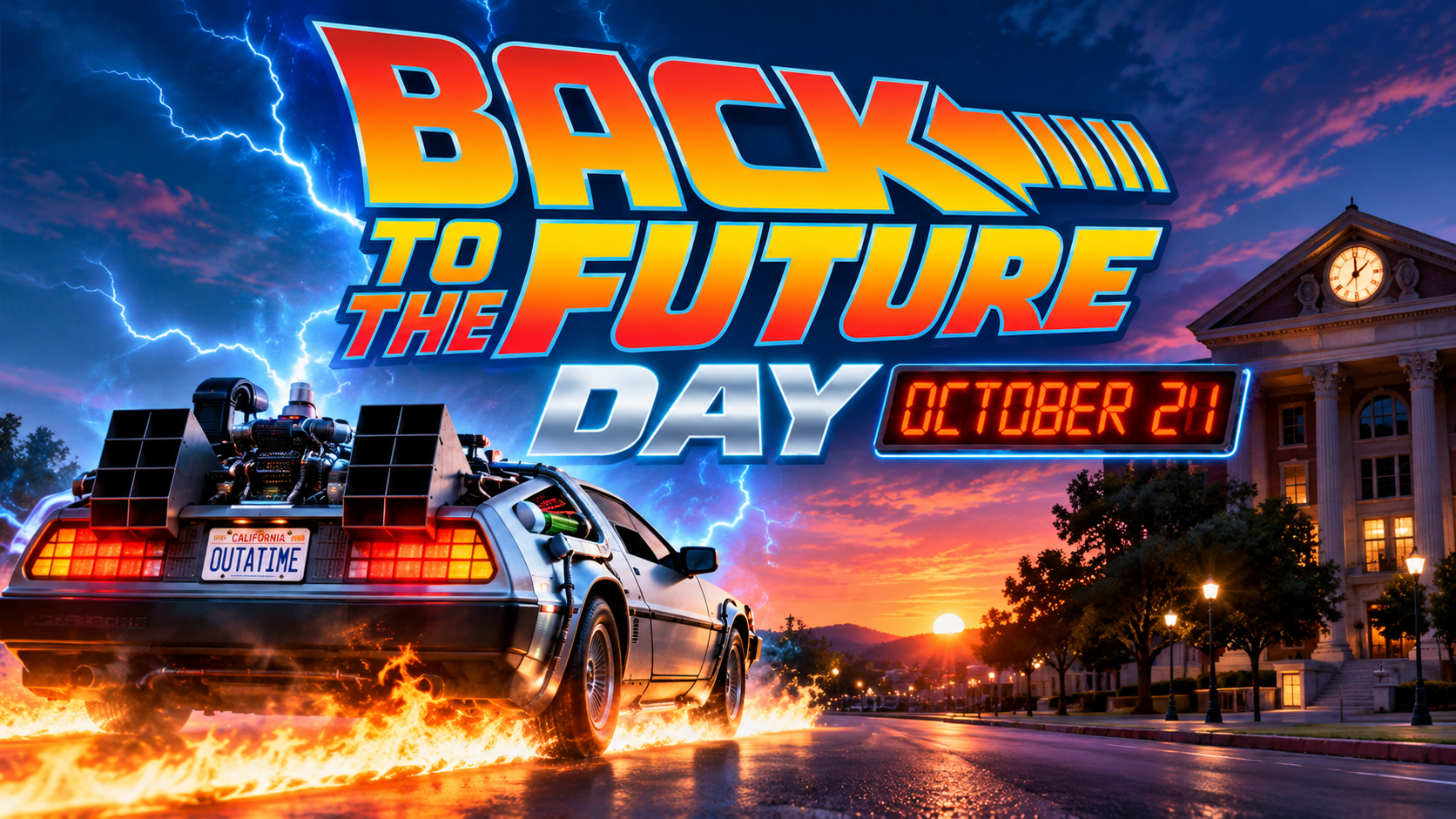
Every year on October 21, movie fans around the world celebrate Back to the Future Day, a day dedicated to one of the most beloved science-fiction movie franchises of all time.
Why October 21?
Because in Back to the Future Part II, Marty McFly and Doc Brown travel from 1985 into the future, arriving on October 21, 2015.
When the movie was released in 1989, 2015 seemed incredibly far away. The filmmakers imagined a future filled with flying cars, hoverboards, self-lacing shoes, video calls, enormous television screens, and technology that could transform everyday life.
Eventually, October 21, 2015 actually arrived.
We didn’t have highways filled with flying cars, and teenagers weren’t riding real hoverboards through town. But something fascinating had happened: some of the futuristic ideas imagined by the filmmakers didn’t seem quite as impossible anymore.
That helped turn October 21 into a celebration not only of the movies, but also of nostalgia, imagination, technology, and our fascination with the future.
Why Is Back to the Future Day October 21?
The date comes directly from Back to the Future Part II.
At the beginning of the movie, Doc Brown arrives in his famous DeLorean time machine and convinces Marty McFly and Jennifer Parker to travel with him into the future.
Their destination is:
October 21, 2015.
Marty enters a futuristic version of Hill Valley filled with technology that audiences in 1989 could only imagine.
There are flying vehicles.
People ride hoverboards.
Shoes automatically tighten themselves.
Video calls are common.
Televisions cover walls.
Information appears instantly on electronic screens.
Even ordinary household appliances seem dramatically more advanced.
For audiences watching the movie during the late 1980s and early 1990s, the year 2015 represented a distant future.
Then something unusual happened.
The future caught up with the movie.
On October 21, 2015, people around the world realized that the fictional date from the movie had finally become the present.
Fans celebrated with screenings, costumes, DeLorean displays, merchandise, social media posts, and countless comparisons between the movie’s fictional 2015 and the real world.
The date has remained known as Back to the Future Day ever since.
The Movie That Started Everything
The original Back to the Future was released in 1985.
Directed by Robert Zemeckis and written by Zemeckis and Bob Gale, the movie introduced audiences to teenager Marty McFly, played by Michael J. Fox, and eccentric scientist Dr. Emmett “Doc” Brown, played by Christopher Lloyd.
Doc Brown has accomplished something extraordinary.
He has built a time machine.
But instead of creating some giant futuristic spacecraft, Doc builds his invention inside a DeLorean DMC-12.
That decision helped create one of the most recognizable vehicles in movie history.
After a dangerous encounter sends Marty accidentally traveling from 1985 back to 1955, he discovers that his actions in the past have disrupted the circumstances that originally brought his parents together.
Marty now faces a terrifying possibility.
If his parents don’t fall in love, Marty himself may never exist.
With help from the younger version of Doc Brown, Marty must repair the timeline while also figuring out how to return to 1985.
The movie combines science fiction, comedy, adventure, romance, family drama, and nostalgia in a way that continues to appeal to audiences decades later.
The DeLorean Became a Pop-Culture Icon
Few movie vehicles are as recognizable as the DeLorean time machine.
Even people who have never watched the entire trilogy often recognize the stainless-steel car with its gull-wing doors.
In the story, the DeLorean needs to reach 88 miles per hour before it can travel through time.
That number became permanently connected to the franchise.
The movie also introduced fictional technology such as the flux capacitor, the device Doc Brown says makes time travel possible.
None of it needed to be scientifically realistic to capture people’s imaginations.
The DeLorean represented something much bigger.
It represented the possibility of going somewhere impossible.
Imagine being able to sit inside a car, reach 88 miles per hour, and suddenly find yourself decades in the past or future.
Where would you go?
What would you want to see?
And would you risk changing anything?
Those questions are part of what makes stories about time travel so fascinating.
Traveling to 2015
The first movie primarily explored the past.
Back to the Future Part II gave audiences the opportunity to imagine the future.
Marty travels forward thirty years from 1985 to 2015.
The future Hill Valley he discovers is filled with exaggerated technological advancements.
Some were intentionally humorous.
Others were surprisingly close to technologies that eventually became part of everyday life.
That makes watching the movie today particularly interesting.
We are no longer watching filmmakers predict our future.
We are watching what people in the 1980s thought our future might look like.
What Back to the Future Part II Got Surprisingly Close To
The movie didn’t perfectly predict 2015, but several ideas resemble technologies that eventually became common.
Video Calls
Video communication seemed extremely futuristic when the movie was made.
Today, video calling is ordinary.
People regularly communicate through smartphones, computers, and tablets while seeing one another in real time.
Families talk across the country.
Businesses conduct meetings remotely.
Doctors can provide certain consultations through telehealth.
Students can attend classes online.
The technology has become so common that many people barely think about how futuristic it once seemed.
Large Flat-Screen Televisions
Televisions in the late 1980s were generally bulky compared with today’s displays.
The movie imagined large screens that could display multiple sources of information.
Modern homes now commonly have large, thin televisions with streaming services, internet connectivity, apps, gaming systems, and multiple viewing options.
Wearable Technology
Characters in the fictional 2015 use devices that resemble forms of wearable technology.
Today we have smartwatches, wireless earbuds, fitness trackers, augmented-reality devices, and other technology designed to be worn throughout the day.
Voice-Controlled Technology
Talking to computers once seemed like something belonging almost exclusively to science fiction.
Now people routinely use voice assistants and voice controls to operate phones, televisions, vehicles, speakers, and smart-home devices.
Biometric Technology
The movie also imagined technology using personal biological information for identification.
Today fingerprint scanners and facial recognition are widely used for unlocking devices, verifying identity, and authorizing certain transactions.
What About the Hoverboard?
Perhaps nothing from the movie’s version of 2015 captured people’s imagination quite like the hoverboard.
Marty grabs what looks like a skateboard without wheels and uses it to escape Griff Tannen and his gang.
The hoverboard became one of the franchise’s most famous fictional inventions.
When the real 2015 arrived, people naturally asked:
Where are our hoverboards?
Devices marketed as “hoverboards” eventually became popular, but they were generally self-balancing electric scooters with wheels.
They weren’t the floating boards Marty McFly rode through Hill Valley.
Experimental technologies have demonstrated limited forms of magnetic levitation and similar concepts, but the convenient, inexpensive flying skateboard from the movie remains science fiction.
At least for now.
Where Are the Flying Cars?
The fictional 2015 also imagined skies filled with flying automobiles.
That prediction didn’t become everyday reality either.
Cars still spend most of their time firmly attached to the ground.
However, companies have continued experimenting with electric aircraft, autonomous vehicles, air taxis, and other transportation technologies.
The exact future imagined by Back to the Future Part II didn’t arrive.
But humanity certainly hasn’t stopped trying to reinvent transportation.
Nike and the Self-Lacing Shoe
One of the coolest pieces of futuristic clothing in the movie was Marty’s pair of Nike shoes.
After putting them on, the shoes automatically tighten.
The idea became so closely associated with the movie that Nike eventually developed real self-lacing footwear inspired by the concept.
It’s a fascinating example of the relationship between science fiction and innovation.
Sometimes filmmakers imagine technology.
Then engineers grow up watching those movies.
Years later, they try to build it.
Science fiction doesn’t always predict the future.
Sometimes it inspires people to create it.
The Future Rarely Looks Like We Expect
One of the most interesting lessons of Back to the Future Day is how difficult predicting the future really is.
The movie imagined flying cars and hoverboards.
But some of the biggest changes to everyday life developed in completely different directions.
Consider how much technology has changed since the late 1980s.
Smartphones allow people to carry cameras, maps, music libraries, calculators, televisions, newspapers, calendars, games, and communication systems in their pockets.
Search engines give people access to enormous amounts of information almost instantly.
Social media allows someone to publish something that can potentially reach people around the world within seconds.
Streaming services provide access to enormous libraries of entertainment without leaving home.
Artificial intelligence can generate text, images, software, music, and other digital content.
GPS navigation can guide someone almost anywhere.
Online shopping can deliver products directly to someone’s home.
Some of those developments would have sounded just as unbelievable in 1989 as a hoverboard.
The future arrived.
It simply didn’t look exactly the way Hollywood imagined.
Back to the Past
The franchise wasn’t only about imagining tomorrow.
It was also about remembering yesterday.
The first movie took audiences from 1985 back to 1955.
That allowed the filmmakers to explore generational differences.
Marty discovers that his parents weren’t always the adults he knew.
They were once teenagers with fears, insecurities, dreams, mistakes, and complicated relationships of their own.
That’s one of the deeper ideas behind the story.
We often know our parents only as parents.
We don’t always think about who they were before we existed.
They had friendships.
They had dreams.
They experienced heartbreak.
They made embarrassing mistakes.
They worried about their futures.
In that sense, Marty’s journey isn’t simply through time.
It’s a journey toward understanding his family.
Would You Change the Past?
The trilogy repeatedly explores one of the biggest questions surrounding time travel.
If you could go back, would you change something?
Most people probably have moments they wish they could revisit.
Maybe there is something you regret saying.
Maybe there is someone you wish you had spent more time with.
Maybe there was an opportunity you wish you had taken.
Maybe you would want one more conversation with someone you loved.
But Back to the Future constantly reminds us that changing one thing could affect countless others.
Marty’s smallest actions sometimes produce enormous consequences.
The movies turn that idea into comedy and adventure, but underneath it is a meaningful message:
Our choices matter.
We cannot actually climb into a DeLorean and repair yesterday.
But we can decide what we do today.
The Power of Nostalgia
Back to the Future Day is also a celebration of nostalgia.
For people who watched these movies growing up, seeing Marty McFly’s skateboard, Doc Brown’s wild white hair, the Hill Valley clock tower, or the DeLorean can instantly bring back memories.
Movies have a remarkable ability to become connected with periods of our lives.
You may remember who you watched a movie with.
You may remember the theater where you saw it.
You may remember renting it from a video store.
You may remember watching it repeatedly on VHS.
Years later, seeing that movie again can briefly make the past feel close.
We can’t physically travel backward in time.
But memories sometimes come remarkably close.
“Where We’re Going, We Don’t Need Roads”
One of the franchise’s most famous moments comes when Doc Brown prepares the DeLorean for another journey.
The idea perfectly captures what makes the series so much fun.
The future represents possibility.
It represents places we haven’t been.
Technology we haven’t invented.
People we haven’t met.
Experiences we haven’t had.
Nobody knows exactly what the world will look like thirty years from now.
Think about someone watching Back to the Future Part II in 1989.
Could they have imagined today’s smartphones?
Social media?
Streaming entertainment?
Artificial intelligence?
Modern electric vehicles?
The internet becoming such a central part of everyday life?
Some developments were predicted surprisingly well.
Others were almost completely unexpected.
The same will probably be true of our predictions today.
How to Celebrate Back to the Future Day
October 21 gives fans plenty of ways to celebrate.
You could watch the original Back to the Future trilogy and experience Marty and Doc’s adventures again.
Wear a Marty McFly-inspired outfit.
Display a DeLorean model.
Listen to music from the movies.
Learn about technologies that seemed impossible in the 1980s but exist today.
Compare the movie’s 2015 with the real world.
Introduce someone younger to the movies for the first time.
Or simply ask yourself a classic time-travel question:
If you had Doc Brown’s DeLorean for one day, where would you go?
Would you travel into history?
Would you revisit your childhood?
Would you see your parents when they were young?
Would you travel decades into the future?
Or would you decide that some things are better left unknown?
More Than a Movie Holiday
Back to the Future Day may have started with a fictional date on a movie screen, but it has grown into something larger.
It celebrates imagination.
It celebrates nostalgia.
It celebrates technology.
And it reminds us how quickly the future becomes the present.
October 21, 2015 once sounded impossibly distant.
Then it arrived.
Now it is part of the past.
That alone feels like something Doc Brown would appreciate.
Time continues moving whether we’re ready for it or not.
Today’s science fiction could become tomorrow’s ordinary technology.
Today’s children will someday look back at our smartphones and computers the way we look at cassette players, VHS tapes, pay phones, and giant television sets.
And today’s future will eventually become someone’s nostalgia.
Final Thoughts
Every October 21, Back to the Future Day gives us an excuse to celebrate Marty McFly, Doc Brown, the DeLorean, the flux capacitor, hoverboards, and one of cinema’s most memorable interpretations of time travel.
But there is another reason the day continues to resonate.
Back to the Future asks us to think about three things that affect every person’s life:
Where we came from.
What we’re doing now.
Where we’re going next.
We may never have a DeLorean capable of reaching 88 miles per hour and disappearing through time.
We may never get the chance to visit ourselves thirty years in the future.
And we certainly can’t return to yesterday and rewrite everything we wish had happened differently.
But we do have today.
And what we do with today helps create tomorrow.
So this October 21, enjoy the movies, remember the past, imagine the future, and appreciate how incredible it is to live during a time when yesterday’s science fiction can sometimes become today’s reality.
Because if Back to the Future taught us anything, it’s that the future isn’t simply somewhere we’re going.
It’s something we’re creating every day.


Leave a ReplyCancel reply