
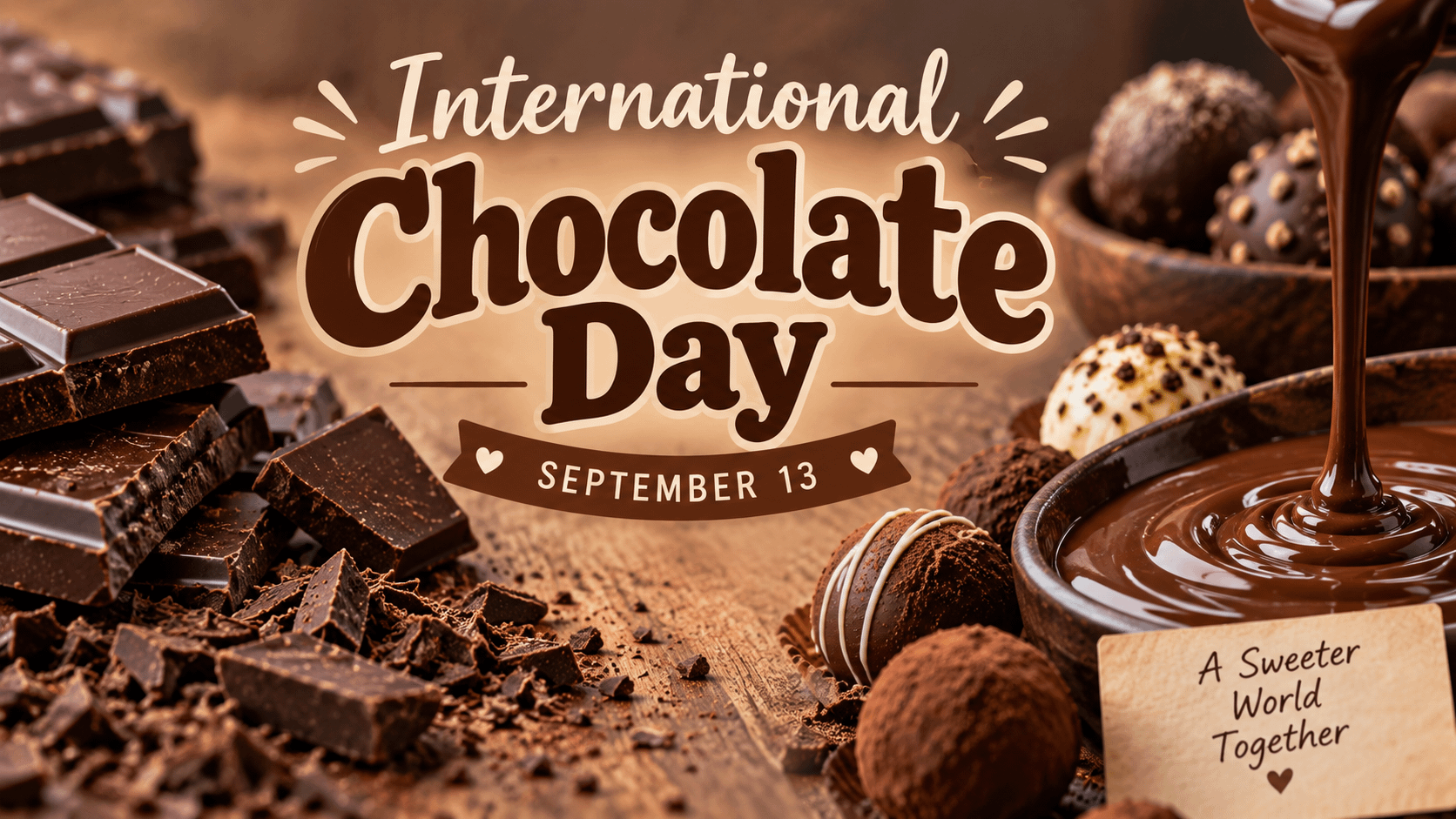
Few foods have the power to make people smile quite like chocolate. Whether it comes in the form of a creamy milk chocolate bar, a rich dark chocolate truffle, a warm brownie fresh from the oven, or a cup of comforting hot chocolate, chocolate has earned a special place in cultures and kitchens around the world.
Every year on September 13, International Chocolate Day gives chocolate lovers an excellent reason to celebrate one of the world’s most beloved treats.
But chocolate is much more than candy.
Its story stretches back thousands of years, beginning with cacao in the ancient Americas and eventually developing into the enormous worldwide chocolate industry we know today. Chocolate has been used ceremonially, enjoyed as a beverage, given as a gift, incorporated into countless desserts, and associated with everything from romance to holidays.
International Chocolate Day is a chance to enjoy your favorite chocolate treat while also appreciating the remarkable history behind it.
When Is International Chocolate Day?
International Chocolate Day is celebrated annually on September 13.
The date is often associated with the birthday of Milton S. Hershey, who was born on September 13, 1857. Hershey became one of the most influential figures in the development of America’s chocolate industry.
There are several other chocolate-related celebrations throughout the year, including World Chocolate Day on July 7 and numerous days devoted to particular varieties of chocolate and chocolate desserts.
But September 13 gives chocolate lovers another opportunity to recognize the treat that has become a worldwide favorite.
Chocolate Has an Ancient History
The chocolate bar sitting on a grocery store shelf may seem like a modern creation, but the story behind its primary ingredient goes back thousands of years.
Chocolate begins with the cacao tree, Theobroma cacao, which is native to the tropical Americas.
Long before Europeans encountered cacao, Indigenous civilizations of Mesoamerica were cultivating and consuming it.
The Olmec civilization is often connected with some of the earliest known uses of cacao. Later civilizations, particularly the Maya and Aztecs, incorporated cacao into their cultures.
However, ancient chocolate looked very different from the sweet candy we recognize today.
Cacao was commonly prepared as a beverage rather than made into solid bars.
The resulting drink could be bitter and might be flavored with ingredients such as spices or chili peppers.
For the Maya, cacao beverages could play roles in celebrations, ceremonies, and social gatherings.
The Aztecs also valued cacao tremendously. Cacao beans were so valuable that they could even function as a form of exchange.
Chocolate wasn’t simply dessert.
It could represent wealth, status, tradition, and cultural significance.
Chocolate Makes Its Way to Europe
European encounters with cacao eventually introduced chocolate to a completely different audience.
Spanish explorers and colonists encountered cacao traditions in the Americas, and chocolate beverages gradually became popular in Spain.
Europeans began adapting chocolate to their own tastes.
Instead of consuming the bitter versions associated with earlier cacao traditions, they increasingly sweetened chocolate with sugar. Other flavorings, including cinnamon and vanilla, could also be added.
Chocolate drinking eventually spread through European aristocratic circles.
For a long period, chocolate remained expensive and was largely associated with wealthy consumers.
Then industrialization transformed chocolate.
How Chocolate Became the Treat We Know Today
The 18th and 19th centuries brought technological advances that dramatically changed chocolate production.
Manufacturers discovered better methods for processing cacao beans, separating cocoa solids and cocoa butter, refining chocolate, and creating smoother textures.
One particularly important development came in 1828 when Dutch chemist Coenraad van Houten patented a cocoa press that helped remove cocoa butter from roasted cacao.
Chocolate manufacturing continued evolving throughout the century.
In 1847, the British chocolate company J. S. Fry & Sons is commonly credited with producing one of the first modern solid eating chocolate bars by combining cocoa powder, sugar, and cocoa butter.
Another major breakthrough followed with the development of milk chocolate.
Swiss chocolatier Daniel Peter worked with milk products to create a commercially successful milk chocolate during the 1870s.
Then came another important innovation: conching.
Swiss chocolatier Rodolphe Lindt developed a conching process in 1879 that helped create smoother, more refined chocolate.
These innovations gradually transformed chocolate from a luxury beverage into the smooth confection enjoyed around the world today.
Milton Hershey and September 13
The September 13 celebration has an especially strong connection to American chocolate history because it is the birthday of Milton Snavely Hershey.
Hershey was born on September 13, 1857, in Pennsylvania.
His road to success wasn’t immediate.
Before becoming famous for chocolate, Hershey experienced business failures and eventually found success producing caramel.
After recognizing the possibilities of milk chocolate, he shifted his attention toward chocolate manufacturing.
The Hershey Chocolate Company helped make milk chocolate affordable and widely available to American consumers.
Hershey also developed the Pennsylvania community that became known as Hershey, creating an entire town around his growing business.
His influence went beyond chocolate production. Milton Hershey and his wife, Catherine, established a school for orphaned boys in 1909. The institution eventually became the Milton Hershey School.
Today, Hershey remains one of the names most closely associated with American chocolate.
That makes September 13 a fitting day to celebrate chocolate and its evolution.
From Cacao Bean to Chocolate Bar
Chocolate has a surprisingly complicated journey before reaching your kitchen.
It begins with cacao pods growing on cacao trees in warm tropical climates.
Inside the pods are cacao beans surrounded by pulp.
After harvesting, the beans typically go through several important stages.
They are fermented, dried, roasted, cracked, processed, refined, and eventually transformed into chocolate.
Fermentation is particularly important because it helps develop the flavor compounds that ultimately contribute to chocolate’s distinctive taste.
The beans are later roasted, which develops their flavor further.
After processing, cacao can eventually become ingredients such as cocoa solids and cocoa butter.
Manufacturers combine and process these components differently depending on the type of chocolate being produced.
It’s a long journey from tropical cacao tree to chocolate bar.
Dark Chocolate
Dark chocolate typically contains cocoa solids, cocoa butter, and sugar, although exact recipes vary considerably.
Generally, the higher the percentage of cacao, the stronger and less sweet the chocolate tastes.
A 50% cacao chocolate bar, for example, will usually taste considerably sweeter than an 85% cacao bar.
Dark chocolate can have an impressive range of flavors.
Depending on the cacao variety, growing region, processing, and recipe, you may notice notes reminiscent of fruit, nuts, coffee, caramel, earth, or spices.
Much like coffee and wine, chocolate can reveal surprisingly complex flavors when tasted carefully.
Milk Chocolate
Milk chocolate is one of the most familiar forms of chocolate in the United States.
It combines chocolate ingredients with sugar and milk ingredients, producing the sweet, creamy flavor many people associate with classic candy bars.
Its mild flavor also makes it extremely versatile.
Milk chocolate appears in everything from candy bars and cookies to cakes, ice cream, sauces, and holiday treats.
For many people, milk chocolate was their introduction to the world of chocolate.
What About White Chocolate?
The name occasionally causes debate among chocolate enthusiasts because white chocolate doesn’t contain the cocoa solids responsible for the familiar brown color of milk and dark chocolate.
However, genuine white chocolate contains cocoa butter, the natural fat derived from cacao.
It is generally combined with ingredients such as sugar and milk solids.
The result is a creamy, sweet product with a very different flavor profile from dark or milk chocolate.
Whether it’s your favorite or not, white chocolate still has a connection to the cacao bean through cocoa butter.
Why Do We Love Chocolate So Much?
Part of chocolate’s popularity comes from its remarkable sensory experience.
Chocolate contains cocoa butter, which melts near body temperature. That’s one reason good chocolate seems to melt so smoothly in your mouth.
Then there is the combination of sweetness, aroma, texture, and cocoa flavor.
But chocolate’s appeal isn’t purely physical.
Chocolate is also connected to memories.
Think about birthday cakes.
Halloween candy.
Christmas stockings.
Valentine’s Day boxes.
Easter baskets.
S’mores around a campfire.
Chocolate chip cookies coming out of the oven.
Brownies cooling on the counter.
A mug of hot chocolate on a cold evening.
Chocolate frequently appears during moments of celebration, comfort, friendship, and family tradition.
Sometimes the memory surrounding the chocolate is every bit as important as the chocolate itself.
Chocolate Around the World
One of the best things about International Chocolate Day is recognizing how widely chocolate is enjoyed.
Different countries and cultures have developed their own chocolate traditions and specialties.
Belgium is famous for pralines and beautifully crafted chocolates.
Switzerland has a long history of chocolate innovation and is strongly associated with smooth milk chocolate.
Mexico maintains deep connections to cacao’s ancient history, with chocolate appearing in both sweet and savory preparations.
France is famous for elegant chocolate pastries, mousses, ganaches, and artisan chocolates.
Italy has contributed favorites such as gianduja, the chocolate-and-hazelnut combination associated with the Piedmont region.
In the United States, chocolate appears in countless iconic desserts, including chocolate chip cookies, brownies, chocolate cake, fudge, and s’mores.
Chocolate truly has become an international food.
Fun Ways to Celebrate International Chocolate Day
Celebrating September 13 doesn’t have to be complicated.
The obvious choice is simply to enjoy some chocolate.
But you can make the occasion more memorable by turning it into an experience.
Try several varieties of chocolate side by side. Pick up milk chocolate and a few dark chocolates with different cacao percentages and compare their flavors.
You may be surprised by how different they taste.
Another option is to make a homemade chocolate dessert.
Try baking:
- Chocolate chip cookies
- Fudge brownies
- Chocolate cupcakes
- Chocolate cheesecake
- Chocolate mousse
- Chocolate cream pie
- Chocolate-covered strawberries
- Chocolate lava cakes
- Chocolate fudge
- Homemade hot chocolate
International Chocolate Day is also a perfect excuse to visit a local chocolate shop or bakery.
Look for something you haven’t tried before.
Create a Chocolate Tasting
Want to turn International Chocolate Day into something fun for friends or family?
Create your own chocolate tasting.
Purchase several chocolates ranging from milk chocolate to increasingly darker varieties.
For example, you might include:
Milk chocolate
50% dark chocolate
60% dark chocolate
70% dark chocolate
85% dark chocolate
Taste them from the mildest to the strongest.
Instead of immediately chewing each piece, allow the chocolate to melt slowly.
Notice the aroma.
Pay attention to the texture.
Look for different flavor notes.
You might detect caramel, berries, nuts, coffee, vanilla, citrus, or roasted flavors.
Everyone can rank their favorites afterward.
It’s an easy activity that turns a simple chocolate bar into an experience.
Try Chocolate in a Savory Dish
Chocolate doesn’t always have to mean dessert.
Cacao and chocolate can also appear in savory cooking.
Perhaps the most famous example is Mexican mole, although mole recipes vary widely and not all versions contain chocolate.
Unsweetened cocoa can also be incorporated carefully into certain chili recipes, spice rubs, sauces, and braised dishes.
The goal isn’t necessarily to make the meal taste like a chocolate bar.
Instead, cacao can add bitterness, richness, color, and depth.
International Chocolate Day can therefore be an opportunity to discover a completely different side of chocolate.
Pair Chocolate With Other Flavors
Chocolate works beautifully with an enormous variety of ingredients.
Classic pairings include:
Chocolate and peanut butter for a salty-sweet combination.
Chocolate and strawberries for a fresh, romantic favorite.
Chocolate and caramel for sweetness and richness.
Chocolate and mint for a refreshing contrast.
Chocolate and orange for a bright citrus flavor.
Chocolate and raspberry for a tart, fruity balance.
Chocolate and coffee for deep roasted flavors.
Chocolate and hazelnut for a rich European-inspired combination.
Chocolate and sea salt for a simple pairing that enhances sweetness and cocoa flavor.
Experimenting with pairings is one of the easiest ways to celebrate.
Support a Local Chocolatier
International Chocolate Day can also be an opportunity to support small businesses.
Instead of grabbing your usual candy bar, visit an independent chocolatier, candy shop, bakery, café, or dessert business.
Many artisan chocolate makers produce bonbons, truffles, caramels, chocolate bars, chocolate-covered nuts, and other specialty treats.
Ask what’s made locally or what the shop recommends.
You may discover a new favorite while supporting a business in your community.
Learn Where Your Chocolate Comes From
Chocolate is enjoyable, but International Chocolate Day can also encourage us to think about where cacao comes from.
Cacao is primarily grown in tropical regions close to the equator, and West Africa is particularly important to global cocoa production.
The cocoa industry has also faced serious challenges involving farmer livelihoods, labor conditions, deforestation, and sustainability.
Consumers interested in these issues can learn more about how particular chocolate companies source their cacao.
Certifications and sourcing programs aren’t all identical, so it’s worth looking beyond packaging claims and learning what a producer actually does.
Celebrating chocolate can include appreciating the farmers whose work makes it possible.
Share Chocolate With Someone
Chocolate might taste even better when it’s shared.
Bring chocolate treats to coworkers.
Give a friend their favorite candy bar.
Bake cookies with your children or grandchildren.
Surprise someone with brownies.
Drop off chocolate for a neighbor.
Send a box of chocolates to someone you haven’t seen recently.
Food has always been one of the simplest ways people show kindness.
You don’t need a major occasion.
Sometimes handing someone a chocolate treat and saying, “I thought you’d enjoy this,” is enough to brighten their day.
Interesting Chocolate Facts
Chocolate has accumulated plenty of interesting stories throughout its long history.
The scientific name of the cacao tree is Theobroma cacao. The genus name comes from Greek roots commonly translated as “food of the gods.”
Cacao trees thrive in warm, humid tropical environments.
Chocolate’s familiar smooth texture depends heavily on cocoa butter.
Dark, milk, and white chocolate have noticeably different compositions and flavor profiles.
Chocolate can be used in beverages, desserts, candy, baked goods, sauces, and savory dishes.
And although chocolate feels like an everyday food today, it spent centuries as something relatively expensive and exclusive.
That’s quite a transformation for a seed growing inside a tropical fruit.
A Day for Chocolate Lovers Everywhere
International Chocolate Day isn’t one of those celebrations that requires elaborate planning.
That’s part of what makes it fun.
You can celebrate with a single square of your favorite chocolate.
You can bake a tray of brownies.
You can visit a local chocolatier.
You can make chocolate-covered strawberries with your family.
You can experiment with dark chocolate you’ve never tried.
Or you can simply open your favorite candy bar and enjoy it.
But behind that small piece of chocolate is an extraordinary story.
It is a story that begins with cacao trees in the tropical Americas, travels through ancient civilizations, crosses oceans, changes through centuries of experimentation and industrial innovation, and eventually becomes one of the world’s favorite foods.
Happy International Chocolate Day!
On September 13, give yourself permission to enjoy a little chocolate.
Choose your longtime favorite or try something completely new. Bake something chocolatey, share a treat with someone you care about, support a local chocolate maker, or learn a little more about where cacao comes from.
International Chocolate Day reminds us that sometimes life’s simplest pleasures can have surprisingly fascinating stories behind them.
Chocolate has crossed cultures, continents, and centuries, yet its ability to bring people a moment of enjoyment remains remarkably simple.
So unwrap the chocolate bar.
Cut yourself a piece of chocolate cake.
Bake those brownies.
Pour the hot chocolate.
Share something sweet with somebody else.
And enjoy a celebration thousands of years in the making.
What’s your all-time favorite chocolate treat—the one you’d choose above everything else?
Leave a ReplyCancel reply