
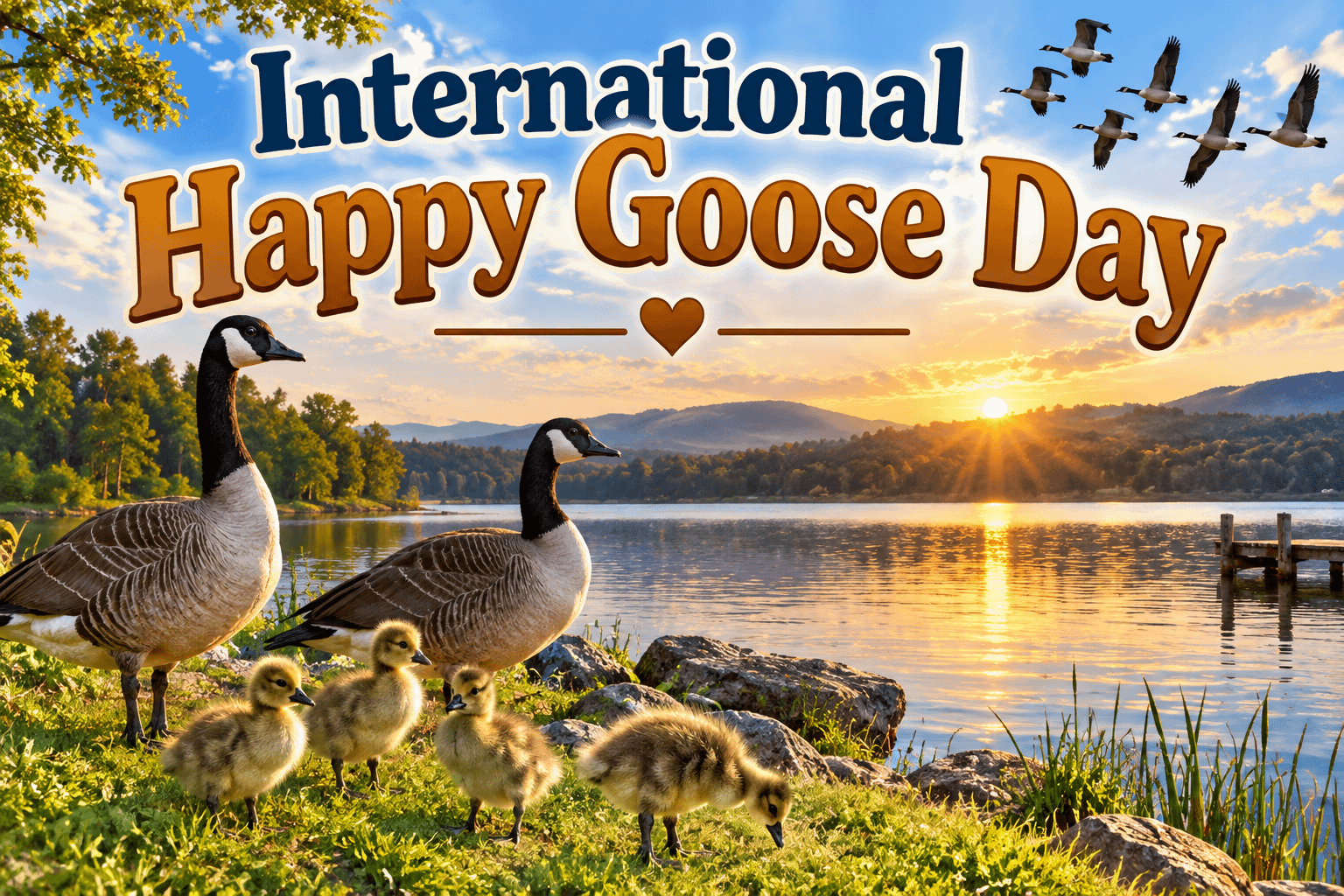
Every year on September 29, International Happy Goose Day gives us an opportunity to appreciate one of nature’s most recognizable, entertaining, and sometimes surprisingly complicated birds: the goose.
Geese can be graceful as they glide quietly across a lake, impressive when they fly overhead in their famous V-shaped formations, and downright hilarious when they waddle across a park as though they own the place. They can also be loud, protective, curious, social, and remarkably intelligent.
International Happy Goose Day is a lighthearted celebration, but it can also remind us to appreciate wildlife, learn more about the animals sharing our environment, and recognize just how fascinating geese really are.
Why Celebrate Geese?
For many people, geese are simply part of the scenery.
You might see them swimming across a pond, resting beside a lake, grazing on grass, or flying overhead during seasonal migrations. Because they are so familiar, it can be easy to overlook how remarkable they are.
Geese are highly social birds. They communicate with one another, form strong family relationships, protect their young, and cooperate during migration.
Watch a family of geese closely and you may notice how attentive the adults are to their goslings. One parent may lead while another watches from behind, helping keep the family together.
Their behavior provides a fascinating glimpse into cooperation and survival in the natural world.
The Famous V Formation
One of the most recognizable sights associated with geese is a flock flying in a V formation.
There is a practical reason for it.
Flying this way can help birds take advantage of aerodynamic effects created by the birds ahead of them. Instead of every goose doing all the work independently, the formation can make long-distance flight more efficient.
The lead position can be demanding, so members of a flock may change positions during a journey.
It is a remarkable example of cooperation.
There is also something inspiring about watching a flock move together across the sky. Each bird has its place, yet the entire group is heading toward the same destination.
Humans sometimes use the image as a metaphor for teamwork: people can often travel farther when they support one another rather than trying to carry every burden alone.
Geese Are Excellent Communicators
Anyone who has spent time around geese knows they are not exactly quiet.
Honking is one of the ways geese communicate.
Different vocalizations can help them maintain contact, signal danger, interact with family members, or communicate with the flock.
Those calls become especially noticeable when a flock passes overhead.
You may hear them before you even see them.
Look toward the sky, and suddenly there they are—dozens of birds traveling together in an organized formation.
Their voices are part of the experience.
Geese Are Protective Parents
A goose standing near its goslings should always be treated with respect and given plenty of space.
Adult geese can become highly protective when they believe their young are threatened.
What sometimes appears to humans as aggression can simply be defensive behavior from a parent protecting its family.
This is particularly important to remember during spring and early summer, when goslings are common around ponds, lakes, parks, and other areas where geese nest.
Admire them from a distance rather than approaching them.
Wildlife does not need to be touched or handled to be appreciated.
Sometimes the best way to enjoy an animal is simply to observe it respectfully.
The Adorable Gosling Stage
It is difficult not to smile when you see a group of fluffy goslings following their parents.
Young geese are called goslings, and they begin exploring their surroundings relatively soon after hatching.
Families frequently travel together as the goslings grow.
Over time, those tiny bundles of yellow or gray fluff develop feathers and begin looking more like the adult geese around them.
Watching that transformation can be especially enjoyable for people who regularly walk around the same local lake or park.
One week the goslings seem tiny.
A few weeks later, you may wonder how they grew so quickly.
Geese Around the World
There are numerous species of geese found across different parts of the world.
In North America, one of the most familiar is the Canada goose, recognizable by its black head and neck, white cheek patch, and brownish body.
Other goose species have their own distinctive colors, markings, habitats, and migration patterns.
Some populations migrate tremendous distances, while others may remain in the same general area throughout much of the year.
Their ability to adapt is one reason geese have become such a familiar presence around parks, golf courses, reservoirs, farmland, wetlands, and urban areas.
Geese and Their Environment
Geese are part of larger ecosystems.
Like other wildlife, they interact with plants, water, predators, other birds, and their surrounding habitat.
Wetlands are particularly important environments for many waterfowl species. These areas can provide food, nesting opportunities, resting places, and protection.
International Happy Goose Day can therefore be more than simply celebrating a funny bird.
It can be a reminder that healthy wildlife populations depend on healthy habitats.
Protecting lakes, rivers, wetlands, and other natural spaces benefits far more than geese.
Those environments support countless plants and animals.
When Geese Become Our Neighbors
Geese have become extremely comfortable living around people in many communities.
You might find them at a city park, school field, golf course, office complex, neighborhood pond, or waterfront.
This sometimes creates conflict.
Large populations of geese can damage grass, leave significant amounts of droppings, or become defensive near nesting areas.
The challenge is learning how humans and wildlife can share spaces responsibly.
People should avoid disturbing nests, chasing birds, or approaching goslings. Local wildlife guidance should be followed when geese become a problem in public or private spaces.
Respecting wildlife does not mean pretending conflicts never happen. It means dealing with those conflicts responsibly.
Should You Feed Geese?
Throwing food to geese may seem like a fun way to interact with them, but feeding wild animals is not always beneficial.
Bread in particular has traditionally been associated with feeding ducks and geese, yet it offers limited nutritional value compared with their natural diet.
Feeding wildlife can also encourage large numbers of birds to gather in one location, potentially changing their normal behavior.
Rules vary from one park or community to another, so follow posted regulations and local wildlife recommendations.
Often, the simplest way to celebrate geese is simply to watch them.
Bring a camera or binoculars instead of a bag of bread.
Fun Facts About Geese
There is much more to geese than honking and waddling.
Geese are strong flyers, and some populations travel considerable distances during migration. They are social animals and often maintain close relationships with mates and family members.
Goslings can move around and follow their parents soon after hatching.
Geese are also remarkably alert. Their watchful behavior has even contributed to their historical reputation as effective natural alarm systems.
And while their walk might occasionally look awkward, put a goose in the water and the same bird suddenly appears incredibly graceful.
That contrast is part of their charm.
What Geese Can Teach Us About Teamwork
International Happy Goose Day can also provide a surprisingly meaningful lesson.
Think about that V formation again.
One bird leads for a while.
Others follow.
Eventually, another can take its turn.
The flock continues moving.
There is something worth remembering in that image.
Life does not always require us to be the person at the front.
Sometimes we lead.
Sometimes we follow.
Sometimes we encourage someone who is struggling.
And sometimes we are the one who needs help.
Strength does not always mean traveling alone.
There can be tremendous strength in allowing others to travel beside us.
Slow Down and Notice Nature
Modern life moves quickly.
Phones buzz.
Emails arrive.
Responsibilities pile up.
Schedules fill.
It becomes easy to walk through the world without really noticing what is around us.
Then a flock of geese flies overhead.
For a few seconds, you might stop.
You hear the honking.
You look toward the sky.
You watch the formation disappear into the distance.
Those small moments can reconnect us with the natural world.
You don’t necessarily need to travel to a national park or wilderness area to experience nature. Sometimes nature is waiting at the neighborhood pond.
International Happy Goose Day provides a simple excuse to notice it.
Ways to Celebrate International Happy Goose Day
Celebrating doesn’t need to be complicated.
Visit a local lake, wetland, nature preserve, or park and spend some time watching geese from a respectful distance. Bring binoculars and see how many different birds you can identify.
Take photographs without disturbing the animals.
Learn about goose species found in your region or read about their migration patterns.
Families can turn the day into an educational activity by teaching children about goslings, habitats, migration, and respectful wildlife observation.
You could also support an organization working to protect wetlands, birds, or local wildlife habitats.
Even something as simple as picking up litter near a local park can make the celebration meaningful.
Take the Perfect Goose Photograph
Geese can make wonderful photography subjects.
A goose swimming across calm water at sunrise can create a peaceful photograph. A flock flying against a colorful evening sky can be spectacular.
Goslings following their parents provide another wonderful opportunity.
Just remember that getting the photograph is never more important than respecting the animal.
Use distance and patience.
Wildlife photography is often better when the animals are behaving naturally rather than reacting to the photographer.
Appreciate the Ordinary
Perhaps one of the best lessons of International Happy Goose Day is learning to appreciate animals we normally overlook.
People often become excited when they see rare wildlife.
Geese rarely receive the same reaction because they are so familiar.
But common does not mean uninteresting.
Sometimes the things we see every day deserve another look.
Watch a goose carefully.
Notice how it communicates.
Watch how families stay together.
Observe how gracefully it moves across the water.
Listen when a flock passes overhead.
There is something remarkable happening right in front of us.
We simply have to notice.
Happy International Happy Goose Day!
International Happy Goose Day may be one of the more unusual celebrations on the calendar, but that is exactly what makes days like this fun.
It gives us permission to celebrate something simple.
Today, appreciate the honking, waddling, swimming, flying characters that share our parks, lakes, wetlands, and skies.
Learn something new about them.
Watch them from a respectful distance.
Take a picture.
Enjoy the sight of a family of goslings.
And the next time you hear a flock honking overhead, look up.
For just a moment, forget everything else and watch them travel together across the sky.
Happy International Happy Goose Day!
What is your favorite memory of seeing geese—watching goslings at a lake, hearing a flock overhead, or having one hilariously decide that you were standing a little too close?
Leave a ReplyCancel reply