There is something instantly recognizable about the sound of a bowling alley.
The rumble of a bowling ball traveling down a polished wooden lane. The explosive crash of 10 pins when someone throws a strike. The cheers coming from the next lane. The occasional groan when a perfectly good-looking ball suddenly curves into the gutter.
And, of course, someone celebrating a lucky strike as though they just won a professional championship.
That combination of competition, entertainment, food, friendship, and laughter is exactly what makes National Bowling Day worth celebrating.
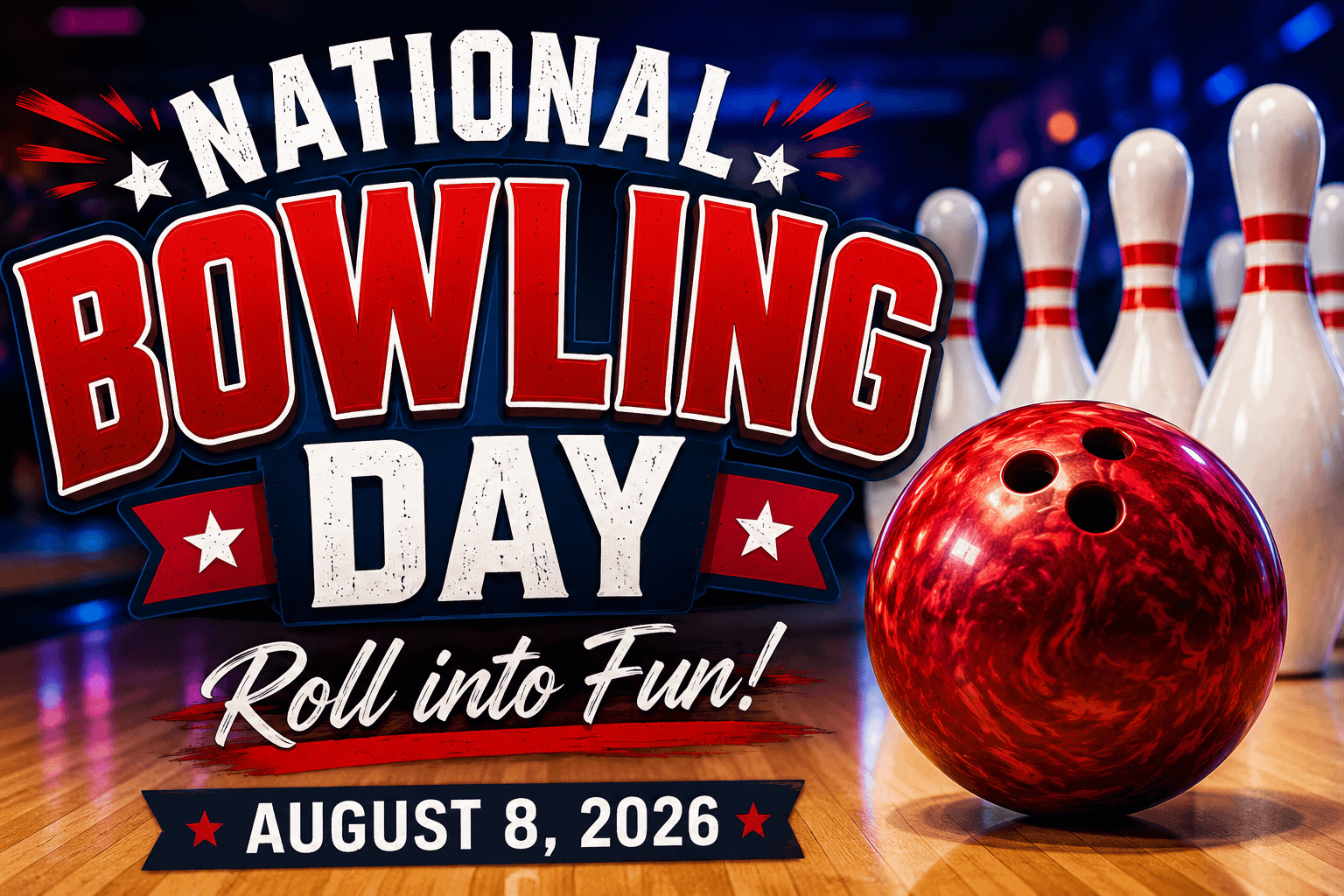
Observed on the second Saturday in August, National Bowling Day falls on August 8 in 2026. It is a day dedicated to one of the most recognizable recreational activities in America and an excellent excuse to gather your family or friends for a few games.
You don’t have to be an experienced bowler.
You don’t have to own a bowling ball.
You don’t even have to understand exactly how bowling scoring works.
All you really need is a willingness to step up to the lane and give it a shot.
Whether you’re chasing a perfect 300 or simply trying to keep your ball out of the gutter, National Bowling Day reminds us that sometimes the simplest activities create the best memories.
What Is National Bowling Day?
National Bowling Day celebrates bowling as both a competitive sport and a recreational activity.
Bowling has entertained generations of families, friends, coworkers, competitive athletes, and casual players. It is one of those rare activities where people with dramatically different skill levels can still participate together.
An experienced league bowler might average more than 200 points per game.
A beginner might be thrilled to break 100.
A child using bumpers might simply celebrate every pin that falls.
All three can bowl beside one another and have a great time.
That accessibility is one of the reasons bowling has remained popular for generations.
National Bowling Day encourages people to visit bowling centers, support local lanes, introduce new people to bowling, participate in friendly competitions, and appreciate the traditions surrounding the sport.
But perhaps the best reason to celebrate is even simpler:
Bowling is fun.
When Is National Bowling Day 2026?
National Bowling Day is traditionally celebrated on the second Saturday in August.
In 2026, National Bowling Day is Saturday, August 8.
Because it falls on a Saturday, it is perfectly positioned for family outings, date nights, birthday celebrations, friendly tournaments, and evening trips to the bowling alley.
Some bowling centers may also offer special National Bowling Day promotions, so checking with your local bowling center before heading out could be worthwhile.
Bowling Has Ancient Roots
Bowling may seem like a relatively modern activity, but humans have apparently enjoyed games involving rolling objects toward targets for a very long time.
Various bowling-like games have existed throughout history, although they differed significantly from the ten-pin bowling most Americans recognize today.
The basic concept is incredibly simple:
Take an object.
Roll or throw it.
Try to hit another object.
That simplicity allowed different versions of bowling-style games to develop independently in different places and cultures.
Over time, rules became more organized, equipment improved, and modern bowling gradually developed.
Today, there are several forms of bowling around the world, but ten-pin bowling has become one of the most recognizable.
The Rise of Bowling in America
Bowling became deeply embedded in American recreational culture during the 19th and 20th centuries.
As communities grew and entertainment businesses expanded, bowling alleys became important social gathering places.
People weren’t simply going somewhere to compete.
They were going somewhere to socialize.
Bowling leagues became particularly important.
Coworkers formed teams.
Friends created weekly bowling traditions.
Businesses sponsored teams.
Couples bowled together.
Community organizations held tournaments.
Generations of bowlers began spending the same evening every week at their local bowling center.
For many people, league night wasn’t simply about bowling.
It was about belonging somewhere.
The Golden Age of Bowling
Bowling became especially prominent in American culture during the middle decades of the 20th century.
Bowling centers appeared throughout cities and suburbs, and league participation became enormously popular.
Television helped introduce competitive bowling to even larger audiences.
Suddenly, people weren’t just bowling recreationally—they could watch highly skilled bowlers compete.
Professional bowlers demonstrated that what appeared to be a simple recreational game involved tremendous precision, consistency, strategy, and mental focus.
The sport became part of everyday American entertainment culture.
Bowling alleys became recognizable community institutions.
And although entertainment has changed dramatically since then, bowling has managed to survive.
Why Bowling Has Lasted for Generations
Think about how much entertainment has changed.
Arcades arrived.
Home video games exploded in popularity.
The internet changed how people socialize.
Streaming services brought nearly unlimited entertainment into people’s homes.
Smartphones gave people something to do almost everywhere.
Yet bowling centers are still here.
Why?
Because bowling offers something screens cannot completely replace.
It brings people together physically.
You have to stand up.
You have to participate.
You have to interact with the people around you.
And every few minutes, something unpredictable happens.
Someone throws an unexpected strike.
Someone completely misses the pins.
Someone converts an impossible-looking spare.
Someone accidentally celebrates before realizing one pin is still standing.
Those moments become shared experiences.
The Basics of Ten-Pin Bowling
For anyone celebrating National Bowling Day for the first time, the basic rules are relatively easy to understand.
A standard bowling game contains 10 frames.
At the beginning of each frame, 10 pins are arranged at the end of the lane.
The goal is simple:
Knock down as many pins as possible.
Most frames allow a bowler up to two rolls.
If you knock down all 10 pins on your first roll, you’ve scored a strike.
If you knock down some pins on your first roll and the remaining pins on your second, you’ve scored a spare.
If pins remain standing after both rolls, the frame is considered open.
Strikes and spares earn bonus points based on future rolls, which makes scoring more interesting.
The 10th frame has special rules allowing additional rolls when a bowler records a strike or spare.
What Is a Perfect Bowling Game?
The ultimate achievement in ten-pin bowling is a perfect 300 game.
To accomplish it, a bowler must throw 12 consecutive strikes.
Why 12 when there are only 10 frames?
Because strikes in the 10th frame earn two additional rolls.
That means the bowler must knock down 120 pins across 12 perfect deliveries.
It sounds easy when reduced to one instruction:
“Just throw strikes.”
Anyone who has actually bowled knows how difficult that is.
Even experienced bowlers can spend years chasing a perfect game.
Why Throwing a Strike Feels So Good
There is something incredibly satisfying about a perfectly delivered bowling ball.
You release it.
It travels toward the pins.
For a moment, you know it looks good.
Then—
CRASH!
Every pin disappears.
Strike.
Even casual bowlers celebrate.
People turn around smiling.
Friends give high-fives.
Children jump up and down.
Sometimes strangers on nearby lanes even notice.
It’s a small victory, but that’s part of bowling’s appeal.
The game gives you repeated opportunities to experience success.
Even if your overall score isn’t impressive, one great strike can make the entire game feel worthwhile.
Bowling Is Easy to Learn and Difficult to Master
One of bowling’s greatest strengths is that beginners can start almost immediately.
Pick up a ball.
Walk toward the foul line.
Roll the ball toward the pins.
That’s enough to start.
But serious bowling becomes surprisingly technical.
Experienced bowlers consider factors such as:
- Approach timing
- Footwork
- Release
- Ball speed
- Rotation
- Hook
- Entry angle
- Targeting
- Lane oil patterns
- Ball construction
- Spare shooting
- Lane transitions
A professional bowler isn’t simply throwing the ball harder.
They’re making precise decisions and adjustments.
That creates an interesting balance.
Bowling is simple enough for almost anyone to enjoy but complex enough that someone can spend a lifetime improving.
The Mysterious Bowling Ball Hook
If you’ve watched experienced bowlers, you’ve probably noticed something interesting.
Their bowling balls often don’t travel straight.
Instead, the ball travels down the lane and then curves toward the pins.
This is known as a hook.
The hook helps the ball enter the pocket at an angle that can improve strike potential.
Right-handed bowlers generally target the pocket between the head pin and the pin immediately to its right. Left-handed bowlers typically approach from the opposite side.
Creating a consistent hook requires proper technique, equipment, and practice.
Beginners shouldn’t worry too much about mastering it immediately.
Sometimes simply hitting the pins is victory enough.
The Dreaded Gutter Ball
Every bowler knows the feeling.
The ball leaves your hand.
For half a second, everything seems fine.
Then it starts drifting.
“No.”
It keeps drifting.
“Come back.”
It doesn’t.
The ball drops into the gutter.
Zero pins.
Your friends laugh.
You laugh.
And then you wait for the ball to return so you can try again.
Gutter balls are almost a rite of passage in bowling.
Even good bowlers make mistakes.
National Bowling Day isn’t about perfection.
Sometimes the gutter balls create better stories than the strikes.
Bowling Terms Every Player Should Know
Bowling has developed its own vocabulary over the years.
Here are some common terms you might hear at the lanes:
Strike: Knocking down all 10 pins with the first ball of a frame.
Spare: Knocking down all remaining pins with the second ball.
Turkey: Three consecutive strikes.
Gutter ball: A ball that enters the gutter and misses the pins.
Split: A challenging arrangement of separated pins remaining after the first roll.
Pocket: The ideal area where the ball enters the pins to maximize strike potential.
Foul: Crossing the foul line during a delivery.
Open frame: A frame where the bowler does not record a strike or spare.
Perfect game: A score of 300.
Series: The combined score of multiple games, commonly three in league competition.
Learning the language makes the game even more enjoyable.
Why Bowling Is Great for Families
Modern families have endless entertainment options, but finding something multiple generations genuinely enjoy can be difficult.
Bowling is one of those activities that can work for almost everyone.
Children can use lightweight bowling balls.
Bumpers can prevent gutter balls.
Ball ramps can help younger children roll the ball.
Adults can compete normally.
Grandparents can bowl alongside grandchildren.
And everyone can encourage each other.
Imagine a young child knocking down all 10 pins for the first time.
Their score might not matter.
That single strike could become the highlight of the entire family outing.
Bowling Makes a Great Date Night
National Bowling Day can also become a fun date-night idea.
Unlike activities where you’re sitting silently for hours, bowling naturally encourages conversation and interaction.
There is plenty of time to talk between turns.
You can compete.
You can laugh at each other’s mistakes.
You can celebrate good shots.
And if the competition becomes serious, perhaps the loser buys dessert afterward.
Bowling also removes some of the pressure associated with more formal dates.
You don’t need to be good.
In fact, being terrible at bowling together can make the night even more entertaining.
Bowling With Friends
Few things reveal someone’s competitive personality faster than bowling with friends.
Everyone starts casually.
“It’s just for fun.”
Then someone throws two strikes.
Suddenly everyone cares about the scoreboard.
By frame seven, people are calculating exactly what they need to win.
That friendly competition makes bowling perfect for group outings.
Create teams.
Establish ridiculous team names.
Make a small trophy.
Give out funny awards.
Turn an ordinary bowling trip into an annual National Bowling Day tradition.
Bowling Leagues and Community
League bowling remains one of the strongest traditions associated with the sport.
Bowling leagues allow people to meet regularly and compete over an extended season.
Some leagues are serious.
Others are mostly social.
Either way, leagues create relationships.
You see the same people week after week.
You encourage teammates.
You develop friendly rivalries.
You watch bowlers improve.
You celebrate great games.
And eventually, league night becomes part of your routine.
For many bowlers, the friendships are just as important as the scores.
Bowling Centers as Community Gathering Places
Local bowling centers frequently provide much more than lanes.
They host:
Birthday parties.
Fundraisers.
Youth programs.
School events.
Company celebrations.
League competitions.
Family gatherings.
Holiday parties.
Community tournaments.
Some people may have attended the same local bowling center for decades.
That makes National Bowling Day a good opportunity to support these local businesses.
Book a lane.
Order some food.
Bring friends.
Consider joining a league.
Keeping bowling centers active helps preserve a recreational tradition for future generations.
Bowling Alley Food Is Part of the Experience
Let’s be realistic.
For many people, bowling alley food is part of the reason to go bowling.
Pizza between frames?
Absolutely.
French fries?
Of course.
Chicken wings?
Even better.
Nachos, burgers, pretzels, mozzarella sticks, soft drinks, and other casual favorites have long been associated with bowling centers.
Modern bowling venues have expanded the concept considerably.
Some now feature full restaurants, sports bars, craft beverages, upgraded seating, and extensive menus.
A simple bowling trip can easily become an entire evening of entertainment.
Glow Bowling Changes the Atmosphere
Traditional bowling has its own charm.
But when the lights go down, the music turns up, and colorful lights illuminate the lanes, bowling becomes something completely different.
Glow bowling—sometimes called cosmic bowling—is popular at many modern bowling centers.
Depending on the location, you might find:
Black lights.
Music.
Videos.
Colored lane lighting.
Glowing equipment.
Party-style effects.
For families, teenagers, couples, and groups of friends, glow bowling can make National Bowling Day feel like a special event rather than an ordinary trip to the lanes.
Bowling Can Become a Personal Challenge
You don’t necessarily need to compete against other people.
Bowling can also be about competing against yourself.
Maybe your current personal best is 125.
Your next goal could be 140.
Then 150.
Perhaps you want to improve your spare shooting.
Maybe you’re working toward your first turkey.
Perhaps your ultimate goal is bowling a 200 game.
Small goals make improvement exciting.
That makes bowling similar to many other sports.
The person you’re really trying to beat is sometimes the person you were yesterday.
Bowling Teaches You to Make Adjustments
One of the most valuable lessons bowling teaches is that repeating the same mistake usually produces the same result.
If your ball consistently misses left, you need to adjust.
If you’re missing right, adjust.
If the lane conditions change, adjust.
If your timing is wrong, adjust.
Experienced bowlers constantly observe what happens and make small changes.
Life often works the same way.
Not every attempt will succeed.
Sometimes you miss.
Sometimes something that worked yesterday doesn’t work today.
You evaluate what happened, make an adjustment, and try again.
Bowling Teaches Persistence
Imagine throwing a terrible first frame.
Then another bad frame.
You could decide the entire game is ruined.
Or you could keep bowling.
Suddenly you throw a spare.
Then a strike.
Then another strike.
Your score starts recovering.
Bowling gives you another opportunity every frame.
That’s a valuable reminder:
A bad start doesn’t always determine how you finish.
Sometimes all you need is another opportunity.
Bowling and Sportsmanship
Bowling also teaches sportsmanship.
Celebrate your success.
But celebrate other people’s success too.
Congratulate someone when they throw a strike.
Encourage beginners.
Don’t embarrass someone who’s struggling.
Respect bowlers on neighboring lanes.
And remember that recreational bowling should primarily be enjoyable.
Winning is fun.
But treating people well matters more than whatever number appears on the scoreboard.
Fun Ways to Celebrate National Bowling Day
The easiest celebration is simply going bowling.
But you can make National Bowling Day even more memorable by creating your own traditions.
Host a Family Bowling Tournament
Invite parents, grandparents, siblings, cousins, children, and other relatives.
Divide everyone into teams.
Create a championship trophy.
Then bring the trophy back every National Bowling Day.
Eventually, you could have years of family champions.
Create Funny Bowling Awards
Not everyone has to win because of their score.
Give awards such as:
Most Strikes
Most Improved
Best Celebration
Most Dramatic Gutter Ball
Slowest Bowling Ball
Luckiest Strike
Best Team Name
Best Bowling Outfit
Sometimes the funniest awards become the most memorable.
Try a Bowling Challenge
Add unusual rules to one recreational game.
For example:
Bowl one frame with your opposite hand.
Try bowling unusually slowly.
Have teammates predict how many pins you’ll knock down.
Create team competitions.
Just make sure any challenge follows the bowling center’s safety rules.
Introduce Someone to Bowling
Know someone who has never bowled?
Invite them.
National Bowling Day is an ideal opportunity to introduce a child, friend, coworker, or family member to the lanes.
Their first strike could become a memory they never forget.
Join a Bowling League
If you enjoy your National Bowling Day outing, don’t let it end there.
Ask your local bowling center about leagues.
You might discover a new weekly hobby while meeting new people.
Create a National Bowling Day Tradition
Some of the best traditions begin accidentally.
Maybe you take your family bowling this National Bowling Day.
Everyone has fun.
So you do it again next year.
Eventually, National Bowling Day becomes something everyone expects.
Perhaps you keep track of each year’s champion.
Maybe there’s a trophy.
Maybe the winner chooses where everyone eats afterward.
Years later, you might realize something important.
Nobody remembers who won most of those games.
But everyone remembers being together.
That’s what traditions are really about.
Put the Phone Down and Enjoy the Moment
Bowling can also offer something increasingly valuable: a reason to look away from screens.
Yes, someone will probably take pictures.
Someone may post their strike celebration online.
But the actual activity requires participation.
You can’t bowl effectively while staring at your phone.
You have to get up.
Choose your ball.
Watch your friends.
Take your turn.
Cheer.
Laugh.
Talk.
In a world filled with digital entertainment, sometimes spending two hours doing something together in person can feel surprisingly refreshing.
National Bowling Day Is Really About Connection
Bowling has never been just about knocking over pins.
It’s about the conversations happening behind the lanes.
It’s about parents teaching children how to hold a bowling ball.
It’s about grandparents bowling with grandchildren.
It’s about coworkers becoming friends.
It’s about couples laughing together.
It’s about teammates encouraging each other.
It’s about someone finally throwing a strike after struggling all night and everyone celebrating as though they just won a championship.
Those are the moments people remember.
Life Is a Little Like Bowling
Maybe there’s a small life lesson hiding somewhere between the foul line and those 10 pins.
Sometimes you throw the perfect ball and everything falls into place.
Sometimes you leave one pin standing.
Sometimes you completely miss your target.
Sometimes your ball ends up in the gutter.
But the ball comes back.
And you get another turn.
You adjust your approach.
You try something different.
You keep going.
That’s not a bad reminder to carry beyond the bowling alley.
One bad frame doesn’t determine the entire game.
Celebrate National Bowling Day on August 8, 2026
This Saturday, August 8, 2026, gather some friends, bring the family, invite someone on a date, or challenge your coworkers to a friendly game for National Bowling Day.
Find your local bowling center.
Rent those unmistakable bowling shoes.
Search the rack for the perfect ball.
Type a ridiculous nickname into the scoring system.
Order some food.
Then step onto the approach and take your shot.
Maybe you’ll bowl your best game ever.
Maybe you’ll throw three strikes in a row.
Maybe you’ll finally break 200.
Maybe you’ll spend the afternoon trying to understand why your ball keeps going into the gutter.
It really doesn’t matter.
Because National Bowling Day isn’t about being the best bowler in the building.
It’s about having fun.
It’s about friendly competition.
It’s about supporting local bowling centers.
It’s about trying something different.
Most importantly, it’s about spending time with people.
Years from now, you probably won’t remember whether you scored 97, 147, or 197.
You might remember who was standing beside you.
You might remember everyone laughing.
You might remember your child’s first strike.
You might remember the ridiculous celebration after someone somehow converted a difficult spare.
Those are the moments worth creating.
So grab a bowling ball, aim for the pocket, and send it down the lane.
And if it ends up in the gutter?
Smile.
The ball will come back.
You get another shot.
Happy National Bowling Day! 🎳
Read More Holidays & National Days
Leave a Reply