
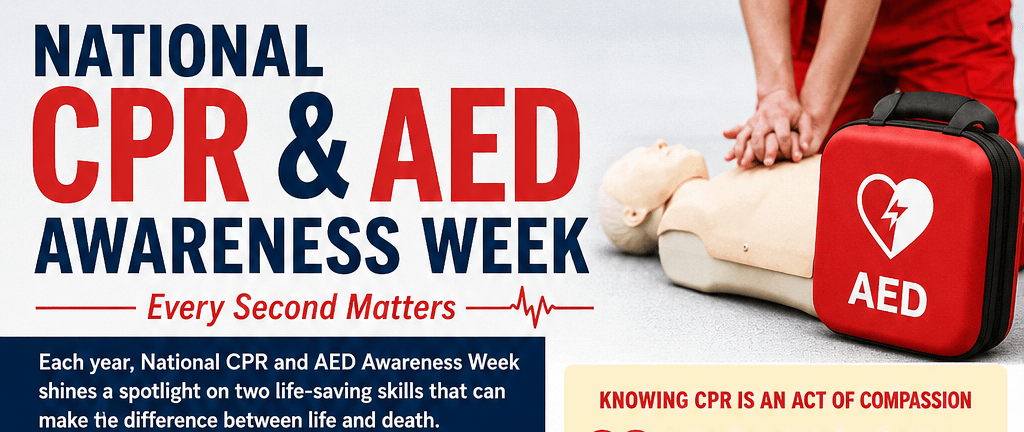
Each year, National CPR and AED Awareness Week shines a spotlight on two life-saving skills that can make the difference between life and death: CPR (Cardiopulmonary Resuscitation) and the use of an AED (Automated External Defibrillator). This important awareness week serves as a reminder that emergencies can happen anywhere — at home, at work, at school, during sports events, or even while walking through a crowded store — and ordinary people have the power to save lives when they are prepared.
Sudden cardiac arrest affects hundreds of thousands of people every year. It often strikes without warning, stopping the heart from pumping blood effectively to the brain and vital organs. When this happens, every second counts. Immediate CPR can help keep oxygen flowing through the body, while an AED can restore a normal heart rhythm through an electric shock. Together, these actions dramatically increase the chances of survival before emergency responders arrive.
One of the biggest misconceptions is that CPR and AED use should only be handled by medical professionals. In reality, many lives are saved by bystanders — parents, coworkers, teachers, friends, coaches, and even strangers — who were willing to act quickly. Modern AED devices are designed with voice instructions that guide users step-by-step, making them accessible for people with little or no medical experience.
National CPR and AED Awareness Week also highlights the importance of education and preparedness. Communities across the country use this week to host training sessions, workplace safety events, school demonstrations, and public awareness campaigns. These programs encourage people to learn basic CPR techniques, understand how AEDs work, and feel confident enough to step forward during an emergency.
Knowing CPR is not just a skill — it is an act of compassion. It means being ready to help a loved one, neighbor, coworker, or complete stranger during one of the most critical moments of their life. Many survivors of cardiac arrest are alive today because someone nearby chose courage over fear and took action before paramedics arrived.
Businesses, schools, churches, gyms, restaurants, and community centers are also encouraged to evaluate their emergency preparedness during this week. Having accessible AEDs, properly trained staff, and clear emergency response plans can save precious time when every moment matters. Awareness alone is important, but preparation is what truly saves lives.
This week is also an opportunity to encourage families to talk openly about emergency situations. Children, teenagers, and adults alike can benefit from understanding what to do if someone collapses or stops breathing. Even learning how to call 911 effectively and locate an AED can make a significant impact during a crisis.
National CPR and AED Awareness Week is ultimately about empowerment. It reminds us that saving a life is not always dependent on advanced medical equipment or years of professional training. Sometimes it begins with one person willing to step forward, remain calm, and act quickly.
You never know whose life you may save someday — a friend, a coworker, a family member, or a stranger who becomes someone’s miracle story. Taking the time to learn CPR and AED use today could become the reason someone gets a second chance tomorrow.
Read More Holidays & National Days
Leave a ReplyCancel reply