
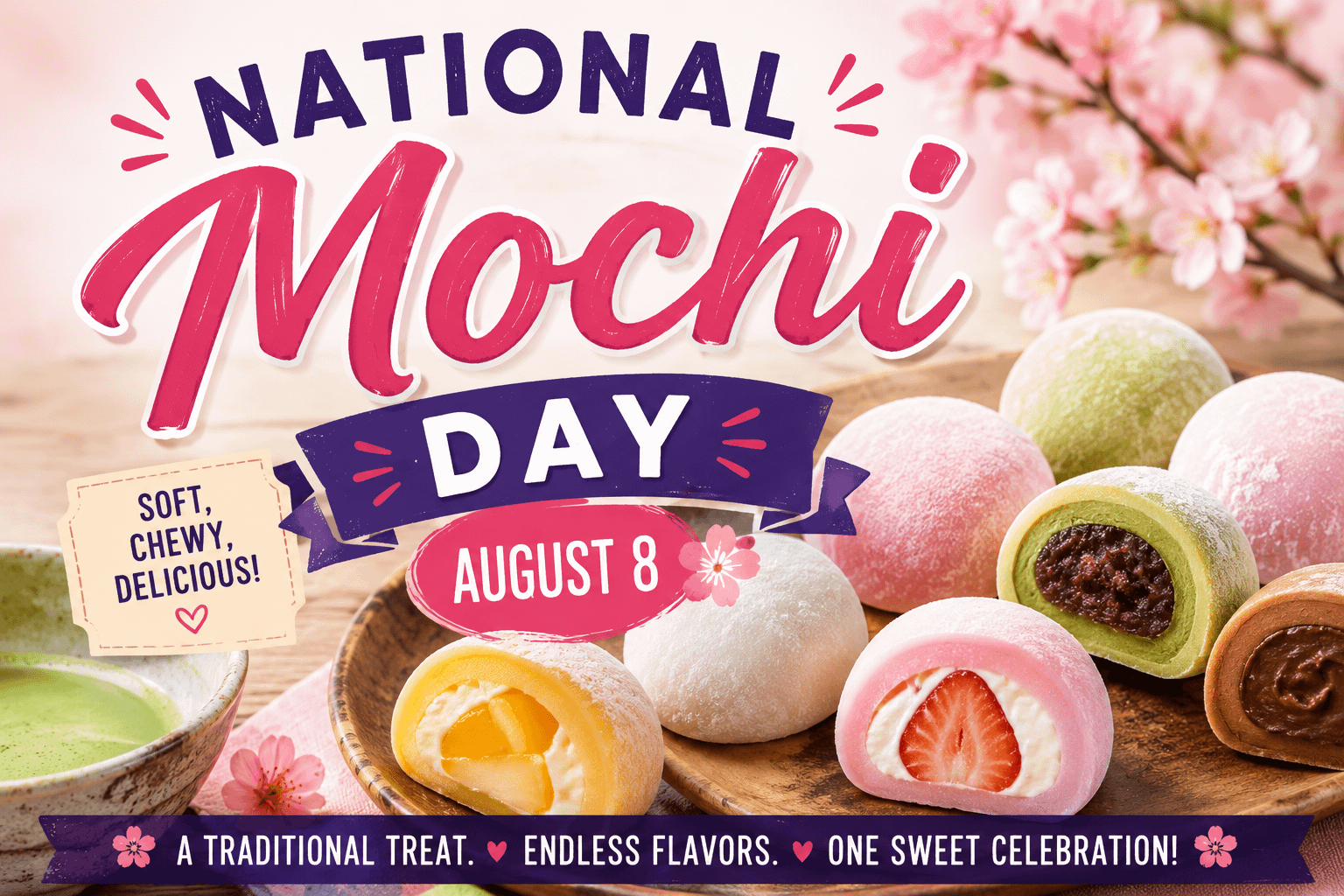
Every year on August 8, National Mochi Day gives food lovers a delicious reason to celebrate one of Japan’s most fascinating and recognizable foods: mochi.
Soft, chewy, stretchy, and incredibly versatile, mochi delivers an eating experience that is difficult to compare with almost anything else. It can surround sweet red bean paste, be paired with fresh fruit, wrap a scoop of ice cream, appear in soup, or be grilled and seasoned for a savory snack.
For many Americans, colorful mochi ice cream was their introduction to this unique food. Today, packages filled with strawberry, mango, chocolate, matcha, vanilla, and other flavors can be found in many supermarkets.
But mochi’s story goes far beyond the freezer aisle.
Mochi has deep connections to Japanese history, culture, family traditions, religious customs, seasonal celebrations, and especially the Japanese New Year. For generations, making and sharing mochi has been a way to bring people together.
National Mochi Day is therefore an opportunity to do more than enjoy something delicious. It can also be a day to discover the traditions behind the food, support Japanese businesses, experiment with unfamiliar flavors, and appreciate how food connects cultures and generations.
So grab your favorite mochi—or find a flavor you’ve never tried—and celebrate National Mochi Day.
What Exactly Is Mochi?
Traditional Japanese mochi is made from a special type of short-grain glutinous rice.
The word “glutinous” refers to the rice’s sticky texture rather than gluten. When properly prepared, the rice becomes incredibly sticky and elastic.
Traditional mochi preparation begins by soaking and steaming the rice. The cooked rice is then pounded repeatedly until the individual grains transform into a smooth, cohesive, stretchy mass.
The finished mochi can then be shaped into cakes and used in many different preparations.
Its texture is one of its defining characteristics.
Mochi is soft but resistant, requiring you to chew rather than allowing it to simply dissolve in your mouth. That distinctive chewiness has helped make mochi increasingly popular with adventurous dessert lovers around the world.
Modern recipes sometimes simplify the process by using glutinous rice flour rather than pounding whole rice.
Either way, the result is something unlike the typical cakes, cookies, candies, and pastries many Americans grow up eating.
Mochi Is More Than Mochi Ice Cream
Mention mochi in the United States and someone will probably picture small, colorful balls of ice cream wrapped in chewy dough.
Mochi ice cream is delicious, but it represents only one modern interpretation of mochi.
Traditional mochi itself does not necessarily contain ice cream—or any filling at all.
Mochi can be:
- Filled with sweet bean paste
- Served with fresh fruit
- Toasted or grilled
- Added to soup
- Coated with soybean powder
- Covered with sesame
- Flavored with matcha
- Wrapped in seaweed
- Seasoned with soy sauce
- Used in desserts
- Incorporated into traditional celebrations
Once you begin exploring Japanese cuisine, you quickly discover that mochi is not simply one dessert.
It is an entire category of food with many preparations.
The Long History of Mochi
Mochi has been eaten in Japan for centuries.
Its history is closely connected to the importance of rice within Japanese society. Rice historically represented much more than a basic food. It played important roles in agriculture, economics, religious practices, ceremonies, and community life.
Because rice was so valuable, foods prepared from it could take on special significance.
Mochi eventually became associated with celebrations and important occasions.
Rather than being viewed only as an everyday snack, mochi could symbolize good fortune, prosperity, strength, longevity, and new beginnings.
These cultural connections remain particularly visible during Japanese New Year celebrations.
Today, people around the world may encounter mochi primarily as dessert, but understanding its history adds another layer of appreciation to every bite.
The Tradition of Mochitsuki
One of the most fascinating traditions associated with mochi is mochitsuki, the traditional process of pounding rice to create mochi.
The process begins with glutinous rice that has been soaked and steamed.
The rice is placed inside a large traditional mortar called an usu.
A heavy wooden mallet known as a kine is then used to pound the rice.
Mochitsuki frequently involves at least two people working together.
One person swings the mallet while another turns, folds, and moistens the rice between strikes.
The process requires extraordinary timing.
The person handling the rice must quickly pull their hands away before the next strike lands.
As the pounding continues, the rice gradually changes. Individual grains disappear as the mixture becomes smoother, stickier, and increasingly elastic.
Eventually, the rice becomes the familiar stretchy mochi dough.
Watching traditional mochitsuki can be almost as entertaining as eating the finished product.
More importantly, the process demonstrates how food preparation can become a communal activity.
Families and communities can gather together, share responsibilities, and celebrate while preparing food.
Mochi and the Japanese New Year
Mochi is especially important during Japanese New Year celebrations.
The beginning of a new year is traditionally a time for family, reflection, renewal, and hopes for prosperity in the months ahead.
Mochi appears in several New Year customs.
One of the best-known examples is kagami mochi.
What Is Kagami Mochi?
Kagami mochi is a traditional Japanese New Year decoration typically made from round mochi cakes stacked on top of one another.
It is often topped with a citrus fruit.
The decoration has symbolic significance and is traditionally displayed during the New Year period.
Rather than simply being decorative food, kagami mochi represents the deep connection between mochi, spirituality, tradition, and seasonal celebration.
Later, the mochi may be broken and eaten as part of another tradition known as Kagami Biraki.
These customs demonstrate how food can carry meaning far beyond taste.
Mochi in Ozoni
Another New Year tradition involving mochi is ozoni.
Ozoni is a soup traditionally eaten during the New Year season.
Mochi is an important ingredient, but the rest of the dish can vary depending on the region, household, and family tradition.
Broths, vegetables, meats, seafood, and seasonings may differ considerably.
Even the shape and preparation of the mochi can vary.
That regional diversity is part of what makes traditional food so interesting. There isn’t always one universal recipe.
Instead, dishes evolve through geography, family history, available ingredients, and local customs.
Daifuku: One of the Most Popular Mochi Treats
If you’d like to move beyond mochi ice cream, daifuku is an excellent place to start.
Daifuku generally consists of soft mochi wrapped around a sweet filling.
A classic version contains anko, a sweet paste traditionally made from azuki beans.
The contrast is wonderful.
The outside is soft and chewy while the inside is smooth and sweet.
Today, daifuku can contain an enormous variety of fillings.
You might encounter:
- Sweet red bean paste
- White bean paste
- Matcha cream
- Chocolate
- Custard
- Fruit
- Sweet cream
- Chestnut
- Sesame
- Peanut fillings
Modern dessert makers continue experimenting with new flavors while maintaining the recognizable mochi exterior.
Ichigo Daifuku
One particularly beautiful variation is ichigo daifuku.
“Ichigo” means strawberry in Japanese.
This dessert commonly combines a fresh strawberry with sweet bean paste and mochi.
The result offers several textures at once.
First comes the soft, chewy mochi.
Then the smooth sweetness of the filling.
Finally, the fresh strawberry adds juiciness, acidity, and natural sweetness.
It is a wonderful example of how relatively simple ingredients can produce an unforgettable dessert.
What Is Mochi Ice Cream?
Mochi ice cream combines a thin layer of mochi dough with a small portion of ice cream.
The result is a bite-sized frozen dessert with an unusual contrast.
The outside is soft and chewy.
The inside is cold and creamy.
That combination has helped mochi ice cream become extremely popular outside Japan, particularly in the United States.
Its convenient individual portions also make it ideal for sampling different flavors.
Instead of committing to one large dessert, you can try several varieties.
Popular Mochi Ice Cream Flavors
One of the most enjoyable parts of National Mochi Day is choosing flavors.
Popular options include:
Strawberry
Sweet, fruity, and approachable, strawberry is a great introduction for anyone trying mochi ice cream for the first time.
Mango
Mango adds a tropical sweetness that pairs beautifully with the soft mochi exterior.
Chocolate
Chocolate offers a familiar flavor with an unfamiliar texture, making it another excellent choice for beginners.
Vanilla
Simple vanilla allows the contrast between creamy ice cream and chewy mochi to take center stage.
Matcha
Matcha brings the distinctive earthy flavor of green tea to the dessert.
Coconut
Creamy coconut works particularly well with mochi’s texture and provides a tropical character.
Coffee
Coffee mochi ice cream combines dessert sweetness with roasted coffee flavor.
Cookies and Cream
A modern favorite that blends a familiar American ice cream flavor with the Japanese-inspired mochi exterior.
Don’t be afraid to try something outside your usual preferences.
That’s part of the fun.
Kinako Mochi
Another traditional way to enjoy mochi involves kinako, roasted soybean flour.
Kinako has a warm, nutty flavor that pairs wonderfully with mochi.
The mochi may be coated in kinako and sweetened, creating a relatively simple treat where the ingredients complement each other instead of competing for attention.
If you’re accustomed to heavily flavored modern desserts, traditional preparations like kinako mochi can provide a completely different experience.
Savory Mochi
Mochi isn’t limited to dessert.
That may surprise people whose only experience is mochi ice cream.
Traditional mochi can be grilled or toasted, creating an appealing contrast between a slightly crisp exterior and a soft, stretchy interior.
Seasonings can transform it into a savory snack.
Soy sauce and nori are particularly popular companions.
Isobeyaki
One traditional preparation worth discovering is isobeyaki.
Mochi is grilled or toasted, seasoned with soy sauce, and commonly wrapped with nori.
The result combines several sensations at once:
Chewy mochi.
Savory soy sauce.
Crisp seaweed.
It is dramatically different from strawberry or chocolate mochi ice cream and demonstrates just how versatile mochi can be.
Why Do People Love Mochi?
Flavor certainly matters, but texture may be mochi’s greatest attraction.
People often seek foods that offer contrasting textures.
Think about crispy fried chicken with juicy meat inside.
Or crunchy cookies paired with soft ice cream.
Mochi provides its own distinctive contrast.
Depending on the preparation, you might experience chewy mochi surrounding creamy ice cream, soft bean paste, or juicy fruit.
For people who enjoy interesting textures, mochi can become addictive.
Mochi’s Growing Popularity in America
Mochi has become increasingly visible throughout the United States.
What once required a visit to a Japanese specialty market can now frequently be found at supermarkets, restaurants, dessert shops, warehouse stores, and frozen-food retailers.
Mochi ice cream has played an especially important role in introducing Americans to the food.
Its colorful appearance also makes it naturally suited to social media.
Pictures of pink strawberry mochi, green matcha mochi, purple taro varieties, and tropical mango flavors are visually appealing.
Videos showing the stretchy texture can make people curious enough to try it themselves.
The popularity of mochi is another example of how food can introduce people to cultures beyond their own.
How to Celebrate National Mochi Day
There is no complicated requirement for celebrating National Mochi Day.
Start with the obvious:
Eat some mochi.
But if you’d like to turn August 8 into a bigger celebration, there are plenty of possibilities.
Try Mochi for the First Time
Never eaten mochi?
National Mochi Day is the perfect excuse.
If you’re hesitant about unfamiliar flavors, begin with something you already enjoy.
Chocolate lovers can try chocolate.
Strawberry fans can start with strawberry.
Coffee drinkers might enjoy coffee-flavored mochi ice cream.
Once you’re comfortable with the texture, branch out.
Try matcha, red bean, black sesame, or another traditional flavor.
Have a Mochi Tasting Party
Turn National Mochi Day into a small gathering.
Purchase several varieties of mochi and create your own tasting station.
Give each person a scorecard with categories including:
- Flavor
- Texture
- Sweetness
- Appearance
- Filling
- Overall enjoyment
Have everyone taste each variety without knowing what it is.
At the end, reveal the flavors.
You may discover that the flavor everyone expected to dislike becomes the winner.
Try Traditional Mochi
If you’ve only eaten mochi ice cream, challenge yourself to explore traditional versions.
Look for a Japanese bakery, Asian supermarket, Japanese grocery store, restaurant, or dessert shop.
Ask what type of mochi they recommend.
You might discover daifuku, strawberry-filled mochi, kinako mochi, or another variety you’ve never encountered.
Try Making Mochi at Home
Making traditional mochi from whole rice can be a significant project, but modern recipes have made homemade versions more accessible.
Many home recipes use glutinous rice flour, sugar, water, and starch.
Once the dough is cooked and cooled enough to handle, it can be divided and shaped.
Then comes the creative part.
Choose your fillings.
Try:
- Strawberries
- Chocolate
- Sweet red bean paste
- Peanut butter
- Ice cream
- Mango
- Sweetened cream
- Custard
Homemade mochi may not look perfect the first time.
That’s okay.
National Mochi Day is about having fun and learning something new.
Pair Mochi With Japanese Tea
Mochi and tea can make a wonderful pairing.
Sweet desserts often benefit from beverages that offer bitterness, earthiness, or roasted flavors.
Consider pairing your mochi with:
Matcha – Rich, earthy, and distinctive.
Sencha – A classic Japanese green tea.
Genmaicha – Green tea blended with roasted rice, providing a comforting roasted character.
Hojicha – Roasted Japanese green tea with a warm flavor.
Set aside a little time, make a cup of tea, put away your phone, and enjoy your mochi slowly.
Sometimes the best celebration is simply appreciating what you’re eating.
Support Japanese and Asian-Owned Businesses
National Mochi Day can also become an opportunity to support businesses in your community.
Look for Japanese:
- Bakeries
- Restaurants
- Grocery stores
- Dessert shops
- Tea houses
- Cafés
Instead of automatically choosing something familiar, ask the employees what they recommend.
You might leave with a new favorite dessert.
Learn Something About Japanese Culture
Food becomes even more meaningful when you understand its background.
Spend a few minutes on National Mochi Day learning about Japanese culture and culinary traditions.
Research:
- Mochitsuki
- Kagami mochi
- Japanese New Year traditions
- Ozoni
- Daifuku
- Regional mochi varieties
- Japanese tea culture
One small food holiday can become an opportunity to learn about centuries of history.
Share Mochi With Someone
Food has always had the ability to bring people together.
Buy an extra package and share it with a friend, family member, neighbor, or coworker.
Even better, find someone who has never eaten mochi.
Let them choose their first flavor.
Experiencing something new together can turn an ordinary snack into a memory.
Create a Mochi Dessert Board
Charcuterie boards aren’t only for cheese and meat.
Create a dessert board featuring different types of mochi.
Include:
- Mochi ice cream
- Daifuku
- Fresh strawberries
- Mango slices
- Chocolate
- Japanese cookies
- Matcha treats
- Fresh berries
Serve Japanese tea alongside the board.
It can become an easy National Mochi Day party centerpiece.
Fun Facts About Mochi
Here are some fun facts to share while celebrating:
Mochi has centuries of history.
It existed long before today’s mochi ice cream trend.
Mochi is traditionally connected to celebrations.
Japanese New Year customs are particularly associated with mochi.
Mochi isn’t always dessert.
It can be grilled, seasoned, added to soups, and enjoyed in savory dishes.
Traditional mochi making is physically demanding.
Pounding steamed rice into a smooth mass requires strength, coordination, and patience.
Mochi comes in countless varieties.
Different fillings, coatings, flavors, shapes, and preparation methods create very different experiences.
Texture is a major part of mochi’s appeal.
Its unmistakable chewiness separates it from most Western desserts.
A Note About Eating Mochi Safely
Traditional mochi can be extremely chewy and sticky.
Because of that texture, it should be eaten carefully.
Take small bites and chew thoroughly, particularly when serving traditional mochi to older adults or others who may have difficulty chewing or swallowing.
Young children should also be closely supervised, and large pieces should not be given to anyone who cannot safely chew them.
Enjoying mochi slowly isn’t only safer—it also gives you more time to appreciate its unique texture.
From Tradition to Modern Creativity
One of the most interesting things about mochi is how successfully it has traveled between tradition and innovation.
On one side are centuries-old customs.
Mochitsuki.
New Year’s celebrations.
Kagami mochi.
Ozoni.
Traditional daifuku.
On the other side are modern creations.
Mochi ice cream.
Chocolate-filled mochi.
Mango mochi.
Cookies-and-cream varieties.
Creative bakery desserts inspired by mochi’s texture.
The old and new don’t necessarily have to compete.
They can coexist.
Traditional preparations preserve cultural history while modern interpretations introduce new generations of people to the food.
Someone who discovers mochi through a supermarket package of strawberry mochi ice cream may eventually become curious about daifuku, mochitsuki, or Japanese New Year traditions.
Food can become the doorway to learning.
Why National Mochi Day Is Worth Celebrating
At first glance, National Mochi Day might simply look like another fun food holiday.
And there is absolutely nothing wrong with celebrating by eating dessert.
But it can become something more.
Food tells stories.
It tells us about agriculture, geography, religion, immigration, family traditions, celebrations, creativity, and cultural exchange.
Mochi tells a particularly interesting story because it has traveled from centuries-old Japanese traditions into modern dessert shops and supermarkets around the world.
Every generation finds new ways to enjoy it.
Yet the traditional food remains connected to its history.
That combination makes mochi worth discovering.
Make August 8 Delicious
National Mochi Day is the perfect opportunity to step outside your usual dessert routine.
If you’ve never eaten mochi, try it.
If you’ve only eaten mochi ice cream, explore traditional daifuku.
If you already love daifuku, try grilled savory mochi.
If you’re already a mochi expert, introduce someone else to your favorite variety.
The possibilities are almost endless.
Food holidays are ultimately about having a little fun.
They give us an excuse to try something different, visit a new restaurant, learn a recipe, share food with someone we care about, or discover another culture’s traditions.
National Mochi Day can do all of those things.
Happy National Mochi Day!
On August 8, celebrate National Mochi Day with something soft, chewy, sweet—or perhaps even savory.
Pick up your favorite mochi ice cream.
Visit a Japanese bakery.
Try daifuku.
Drink Japanese tea.
Learn about mochitsuki.
Make homemade mochi.
Share a few pieces with friends or family.
Most importantly, take a moment to appreciate the history and tradition behind the food you’re enjoying.
From centuries-old Japanese celebrations to today’s colorful freezer-aisle creations, mochi demonstrates how a traditional food can continue evolving while connecting people across generations and cultures.
Whether your favorite is strawberry, mango, matcha, chocolate, red bean, black sesame, or something completely different, August 8 gives you the perfect excuse to enjoy it.
Happy National Mochi Day!
Engagement Question
What is your favorite type or flavor of mochi—and if you’ve never tried mochi before, which flavor would you choose first?
Read More Holidays & National Days
Leave a ReplyCancel reply