
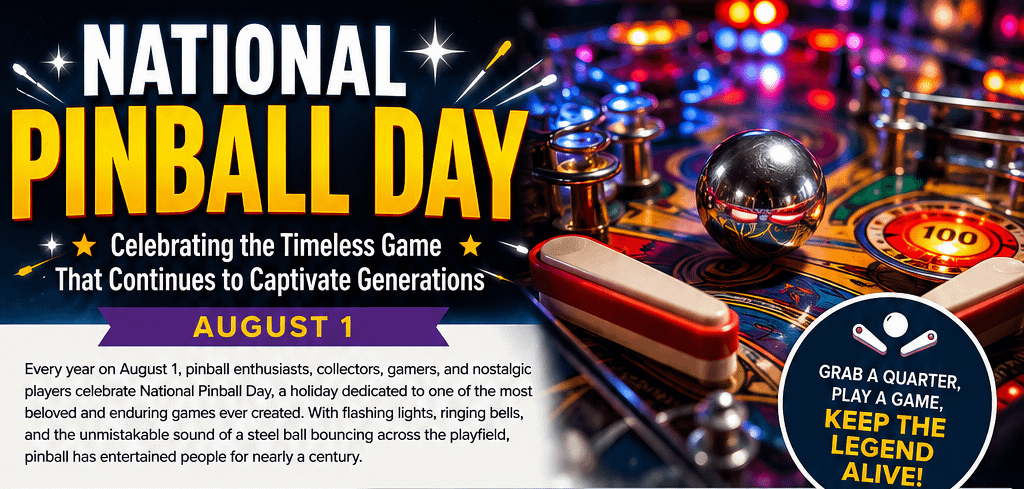
Every year on August 1, arcade enthusiasts, collectors, gamers, and nostalgic players celebrate National Pinball Day, a holiday dedicated to one of the most beloved and enduring games ever created. With flashing lights, ringing bells, colorful artwork, and the unmistakable sound of a steel ball bouncing across the playfield, pinball has entertained people for nearly a century.
Unlike many games that fade into history, pinball continues to thrive. It bridges generations, bringing together grandparents who remember playing in the 1950s, parents who spent afternoons in arcades during the 1980s, and younger players discovering the excitement of the game for the first time. Whether you enjoy vintage electro-mechanical machines or the newest digital masterpieces packed with modern technology, National Pinball Day is the perfect excuse to celebrate this unique combination of art, engineering, and skill.
What Is National Pinball Day?
National Pinball Day is observed annually on August 1 to recognize the rich history of pinball and the passionate community that has kept the game alive for decades.
The date honors Roger Sharpe, one of the most influential figures in pinball history. His work transformed public perception of the game and helped restore its reputation as a legitimate game of skill rather than one based solely on chance.
Today, the holiday celebrates:
- The history of pinball
- Classic arcade culture
- Modern pinball innovation
- Skilled competitive players
- Collectors and restorers
- The joy of simply playing for fun
Whether you’re chasing a new personal best or introducing someone to their first machine, National Pinball Day is about appreciating a game that has stood the test of time.
The Incredible Story Behind National Pinball Day
Roger Sharpe’s name is forever linked to pinball history.
During much of the mid-20th century, pinball machines were viewed with suspicion. Many cities believed they encouraged gambling because early machines lacked player-controlled flippers. Since outcomes depended largely on luck, lawmakers grouped pinball alongside games of chance.
As a result, cities including New York, Chicago, and Los Angeles enacted bans that lasted for decades.
Everything changed in 1976.
Roger Sharpe appeared before the New York City Council during a hearing that would determine whether pinball should remain illegal. Instead of simply explaining the game’s mechanics, Sharpe demonstrated them.
Standing before the council with reporters watching, he called his shot in advance and skillfully launched the ball exactly where he predicted it would go. The successful shot proved that experienced players could control the outcome through practice and precision.
The demonstration helped convince officials to lift New York City’s 35-year ban on pinball.
That moment became one of the most famous events in arcade history and helped launch pinball into a new era of popularity.
The Origins of Pinball
Pinball’s story began long before electronic arcades.
Its earliest ancestors can be traced to 18th-century French tabletop games such as Bagatelle, where players launched balls across boards filled with pins and obstacles.
By the early 1930s, manufacturers in America began producing mechanical games that closely resembled modern pinball machines.
These early machines featured:
- Wooden cabinets
- Metal balls
- Simple scoring systems
- Spring-loaded plungers
- Rows of nails and pins that redirected the ball
Players had no control after launching the ball.
Success depended largely on luck.
The Invention of the Flipper Changed Everything
The biggest turning point in pinball history came in 1947.
The Gottlieb company introduced Humpty Dumpty, the first commercially successful machine featuring player-controlled flippers.
Suddenly, players weren’t merely spectators.
They became active participants.
The addition of flippers transformed pinball into a true skill game requiring:
- Fast reflexes
- Timing
- Strategy
- Practice
- Precision
- Decision making
Modern pinball owes its popularity to this revolutionary innovation.
The Golden Age of Pinball
Throughout the 1950s, 60s, and 70s, pinball machines became staples of American entertainment.
They appeared almost everywhere:
- Arcades
- Bowling alleys
- Pizza restaurants
- Shopping centers
- Bus stations
- College campuses
- Convenience stores
- Family game rooms
Children eagerly spent their allowance while adults competed for bragging rights and high scores.
For many people, pinball represented the heart of arcade culture before video games became dominant.
The Evolution of Modern Pinball
Today’s machines are technological marvels.
Modern manufacturers combine traditional gameplay with cutting-edge electronics to create incredibly immersive experiences.
Current machines may include:
- Full-color LCD displays
- Voice acting
- Movie-quality soundtracks
- Animated toys
- Motorized ramps
- Interactive missions
- Hundreds of LED lights
- Internet-connected leaderboards
- Complex rule sets
- Multi-stage wizard modes
Despite these advancements, the basic objective remains unchanged:
Keep the ball alive and score as many points as possible.
Pinball Is a Beautiful Blend of Art and Engineering
One reason collectors treasure pinball machines is because every cabinet is a work of art.
Artists spend months designing:
- Vibrant cabinet graphics
- Detailed playfield illustrations
- Character artwork
- Sculpted toys
- Custom lighting effects
Meanwhile, engineers carefully design each playfield to create exciting ball movement, satisfying shots, and endless replay value.
Few entertainment products combine visual art, mechanical engineering, electrical design, software programming, music, and storytelling as seamlessly as pinball.
Why Pinball Never Gets Old
Unlike many digital games where every level is identical, every pinball game unfolds differently.
Tiny changes in speed, angle, and timing create entirely new experiences each time you play.
This unpredictability keeps players coming back.
Pinball rewards:
- Practice
- Patience
- Observation
- Muscle memory
- Creativity
- Adaptability
Even expert players continue learning new techniques after thousands of games.
Competitive Pinball Is Bigger Than Ever
Many people are surprised to discover that competitive pinball is flourishing around the world.
Professional tournaments attract players from dozens of countries.
Competitors battle for:
- International rankings
- Championship titles
- Cash prizes
- Trophy collections
- Prestige within the pinball community
Tournament players often spend years mastering advanced techniques such as:
- Dead flips
- Live catches
- Post passes
- Alley passes
- Drop catches
- Nudging without tilting
Watching elite competitors can be every bit as exciting as watching professional esports or traditional sporting events.
Famous Pinball Machines
Over the decades, several machines have become legendary among collectors and fans.
Some of the most beloved include:
- The Addams Family
- Medieval Madness
- Attack From Mars
- Twilight Zone
- Monster Bash
- Indiana Jones
- Black Knight
- FunHouse
- Theatre of Magic
- Jurassic Park
- Godzilla
Each machine offers unique themes, rules, artwork, and challenges that keep players coming back for “just one more game.”
Pinball in Popular Culture
Pinball has become deeply woven into entertainment history.
It has appeared in:
- Hollywood films
- Television sitcoms
- Comic books
- Music videos
- Shopping malls
- Family entertainment centers
- Classic diners
- Bars and breweries
Perhaps its most famous cultural moment came with The Who’s rock opera Tommy, featuring the legendary song “Pinball Wizard.” The song introduced millions of people to the idea of mastering the silver ball and helped cement pinball as a cultural icon.
Fun Facts About Pinball
Did you know?
- The average steel pinball travels surprisingly fast, reaching speeds that challenge even experienced players.
- Some modern machines contain more than 3,000 individual parts.
- Collectible machines can sell for over $25,000 depending on rarity and condition.
- Many collectors own dozens—or even hundreds—of machines.
- Every pinball machine uses carefully calibrated physics to create consistent gameplay.
- Competitive players often spend years perfecting their skills.
Ways to Celebrate National Pinball Day
Need inspiration for celebrating? Here are several fun ideas.
Visit an Arcade
Support your local arcade by spending a few hours playing classic and modern machines.
Explore a Pinball Museum
Many museums feature rows of fully playable machines spanning decades of pinball history.
Host a Tournament
Invite family and friends for a friendly high-score competition.
Learn Basic Techniques
Practice trapping the ball, aiming shots, and mastering controlled flips.
Watch a Tournament
Professional pinball competitions are streamed online throughout the year and showcase incredible skill.
Restore a Classic Machine
If you’re mechanically inclined, restoring an older machine can become a rewarding hobby.
Share Your Favorite Memories
Post photos of your favorite pinball machine on social media and encourage others to share theirs.
Why Pinball Continues to Inspire
In an era dominated by smartphones and online gaming, pinball offers something refreshingly different.
Every game is physical.
Players hear the sounds, feel the flippers respond instantly beneath their fingertips, and watch the ball react in real time. There are no loading screens or downloadable content—just skill, focus, and excitement.
Pinball also reminds us that great games don’t need to be complicated to be endlessly entertaining. Its combination of chance, precision, and fast-paced action creates an experience that is as exciting today as it was decades ago.
The Lasting Legacy of National Pinball Day
National Pinball Day is about much more than celebrating an arcade game. It recognizes the creativity, innovation, craftsmanship, and community that have kept pinball alive for generations.
From its humble beginnings as a simple mechanical amusement to today’s sophisticated machines packed with lights, music, and storytelling, pinball has continually evolved while staying true to its core: providing fun, challenge, and unforgettable moments.
So this August 1, seek out a pinball machine, challenge a friend to beat your high score, visit a local arcade or museum, or simply take a moment to appreciate the remarkable history behind the silver ball.
Whether you’re a lifelong collector or a first-time player, National Pinball Day is the perfect opportunity to celebrate one of the greatest games ever made.
Happy National Pinball Day! May your shots be accurate, your multiballs be plentiful, and your high scores keep climbing.
Read More Holidays & National Days
Leave a ReplyCancel reply