
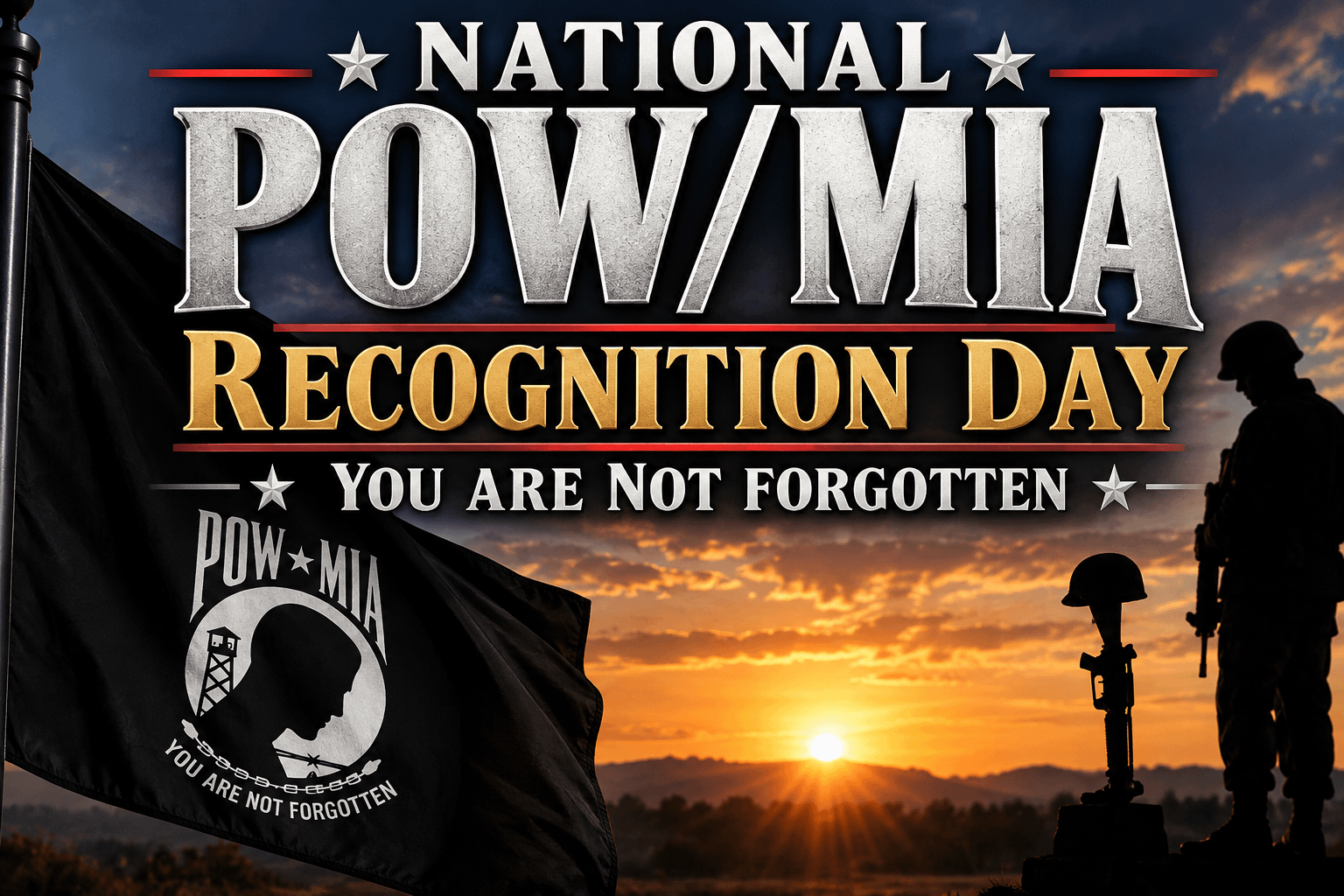
Every year, Americans pause on National POW/MIA Recognition Day to remember members of the United States Armed Forces who were prisoners of war and those who remain missing in action.
Observed on the third Friday of September, this national day of remembrance carries a simple but powerful message:
You are not forgotten.
It is a day to honor courage, sacrifice, uncertainty, and the families who have lived without answers. While many military observances celebrate victories or recognize those who returned home, National POW/MIA Recognition Day asks us to remember those whose stories did not end with a homecoming.
Some endured captivity and eventually returned.
Others disappeared during war and never came home.
Their families waited.
Their fellow service members remembered.
And generations later, America continues to honor them.
What Does POW/MIA Mean?
POW stands for Prisoner of War—a member of the armed forces captured and held by an enemy during an armed conflict.
MIA stands for Missing in Action—a service member whose whereabouts are unknown following military operations.
Behind those abbreviations are real people.
They were sons and daughters, fathers and mothers, brothers and sisters, husbands and wives, friends and fellow service members.
Each person had dreams, relationships, memories, and people waiting for them at home.
That is important to remember because terms such as POW and MIA can sometimes sound like military classifications. But behind every classification is a human story.
National POW/MIA Recognition Day makes sure those stories are not forgotten.
When Is National POW/MIA Recognition Day?
National POW/MIA Recognition Day is observed annually on the third Friday in September.
In 2026, National POW/MIA Recognition Day falls on Friday, September 18.
Across the country, military installations, veterans organizations, government agencies, communities, and families may hold ceremonies and remembrance events.
The POW/MIA flag is also prominently displayed as a symbol of America’s commitment to remembering prisoners of war and those who remain missing.
The Meaning of the POW/MIA Flag
One of the most recognizable symbols associated with the observance is the black-and-white POW/MIA flag.
The flag depicts the silhouette of a man’s head, a guard tower and barbed wire.
Beneath the image are words that have become inseparable from America’s commitment to its missing service members:
YOU ARE NOT FORGOTTEN
Those four words capture the purpose of National POW/MIA Recognition Day.
They are a promise.
They tell former prisoners of war that their suffering and sacrifice are remembered.
They tell families of missing service members that their loved ones have not disappeared from America’s memory.
And they remind future generations that remembrance is a responsibility.
Remembering America’s Prisoners of War
Throughout American history, service members have experienced the unimaginable reality of enemy captivity.
Prisoners of war have endured isolation, hunger, disease, physical suffering, psychological abuse, uncertainty, and separation from everyone they loved.
For some, captivity lasted months.
For others, it lasted years.
Survival could require extraordinary courage and determination.
Those who eventually returned home sometimes carried experiences that were difficult for others to fully understand. Freedom did not necessarily erase what happened during captivity.
National POW/MIA Recognition Day gives Americans an opportunity to recognize those sacrifices.
Their stories remind us that military service sometimes demands far more than most people will ever be asked to give.
Remembering Those Missing in Action
There is another painful part of this observance: remembering those who never returned.
When someone is missing in action, their family can face a uniquely difficult form of grief.
There may be unanswered questions.
What happened?
Where are they?
Did they suffer?
Will they ever be found?
Will the family ever be able to bring them home?
Those questions can remain for years or even generations.
For many families, there is no final goodbye.
There may be no grave to visit and no complete explanation of what happened.
That uncertainty makes remembrance especially important.
National POW/MIA Recognition Day tells those families that America still remembers the person they love.
The Families Who Wait
When discussing POWs and MIAs, we should also remember the families.
Military service affects more than the person wearing the uniform.
Parents wait for children.
Spouses wait for husbands and wives.
Children wait for parents.
Brothers and sisters wait for siblings.
When someone goes missing during war, an entire family can become trapped between hope and grief.
They may hope their loved one somehow survived while simultaneously fearing the worst.
Days become months.
Months become years.
For some families, years become decades.
Some parents died without knowing exactly what happened to their child.
Some children grew old without knowing what happened to their father.
Some families have spent generations searching for answers.
National POW/MIA Recognition Day belongs to them, too.
Their waiting deserves recognition.
Their love deserves recognition.
Their perseverance deserves recognition.
Why Bringing Them Home Still Matters
The commitment to account for missing American service members extends far beyond memorial ceremonies.
Efforts continue to locate, identify, and return the remains of Americans missing from past conflicts.
Modern technology, historical research, forensic science, DNA analysis, archaeological investigation, military records, eyewitness accounts, and cooperation with foreign governments can all contribute to identifying missing personnel.
Sometimes answers come decades after a war has ended.
For a family that has waited generations, an identification can finally provide something they may have wondered whether they would ever receive:
an answer.
It cannot restore the years that were lost.
It cannot undo the tragedy.
But it can allow a service member to finally come home.
That matters.
More Than Numbers
Historical statistics are important, but numbers alone can never tell the entire story.
Imagine one empty chair at a family dinner.
One bedroom left untouched.
One mother waiting for news.
One father wondering what happened to his son.
One child asking when Dad is coming home.
One spouse watching the door.
Multiply that heartbreak across thousands of families and multiple generations, and we begin to understand why National POW/MIA Recognition Day remains so significant.
Every number represents a person.
Every person represents a story.
Every story represents people who loved them.
Why Remembrance Still Matters
As wars move further into history, there is always a danger that the people who lived through them become reduced to names, dates, photographs, and statistics.
National POW/MIA Recognition Day fights against that.
It asks us to remember the human cost of war.
It reminds younger generations that freedom has been defended by ordinary people who were asked to endure extraordinary circumstances.
It also teaches something deeper about gratitude.
Remembering someone does not require personally knowing them.
You may never have met a prisoner of war.
You may not have a missing service member in your family.
You may never have served in the military.
You can still stop for a moment and recognize their sacrifice.
Ways to Observe National POW/MIA Recognition Day
There are many meaningful ways to participate in National POW/MIA Recognition Day.
You can learn the story of an American who was held as a prisoner of war or remains missing in action. Instead of remembering only statistics, learn a person’s name and story.
Attend a POW/MIA recognition ceremony in your community if one is available.
Visit a veterans memorial and spend a few quiet moments reflecting on the people represented there.
Display the POW/MIA flag appropriately.
Thank former prisoners of war and listen to their stories when they choose to share them.
Support organizations and programs dedicated to veterans, military families, POW/MIA remembrance, and recovering missing American personnel.
Parents and teachers can also use the day to explain to younger generations what POW and MIA mean and why the country continues to remember.
Even something as simple as sharing a remembrance message can help keep these stories alive.
Teach the Next Generation
Perhaps one of the most important responsibilities surrounding National POW/MIA Recognition Day is education.
Eventually, the generations who personally remember America’s earlier wars will no longer be here to tell their stories.
Then the responsibility becomes ours.
We must tell younger generations why the POW/MIA flag exists.
We must explain why families waited.
We must teach them about sacrifice.
We must teach them that some service members went to war and never returned.
History survives when people choose to remember it.
If we stop telling these stories, names become statistics.
If we continue telling them, their humanity remains.
Remember the Empty Chair
At some POW/MIA ceremonies, an empty place at a table symbolizes those who cannot be present.
It is a powerful image.
An empty chair may seem like nothing more than an unused piece of furniture.
But to someone who has lost or is missing a loved one, an empty chair can represent everything.
It represents the person who should be sitting there.
The voice that should still be heard.
The stories that should still be told.
The birthdays that should have been celebrated.
The holidays that should have been shared.
The years that should have been lived.
That empty place is one reason remembrance matters.
Honor Them Beyond One Day
National POW/MIA Recognition Day occurs once each year, but remembering America’s prisoners of war and missing service members should not be limited to a single Friday in September.
Their stories belong to American history.
Learn their names.
Tell their stories.
Honor their families.
Teach your children and grandchildren what POW/MIA means.
When you see the black-and-white flag, take a moment to remember why it flies.
It represents people.
It represents sacrifice.
It represents families still carrying unanswered questions.
And above all, it represents a promise.
You Are Not Forgotten
National POW/MIA Recognition Day reminds us that some of the greatest sacrifices made in service to this country happened far away from home and outside the public eye.
Some Americans endured captivity and eventually returned.
Some gave their lives.
Some remain missing.
And some families are still waiting for answers generations later.
We cannot change what happened to them.
But we can determine whether they are remembered.
We can speak their names.
We can tell their stories.
We can honor their families.
We can teach the next generation.
And we can continue the promise represented by the POW/MIA flag:
You are not forgotten.
To every American who endured captivity, we remember you.
To every American who never returned home, we remember you.
To every family that spent years waiting for answers, we remember you.
To every service member still unaccounted for, America continues to remember.
Until they all come home.
How will you take a moment this National POW/MIA Recognition Day to honor those who sacrificed and those who never made it home?
Leave a ReplyCancel reply