
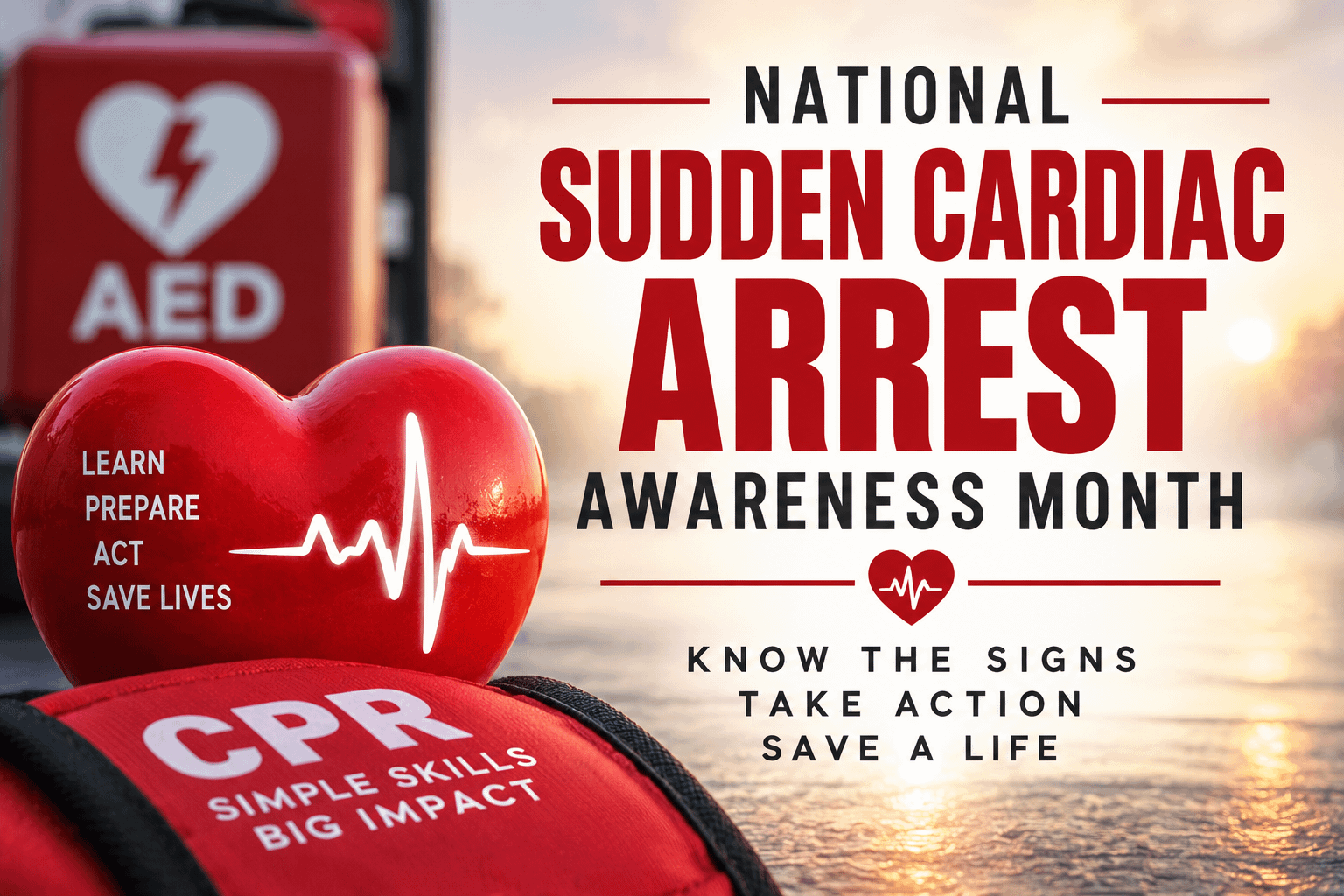
Every October, National Sudden Cardiac Arrest Awareness Month brings attention to one of the most urgent medical emergencies a person can face. It is an opportunity to educate ourselves, our families, our workplaces, and our communities about sudden cardiac arrest—and, most importantly, about what ordinary people can do when it happens.
Sudden cardiac arrest can occur without warning. A person may be talking, exercising, working, eating dinner, or simply spending time with family when they suddenly collapse.
When that happens, the actions of the people nearby can make an enormous difference.
Learning to recognize cardiac arrest, calling 911, performing CPR, and using an automated external defibrillator (AED) are skills that can turn a bystander into a lifesaver.
What Is Sudden Cardiac Arrest?
Sudden cardiac arrest occurs when the heart suddenly stops effectively pumping blood throughout the body. When blood flow stops, the brain and other vital organs are deprived of oxygen.
A person experiencing cardiac arrest typically becomes unresponsive and is not breathing normally. They may sometimes gasp, which should not be mistaken for normal breathing.
Cardiac arrest is a medical emergency in which every moment matters.
According to the American Heart Association, approximately 350,000 people in the United States experience out-of-hospital cardiac arrest each year, and about 90% of these events are fatal. Immediate CPR can double or even triple a person’s chance of survival.
Those numbers demonstrate why Sudden Cardiac Arrest Awareness Month is about more than spreading information. It is about preparing people to act.
Cardiac Arrest Is Not the Same as a Heart Attack
One of the most important things to understand is the difference between a heart attack and cardiac arrest.
The terms are sometimes used interchangeably, but they describe different medical emergencies.
A heart attack generally occurs when blood flow to part of the heart muscle becomes blocked.
Cardiac arrest occurs when the heart suddenly stops pumping effectively.
A heart attack can sometimes lead to cardiac arrest, but they are not the same condition.
Understanding that distinction matters because a person in cardiac arrest requires immediate lifesaving intervention.
Recognizing Sudden Cardiac Arrest
Cardiac arrest may happen with little or no warning.
Two of the most important signs are:
- Sudden loss of responsiveness
- No normal breathing
A person experiencing cardiac arrest may collapse and fail to respond when you speak to or touch them. They may not breathe at all, or they may make abnormal gasping sounds.
Do not assume that gasping means everything is okay.
If someone suddenly collapses, is unresponsive, and isn’t breathing normally, treat the situation as an emergency.
Call 911 immediately, begin CPR, and get an AED if one is available.
Why CPR Matters
CPR helps maintain blood circulation when the heart is no longer pumping normally.
Those first few minutes before professional emergency responders arrive can be critical.
For adults and teens who suddenly collapse, Hands-Only CPR can provide lifesaving assistance. The basic concept is simple: call 911 and perform repeated chest compressions until additional help or an AED becomes available.
The American Heart Association reports that immediate CPR can double or triple a cardiac-arrest victim’s chance of survival.
Yet many people who experience cardiac arrest still do not receive CPR from a bystander.
American Heart Association data from 2024 found that only about 42% of adults experiencing out-of-hospital cardiac arrest received bystander CPR.
That means there is tremendous room for communities to become better prepared.
Don’t Be Afraid to Help
Fear can stop people from acting.
Someone may worry:
“What if I do CPR incorrectly?”
“What if I hurt the person?”
“What if I don’t know exactly what I’m doing?”
But when someone is in cardiac arrest, doing nothing can have devastating consequences.
You don’t need to be a doctor, nurse, firefighter, or paramedic to begin helping.
Call 911. Follow the dispatcher’s instructions. Begin CPR. Ask someone to locate an AED.
Training can give you additional confidence, but recognizing the emergency and being willing to act are incredibly important.
The Importance of AEDs
An automated external defibrillator, commonly called an AED, is a portable device designed to analyze the heart’s rhythm and, when appropriate, deliver an electrical shock.
AEDs can often be found in places such as schools, airports, gyms, workplaces, community centers, shopping areas, sports facilities, and other public locations.
Modern AEDs are designed so members of the public can use them. The device provides step-by-step instructions and will deliver a shock only when its analysis determines one is appropriate.
If someone collapses from suspected cardiac arrest, one person can begin CPR while another person retrieves the nearest AED.
Once the AED arrives, turn it on and follow its instructions while continuing to follow directions from emergency services.
You do not need to diagnose the person’s heart rhythm yourself. The AED does that.
Know Where the AED Is Before You Need It
Most of us know where the fire extinguishers are in our workplaces, schools, or businesses.
We should also know where the AEDs are.
The middle of an emergency is not the ideal time to begin searching.
During National Sudden Cardiac Arrest Awareness Month, take a few minutes to look around the places where you spend the most time.
Where is the AED at your workplace?
Does your child’s school have one?
Does your church have one?
What about your gym, community center, sports league, restaurant, or other organization?
If an AED is available, make sure people know where it is and that it can be accessed quickly.
Cardiac Arrest Can Happen at Home
It is easy to imagine cardiac arrest happening somewhere public, but many incidents happen inside private residences.
That makes CPR knowledge especially personal.
The stranger you someday help might not be a stranger at all.
It could be your spouse.
Your parent.
Your child.
Your friend.
Your neighbor.
Or another person you love.
Learning CPR isn’t simply something we do for the community. It is something we can do for the people closest to us.
Everyone Can Help Build a More Prepared Community
Sudden Cardiac Arrest Awareness Month provides an excellent opportunity for schools, businesses, churches, sports organizations, restaurants, community groups, and families to evaluate their emergency preparedness.
That might mean organizing CPR and AED training.
It might mean checking existing AED equipment.
It could mean teaching employees where AEDs are located.
Schools and athletic organizations can review their emergency action plans and make sure coaches and staff know what to do if an athlete or spectator suddenly collapses.
Businesses can ensure employees know how to contact emergency services and quickly locate lifesaving equipment.
Families can talk about CPR and encourage older children and adults to receive training.
Preparedness does not have to be complicated.
Sometimes it begins with one simple question:
Would we know what to do if someone suddenly collapsed right now?
Awareness Must Lead to Action
Awareness campaigns are most meaningful when they inspire people to do something.
This October, consider taking one action you haven’t taken before.
Learn Hands-Only CPR.
Take a CPR course.
Find the AEDs in the places you visit regularly.
Encourage your workplace to offer CPR and AED training.
Ask whether your child’s school or sports organization has an emergency action plan.
Share reliable information about cardiac arrest with your friends and family.
The Sudden Cardiac Arrest Foundation’s Ready to Respond initiative emphasizes exactly this idea: learn the facts, gain the skills, and be prepared to save a life.
Seconds Matter
When cardiac arrest occurs, there isn’t time to wait and hope someone else knows what to do.
Emergency medical professionals are essential, but the people already standing nearby have an opportunity to begin lifesaving actions before responders arrive.
Call 911.
Start CPR.
Get an AED.
Use it.
Continue until professional help takes over.
Those actions are simple enough to remember, yet powerful enough to help save someone’s life.
Knowledge Creates Confidence
Many people hesitate during emergencies because they are afraid of making a mistake.
Training helps replace some of that uncertainty with confidence.
Once you’ve practiced CPR on a training manikin and learned how an AED works, the equipment becomes much less intimidating.
You begin to understand that an AED is specifically designed to guide you.
You learn what effective chest compressions feel like.
You practice responding instead of freezing.
No training can make a real emergency easy, but preparation can make action more likely.
A Month That Could Save Lives All Year
National Sudden Cardiac Arrest Awareness Month lasts throughout October, but the lessons learned during the month can matter every day of the year.
We cannot predict when cardiac arrest will happen.
We can prepare for what we will do if it does.
Imagine how many communities would become safer if more people learned CPR.
Imagine if everyone knew where the nearest AED was located.
Imagine if every school, workplace, sports facility, church, and community organization regularly practiced its cardiac emergency response plan.
One trained person can make a difference.
One accessible AED can make a difference.
One person willing to step forward can make a difference.
Final Thoughts
National Sudden Cardiac Arrest Awareness Month reminds us of something incredibly important: you do not have to be a medical professional to help save a life.
You can learn CPR.
You can learn how to use an AED.
You can encourage others to become trained.
You can make sure your workplace, school, church, or community organization is prepared.
And if the day ever comes when someone suddenly collapses in front of you, the knowledge you gained today could help you respond when every second matters.
This October, don’t stop at awareness.
Learn the signs. Learn CPR. Know where the AED is. Be ready to act.
Because someday, somewhere, someone may need help—and the person standing closest to them could be you.
Would you know what to do if someone suddenly went into cardiac arrest in front of you?
Leave a ReplyCancel reply