
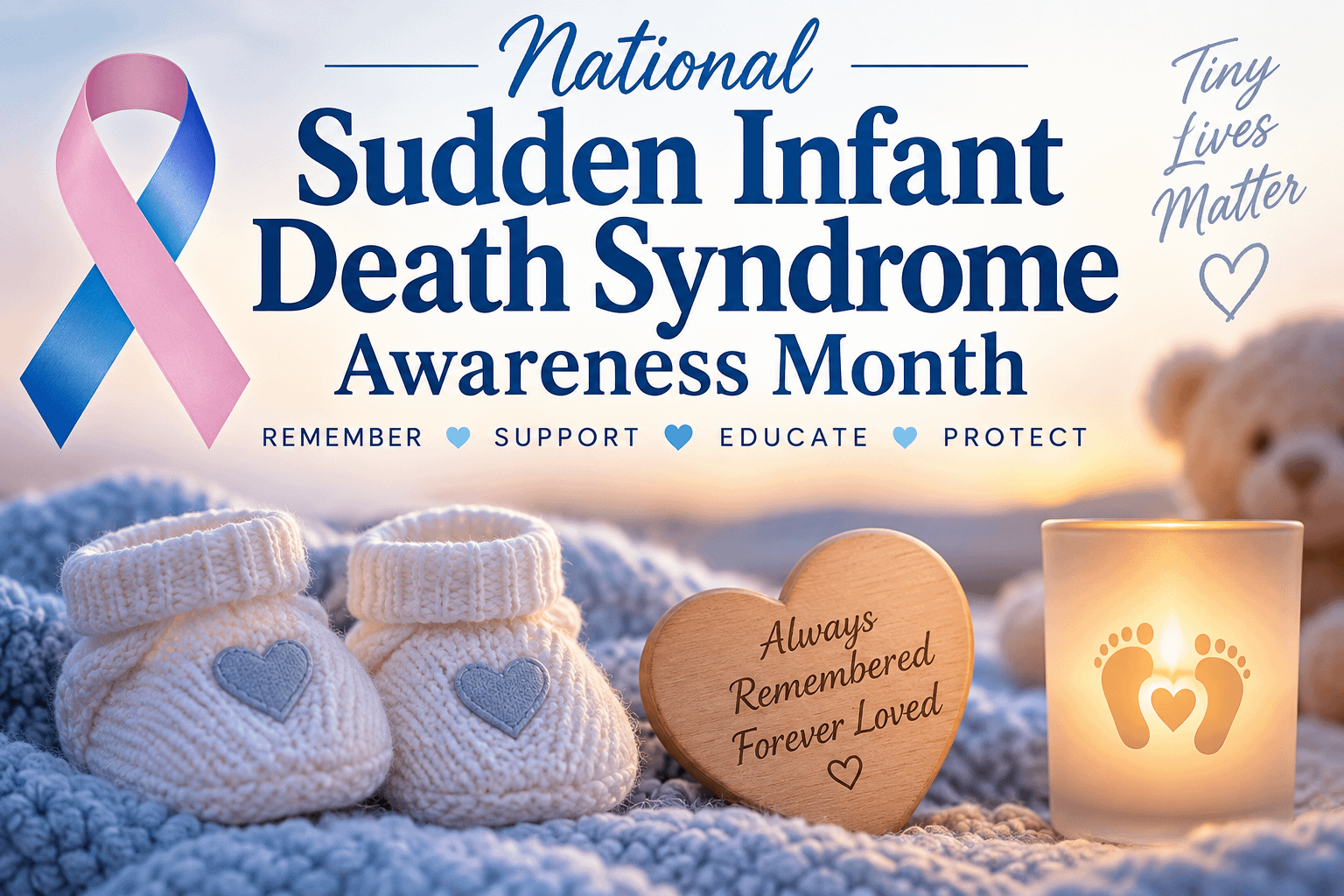
Every October, National Sudden Infant Death Syndrome Awareness Month brings attention to one of the most heartbreaking experiences a family can endure: the sudden and unexpected death of a baby.
Sudden Infant Death Syndrome, commonly known as SIDS, is the sudden death of an infant younger than one year that remains unexplained even after a thorough investigation. For parents and families affected by SIDS, the loss can leave behind overwhelming grief and questions that may never receive complete answers.
National SIDS Awareness Month is a time to remember the babies whose lives ended far too soon, support grieving parents and families, educate caregivers about safer infant sleep practices, and continue efforts to better understand and reduce sleep-related infant deaths.
Most importantly, it is a time for compassion.
Behind every statistic is a baby who was deeply loved. Behind every loss is a family whose world changed forever.
What Is Sudden Infant Death Syndrome?
SIDS generally occurs while an infant is sleeping and is sometimes referred to as “crib death.” However, that term can be misleading because SIDS is not necessarily caused by a crib.
SIDS is one category within the broader term Sudden Unexpected Infant Death, or SUID. SUID describes the sudden and unexpected death of an infant younger than one year in which the cause is not immediately apparent.
Some sudden unexpected infant deaths are eventually attributed to accidental suffocation or strangulation in a sleeping environment, infection, metabolic disorders, cardiac conditions, or other identifiable causes. When an extensive investigation cannot determine why the infant died, the death may be classified as SIDS.
Researchers have learned a great deal about infant sleep safety and factors associated with increased or decreased risk, but SIDS remains complex.
There is no single action that can guarantee SIDS will never happen.
That distinction matters, particularly when speaking with grieving parents. Awareness should never become blame.
Why October Matters
Awareness months provide an opportunity to bring subjects that are often difficult to discuss into the open.
SIDS is especially difficult because it involves the death of a baby who may have appeared healthy shortly before dying. Parents may put their child to sleep expecting another ordinary night and suddenly find themselves living through an unimaginable tragedy.
October gives communities an opportunity to talk about infant safety while also acknowledging the emotional devastation surrounding infant loss.
Education can help caregivers learn evidence-based recommendations for safer sleep environments. Awareness can encourage research. Public conversations can remind grieving families that their babies are remembered.
National SIDS Awareness Month also takes place during Pregnancy and Infant Loss Awareness Month, making October an important period for recognizing families grieving miscarriages, stillbirths, neonatal deaths, SIDS, and other forms of infant loss.
Different circumstances surround every loss, but every child matters.
Creating a Safer Sleep Environment
One of the most important parts of SIDS awareness is helping parents and caregivers understand current safer-sleep recommendations.
The American Academy of Pediatrics recommends placing infants on their backs for every sleep until they reach one year of age.
Babies should sleep on a firm, flat, non-inclined sleep surface intended for infant sleep. The sleeping area should remain free from soft objects and loose bedding.
That means keeping items such as pillows, blankets, bumper pads, stuffed animals, and similar soft materials out of an infant’s sleep space.
Room-sharing without bed-sharing is also recommended. Keeping the baby’s sleep space in the parents’ room can make feeding, comforting, and monitoring easier while providing the infant with a separate sleeping surface.
Parents and caregivers should also avoid exposing infants to cigarette smoke, nicotine, marijuana, and other substances.
Breastfeeding, when possible and desired, is associated with a reduced risk of SIDS. Offering a pacifier at nap time and bedtime may also reduce risk once feeding is well established when applicable.
Parents should discuss questions about their baby’s individual circumstances with their pediatrician or another qualified healthcare professional.
Safe Sleep Is Everyone’s Responsibility
Infant sleep safety is not something only parents need to understand.
Grandparents, babysitters, relatives, daycare providers, friends, and anyone else caring for an infant should know the family’s safe-sleep routine.
Sometimes older generations were taught recommendations that differ significantly from today’s guidance. For example, parents decades ago may have been instructed to place babies on their stomachs.
Medical recommendations changed as researchers gathered stronger evidence.
That means conversations about safe sleep should focus on education rather than criticism.
Parents can clearly explain their expectations to anyone watching their child:
Place the baby on their back.
Use the approved sleep space.
Keep blankets, pillows, stuffed animals, and other soft objects outside the baby’s sleeping area.
Following the same routine every time a baby sleeps—including naps—helps create consistency among caregivers.
The Grief of Losing a Baby
While education is essential during SIDS Awareness Month, we cannot forget the families already living with the consequences of infant loss.
Losing a child changes a parent forever.
There may be shock, disbelief, anger, sadness, guilt, loneliness, confusion, and countless questions.
Parents may replay their final moments with their baby repeatedly.
They may wonder whether they missed something.
They may ask themselves what they could have done differently.
They may search desperately for an explanation.
When a death remains unexplained, those unanswered questions can become another painful part of grief.
This is why compassion is so important.
A grieving parent does not need someone searching for a reason to blame them. They need people willing to acknowledge their child’s life and their loss.
Sometimes the most meaningful words are simply:
“I remember your baby.”
“I’m here for you.”
“You can talk about your child with me.”
Parents May Grieve Differently
There is no universal way to grieve the death of a child.
Some parents talk openly about their baby.
Others become quiet.
Some cry frequently.
Others rarely cry in front of people.
Some want to look at photographs and share memories.
Others may need time before they can do that.
Mothers and fathers may also express grief differently from one another. One parent may need conversation while another copes by working, staying busy, exercising, praying, writing, or spending time alone.
Different expressions of grief do not mean one parent loved the child more than another.
Grief is personal.
Families need permission to mourn in the ways that help them survive their loss.
Remembering the Babies
One fear many bereaved parents carry is that their child will eventually be forgotten.
When someone dies after decades of life, there may be thousands of stories people can share about them.
When a baby dies, the number of memories may be much smaller—but the love is not.
A short life can leave a permanent impact.
During National SIDS Awareness Month, families may choose to honor their babies by lighting candles, displaying photographs, creating memorial keepsakes, planting trees or flowers, participating in remembrance walks, donating to research organizations, supporting another grieving family, or simply saying their child’s name.
There is no correct way to remember a baby.
What matters is acknowledging that the baby’s life mattered.
Supporting a Family After Infant Loss
Many people want to support grieving parents but are afraid they will say the wrong thing.
That fear can sometimes cause friends and relatives to disappear precisely when parents need support most.
You do not need perfect words.
You need compassion.
Listen without trying to fix grief.
Say the baby’s name if the parents are comfortable hearing it.
Remember important dates.
Check in months later—not only during the first few weeks after the death.
Offer practical assistance such as bringing dinner, helping with household responsibilities, or simply sitting with someone who does not want to be alone.
Avoid statements intended to explain the tragedy.
Sometimes there is no explanation that will make the loss feel acceptable.
Presence can mean more than answers.
Grief Does Not Have an Expiration Date
One of the greatest misconceptions about grief is that people eventually “get over” losing someone they love.
Parents may learn how to carry their grief, but that does not mean the love disappears.
Birthdays can remain difficult.
The anniversary of the child’s death can remain painful.
Holidays can feel different.
Seeing children who would be approximately the same age may trigger unexpected emotions years later.
Milestones the child never reached can become reminders of the future the family imagined.
Grief can return unexpectedly through a song, photograph, smell, location, dream, or memory.
Families should never be pressured to follow someone else’s timetable for healing.
Turning Awareness Into Compassion
Awareness should accomplish more than placing a ribbon on social media for a month.
It should change how we care for one another.
It should encourage parents and caregivers to learn safer sleep recommendations.
It should motivate communities to make reliable infant-safety information accessible.
It should encourage continued medical research into unexplained infant deaths.
And it should remind grieving families that their children have not been forgotten.
Sometimes awareness means education.
Sometimes awareness means prevention.
Sometimes awareness means research.
And sometimes awareness simply means sitting beside someone whose heart has been shattered and allowing them to talk about the baby they still love.
Every Baby Deserves to Be Remembered
National Sudden Infant Death Syndrome Awareness Month carries both hope and heartbreak.
There is hope that continued research and education can help reduce infant deaths.
There is hope that more parents and caregivers will understand safer sleep practices.
There is hope that families experiencing infant loss will find stronger support systems.
But there is also remembrance.
We remember the babies who should have had more birthdays.
We remember the parents who imagined first steps, first words, first days of school, graduations, and futures that never arrived.
We remember families who woke up one morning and discovered that life would never again be what it had been before.
Their children existed.
Their children were loved.
Their children mattered.
And their children deserve to be remembered.
During National Sudden Infant Death Syndrome Awareness Month, may we educate without blaming, support without judging, listen without trying to fix, and remember without being afraid to speak the names of children who are deeply missed.
For every parent carrying the memory of a baby they can no longer hold, love remains.
And sometimes remembrance is one of the most powerful ways we can continue that love.
How can we create communities where grieving parents feel safe talking about their babies and know their children will always be remembered?
Leave a ReplyCancel reply