
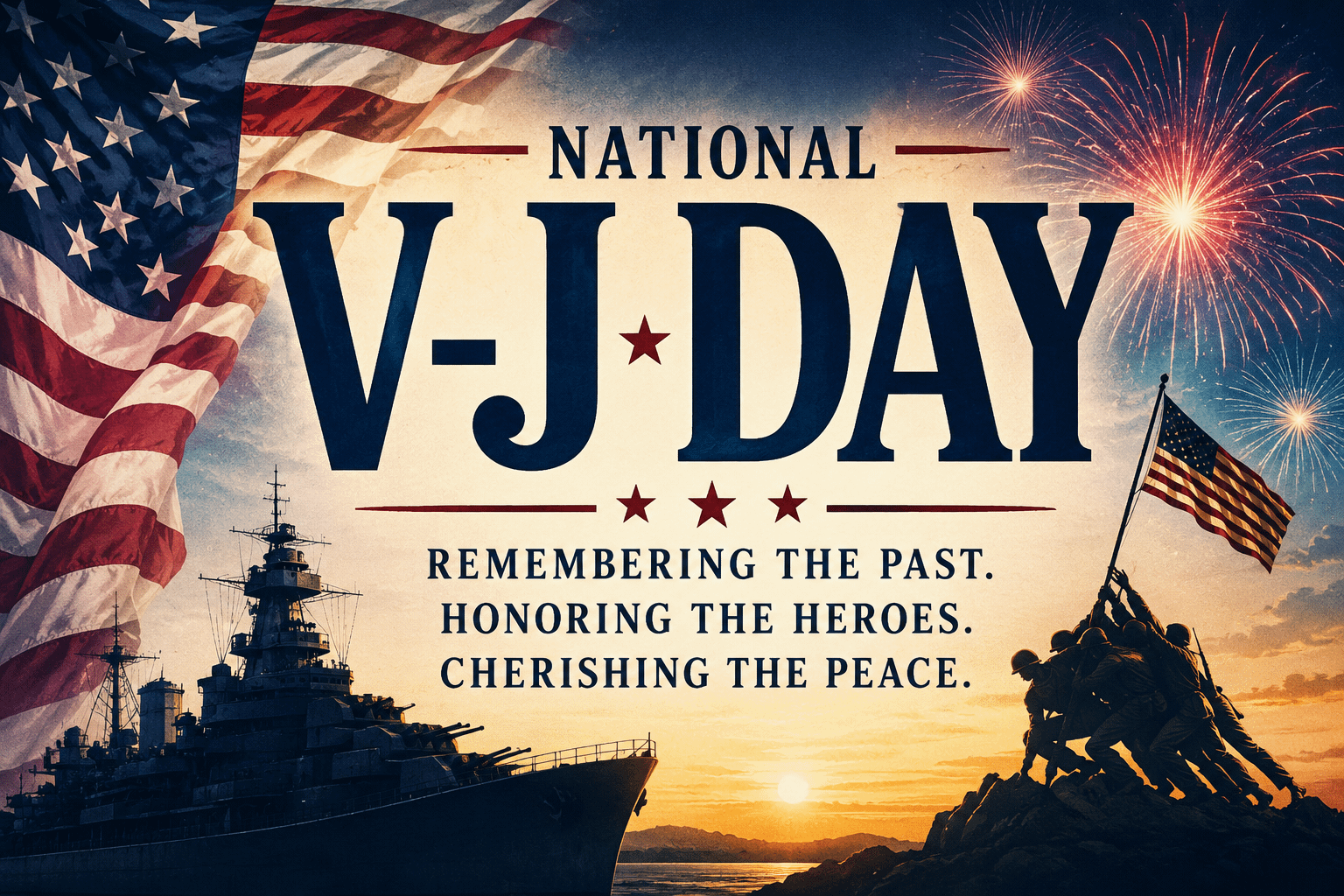
National V-J Day is a day of remembrance marking one of the most significant turning points of the 20th century—the end of World War II. V-J stands for Victory over Japan, referring to Japan’s surrender in 1945 and the conclusion of a global conflict that had devastated nations, transformed societies, and claimed tens of millions of lives.
For Americans who lived through World War II, the announcement of Japan’s surrender brought an extraordinary mixture of relief, celebration, exhaustion, gratitude, and remembrance. Families who had spent years worrying about loved ones serving overseas finally had reason to believe that soldiers, sailors, Marines, airmen, and other service members would soon be coming home.
But V-J Day is more than a celebration of military victory. It is also an opportunity to remember the tremendous human cost of World War II, honor those who served and sacrificed, recognize the civilians who supported the war effort, and reflect on the responsibility future generations have to pursue peace.
What Does V-J Day Mean?
V-J Day means Victory over Japan Day.
The term refers to the surrender of Imperial Japan to the Allied powers in August 1945. Japan announced its acceptance of the Allied surrender terms on August 15, 1945, while the formal surrender documents were signed aboard the USS Missouri in Tokyo Bay on September 2, 1945.
Because of these different milestones, references to V-J Day can involve more than one date.
August 14 is especially associated with the announcement in the United States because President Harry S. Truman announced Japan’s acceptance of the surrender terms on that date in Washington. August 15 became known as V-J Day in many parts of the world because of time-zone differences and the timing of the public announcement.
September 2 represents the formal conclusion of the surrender process.
In the United States, Rhode Island continues to observe Victory Day on the second Monday of August, carrying forward a state tradition connected with the end of World War II.
Regardless of the particular observance date, the historical significance remains the same: after nearly six years of worldwide war—and almost four years of direct American participation—the Second World War was finally ending.
America Enters World War II
Although World War II began in Europe in September 1939, the United States did not formally enter the conflict until December 1941.
That changed dramatically following the Japanese attack on the American naval base at Pearl Harbor in Hawaii on December 7, 1941.
The surprise attack killed more than 2,400 Americans and damaged or destroyed numerous ships and aircraft.
The following day, President Franklin D. Roosevelt addressed Congress and famously described December 7 as “a date which will live in infamy.”
Congress declared war on Japan.
Germany and Italy subsequently declared war on the United States, bringing America fully into a conflict spanning Europe, Africa, Asia, and the Pacific.
Millions of Americans would eventually serve in the armed forces.
At home, millions more contributed by working in factories, buying war bonds, rationing essential goods, volunteering, growing victory gardens, collecting scrap materials, and supporting the enormous industrial effort required to fight a global war.
The Brutal War in the Pacific
The Pacific Theater became one of the most difficult and deadly parts of World War II.
American and Allied forces fought across enormous distances, often battling for strategically important islands that could provide airfields, naval bases, and staging areas for further operations.
Battles such as Midway, Guadalcanal, Saipan, Iwo Jima, and Okinawa became symbols of the intensity of the Pacific War.
The Battle of Midway in June 1942 proved particularly important. American forces inflicted devastating losses on the Japanese carrier fleet, helping shift the strategic momentum of the Pacific conflict.
From there, Allied forces gradually moved closer to the Japanese home islands through campaigns sometimes described as “island hopping.”
But progress came at an enormous cost.
The Battle of Iwo Jima in early 1945 produced one of the most recognizable images of the entire war—the raising of the American flag on Mount Suribachi.
The Battle of Okinawa, fought from April through June 1945, demonstrated how costly an invasion of the Japanese home islands might become. American forces suffered heavy casualties, Japanese military losses were catastrophic, and Okinawan civilians endured devastating suffering.
By the summer of 1945, Nazi Germany had already surrendered in Europe.
But the Pacific War continued.
Victory in Europe Came First
Before V-J Day, Americans celebrated another historic milestone: V-E Day, or Victory in Europe Day.
Nazi Germany surrendered in May 1945, effectively ending the European portion of World War II.
For American service members fighting in the Pacific—and the families waiting for them at home—the war was not finished.
There was tremendous concern that defeating Japan might require an invasion of the Japanese home islands. Military planners prepared for the possibility of prolonged and extremely costly fighting.
Then events moved rapidly during August 1945.
The Atomic Bombings
On August 6, 1945, the United States dropped an atomic bomb on Hiroshima.
Three days later, on August 9, a second atomic bomb was dropped on Nagasaki.
The bombings caused catastrophic destruction and enormous loss of civilian life, both immediately and through subsequent injuries and radiation-related effects.
The use of atomic weapons remains one of the most debated decisions in modern history.
Supporters of President Harry S. Truman’s decision have argued that the bombs accelerated Japan’s surrender and avoided an invasion that could have produced massive American, Allied, Japanese military, and civilian casualties.
Critics have questioned whether the bombings were necessary, particularly the second bombing, and have emphasized the devastating humanitarian consequences of nuclear warfare.
Historical discussion also considers other factors surrounding Japan’s surrender, including the Soviet Union’s declaration of war against Japan and invasion of Japanese-held territory in Manchuria.
V-J Day therefore exists within a complicated historical context.
Remembering the end of the war does not require ignoring the suffering that accompanied it. Understanding history means recognizing both the relief experienced when the fighting stopped and the immense human tragedy that preceded that moment.
Japan Announces Its Surrender
On August 15, 1945, Japanese Emperor Hirohito addressed the Japanese people by radio and announced Japan’s acceptance of the Allied surrender terms.
For many Japanese citizens, it was the first time they had ever heard the emperor’s voice.
Across Allied nations, news of Japan’s surrender produced enormous celebrations.
In the United States, crowds filled streets.
People hugged strangers.
Car horns sounded.
Church bells rang.
Flags appeared from windows and buildings.
Newspapers printed enormous headlines announcing the end of the war.
After years of casualty reports, rationing, military deployments, uncertainty, and fear, Americans finally received the news they had desperately hoped to hear:
The war was ending.
The Famous Times Square Kiss
One of the most famous photographs associated with V-J Day was taken in New York City’s Times Square.
Photographer Alfred Eisenstaedt captured an American sailor kissing a woman dressed in white amid the celebrations.
The photograph appeared in Life magazine and became an enduring image associated with the spontaneous celebrations marking the war’s conclusion.
Over the decades, the photograph has also generated discussion about the identities of the people pictured and the circumstances of the kiss, reminding modern audiences that famous historical images can carry more complicated stories than their original symbolism suggests.
Still, the image remains closely connected with the public memory of V-J Day and the overwhelming emotions experienced when Americans learned the war was ending.
The Formal Surrender Aboard the USS Missouri
Although Japan announced its surrender in August, the formal surrender ceremony took place on September 2, 1945.
Representatives of Japan and the Allied powers gathered aboard the battleship USS Missouri in Tokyo Bay.
Japanese Foreign Minister Mamoru Shigemitsu signed the Instrument of Surrender on behalf of the Japanese government, while General Yoshijiro Umezu signed on behalf of the Japanese armed forces.
General Douglas MacArthur signed as Supreme Commander for the Allied Powers.
Representatives from other Allied nations also signed.
With those signatures, World War II formally came to an end.
After years of fighting across continents and oceans, humanity had reached the conclusion of the deadliest conflict in modern history.
Remembering America’s World War II Generation
National V-J Day provides an opportunity to remember the generation of Americans whose lives were transformed by World War II.
More than 16 million Americans served in the U.S. armed forces during the war.
Many never returned home.
Others came home carrying physical injuries, emotional wounds, and memories they rarely discussed.
Their families also sacrificed.
Parents waited for letters.
Wives and husbands lived with uncertainty.
Children grew up while fathers or mothers served overseas.
Communities mourned when telegrams arrived announcing that local sons, brothers, husbands, fathers, and friends had been killed or were missing.
The sacrifices extended far beyond the battlefield.
The Home Front
America’s wartime effort required an extraordinary mobilization of industry and society.
Factories that once produced civilian products began manufacturing tanks, aircraft, ships, weapons, ammunition, vehicles, and military equipment.
Women entered industrial jobs in unprecedented numbers.
The cultural image of Rosie the Riveter became a lasting symbol of the millions of women who worked in defense industries and other essential occupations.
Americans participated in rationing programs involving items such as gasoline, sugar, meat, rubber, and other materials.
Families planted victory gardens.
Children collected scrap metal.
Citizens purchased war bonds.
Communities organized blood drives and volunteer programs.
The entire nation became connected to the war effort in one way or another.
Remembering Difficult Chapters at Home
Commemorating victory should also include an honest understanding of America’s wartime history.
One of the most serious injustices committed during the war was the forced removal and incarceration of approximately 120,000 people of Japanese ancestry in the United States, most of whom were American citizens.
Families were forced to leave homes, businesses, farms, and communities.
Decades later, the United States government formally acknowledged the injustice and provided an official apology and reparations to surviving detainees through the Civil Liberties Act of 1988.
Remembering this history matters.
Patriotism and historical understanding are not weakened by acknowledging mistakes. A nation can honor those who defended freedom while also learning from moments when the principles of freedom were not extended equally to everyone.
The Human Cost of World War II
World War II was not simply a collection of famous battles and military victories.
It was a human catastrophe.
Tens of millions of people died worldwide, including soldiers and civilians.
Entire cities were destroyed.
Millions were displaced.
Families were separated permanently.
The Holocaust resulted in the systematic murder of six million Jews by Nazi Germany and its collaborators, alongside millions of other victims targeted for persecution and death.
Across Europe and Asia, civilian populations suffered bombing, starvation, forced labor, occupation, massacres, disease, and displacement.
The Pacific War brought additional atrocities and enormous civilian suffering throughout China, Southeast Asia, the Pacific islands, and Japan.
That reality gives V-J Day deeper meaning.
The celebration of peace becomes more powerful when we understand the price humanity paid for war.
What Happened After V-J Day?
Japan’s surrender ended the fighting, but it also began a new chapter.
American and Allied forces occupied Japan, and the country underwent major political and social changes.
Japan adopted a new constitution and developed into a democratic nation.
The United States and Japan eventually became close allies and major economic partners.
That transformation is one of the remarkable developments of the postwar era.
Two nations that fought a brutal war eventually built a relationship based on diplomacy, commerce, security cooperation, and shared interests.
It offers an important historical lesson:
Former enemies do not have to remain enemies forever.
Peace can create possibilities that war cannot.
Why National V-J Day Still Matters
More than eight decades have passed since World War II ended.
The number of surviving World War II veterans grows smaller every year.
That makes remembrance increasingly important.
Future generations will not be able to hear these stories directly from veterans forever.
Eventually, responsibility for preserving those memories will belong entirely to their descendants, historians, museums, educators, communities, and ordinary citizens.
V-J Day encourages us to ask important questions.
What did previous generations sacrifice?
What can we learn from their experiences?
How do nations prevent another global conflict?
How should military victory be remembered alongside civilian suffering?
How do we preserve freedom while ensuring that fear does not cause us to abandon our own principles?
These questions make history relevant far beyond a single anniversary.
Ways to Observe National V-J Day
There are many meaningful ways to recognize V-J Day.
Take time to learn about the Pacific Theater and the men and women who served there.
Visit a military museum, historical site, memorial, or veterans cemetery.
Read firsthand accounts written by World War II veterans.
Watch interviews with veterans while those invaluable oral histories remain available.
Look through family photographs, letters, medals, uniforms, newspapers, or military records from the World War II era.
If someone in your family served during the war, research their unit and military history.
Display the American flag respectfully.
Attend a community remembrance ceremony.
Thank a World War II veteran if you have the opportunity to meet one.
You can also spend time learning about the experiences of civilians throughout the conflict, including those living in Europe, Japan, China, Southeast Asia, and Pacific island communities.
The more perspectives we understand, the more complete our understanding of history becomes.
Teach Younger Generations
One of the most important ways to observe V-J Day is simply to tell the story.
Children growing up today are separated from World War II by several generations.
Names such as Pearl Harbor, Midway, Iwo Jima, Okinawa, Hiroshima, Nagasaki, and the USS Missouri may appear briefly in textbooks, but understanding their significance requires more than memorizing dates.
Young people should understand that history happened to real people.
The soldiers were someone’s sons.
The nurses were someone’s daughters.
The civilians were someone’s parents and children.
The names engraved on memorials represent individuals who had dreams, families, friendships, fears, and futures.
When history becomes personal, remembrance becomes meaningful.
Honor Veterans Beyond One Day
V-J Day is also a reminder that honoring veterans should not be limited to anniversaries.
Veterans from every generation deserve gratitude and support.
Some return from military service carrying visible injuries.
Others carry wounds that cannot easily be seen.
Communities can honor veterans by supporting veterans organizations, listening to their experiences, helping military families, visiting veterans who may be isolated, and preserving their stories.
For World War II veterans in particular, time is precious.
Every recorded conversation, photograph, letter, diary, and memory preserved today becomes part of tomorrow’s historical record.
Victory Should Lead to Gratitude
It would be easy to view V-J Day simply as a celebration.
But its deeper message is gratitude.
Gratitude for those who served.
Gratitude for those who sacrificed.
Gratitude for families who waited.
Gratitude for workers who supported the war effort.
Gratitude for the peace that followed.
And gratitude for the opportunity to learn from history.
Victory ended the fighting, but remembrance ensures the sacrifices are not forgotten.
Remembering Those Who Never Came Home
Behind every victory celebration were families who could not celebrate in the same way.
For them, the war’s end did not bring their loved one home.
An empty chair remained at the dinner table.
A bedroom remained unchanged.
A photograph became a treasured reminder.
A folded flag represented a life that ended far too soon.
V-J Day should always include those families in our remembrance.
The freedom celebrated at the end of World War II came at an extraordinary cost.
That cost was paid not only by those who died but also by the people who loved them.
From War to Peace
Perhaps the greatest lesson of V-J Day is not simply that one side defeated another.
It is that eventually the guns became silent.
Ships stopped firing.
Aircraft stopped bombing.
Soldiers stopped advancing.
Families began welcoming loved ones home.
Nations began rebuilding.
Enemies eventually became partners.
Life moved forward.
The end of World War II demonstrated both humanity’s terrible capacity for destruction and its remarkable ability to rebuild afterward.
Remembering both sides of that truth is essential.
A Day to Remember, Reflect, and Honor
National V-J Day represents one of the defining moments in American and world history.
It marks the conclusion of a war that reshaped the global order and affected nearly every aspect of life for an entire generation.
But remembering V-J Day should involve more than looking at old photographs of cheering crowds.
We should remember the sailors standing aboard ships thousands of miles from home.
We should remember Marines fighting across Pacific islands.
We should remember soldiers, pilots, nurses, medics, factory workers, volunteers, and military families.
We should remember civilians who endured unimaginable suffering.
We should remember those who returned.
And we should remember those who never had the opportunity.
Most importantly, we should remember why peace matters.
History gives each generation a choice: forget the sacrifices of those who came before us, or preserve their stories and learn from them.
On National V-J Day, we honor a generation that endured years of uncertainty and sacrifice before finally hearing the words they had waited so long to hear:
The war was over.
May we remember the fallen, honor those who served, preserve their stories, and never take peace for granted.
What story from the World War II generation do you believe future generations should never forget?
Leave a ReplyCancel reply