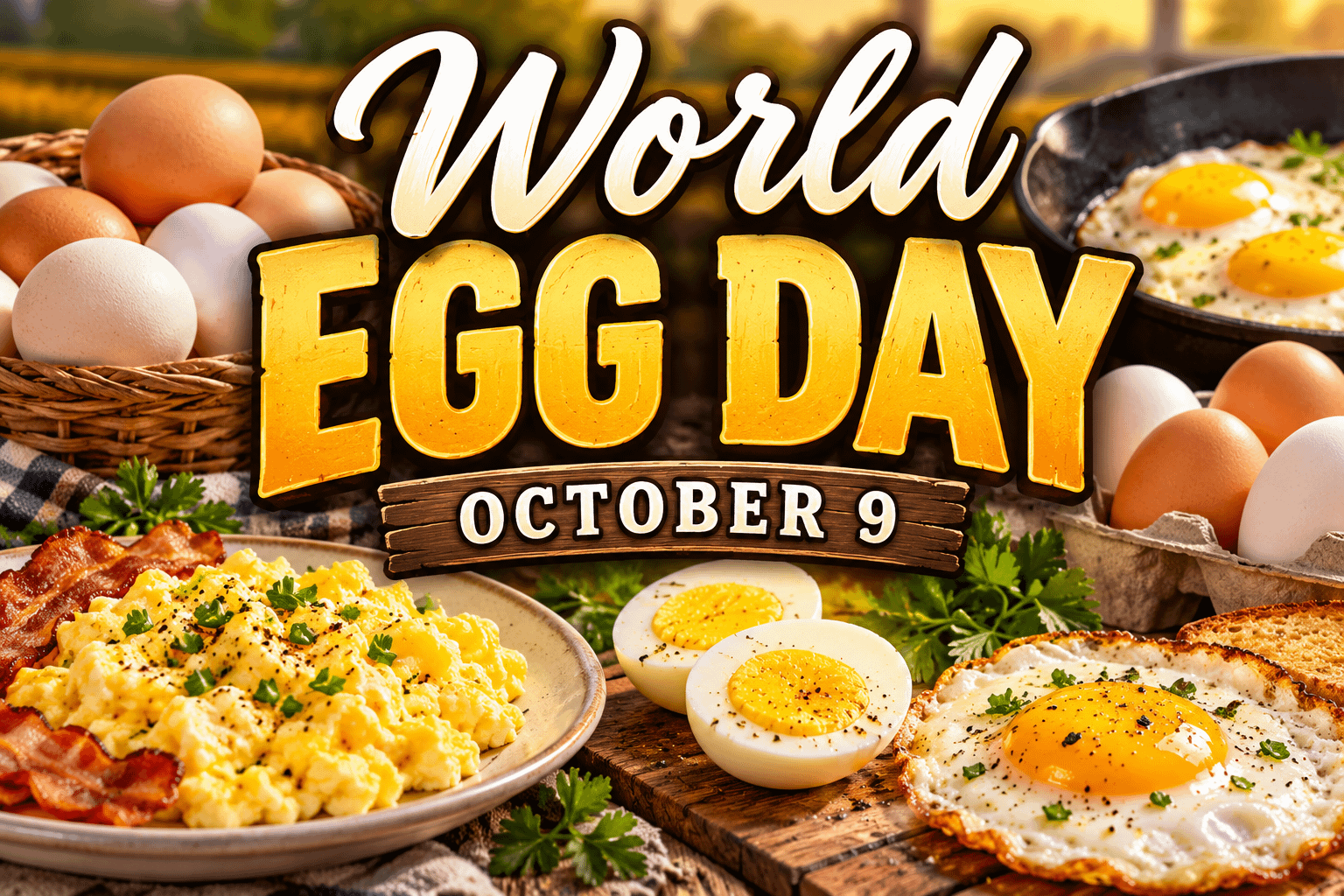
Every year, people around the world come together to celebrate a food that may be small, simple, and inexpensive, but has played an enormous role in diets and cultures for generations: the egg.
World Egg Day is celebrated on the second Friday of October each year. In 2026, World Egg Day falls on October 9.
Whether scrambled for breakfast, sliced over a salad, baked into a cake, folded into fried rice, transformed into an omelet, or simply boiled and sprinkled with a little salt and pepper, eggs have earned their place as one of the most versatile foods in the kitchen.
World Egg Day is an opportunity to appreciate more than our favorite egg dishes. It also recognizes the nutritional value of eggs, the farmers and producers who provide them, and the important role eggs play in food traditions throughout the world.
The History of World Egg Day
World Egg Day was established by the International Egg Commission in 1996 during a conference in Vienna, Austria.
The idea was simple: create an annual occasion that recognizes eggs and their contribution to nutrition and diets around the world.
The celebration was designated for the second Friday in October, which means the exact date changes from year to year.
Since then, World Egg Day has grown into an international observance involving egg producers, farmers, food organizations, schools, families, nutrition professionals, businesses, and communities.
Some celebrations focus on nutrition education. Others feature cooking demonstrations, recipe competitions, community events, charitable activities, or educational programs about egg production.
But you don’t need a large event to participate.
Sometimes celebrating World Egg Day is as easy as cracking a couple of eggs into a frying pan and making your favorite breakfast.
A Small Food With a Lot to Offer
Part of what makes eggs remarkable is how much nutrition can fit inside such a small package.
Eggs are well known as a source of high-quality protein. They also provide several important vitamins and minerals.
A large egg generally contains around six grams of protein, although the exact amount can vary depending on its size.
Eggs can also provide nutrients including vitamin B12, riboflavin, selenium, phosphorus and choline, among others.
Choline is particularly noteworthy because it plays a role in several normal functions within the body, including those involving the brain and nervous system.
Egg yolks contain much of an egg’s fat as well as several of its vitamins and other nutrients, while egg whites are especially rich in protein.
The nutritional needs of every person are different, of course, and individual dietary recommendations can depend on overall diet, medical history and other factors. But for many people, eggs can be an affordable and convenient part of a balanced diet.
Eggs Are Incredibly Versatile
One of the greatest things about eggs is how many different ways we can prepare them.
Think about how many options come from a single ingredient.
You can make:
Scrambled eggs
Fried eggs
Poached eggs
Hard-boiled eggs
Soft-boiled eggs
Omelets
Frittatas
Deviled eggs
Egg salad
Breakfast sandwiches
Breakfast burritos
Quiche
French toast
Custards
And that’s only the beginning.
Eggs are also essential ingredients in countless cakes, cookies, breads, casseroles, sauces and desserts.
They can provide structure, moisture and richness in baking. They can help bind ingredients together. Whipped egg whites can introduce air into foods such as meringues and soufflés.
Few ingredients can move so easily between breakfast, lunch, dinner and dessert.
Eggs Around the World
World Egg Day is especially appropriate because eggs aren’t limited to one cuisine.
Cultures around the world have developed their own ways of preparing and enjoying them.
In Japan, tamagoyaki transforms eggs into a rolled omelet that can be slightly sweet or savory.
In Mexico, huevos rancheros traditionally pair eggs with tortillas and a tomato-based sauce.
In North Africa and the Middle East, shakshuka commonly features eggs cooked in a flavorful tomato and pepper sauce.
Spain is famous for tortilla española, traditionally prepared with eggs and potatoes.
Chinese cuisine includes dishes ranging from tomato and scrambled eggs to steamed eggs and egg fried rice.
In France, eggs appear in omelets, quiches and numerous classic preparations.
Across the United States, eggs remain a familiar part of breakfast, appearing alongside toast, potatoes, bacon, sausage, pancakes and countless other combinations.
Different cultures may prepare eggs differently, but the humble egg manages to find a place on tables almost everywhere.
The Incredible Breakfast Egg
For many people, eggs immediately bring breakfast to mind.
There is something comforting about waking up to the smell of eggs cooking in the kitchen.
Scrambled eggs and toast can make a simple weekday breakfast. A vegetable omelet can turn breakfast into a filling meal. A fried egg can transform an ordinary breakfast sandwich.
Then there are breakfast burritos loaded with eggs, potatoes, cheese, vegetables and other favorite ingredients.
Eggs can be as simple or elaborate as you want them to be.
Sometimes the simplest version is still one of the best: two eggs, toast and a hot cup of coffee.
Don’t Forget the Hard-Boiled Egg
Hard-boiled eggs deserve some appreciation of their own.
They’re easy to prepare ahead of time and can be eaten on their own or incorporated into other dishes.
Slice them onto salads.
Turn them into egg salad.
Make deviled eggs.
Add them to a snack plate.
Pair them with vegetables or whole-grain crackers.
Hard-boiled eggs also remind us that good food doesn’t necessarily have to be complicated.
Sometimes simple ingredients are exactly what we need.
Eggs Aren’t Just for Breakfast
If you only eat eggs in the morning, World Egg Day might be the perfect excuse to experiment.
Try adding a fried egg to a burger.
Put a poached egg over roasted vegetables.
Make fried rice with scrambled egg.
Prepare a frittata filled with leftover vegetables.
Make an egg sandwich for lunch.
Or enjoy breakfast for dinner.
Breakfast-for-dinner nights can be inexpensive, easy and fun. Make scrambled eggs, toast, potatoes and fruit, and suddenly dinner is ready without an elaborate recipe.
Eggs and Baking
Anyone who enjoys baking already understands how important eggs can be.
In many recipes, eggs aren’t simply included for flavor.
They perform important jobs.
Eggs can help ingredients bind together. They can contribute moisture and richness. They can help baked goods develop structure.
Separating the yolks and whites creates even more possibilities.
Whipped egg whites can provide volume and lightness, while yolks can add richness to custards, sauces and desserts.
Imagine how different the baking world would be without eggs.
Cakes, cookies, brownies, custards, meringues and countless other favorites often depend on them.
Supporting Farmers and Food Producers
World Egg Day is also an opportunity to recognize the people behind the food.
Before eggs reach the grocery store, restaurant or kitchen table, farmers and workers are involved in producing, collecting, inspecting, packaging, transporting and selling them.
Agriculture is easy to overlook when food is neatly arranged on supermarket shelves.
Days such as World Egg Day give us a reason to remember where our food comes from and appreciate the people involved in bringing it to us.
Consumers who care about farming practices can also use the occasion to learn what labels on egg cartons mean and research the production standards behind the eggs available in their area.
Egg Safety Matters
Because eggs are a perishable food, safe handling and preparation are important.
In the United States, consumers should follow appropriate refrigeration and food-safety practices. The U.S. Food and Drug Administration advises keeping eggs refrigerated and cooking eggs until the yolk and white are firm; dishes containing eggs should also be cooked thoroughly.
People who are at increased risk of foodborne illness should be particularly careful with raw or undercooked eggs and foods containing them.
When preparing dishes that won’t be fully cooked, pasteurized eggs or pasteurized egg products may be appropriate alternatives.
Good food should be enjoyable, but food safety should always be part of the recipe.
Ways to Celebrate World Egg Day
You don’t need anything elaborate to celebrate.
Start your morning with your favorite egg breakfast. Try a preparation you’ve never made before. Teach your children or grandchildren how to scramble an egg. Make deviled eggs for the family. Bake something that uses eggs. Try an egg dish from another culture.
You could even hold your own family omelet challenge.
Set out ingredients such as peppers, onions, spinach, mushrooms, tomatoes and cheese, and let everyone build their own creation.
World Egg Day can also be an opportunity to support a local farmer, donate food to a community organization, or simply learn more about how eggs get from the farm to your refrigerator.
Fun Egg Facts
Eggs have been eaten by humans for thousands of years.
Chicken eggs may be the most familiar option in many households, but people around the world also eat eggs from ducks, quail and other birds.
The color of a chicken egg’s shell doesn’t automatically determine its nutritional quality. Brown and white eggs can both be nutritious.
And despite the old question, World Egg Day probably won’t finally settle the debate over which came first—the chicken or the egg.
Maybe some mysteries are more fun when we keep arguing about them.
A Food That Connects Generations
Perhaps one reason eggs remain so popular is that they are connected to memories.
Maybe you remember someone making scrambled eggs for you before school.
Maybe Sunday breakfast meant eggs, bacon and pancakes.
Maybe your family had a special deviled egg recipe that appeared at every holiday.
Food isn’t only about nutrition.
It can be about tradition, family and connection.
Recipes get passed from parents to children and grandparents to grandchildren. Even something as ordinary as an egg can become part of the memories we carry throughout our lives.
Happy World Egg Day!
World Egg Day reminds us that sometimes the simplest foods deserve a little appreciation.
An egg isn’t flashy. It doesn’t require complicated ingredients or expensive equipment. Yet it can become breakfast, lunch, dinner, dessert or a quick snack.
It provides valuable nutrients, supports countless recipes and appears in cuisines throughout the world.
So on October 9, 2026, crack a few eggs, pull out your favorite skillet and celebrate.
Make an omelet loaded with vegetables.
Cook the perfect fried egg.
Prepare your family’s favorite deviled eggs.
Bake a homemade dessert.
Or keep things simple with scrambled eggs and toast.
Whatever you choose, take a moment to appreciate one of the most useful little ingredients in the kitchen.
Happy World Egg Day!
What’s your favorite way to eat eggs?