
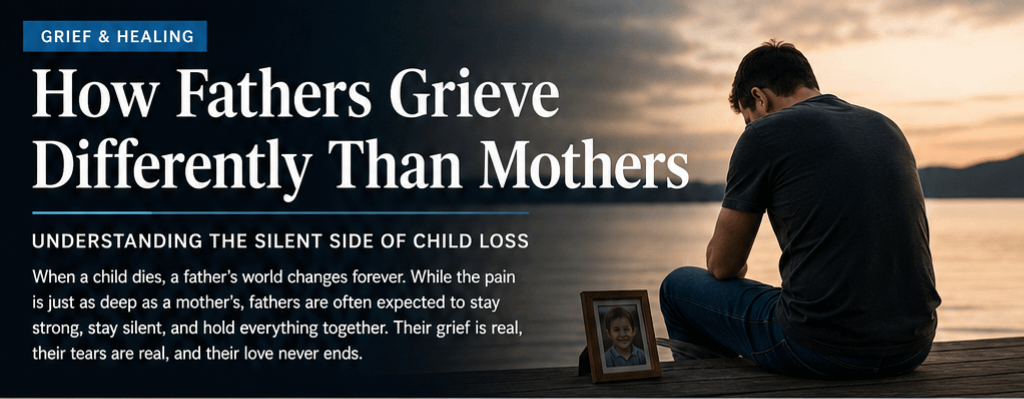
Understanding the Silent Side of Child Loss
The death of a child is one of the most devastating experiences a human being can endure. It challenges everything a parent believes about life, fairness, purpose, and the future. It is a loss that reaches beyond words and leaves a permanent mark on the hearts of those left behind.
When a child dies, both parents suffer an unimaginable heartbreak. The dreams they carried for their son or daughter suddenly disappear. The future they imagined vanishes. The routines, conversations, milestones, and ordinary moments they once took for granted become memories that can never be recreated.
Yet while mothers and fathers share the same loss, they often experience and express their grief in different ways.
These differences do not mean one parent hurts more than the other. They do not mean one loved the child more deeply. Instead, they reflect the unique ways individuals process pain, emotion, responsibility, and trauma.
Unfortunately, society often misunderstands grieving fathers. While mothers are frequently recognized and supported in their grief, fathers are often expected to remain strong, practical, and emotionally composed. Their pain may go unnoticed because it does not always look like traditional grief.
The reality is that fathers grieve deeply. They grieve intensely. They grieve endlessly.
Many simply do it differently.
Understanding those differences can help families communicate better, strengthen relationships after loss, and ensure that fathers receive the support they need during the darkest season of their lives.
The Bond Between a Father and Child
Before discussing grief, it is important to understand the depth of a father’s connection with his child.
For generations, fathers were often portrayed as providers whose primary responsibility was financial support. Modern fatherhood, however, has revealed a much deeper reality.
Today’s fathers are caregivers.
They are teachers.
They are protectors.
They are coaches.
They are role models.
They are best friends.
Many fathers attend school events, help with homework, coach sports teams, read bedtime stories, and spend countless hours building relationships with their children.
A father dreams about his child’s future from the moment he learns he will become a parent.
He imagines:
- First steps.
- First words.
- First day of school.
- Graduation.
- Marriage.
- Grandchildren.
- Shared experiences throughout life.
When a child dies, those dreams die too.
That loss affects fathers every bit as profoundly as it affects mothers.
The difference often lies in how that pain is expressed.
Society’s Expectations of Men
One reason fathers grieve differently is because society teaches men different emotional rules.
From an early age, many boys hear messages such as:
- “Man up.”
- “Be tough.”
- “Don’t cry.”
- “Handle it.”
- “Be strong.”
Over time, these messages shape how many men respond to emotional pain.
While girls are often encouraged to express feelings openly, boys are frequently rewarded for appearing strong and self-controlled.
As adults, these expectations become deeply ingrained.
When tragedy strikes, many fathers instinctively shift into survival mode.
Instead of asking:
“How do I process this pain?”
they ask:
“What needs to be done?”
This mindset often pushes fathers toward action rather than emotional expression.
The result is a grieving father who may appear calm on the outside while carrying overwhelming pain inside.
The Pressure to Be the Strong One
Following the death of a child, fathers often feel a tremendous responsibility to hold the family together.
While their hearts are shattered, they may immediately focus on:
- Funeral arrangements.
- Financial concerns.
- Household responsibilities.
- Supporting their spouse.
- Caring for surviving children.
- Managing family obligations.
Many fathers believe they cannot afford to fall apart because others are depending on them.
Friends and relatives often reinforce this belief by saying things like:
“You need to stay strong.”
“Your wife needs you.”
“Your family depends on you.”
Although intended as encouragement, these statements can unintentionally communicate that the father’s grief is less important.
He begins to believe:
“I can grieve later.”
“I need to help everyone else first.”
“I can’t break down.”
Unfortunately, grief postponed is rarely grief eliminated.
Eventually, those emotions demand attention.
Why Fathers Often Grieve in Silence
One of the most misunderstood aspects of male grief is silence.
Many fathers become quieter after losing a child.
They withdraw socially.
They speak less.
They spend more time alone.
Others may assume this means they are avoiding grief.
The opposite is often true.
Inside their minds, grieving fathers may replay countless memories:
The last conversation.
The last hug.
The last text message.
The last birthday.
The last ordinary day before everything changed.
These memories circulate constantly.
Even when a father says little, grief may occupy nearly every waking moment.
Silence does not mean absence of pain.
Often, it means the pain is too large for words.
The Problem-Solver’s Dilemma
Many fathers naturally approach life through problem-solving.
When something breaks, they fix it.
When challenges arise, they look for solutions.
When loved ones hurt, they try to help.
The death of a child creates a unique challenge because there is nothing to fix.
No solution exists.
No action can reverse the loss.
No amount of effort can change what happened.
For fathers who define themselves through helping and protecting, this reality can create crushing feelings of helplessness.
Many begin asking impossible questions:
Could I have prevented this?
Should I have done something differently?
Did I miss warning signs?
Was there something I could have changed?
These questions often persist for years.
Even when fathers logically know they are not responsible, emotionally they may continue carrying guilt.
The Hidden Burden of Guilt
Guilt is one of the most common emotions experienced by grieving fathers.
Some blame themselves for circumstances surrounding the death.
Others feel guilty for surviving.
Still others feel guilty because they believe they failed in their role as protector.
A father’s instinct is often to keep his child safe.
When that child dies, many fathers feel they have failed at the most important responsibility they ever had.
This guilt can become overwhelming.
Even when family members reassure them, fathers may continue carrying invisible burdens that no one else sees.
They replay decisions repeatedly.
They revisit events countless times.
They search for explanations that may never exist.
The result is emotional exhaustion layered on top of grief itself.
Anger as a Form of Grief
Not all grief looks like sadness.
For many fathers, grief appears first as anger.
This anger can be directed toward:
Doctors.
Drivers.
Addiction.
Disease.
The legal system.
Themselves.
God.
Life.
Sometimes anger feels safer than sadness.
Society often accepts angry men more readily than heartbroken men.
As a result, fathers may express grief through frustration rather than tears.
They may become:
- Irritable.
- Impatient.
- Defensive.
- Emotionally distant.
Loved ones sometimes mistake these behaviors for indifference.
In reality, anger is often covering profound heartbreak.
Beneath the frustration is usually a father struggling to survive unimaginable pain.
Why Many Fathers Return to Work Quickly
One behavior that frequently causes misunderstandings is a father’s decision to return to work shortly after losing a child.
People may wonder:
Why is he already working?
Hasn’t he processed his grief?
Doesn’t he need more time?
For many fathers, work serves several purposes.
Work provides structure when life feels chaotic.
Work offers distraction from constant emotional pain.
Work creates a sense of normalcy during abnormal circumstances.
Work helps fathers feel productive when everything else feels broken.
Returning to work does not mean grief has ended.
Often, grief accompanies them throughout every workday.
They simply carry it differently.
A father may complete his job responsibilities while internally thinking about his child every single minute.
The Loneliness of the Grieving Father
One of the most painful realities fathers face after child loss is loneliness.
Support systems frequently center around mothers.
Visitors ask how the mother is doing.
Friends check on the mother.
Family members focus on the mother’s emotional needs.
While these efforts are important, fathers can become invisible.
People assume they are managing.
People assume they are coping.
People assume they are okay.
Many fathers quietly wonder:
Does anyone realize I lost my child too?
Does anyone care how I’m doing?
Am I supposed to handle this alone?
This loneliness often becomes a secondary grief layered on top of the original loss.
Fathers and Physical Grief
Grief affects more than emotions.
It affects the body.
Many grieving fathers experience physical symptoms including:
- Chronic fatigue.
- Insomnia.
- Appetite changes.
- Weight gain.
- Weight loss.
- Headaches.
- Digestive problems.
- Increased blood pressure.
- Muscle tension.
- Chest pain.
Stress hormones remain elevated for extended periods.
The body essentially remains in survival mode.
Many fathers ignore these symptoms because they focus entirely on emotional survival.
However, physical health often suffers significantly after child loss.
This is one reason fathers need ongoing medical care and support during grief.
When Fathers Cry Alone
A common misconception is that fathers do not cry.
Many do.
They simply cry in different places.
They cry:
In the shower.
In the car.
Late at night.
At a gravesite.
During a quiet moment alone.
After everyone else has gone to bed.
Some fathers hide their tears because they fear appearing weak.
Others cry privately because they want to protect loved ones from additional pain.
These hidden tears often go unseen.
Yet they are evidence of deep love and profound loss.
How Child Loss Impacts Marriage
The death of a child places extraordinary strain on marriages.
Couples often discover they grieve differently.
One spouse may want to talk constantly.
The other may need silence.
One may seek support groups.
The other may avoid them.
One may cry openly.
The other may withdraw inward.
Neither approach is wrong.
The challenge occurs when partners interpret different grieving styles as a lack of love.
A mother may think:
“He doesn’t care.”
A father may think:
“Nothing I do is enough.”
Misunderstandings can grow quickly.
The strongest couples learn to recognize that grief has many languages.
Different expressions do not indicate different levels of love.
Fathers Often Grieve Through Action
Many fathers channel grief into action.
They establish scholarships.
Create foundations.
Organize charity events.
Volunteer.
Advocate for causes.
Support other grieving families.
Build memorials.
Raise awareness.
These actions become a continuation of parenting.
Although their child is gone physically, fathers still feel compelled to honor and protect their legacy.
Helping others often provides meaning during unimaginable suffering.
For some fathers, action becomes an expression of love.
The Fear of Forgetting
One fear shared by many grieving fathers is the fear of forgetting.
They worry about losing details.
The sound of a voice.
A favorite phrase.
A laugh.
A smile.
A memory.
Many fathers hold onto objects because they represent connection.
A jacket.
A baseball glove.
A text message.
A photograph.
A voicemail.
These items become treasures.
They help fathers maintain a bond with their child.
The fear is not simply losing memories.
The fear is losing pieces of the relationship itself.
The Pain of Milestones
For grieving fathers, milestones can be devastating.
Birthdays.
Graduations.
Holidays.
Weddings.
Father’s Day.
Anniversaries.
Every milestone becomes a reminder of what should have been.
Fathers often imagine:
What age their child would be.
What career they might have chosen.
Whether they would be married.
Whether grandchildren might have arrived.
These thoughts can bring overwhelming sadness even years after the loss.
Grief does not follow a schedule.
Certain dates can feel as painful decades later as they did in the beginning.
Why Some Fathers Avoid Talking
Many fathers avoid discussing grief because they fear reopening wounds.
Others worry about burdening loved ones.
Some simply lack the vocabulary to express what they feel.
This does not mean they do not need support.
In fact, many fathers desperately need someone willing to listen without judgment.
Support does not require fixing.
It requires presence.
Sometimes the most healing words are:
“I’m here.”
“Tell me about your child.”
“I remember them.”
“You don’t have to carry this alone.”
Society Needs to Recognize Grieving Fathers
One of the greatest changes needed in grief support is recognition.
Fathers are not secondary mourners.
They are not supporting characters in the story of loss.
They are parents.
They loved deeply.
They dreamed deeply.
They lost deeply.
Every father deserves acknowledgment.
Every father deserves support.
Every father deserves compassion.
Ignoring male grief does not make it disappear.
It simply forces fathers to carry it alone.
The Journey Toward Healing
Healing after child loss is often misunderstood.
Healing does not mean forgetting.
Healing does not mean moving on.
Healing does not mean replacing the child.
Healing means learning to carry grief while continuing to live.
For fathers, healing often includes:
Accepting help.
Talking honestly.
Building support networks.
Honoring memories.
Taking care of physical health.
Finding purpose.
Allowing emotions to exist.
Healing is not about leaving grief behind.
It is about learning how to walk forward while carrying it.
A Father’s Love Never Ends
Death changes many things.
It changes routines.
It changes plans.
It changes the future.
But it does not end a father’s love.
A father remains a father forever.
The relationship continues in memory, in love, and in the impact the child had on his life.
Many grieving fathers find comfort in continuing bonds.
They speak their child’s name.
Celebrate birthdays.
Share stories.
Visit meaningful places.
Honor traditions.
These acts keep love alive.
And love is often what carries fathers through the darkest days.
Conclusion: Fathers Hurt Too
When a child dies, a father’s world changes forever.
He may not express grief the same way a mother does.
He may not cry publicly.
He may not talk often.
He may throw himself into work.
He may become quiet.
He may appear strong.
But beneath that strength is often profound heartbreak.
Fathers grieve differently than mothers, but differently does not mean less.
Their pain is real.
Their tears are real.
Their loneliness is real.
Their love is real.
Every grieving father carries memories, dreams, and a bond that death cannot erase.
If you know a father who has lost a child, remember him.
Speak his child’s name.
Ask how he is doing.
Listen without judgment.
Offer support without expectations.
Most importantly, remind him that his grief matters.
Because behind every grieving father is a parent whose heart was forever changed by love—and forever broken by loss.
A Father’s Guide to Surviving the Loss of a Child
Leave a ReplyCancel reply