
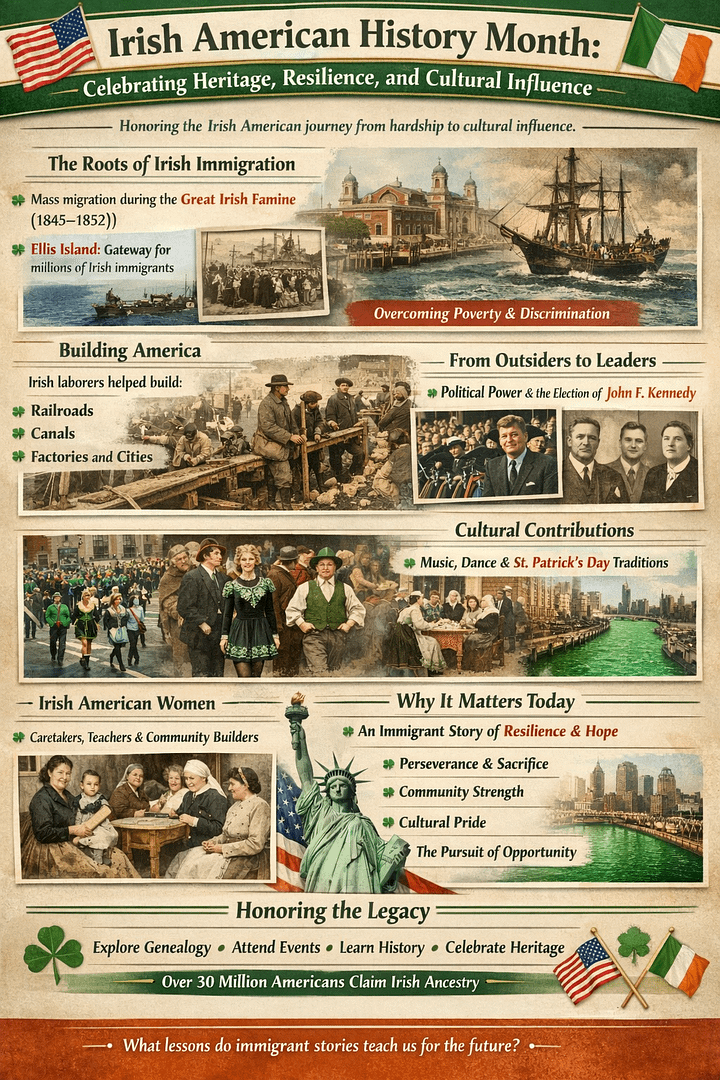
Every March, the United States observes Irish American History Month, a national recognition of the generations of Irish immigrants and Irish Americans whose courage, labor, and cultural influence helped shape the country. While green clothing, festive parades, and celebrations often define public perception of the month, its true purpose is historical reflection — honoring a story of hardship, determination, and transformation that mirrors the broader American immigrant experience.
Irish American History Month invites Americans not only to celebrate heritage but also to understand how identity, struggle, and opportunity intertwine in the building of a nation.
Irish migration to America stretches back to the colonial era, but the most significant wave occurred during the Great Irish Famine (1845–1852). A devastating potato blight destroyed Ireland’s primary food source, leading to mass starvation, disease, and economic collapse. Families faced impossible choices — remain and risk death or leave everything behind for uncertain survival abroad.
Over one million Irish immigrants crossed the Atlantic during this period. Many arrived through Ellis Island, exhausted from long, dangerous journeys aboard overcrowded ships sometimes called “coffin ships” due to high mortality rates.
Upon arrival, the promise of America quickly met harsh reality. Irish immigrants often settled in crowded urban neighborhoods where poverty, disease, and limited employment opportunities were common. Anti-Irish sentiment was widespread, fueled by religious prejudice against Catholics and fears that immigrants would take jobs from native-born workers.
Despite discrimination, Irish communities formed strong support networks centered around churches, neighborhoods, and extended families. These communities became the foundation for future generations’ success.
Faith, Community, and Identity
Religion played a central role in Irish American life. Catholic parishes were more than places of worship — they functioned as social centers, schools, employment networks, and sources of stability in unfamiliar cities.
Irish clergy and religious sisters established hospitals, orphanages, and educational institutions that served both immigrant families and broader communities. Catholic schools helped preserve cultural identity while offering pathways to upward mobility through education.
The parish system also gave Irish Americans a sense of belonging at a time when mainstream society often excluded them. Through shared traditions, music, storytelling, and faith, Irish immigrants maintained connections to their homeland while building a new American identity.
Building America: Labor, Industry, and Sacrifice
Irish Americans were instrumental in building America’s infrastructure during the 19th century. Many took physically demanding and dangerous jobs that others refused, including:
Railroad construction
Canal digging
Mining operations
Factory labor
Urban sanitation and public works
Irish workers helped construct canals such as the Erie Canal and contributed significantly to railroad expansion, including segments tied to the nation’s westward growth.
Working conditions were often brutal. Long hours, unsafe environments, and low wages were common realities. Yet Irish laborers became pioneers of organized labor movements, advocating for fair treatment and workplace protections.
Their activism laid groundwork for labor reforms that later benefited workers across all industries and backgrounds.
Military Service and Patriotism
Irish Americans also demonstrated deep commitment to their adopted country through military service. During the American Civil War, thousands joined both Union and Confederate armies, though Irish brigades fighting for the Union became especially famous for their bravery.
Military service helped Irish immigrants gain acceptance within American society. Participation in national defense reinforced their identity not only as immigrants but as Americans willing to sacrifice for shared ideals.
Irish Americans have continued this tradition through service in every major U.S. conflict, strengthening their legacy of patriotism and civic responsibility.
From Marginalization to Political Power
As Irish communities grew, political engagement became a pathway to opportunity and influence. Urban political organizations helped immigrants navigate employment, housing, and social services.
Cities like Boston, New York, and Chicago saw the rise of Irish American political leadership. Over time, Irish Americans transitioned from a marginalized group into a powerful voting bloc.
The election of John F. Kennedy in 1960 marked a historic milestone. As the first Irish Catholic president, Kennedy symbolized the full integration of Irish Americans into national leadership and public life. His presidency represented not only political success but also cultural acceptance.
Cultural Contributions That Shaped America
Irish culture has profoundly influenced American traditions in ways both visible and subtle.
Music and Arts
Irish folk traditions influenced American bluegrass, country, and folk music. Instruments like the fiddle became central to American musical identity, blending Irish melodies with other cultural sounds.
Literature and Storytelling
Irish storytelling traditions enriched American literature and journalism. Humor, poetry, and narrative storytelling styles carried across generations, helping shape American creative expression.
Celebrations and Public Culture
St. Patrick’s Day transformed from a religious feast day into a nationwide celebration of cultural pride. Parades, festivals, and community gatherings now highlight Irish heritage while celebrating multicultural unity across America.
Irish American Women: Unsung Builders of Community
Irish American women played critical yet often overlooked roles in shaping society. Many worked as domestic workers, nurses, and teachers, sending money home to support relatives while establishing economic stability in America.
Religious sisters founded schools and hospitals that served immigrant populations regardless of background. Their contributions expanded education and healthcare access across growing American cities.
These women were not only caretakers but also community builders who helped families transition into American life.
The Evolution of Irish American Identity
Over generations, Irish Americans transitioned from immigrant outsiders to fully integrated participants in American society. Intermarriage, education, and economic advancement broadened opportunities, while cultural traditions remained strong.
Today, Irish American identity reflects both heritage and adaptation — honoring Irish roots while embracing the diversity of modern America.
More than 30 million Americans claim Irish ancestry, demonstrating how a once-struggling immigrant group became a central thread in the American cultural fabric.
Why Irish American History Month Matters Today
Irish American History Month serves as a reminder that the American story is fundamentally an immigrant story. The challenges faced by Irish immigrants — discrimination, economic hardship, cultural misunderstanding — echo experiences still faced by newcomers today.
By studying Irish American history, we gain perspective on:
The importance of inclusion
The power of community support
The value of cultural preservation
The resilience required to build a better future
It encourages empathy and understanding while celebrating progress.
Honoring the Legacy Today
People celebrate Irish American History Month in many ways:
Attending cultural festivals and parades
Exploring genealogy and family history
Reading Irish American literature
Supporting Irish arts and music
Teaching younger generations about heritage and history
Whether through education or celebration, the month invites Americans to recognize how diverse cultures strengthen the nation.
Irish American history is ultimately a story of hope — proof that perseverance, faith, and community can transform adversity into lasting contribution.
Read More Holidays & National Days
Leave a ReplyCancel reply