
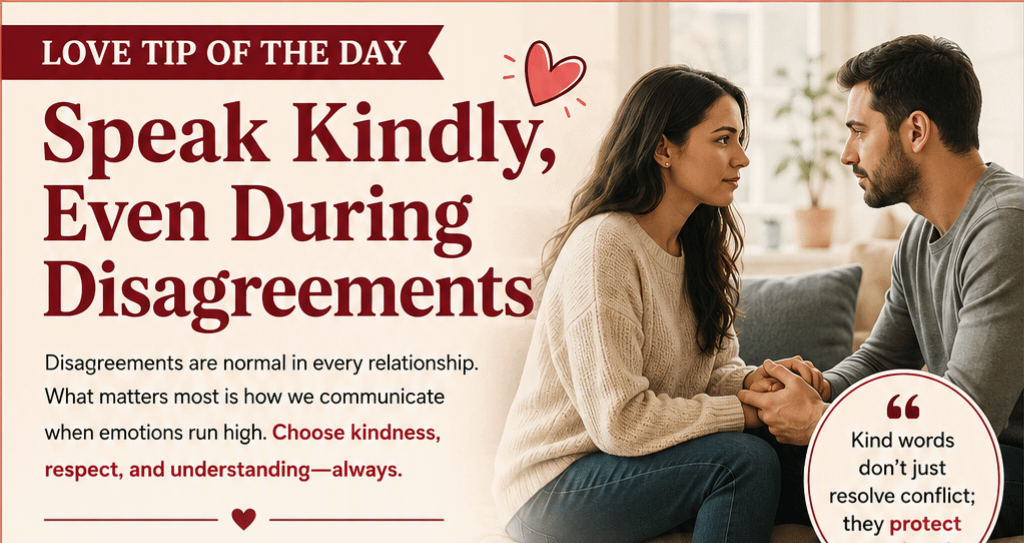
No relationship is free from conflict. Every couple, whether they have been together for a few months or several decades, will experience moments of frustration, misunderstanding, and disagreement. Different personalities, backgrounds, communication styles, and life experiences naturally lead to differing opinions. Conflict itself isn’t the problem—how we handle it is.
Today’s love tip is one of the most valuable habits any couple can develop:
Speak kindly, even during disagreements.
Kindness is often misunderstood. Some people believe speaking kindly means avoiding difficult conversations or pretending everything is okay. In reality, kindness is choosing respect over cruelty, patience over impulsiveness, and understanding over the desire to win. It means communicating honestly without intentionally hurting the person you love.
The words we choose during difficult moments can either strengthen a relationship or slowly chip away at the trust and intimacy we’ve worked so hard to build.
Every Argument Leaves Something Behind
When an argument ends, the issue may be resolved, but the words exchanged often remain.
Think back to disagreements you’ve experienced in your own life. Chances are you don’t remember every detail of the conflict, but you probably remember how someone made you feel. You remember whether they listened, whether they respected you, or whether their words cut deeply.
Our memories hold onto emotional moments.
One harsh sentence spoken in anger can echo in someone’s mind for years.
Likewise, one gentle response during a heated disagreement can become a reminder that your relationship is a safe place, even during difficult conversations.
That’s why kindness matters.
Love Isn’t About Winning
One of the biggest mistakes couples make is treating disagreements like competitions.
People begin keeping score.
- Who was right?
- Who apologized first?
- Who made the bigger mistake?
- Who “won” the argument?
Healthy relationships don’t have winners and losers.
If one person wins by humiliating or hurting the other, both people lose.
Instead, healthy couples ask a different question:
“How can we solve this together?”
The goal should never be to defeat your partner.
The goal should always be to defeat the problem.
When you remember you’re on the same team, the entire conversation changes.
Your Partner Is Not Your Enemy
Arguments have a way of creating emotional distance.
Instead of seeing the person you love, you begin seeing someone who is frustrating, stubborn, or impossible to understand.
That’s when words become weapons.
Instead of attacking the issue, couples attack each other.
They criticize character instead of behavior.
They bring up old mistakes.
They exaggerate.
They assume the worst.
But your partner isn’t your enemy.
The disagreement is.
When you separate the person from the problem, it becomes much easier to communicate with compassion.
The Hidden Damage of Harsh Words
Angry words don’t disappear after they’re spoken.
Many people can still remember painful comments made years—even decades—earlier.
Statements such as:
- “You never do anything right.”
- “I wish I had never met you.”
- “You’re impossible to love.”
- “You’re just like your mother.”
- “You always ruin everything.”
These words often come from temporary anger.
Unfortunately, temporary anger can create permanent memories.
Even after forgiveness, emotional scars sometimes remain.
Before speaking, ask yourself one simple question:
“Will these words help heal this relationship, or will they create a wound?”
If the answer is the second, pause.
Choose Gentle Honesty
Kindness doesn’t require silence.
Healthy relationships require honesty.
You should absolutely express disappointment, hurt feelings, or unmet needs.
The difference lies in how those feelings are communicated.
Instead of saying:
“You never care about me.”
Try:
“I’ve been feeling lonely lately, and I’d really like us to spend more quality time together.”
Instead of:
“You’re so selfish.”
Try:
“When that happened, I felt overlooked.”
The message remains honest.
The delivery becomes loving.
Slow Down Before Responding
Arguments often become worse because people react before they think.
Strong emotions activate our instinct to defend ourselves.
Our heart races.
Our voice becomes louder.
Our thoughts become scattered.
This is exactly when we need to slow down.
Taking even a few seconds before responding can completely change the direction of a conversation.
Consider these simple habits:
- Take one deep breath.
- Count slowly to five.
- Relax your shoulders.
- Speak more slowly than you normally would.
- Lower your voice instead of raising it.
Calmness often invites calmness.
Listen More Than You Speak
Many disagreements continue because both people are focused on being heard.
Few are focused on hearing.
Listening doesn’t mean waiting for your turn to talk.
It means genuinely trying to understand what your partner is experiencing.
Ask questions like:
- “Can you help me understand what upset you?”
- “What did you need from me in that moment?”
- “How did that make you feel?”
These questions communicate love.
People become less defensive when they feel understood.
Watch Your Tone
Communication isn’t only about words.
It’s also about tone, facial expressions, and body language.
A calm sentence spoken sarcastically doesn’t feel kind.
Rolling your eyes.
Crossing your arms.
Laughing dismissively.
Interrupting.
Walking away without explanation.
These actions communicate just as loudly as spoken words.
Kind communication includes:
- Calm tone
- Respectful eye contact
- Open posture
- Patient listening
- Gentle facial expressions
Your body often speaks before your mouth does.
Avoid Bringing Up the Past
One disagreement should remain one disagreement.
Many couples unintentionally turn a small issue into a discussion about everything that has ever gone wrong.
Suddenly you’re arguing about something that happened six months ago.
Or three years ago.
Dragging past mistakes into today’s conversation makes resolution nearly impossible.
Address today’s issue.
Resolve it.
Leave yesterday where it belongs.
Forgiveness means refusing to use old wounds as new weapons.
Give Grace During Difficult Seasons
Sometimes arguments aren’t really about the dishes, the bills, or forgotten plans.
They’re about stress.
Exhaustion.
Financial pressure.
Health concerns.
Family responsibilities.
Grief.
Fear.
People often communicate poorly because they’re carrying invisible burdens.
This doesn’t excuse hurtful behavior, but it reminds us to approach one another with compassion.
Ask yourself:
“What might my partner be carrying today that I can’t see?”
That simple question often softens the heart.
Learn the Power of an Apology
Every person will eventually say something they regret.
Healthy relationships aren’t built by perfection.
They’re built by repair.
A sincere apology sounds like:
“I’m sorry for how I spoke to you.”
“I understand why my words hurt you.”
“You deserve better from me.”
“I want to work on communicating differently.”
Avoid apologies like:
“I’m sorry you feel that way.”
“If you were offended…”
Those statements shift responsibility instead of accepting it.
A genuine apology rebuilds trust one conversation at a time.
Know When to Take a Break
Sometimes emotions become too intense for healthy communication.
Taking a break isn’t giving up.
It’s choosing wisdom.
Agree to pause for twenty or thirty minutes.
Use the time to calm down—not to rehearse more arguments.
Then return with the shared goal of understanding each other instead of defeating each other.
Fill Your Relationship With Positive Words
Relationships naturally become stronger when positive communication outweighs negative communication.
Make encouragement a daily habit.
Say:
- “Thank you.”
- “I appreciate you.”
- “I’m proud of you.”
- “I love you.”
- “I’m grateful for everything you do.”
- “You matter to me.”
These simple phrases create emotional security.
When people consistently feel loved, disagreements become less threatening because the relationship itself feels secure.
Kindness Is a Daily Decision
Kind communication isn’t something we magically possess.
It’s something we choose repeatedly.
Some days that choice is easy.
Other days it requires patience, humility, and self-control.
Love isn’t simply an emotion.
Love is demonstrated through daily choices.
Every gentle response…
Every patient conversation…
Every respectful disagreement…
Every sincere apology…
Every compassionate word…
These small choices slowly build extraordinary relationships.
Growing Together Instead of Growing Apart
Conflict can either divide a couple or deepen their connection.
Couples who learn to speak kindly during disagreements often discover that conflict becomes an opportunity rather than a threat.
They learn more about each other’s fears.
They understand each other’s needs.
They strengthen trust.
They develop emotional safety.
Instead of growing apart after disagreements, they grow closer because each difficult conversation reinforces the belief that love is stronger than frustration.
Final Thoughts
Disagreements are unavoidable.
Cruelty is not.
The next time emotions rise, remember that the person standing across from you is not your opponent. They are someone you have chosen to love, support, and protect.
Your words have tremendous power.
They can tear down or build up.
They can create distance or deepen intimacy.
They can leave scars or bring healing.
Choose the kind of words you hope to hear yourself.
Choose patience when anger seems easier.
Choose understanding when assumptions seem quicker.
Choose grace when pride wants to take over.
Because long after the disagreement is forgotten, your partner will remember how you made them feel.
Love Tip of the Day: Speak kindly, even during disagreements. Loving words don’t avoid conflict—they transform it into an opportunity for deeper understanding, stronger trust, and a healthier, more lasting relationship.
Read More Of Love & Relationships
Leave a ReplyCancel reply