Category: Love & Relationships

  • Why We Fall in Love with Three People in Our Lifetime

    Why We Fall in Love with Three People in Our Lifetime

    Advertisements

    Love isn’t just about who we meet. It’s about who we are when we meet them.

    We don’t love the same way at 18 as we do at 28… or 48… or after heartbreak has carved wisdom into us. That’s why so many people resonate with the idea that we experience three great loves in life. Each one reflects a different stage of our emotional growth — almost like chapters in the story of becoming ourselves.

    These loves aren’t ranked by importance.
    They are connected by transformation.

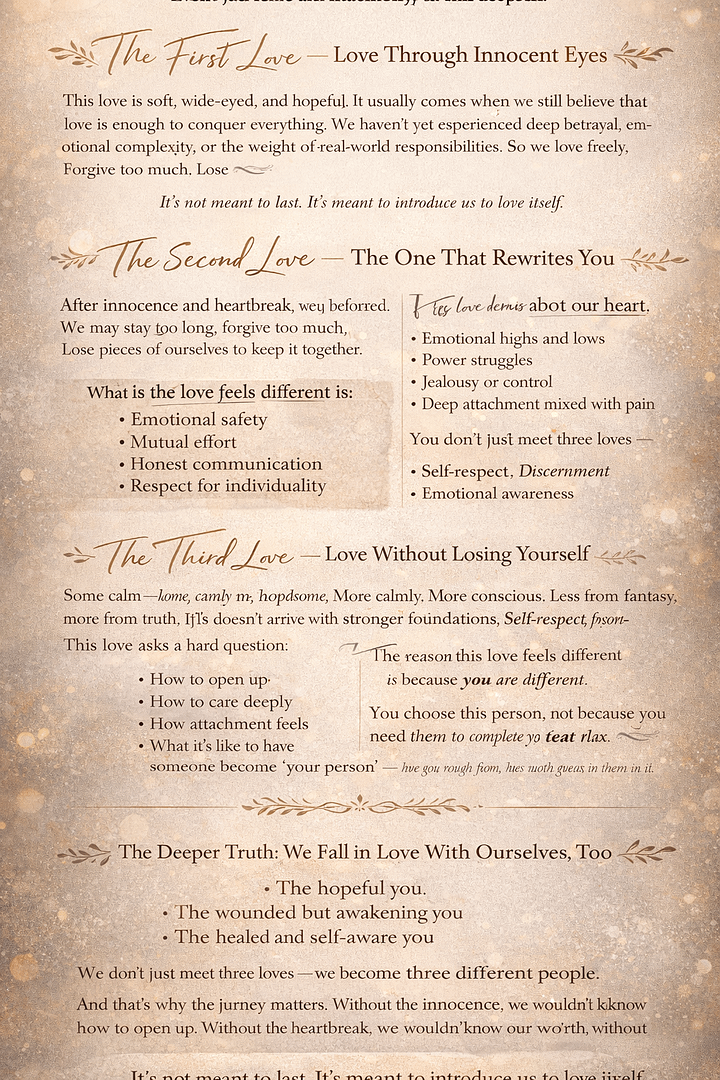
    The First Love — Love Through Innocent Eyes

    This love is soft, wide-eyed, and hopeful. It usually comes when we still believe that love is enough to conquer everything. We haven’t yet experienced deep betrayal, emotional complexity, or the weight of real-world responsibilities.

    So we love freely.

    We text all night.
    We dream big futures.
    We believe feelings equal forever.

    Psychologically, this love is tied to idealism. We project dreams onto the other person. We don’t see incompatibilities because our desire for connection is stronger than our ability to evaluate it realistically.

    And that’s not foolish — it’s developmental.

    This love teaches us:

    How to open up emotionally

    How to care deeply for someone outside ourselves

    How attachment feels

    What it’s like to have someone become “your person”

    When it ends, the pain feels world-ending because it’s our first experience of emotional loss at that depth. But this love cracks the heart open — and once opened, it can love more deeply in the future.

    It’s not meant to last.
    It’s meant to introduce us to love itself.

    The Second Love — The One That Rewrites You

    If the first love opens your heart, the second love tests it.

    This is the relationship that often feels magnetic and intense. It can be passionate, consuming, and deeply emotional — but also unstable. This is where we meet our unresolved patterns, insecurities, and fears.

    We may stay too long.
    Forgive too much.
    Lose pieces of ourselves trying to hold it together.

    This love is often where we encounter:

    Emotional highs and lows

    Power struggles

    Jealousy or control

    Deep attachment mixed with pain

    It hurts because it forces us to confront our own wounds. Maybe we learn we accept less than we deserve. Maybe we learn we confuse chaos with passion. Maybe we discover we’re afraid of being alone, so we tolerate things we shouldn’t.

    This love asks a hard question:

    “Do you love yourself as much as you love them?”

    It is painful, but it awakens boundaries. It teaches us the difference between love and attachment, between intensity and stability, between saving someone and choosing ourselves.

    When this love ends, we often feel shattered — but what’s really happening is reconstruction. We start to rebuild with stronger foundations:

    Self-respect.
    Discernment.
    Emotional awareness.

    This love changes our standards forever.

    The Third Love — Love Without Losing Yourself

    After innocence and heartbreak, we love differently. More calmly. More consciously. Less from fantasy, more from truth.

    This is where the third love enters.

    It doesn’t arrive with fireworks — it arrives with comfort. It doesn’t make your heart race from anxiety; it makes your nervous system relax. You feel safe being seen. You don’t perform. You don’t pretend.

    This love is built on:

    Emotional safety

    Mutual effort

    Honest communication

    Respect for individuality

    Friendship as the foundation

    You don’t have to chase clarity — it’s already there.
    You don’t wonder where you stand — you know.

    The reason this love feels different is because you are different. You’ve learned what you can’t tolerate. You’ve healed parts of yourself. You no longer confuse drama with depth.

    You choose this person, not because you need them to complete you — but because your life is better with them in it.

    That’s the shift from dependency to partnership.

    The Deeper Truth: We Fall in Love With Ourselves, Too

    Each of these loves represents a version of you:

    The hopeful you

    The wounded but awakening you

    The healed and self-aware you

    We don’t just meet three loves — we become three different people.

    And that’s why the journey matters. Without the innocence, we wouldn’t know how to open up. Without the heartbreak, we wouldn’t know our worth. Without the lessons, we wouldn’t recognize peace when it arrives.

    Not Everyone Fits This Exactly — And That’s Okay

    Some people marry their first love.
    Some stay stuck in the second.
    Some take years to reach the third.

    Life isn’t a formula. But emotionally, this pattern appears often because love mirrors personal growth.

    The goal isn’t just to find the “third love.”
    The goal is to become the person who is ready for it.

    Love Is a Journey of Becoming

    The loves that didn’t last weren’t failures. They were teachers. They were shaping your capacity to give and receive love in healthier, deeper ways.

    One day you look back and realize:

    Nothing was random.
    Nothing was wasted.
    Your heart was being prepared for a love that doesn’t just feel good — it feels right.

    Read More Of Love & Relationships
  • When “All I Have” Is Love — And That’s Everything

    Advertisements

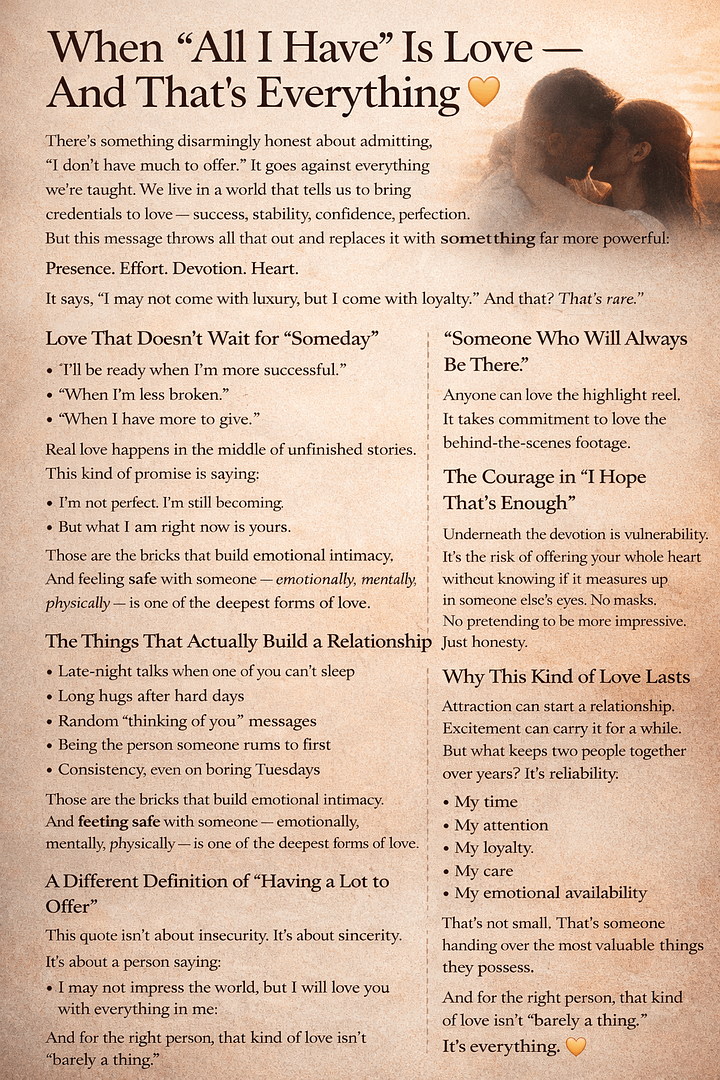
    There’s something disarmingly honest about admitting, “I don’t have much to offer.” It goes against everything we’re taught. We live in a world that tells us to bring credentials to love — success, stability, confidence, perfection. But this message throws all that out and replaces it with something far more powerful:

    Presence. Effort. Devotion. Heart.

    It says, I may not come with luxury, but I come with loyalty.

    And that? That’s rare.

    Love That Doesn’t Wait for “Someday”

    So many people delay loving fully because they think they need to become “more” first.

    “I’ll be ready when I’m more successful.”
    “When I’m less broken.”
    “When I have more to give.”

    But life doesn’t pause while we self-improve. Real love happens in the middle of unfinished stories. This kind of promise is saying:

    I’m not perfect. I’m still becoming. But what I am right now is yours.

    That’s not settling. That’s bravery.

    The Things That Actually Build a Relationship

    Notice what’s being offered. Not diamonds. Not vacations. Not status.

    Instead:

    Late-night talks when one of you can’t sleep

    Long hugs after hard days

    Random “thinking of you” messages

    Being the person someone turns to first

    Consistency, even on boring Tuesdays

    Those are the bricks that build emotional intimacy. Big gestures are memorable. But small, repeated acts of care? Those are what make someone feel safe.

    And feeling safe with someone — emotionally, mentally, physically — is one of the deepest forms of love.

    “Someone Who Will Always Be There”

    This part hits differently. Because “being there” doesn’t just mean showing up when things are easy.

    It means:

    Staying during the quiet seasons

    Listening to the same worries more than once

    Sitting beside someone in silence when words don’t work

    Not disappearing when moods change or life gets messy

    Anyone can love the highlight reel. It takes commitment to love the behind-the-scenes footage.

    This promise is about emotional endurance. It says, You won’t have to face life alone if I can help it.

    That’s partnership. That’s real.

    The Courage in “I Hope That’s Enough”

    That line carries a soft fear that many people hide:

    “I hope I’m enough.”

    Underneath the devotion is vulnerability. It’s the risk of offering your whole heart without knowing if it measures up in someone else’s eyes. No masks. No pretending to be more impressive. Just honesty.

    And vulnerability is the birthplace of true connection. Without it, relationships stay shallow, transactional, guarded. With it, they become deep, human, and real.

    Saying “you have all of me” means:

    My time

    My attention

    My loyalty

    My care

    My emotional availability

    That’s not small. That’s someone handing over the most valuable things they possess.

    Why This Kind of Love Lasts

    Attraction can start a relationship. Excitement can carry it for a while. But what keeps two people together over years?

    It’s not constant fireworks.
    It’s reliability.

    It’s knowing:

    This person answers when I call

    This person notices when I’m off

    This person chooses me even on bad days

    This person stays

    Love that’s built on showing up is steady. And steady love survives stress, time, and change.

    A Different Definition of “Having a Lot to Offer”

    Maybe “not much” is actually misunderstood.

    If someone gives:

    Their presence

    Their consistency

    Their patience

    Their warmth

    Their willingness to grow with you

    They are offering emotional wealth — and that’s worth more than material abundance in the long run.

    You can have money and still feel alone.
    You can have success and still feel unseen.
    But being deeply cared for by someone who is genuinely there? That’s a form of richness most people are still searching for.

    The Heart of the Message

    This isn’t about insecurity. It’s about sincerity.

    It’s about a person saying:
    I may not impress the world, but I will love you with everything in me.

    A loyal presence, a listening ear, warm arms, and a devoted heart are more than enough.

    And for the right person, that kind of love isn’t “barely a thing.”

    It’s everything. 💛

    Read More Of Love & Relationships

  • Looking for Love While Rebuilding Your Life

    Advertisements

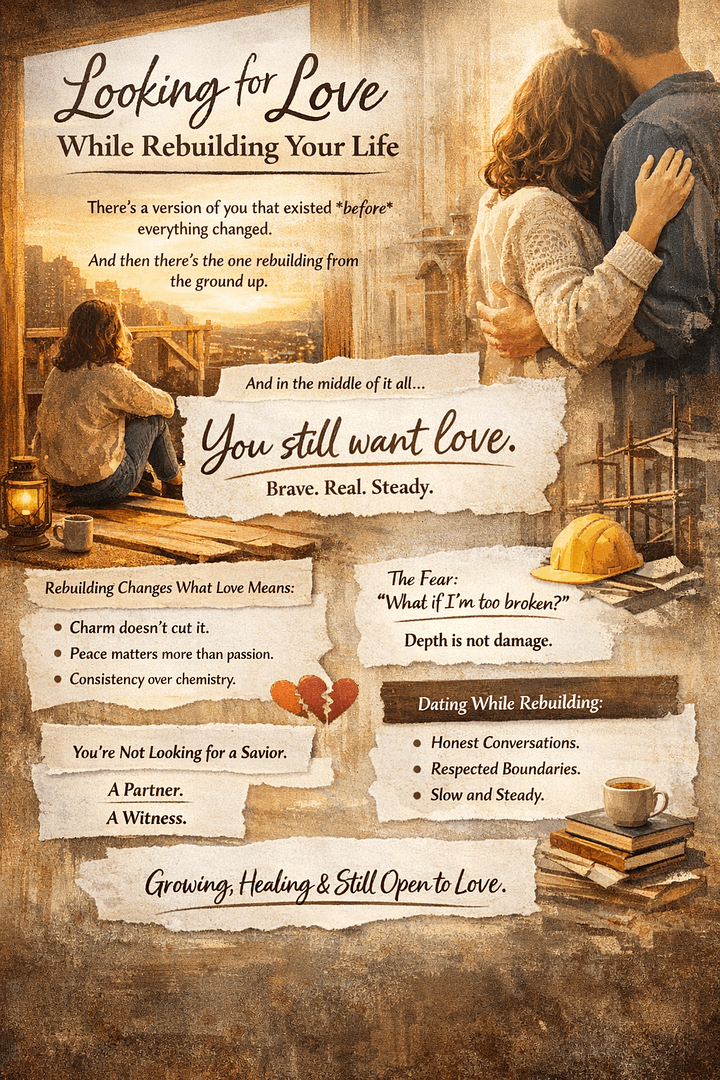
    There’s a version of you that existed before everything changed.

    Before the heartbreak.
    Before the loss.
    Before the divorce, the betrayal, the collapse, the burnout, the moment you realized you couldn’t keep living the same way.

    And then there’s this version.

    The one standing in the middle of the rubble, holding pieces of a life that doesn’t look the way it used to — trying to decide what stays, what goes, and who you’re becoming now.

    It’s here, in this uncertain, half-built space, that a quiet truth often rises:

    You still want love.

    Not the fairytale version.
    Not the naive, reckless kind.
    But the real thing. The steady thing. The safe thing.

    And wanting that while you’re still rebuilding?
    That takes a kind of bravery most people don’t see.


    Rebuilding Changes What Love Means to You

    When life knocks you down, it strips illusions first.

    You stop being impressed by:

    • charm without consistency

    • attention without effort

    • chemistry without emotional safety

    • words that sound good but don’t show up in action

    Because you’ve lived enough to know:

    Butterflies can coexist with anxiety.
    Passion can hide instability.
    Intensity can be mistaken for intimacy.

    Rebuilding sharpens your vision.

    You’re no longer dating for a spark.
    You’re dating for peace.

    You want someone whose presence lowers your blood pressure, not raises your cortisol. Someone who doesn’t feel like another project, another uncertainty, another emotional risk you have to manage alone.

    That shift? It’s not boring.

    It’s evolved.


    The Loneliness of Becoming Someone New

    Rebuilding your life often means becoming unfamiliar, even to yourself.

    Your routines change.
    Your social circles shift.
    Your priorities rearrange.

    You may not go to the same places.
    You don’t laugh at the same things.
    You don’t tolerate what you used to.

    And in the middle of that transformation, there’s a specific kind of loneliness — not just being alone, but being between identities.

    You’re not who you were.
    You’re not fully who you’re becoming.

    Wanting love during this stage isn’t weakness.

    It’s the natural human desire to not walk such a massive internal shift without someone seeing it happen.

    Because rebuilding is exhausting.
    And sometimes you don’t want advice — you want someone to sit beside you and say, “I know this is hard. I’m here.”


    “What If I’m Too Broken?”

    Almost everyone rebuilding their life carries this quiet fear:

    What if I come with too much baggage now?

    You have stories. Scars. Lessons learned the hard way. A past that isn’t light or simple.

    But here’s the truth no one says enough:

    Depth is not damage.

    Yes, you’ve been through things. But those things gave you:

    • emotional intelligence

    • empathy

    • resilience

    • boundaries

    • clarity about what actually matters

    You’re not bringing chaos into a relationship.

    You’re bringing awareness.

    The right person doesn’t see your past as a liability. They see it as proof that you know how to love with intention, not fantasy.


    Dating While Rebuilding Feels Different

    You don’t rush anymore.

    You observe.

    You listen to how someone talks about:

    • their ex

    • their mistakes

    • their family

    • people who’ve hurt them

    You notice if they can apologize.
    If they can handle disagreement without shutting down or exploding.
    If they respect your pace instead of trying to override it.

    You’re not guarded because you’re cold.

    You’re careful because you’ve earned the right to protect your peace.

    And the person meant to be in your life won’t be threatened by that. They’ll be relieved by it.


    You’re Not Looking to Be Saved

    This is one of the biggest differences.

    You don’t need someone to rescue you from your life. You’re already doing the rebuilding.

    Paying the bills.
    Doing the therapy.
    Facing the grief.
    Making the hard decisions.

    You’re not searching for a hero.

    You’re looking for a partner.

    Someone who brings stability, not dependency. Someone who doesn’t need you to shrink so they can feel bigger. Someone who can say, “You handle your life, I handle mine, and we meet in the middle by choice.”

    That kind of connection is built on respect, not neediness.

    And it lasts longer.


    The Risk Is Still There — But So Are You

    Loving again after life has broken you open is terrifying.

    Because you know now:

    People leave.
    Circumstances change.
    Nothing is guaranteed.

    But you also know something else you didn’t know before:

    You can survive loss.

    You’ve already lived through days you thought you couldn’t. You’ve rebuilt once. That changes how you approach love.

    You’re not clinging.

    You’re choosing.

    And that means if things ever fall apart again — you won’t fall apart the same way.

    That’s strength, not fear.


    Love During a Rebuild Is Not a Distraction — It’s Fuel

    Sometimes people treat love like it’s a reward you get after you finish healing.

    But life doesn’t work in neat chapters.

    Sometimes:

    • a conversation helps you trust again

    • a kind partner helps you soften

    • a safe relationship helps you unlearn survival mode

    Love, when it’s healthy, doesn’t interrupt your rebuild.

    It supports it.

    It gives you a soft place to land while you’re doing hard work.


    You’re Allowed to Want Both

    You’re allowed to grow and want companionship.
    To heal and go on dates.
    To rebuild and open your heart slowly.

    You don’t have to be a finished product to be lovable.

    You just have to be real.

    Because the right person isn’t looking for perfection.

    They’re looking for someone who is doing the work, telling the truth, and brave enough to try again.

    And if that’s you?

    You’re further along than you think.

    Read More Of Love & Relationships

    Read More Of Inspiration & Motivation

  • Everything Starts With Honesty

    Advertisements

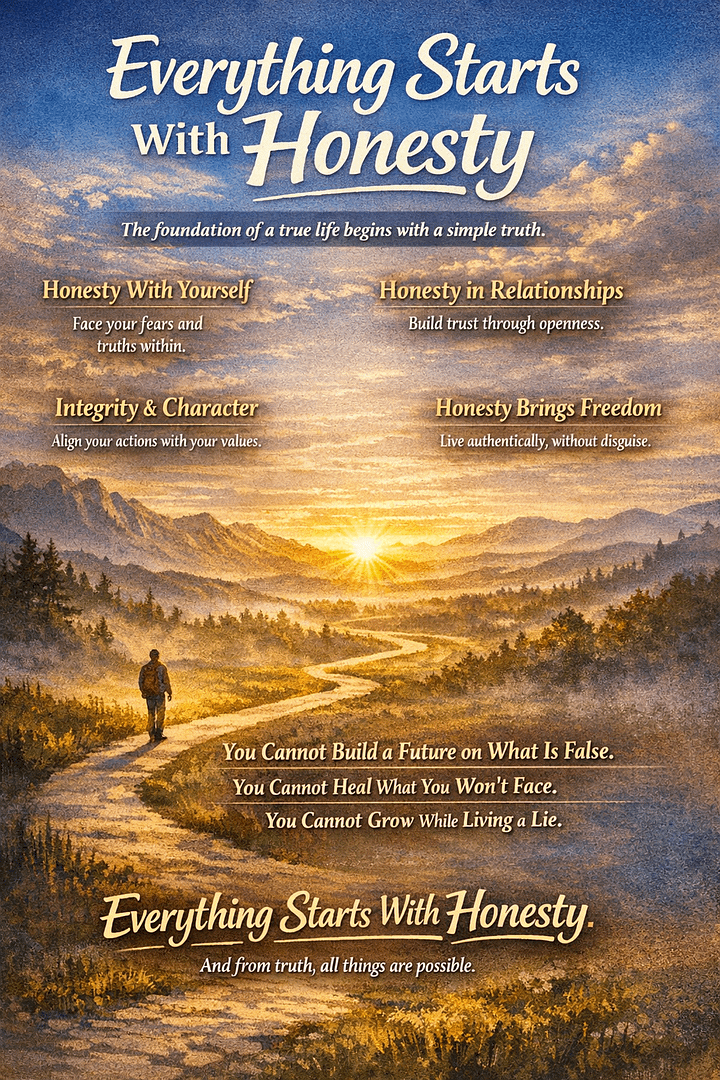
    Honesty is often described as a virtue, a character trait, or a moral expectation. But in reality, it is something far more fundamental: it is the starting point of everything that truly matters. Before trust can be built, before healing can begin, before success can last, and before relationships can deepen, there must be truth. Without honesty, progress is an illusion. With it, even the most difficult realities become workable.

    We live in a world that often rewards appearances over authenticity. Social media filters reality. Professional environments sometimes value performance over transparency. Even in personal relationships, people hide parts of themselves to avoid rejection, conflict, or vulnerability. But while dishonesty may feel safer in the moment, it always comes at a cost. Eventually, what is hidden becomes heavier than what is revealed.

    Everything starts with honesty—especially the life you are trying to build.

    The Courage to Be Honest With Yourself

    The most important truth is also the hardest: the truth you tell yourself.

    Self-honesty requires facing uncomfortable realities. It means acknowledging when you are unhappy instead of pretending everything is fine. It means admitting when you are afraid, when you have made mistakes, or when you are holding onto something that no longer fits who you are becoming. It means recognizing patterns that repeat in your life and accepting your role in them.

    Many people avoid this kind of honesty because it threatens the stories they have built about themselves. We tell ourselves we are “just tired,” when we are actually burned out. We say “this is fine,” when something inside us knows it is not. We blame circumstances, other people, or bad luck when the deeper truth is that we are afraid to change.

    But growth does not begin with motivation. It begins with truth.

    You cannot heal what you refuse to acknowledge. You cannot improve what you will not examine. Self-honesty is not about self-judgment—it is about clarity. Once you are honest about where you are, you finally gain the power to choose where you are going.


    Honesty in Relationships: Where Trust Is Born

    Every meaningful relationship stands or falls on honesty. Trust is not built through perfection; it is built through truth. People do not need you to be flawless—they need you to be real.

    Dishonesty in relationships does not always appear as obvious lies. Sometimes it shows up as silence when something matters, avoidance when conflict is needed, or half-truths meant to “keep the peace.” Over time, these small omissions create emotional distance. What is not said becomes heavier than what is.

    Honesty does not mean brutal honesty. It does not mean speaking without care or compassion. True honesty is rooted in respect—it is about sharing truth in a way that seeks understanding, not harm. It means expressing your needs instead of expecting others to guess them. It means addressing problems before resentment grows. It means being willing to have difficult conversations because the relationship matters more than temporary comfort.

    When honesty is present, relationships gain stability. When it is absent, even the strongest bonds begin to fracture.


    Integrity: When Honesty Becomes Action

    Honesty is not only about what you say—it is about what you do. This is where honesty becomes integrity.

    Integrity is the alignment between your values and your behavior. It is choosing what is right even when no one is watching. It is keeping your word, admitting when you are wrong, and taking responsibility when it would be easier to shift blame.

    In a culture that often celebrates shortcuts and appearances, integrity can feel slow and inconvenient. But what is built without honesty is never secure. Success that depends on deception eventually collapses. Relationships built on falsehood eventually break. A reputation created through manipulation eventually fades.

    A life built on honesty, however, endures.

    When your actions reflect your values, you gain something more valuable than approval: self-respect. And self-respect is the foundation of confidence, leadership, and lasting influence.


    Honesty and Emotional Freedom

    There is a unique kind of freedom that comes from telling the truth. When you stop pretending, hiding, or performing, your mind becomes lighter. You no longer carry the burden of maintaining versions of yourself for different people. You simply exist as who you are.

    Honesty allows you to set boundaries. It gives you permission to say no without guilt, to ask for help without shame, and to walk away from what does not align with your well-being. It teaches you that protecting your truth is not selfish—it is necessary.

    Living honestly also means accepting your limitations. You are not required to be everything to everyone. You are allowed to admit when something is too much, when you are uncertain, or when you need time to grow. This kind of honesty fosters emotional maturity and strengthens resilience.

    When you live in truth, you no longer waste energy maintaining what is false. You use that energy to build what is real.


    Honesty in Healing and Growth

    Every journey of healing begins with acknowledgment. Whether the pain comes from loss, betrayal, failure, or personal struggle, progress does not start with positivity—it starts with honesty.

    You must first name what hurts.

    Avoidance delays healing. Minimizing pain does not make it disappear. But when you allow yourself to say, “This affected me,” or “I am not okay,” you take back control. Honesty gives pain a voice, and once something has a voice, it can be understood, processed, and eventually transformed.

    The same is true for personal growth. Change does not begin with ambition alone. It begins with an honest assessment of where you are, what you need, and what must change. Without that clarity, goals remain fantasies. With it, they become plans.


    Choosing Honesty Every Day

    Honesty is not a single decision—it is a daily practice. It shows up in small moments: telling the truth when it would be easier to stay silent, admitting mistakes instead of defending them, and choosing transparency over image.

    This practice requires courage. Truth is not always comfortable. It may disrupt relationships, challenge routines, or force you to confront realities you would rather avoid. But discomfort is temporary. The consequences of dishonesty last far longer.

    Every time you choose honesty, you strengthen the foundation of your life. You create relationships that are real, goals that are achievable, and a sense of self that does not depend on approval or illusion.


    The Foundation of Everything

    You cannot build a future on what is false.
    You cannot repair what you refuse to acknowledge.
    You cannot become who you are meant to be while hiding from who you are.

    Whether you are trying to rebuild trust, heal old wounds, pursue a new path, or redefine your identity, the starting point is always the same.

    Everything starts with honesty.

    And from that truth, everything else becomes possible.

    Read More Of Love & Relationships

    Read More Of Inspiration & Motivation

Exit mobile version