Category: Love & Relationships

  • How Hard It Is to Love Yourself After Years of Pain

    How Hard It Is to Love Yourself After Years of Pain

    Advertisements

    There comes a point in life when the hardest relationship you will ever have is the relationship with yourself.

    Not because you are difficult to love, but because pain has a way of changing how you see yourself. After years of heartbreak, disappointment, rejection, trauma, grief, emotional abuse, loneliness, or constant struggle, it becomes easy to believe that you are broken beyond repair. Slowly, the pain begins to shape your inner voice until you no longer speak to yourself with compassion, but with criticism.

    That is what many people do not understand about emotional pain. It does not only hurt your heart — it changes the way you think about your worth.

    When someone spends years fighting silent battles, they often stop seeing themselves as someone deserving of love. They begin surviving instead of living. They wake up each day carrying emotional weight that nobody else can see. Smiles become masks. Strength becomes exhaustion hidden behind determination. Even moments of happiness can feel temporary because pain has trained them to expect disappointment.

    After enough hurt, many people stop asking:
    “Will things get better?”

    Instead, they begin asking:
    “How much more can I take?”

    And somewhere along the way, self-love becomes one of the hardest things imaginable.

    Pain Teaches Survival Before It Teaches Healing

    One of the cruelest things about pain is that it teaches survival habits that are difficult to unlearn.

    People who have been hurt repeatedly often become emotionally guarded. They stop trusting easily. They apologize too much. They overthink conversations. They prepare themselves for abandonment before it even happens. They expect rejection even when someone genuinely cares about them.

    Not because they want to think negatively —
    but because pain trained them to protect themselves.

    When your heart has been broken enough times, vulnerability starts to feel dangerous. Loving yourself becomes difficult because you are constantly fighting against years of emotional conditioning. Your mind remembers every failure, every betrayal, every cruel word, every moment you felt unwanted.

    Pain leaves echoes.

    Even years later, those echoes can still whisper:
    “You’re not enough.”
    “You always ruin things.”
    “You’ll just get hurt again.”
    “No one truly stays.”

    The tragedy is that many people begin believing those lies.

    The Exhaustion of Carrying Emotional Pain

    There is a deep exhaustion that comes from carrying emotional pain for years.

    It is not just physical tiredness. It is soul-level exhaustion.

    It is waking up emotionally drained before the day even begins.
    It is pretending you are okay because explaining your pain feels too overwhelming.
    It is feeling disconnected from yourself because you have spent so much time trying to survive that you forgot how to truly live.

    Some people become so used to suffering that peace feels unfamiliar to them. Calmness feels suspicious. Happiness feels temporary. Love feels unsafe.

    That is what long-term emotional pain can do.

    It teaches people to live in defense mode.

    And when you live in defense mode long enough, you stop treating yourself gently. You become your own worst critic. You replay regrets endlessly. You punish yourself for mistakes. You compare yourself to others. You blame yourself for things that were never entirely your fault.

    Eventually, self-hatred can become a habit.

    Not because you truly hate yourself —
    but because you no longer know how to see yourself through loving eyes.

    Loving Yourself After Pain Feels Unnatural

    People often talk about self-love as though it is easy:
    “Just love yourself.”
    “Know your worth.”
    “Be confident.”

    But after years of pain, those words can feel impossible.

    Because self-love after pain is not just about confidence.
    It is about rebuilding trust with yourself.

    It is learning how to believe that you matter after life made you feel invisible.
    It is learning how to speak kindly to yourself after years of self-criticism.
    It is learning how to stop apologizing for simply existing.
    It is learning how to stop measuring your worth by how others treated you.

    That process takes time.

    Sometimes a very long time.

    For people who have carried pain for years, loving themselves may feel uncomfortable at first because they are not used to receiving kindness — even from themselves. They may reject compliments. They may feel guilty resting. They may struggle to believe they deserve happiness.

    Healing can feel unfamiliar because pain became familiar.

    Grieving the Person You Used to Be

    One of the most painful parts of healing is grieving the version of yourself you used to be before life hurt you.

    Many people quietly mourn:

    The innocence they lost.
    The trust they once had.
    The softness they used to carry.
    The dreams that pain interrupted.
    The person they were before survival became necessary.

    That grief is real.

    Sometimes people look at old photographs of themselves and barely recognize the person smiling in them. Not because they changed physically, but because emotionally they became someone different after everything they endured.

    Pain changes people.

    But healing does not mean becoming who you were before the pain.

    Healing means learning how to become whole again in a new way.

    It means allowing yourself to grow into someone wiser, stronger, more compassionate, and more resilient — not because you wanted pain, but because you survived it.

    Healing Is Quiet

    The world often celebrates dramatic transformations, but real healing is usually quiet.

    Healing is:

    Getting out of bed on difficult mornings.
    Choosing not to give up on yourself.
    Going one more day without quitting.
    Setting boundaries for the first time.
    Letting yourself cry instead of pretending to be strong.
    Admitting you are struggling.
    Taking care of your mental health.
    Learning to say “no” without guilt.
    Looking in the mirror and trying not to hate what you see.
    Believing, even slightly, that your life still matters.

    These moments may seem small to others, but for someone carrying years of pain, they are enormous victories.

    Sometimes survival itself is strength.

    You Are More Than What Hurt You

    Pain has a way of convincing people that their wounds define them.

    But your pain is not your identity.

    Yes, what happened to you matters.
    Yes, your scars are real.
    Yes, your struggles changed you.

    But you are still more than the heartbreaks you endured.
    You are more than the abandonment you survived.
    You are more than the mistakes you made while trying to cope.

    Your value was never destroyed by what hurt you.

    Somewhere beneath the exhaustion, fear, and emotional scars is still a human being worthy of love, kindness, patience, understanding, and peace.

    Including from yourself.

    The Courage to Love Yourself Again

    It takes incredible courage to love yourself after years of pain.

    It takes courage to believe your future can still hold joy.
    It takes courage to open your heart again after disappointment.
    It takes courage to stop defining yourself by your worst moments.
    It takes courage to heal when bitterness would feel easier.

    Most importantly, it takes courage to stop abandoning yourself.

    Because self-love is not arrogance.
    It is not perfection.
    It is not pretending you are never hurting.

    Self-love is choosing to care for yourself even while healing.
    It is choosing to believe your life still has value despite your scars.
    It is refusing to let pain become the final chapter of your story.

    And maybe healing does not begin when all the pain disappears.

    Maybe healing begins the moment you decide:
    “I have suffered enough. I deserve peace too.”

    Even if your voice shakes when you say it.

    Even if you are still learning how to believe it.

    Because after years of pain, choosing to love yourself again may be one of the bravest things you will ever do.

    Read More Of Love & Relationships

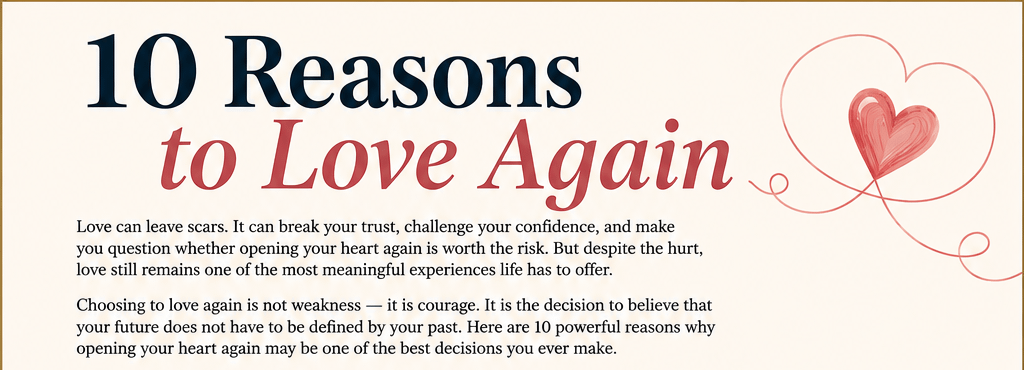
  • 10 Reasons to Love Again

    Advertisements

    Love can leave scars. It can break your trust, challenge your confidence, and make you question whether opening your heart again is worth the risk. After heartbreak, loss, disappointment, or betrayal, many people build emotional walls to protect themselves from future pain. But despite the hurt, love still remains one of the most meaningful experiences life has to offer.

    Choosing to love again is not weakness — it is courage. It is the decision to believe that your future does not have to be defined by your past. Here are 10 powerful reasons why opening your heart again may be one of the best decisions you ever make.

    1. Love Reminds You That You’re Alive

    Real love awakens emotions, hope, passion, and connection. It brings warmth into places that may have felt empty for a long time. When you allow yourself to love again, you begin to feel life more deeply — the laughter, the excitement, the comfort, and even the simple joy of being understood.

    2. Your Past Does Not Define Your Future

    Just because someone hurt you before does not mean everyone will. Every relationship is different because every person is different. Healing begins when you stop allowing old pain to control new possibilities.

    Loving again is not forgetting what happened — it’s choosing not to let it imprison you.

    3. Love Helps You Grow

    Healthy relationships challenge us to become better versions of ourselves. Love teaches patience, communication, forgiveness, empathy, and emotional strength. Sometimes the greatest personal growth happens when we learn how to trust again after disappointment.

    4. You Deserve Happiness

    Many people unknowingly convince themselves they are safer alone after heartbreak. But protecting yourself from pain can also block you from joy. You deserve companionship, affection, support, and the happiness that comes from sharing life with someone who values you.

    Never confuse fear with peace.

    5. Love Can Heal Emotional Wounds

    While time helps wounds heal, genuine love often helps restore the parts of us that pain tried to destroy. A caring person can remind you that kindness still exists, loyalty still matters, and your heart is still capable of feeling safe again.

    Healing rarely happens in isolation alone — sometimes it happens through connection.

    6. Life Is Better When Shared

    The best moments in life become even more meaningful when shared with someone who truly cares about you. Whether it’s celebrating victories, surviving difficult seasons, traveling, building dreams, or simply sitting quietly together, love adds depth to ordinary moments.

    Connection gives life richness.

    7. Love Teaches Courage

    Opening your heart again takes strength. It requires vulnerability and honesty. But courage is not the absence of fear — it’s moving forward despite fear. Every time you choose to love again, you prove to yourself that pain did not defeat you.

    That kind of courage changes a person.

    8. Someone Out There May Need Your Love Too

    Sometimes we focus so much on what we lost that we forget someone else may be searching for the same connection, understanding, and loyalty that we are. Your story, compassion, and experiences may become exactly what another person needs in their life.

    Love is often mutual healing.

    9. Love Creates New Memories

    Heartbreak can trap people inside memories of the past. But loving again creates room for new experiences, new laughter, new traditions, and new moments that remind you life still has beautiful chapters ahead.

    The story is not over simply because one chapter ended painfully.

    10. Love Is One of Life’s Greatest Gifts

    At its best, love inspires people to become kinder, stronger, and more hopeful. It gives meaning to ordinary days and strength during difficult ones. Even though love carries risks, living without it can leave life feeling incomplete.

    The possibility of joy is always worth the risk of healing.

    Final Thoughts

    Loving again does not mean rushing into relationships or ignoring your pain. It means allowing yourself to believe that your heart still deserves connection, happiness, and hope. Healing takes time, but eventually there comes a moment when you must decide whether fear will continue writing your story — or whether courage will.

    Love again when you are ready.

    Not because the world is perfect.
    Not because people never fail.
    But because your heart was never meant to stay closed forever.

    Read More Of Love & Relationships

  • Love Requires Patience, Not Perfection

    Advertisements

    In a world that constantly pushes the idea of “perfect relationships,” many people quietly carry unrealistic expectations about love. Social media highlights polished moments, romantic movies create impossible standards, and people often feel pressure to say the right things, act the right way, and never make mistakes. But real love was never meant to be perfect. Real love requires patience.

    Love is not built in flawless moments. It is built in understanding, forgiveness, growth, and staying present during imperfect seasons of life.

    Every person carries scars, fears, insecurities, and lessons from the past. No relationship exists without misunderstandings, difficult conversations, or moments where emotions become overwhelming. The strongest relationships are not the ones without problems — they are the ones where both people choose patience over pride and understanding over unrealistic expectations.

    Patience in love means learning that people grow at different speeds. One person may communicate openly while the other struggles to express emotions because of past pain. One may need reassurance while the other is still learning vulnerability. Love requires the willingness to slow down long enough to understand each other instead of demanding instant perfection.

    True love also means allowing room for mistakes.

    There will be days when words come out wrong. There will be moments when stress, grief, exhaustion, or fear affect how people respond to each other. Patience reminds us that one difficult moment does not define an entire relationship. It allows grace to exist where judgment once stood.

    Patience is especially important when healing is involved. People who have experienced heartbreak, betrayal, trauma, or loss often carry invisible emotional wounds. Loving someone with patience means recognizing that healing is not linear. Some days will feel peaceful, while other days may reopen old fears. Real love does not rush healing or shame vulnerability. It walks beside it with compassion.

    Love also requires patience with yourself.

    Many people become frustrated because they think they must be perfect to deserve love. They hide flaws, suppress emotions, or feel ashamed of their struggles. But healthy love does not demand perfection. It thrives in honesty, authenticity, and emotional safety. Being loved for who you truly are is far more meaningful than being admired for a perfect image that does not exist.

    Relationships grow strongest when two imperfect people choose commitment, communication, and grace again and again.

    Patience creates space for deeper conversations.
    Patience allows trust to develop naturally.
    Patience turns temporary frustrations into opportunities for understanding.
    Patience keeps love steady during difficult seasons instead of abandoning it at the first sign of struggle.

    Perfection creates pressure.
    Patience creates peace.

    At its core, love is not about finding someone who never fails you. It is about finding someone willing to grow with you, learn with you, and remain present through both beautiful and difficult moments.

    The relationships that last are rarely perfect.
    They are patient.
    They are forgiving.
    They are resilient.
    And most importantly, they are real.

    Read More Of Love & Relationships

  • When You Want to Open Up to Someone Special

    Advertisements

    There are moments in life when your heart becomes so full of unspoken emotions that silence itself starts to feel heavy. You carry conversations in your head that never leave your mouth. You replay memories, fears, disappointments, regrets, and hopes over and over, wishing someone could truly understand what is happening inside you.

    Most people become experts at hiding.

    They learn how to smile while hurting.
    How to laugh while feeling lonely.
    How to say “I’m okay” when they are emotionally exhausted.

    The world often teaches people to protect themselves emotionally. Some are taught not to cry. Some are taught not to burden others with their feelings. Others become silent because every time they tried to open up in the past, they were ignored, mocked, abandoned, or misunderstood.

    Pain changes people.

    It can make someone who was once open and trusting become guarded and distant. It can make a person afraid to become emotionally attached. It can make them overthink every conversation and second-guess every feeling.

    That is why meeting someone who makes you want to open up feels so powerful.

    There is something rare about finding a person who makes your heart feel calm instead of anxious. Someone whose presence feels safe. Someone who listens differently. Someone who notices the sadness hidden behind your smile. Someone who gently asks, “Are you really okay?” and actually waits for the honest answer.

    When you meet someone special like that, something inside you begins to shift.

    You want to tell them about the things you usually keep hidden.

    You want to tell them about the nights you cried when no one knew.
    The heartbreak you never fully healed from.
    The loneliness you carry even in crowded rooms.
    The mistakes you still regret.
    The fears you try to outrun.
    The dreams you rarely say out loud because you are afraid they might never happen.

    But at the same time, fear rises too.

    Because opening up means becoming vulnerable.

    And vulnerability can feel terrifying when life has taught you that people sometimes leave after learning the real you.

    You begin asking yourself questions like:

    “What if I say too much?”
    “What if they see me differently?”
    “What if they lose interest?”
    “What if I become too attached?”
    “What if they hurt me like others did?”

    So instead of speaking, many people stay quiet.

    They type messages and delete them.
    They almost open up, then pull back.
    They hint at their pain without fully explaining it.
    They wait for the “perfect moment” that never seems to come.

    The truth is, opening up to someone special is not easy because it requires trust, and trust is one of the hardest things to rebuild once it has been broken.

    Still, despite all the fear, the heart continues to long for connection.

    Human beings were never meant to carry every burden alone. Deep inside, most people want someone they can safely remove the mask around. Someone they do not have to impress. Someone they can cry in front of without feeling weak. Someone who will stay when life becomes messy and complicated.

    The desire to open up is not attention-seeking.
    It is not weakness.
    It is not emotional dependency.

    It is the natural desire to be emotionally known and emotionally accepted.

    There is healing in finally being honest.

    There is healing in hearing someone say:

    “I understand.”
    “You don’t have to go through this alone.”
    “Thank you for trusting me.”
    “I’m here.”
    “You don’t have to pretend with me.”

    Sometimes those simple words can touch wounds that years of silence never healed.

    The right person will not make you feel ashamed for having emotions. They will not rush you to “get over it.” They will not act annoyed when you are struggling. They will not use your vulnerability against you later during conflict.

    Instead, they will create safety.

    Real emotional safety feels peaceful.
    It feels patient.
    It feels understanding.
    It feels like you can breathe again.

    Opening up also teaches an important lesson: not everyone deserves access to your deepest emotions.

    Trust should be earned, not forced.

    It is okay to take your time. It is okay to open up slowly. You do not have to hand someone every broken piece of your heart all at once. Vulnerability happens in layers. One conversation. One truth. One honest moment at a time.

    Sometimes opening up starts small:

    “Lately I’ve been struggling emotionally.”
    “There’s something I’ve been carrying for a long time.”
    “I usually keep this to myself.”
    “I trust you enough to tell you this.”

    Those simple sentences often carry years of hidden pain behind them.

    And when someone responds with compassion instead of judgment, it can change you.

    For many people, the deepest fear is not rejection — it is being misunderstood.

    They fear someone hearing their pain but minimizing it. They fear being told they are “too emotional,” “too sensitive,” or “too much.” They fear exposing their heart only to feel foolish afterward.

    But the reality is this: the people who genuinely care about you will not punish you for being human.

    Everyone carries invisible battles.

    Some people hide grief.
    Some hide anxiety.
    Some hide trauma.
    Some hide depression.
    Some hide loneliness.
    Some hide the exhaustion of trying to stay strong for everyone else.

    You never truly know how much someone is holding inside.

    That is why kindness matters. That is why listening matters. That is why emotionally safe people are so rare and valuable.

    Opening up to someone special can also deepen love and connection in ways surface-level conversations never could. Real intimacy is not built only through attraction or shared interests. It is built through honesty. Through trust. Through emotional presence.

    When two people can speak openly about their fears, scars, hopes, and struggles without fear of judgment, a deeper kind of bond forms.

    That kind of connection is powerful because it allows people to stop pretending.

    No masks.
    No performances.
    No emotional hiding.

    Just two imperfect people choosing to be real with each other.

    Of course, not every story ends perfectly.

    Sometimes you open your heart and the other person does not know how to hold it. Sometimes people pull away. Sometimes trust is misplaced. Sometimes vulnerability is met with silence.

    And yes, that hurts deeply.

    But even then, your willingness to open up is not something to be ashamed of.

    It means your heart still has the courage to trust despite everything it has survived.

    That is strength.

    Far too many people spend their entire lives emotionally disconnected because fear convinced them that hiding was safer than feeling. They avoid vulnerability so completely that no one ever truly knows them.

    But real connection requires emotional risk.

    It requires honesty.

    It requires saying:

    “This is what hurts me.”
    “This is what I fear.”
    “This is what I carry.”
    “This is who I really am.”

    And hoping the other person stays.

    Sometimes they will.
    Sometimes they won’t.

    But every time you choose honesty over emotional isolation, you give yourself the opportunity to experience something genuine.

    Because in the end, most people are not looking for perfection.

    They are looking for someone who feels safe. Someone who listens. Someone who understands. Someone who sees their scars and chooses not to run away.

    When you want to open up to someone special, what your heart is truly saying is:

    “I’m tired of carrying this alone.”

    And there is nothing weak about that at all.

    Read More Of Love & Relationships

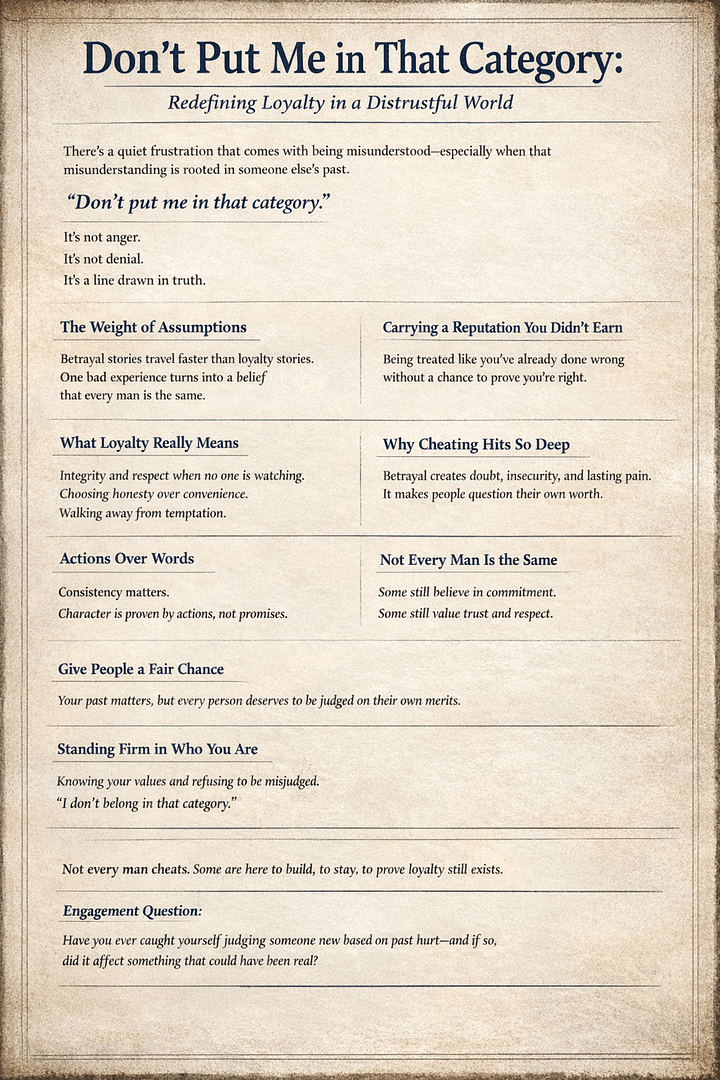
  • Don’t Put Me in That Category: Redefining Loyalty in a Distrustful World

    Advertisements

    There’s a quiet frustration that comes with being misunderstood—especially when that misunderstanding is rooted in someone else’s past. It’s the feeling of being judged before you’ve even had the chance to show who you are. And for many men today, that judgment comes in the form of a label they never earned: being grouped in with men who cheat.

    “Don’t put me in that category.”

    It’s not anger. It’s not denial.
    It’s a line drawn in truth.

    The Weight of Assumptions

    We live in a time where betrayal stories travel faster than loyalty stories. Pain gets shared more than peace. And while those stories are valid—because people really have been hurt—they’ve also created a culture of assumption.

    One bad experience turns into guarded behavior.
    Multiple bad experiences turn into belief.
    And eventually, that belief becomes a filter through which every new person is judged.

    So when a man steps in with honest intentions, he’s not just trying to build something new—he’s also trying to break through walls he didn’t build.

    That’s the part people don’t always see.

    Carrying a Reputation You Didn’t Earn

    There’s something heavy about being treated like you’ve already done wrong before you’ve even had the chance to prove yourself right.

    It shows up in the questions.
    In the doubt behind simple situations.
    In the hesitation to trust even the smallest things.

    And while understanding someone’s past is important, there’s a difference between being aware and being unfair.

    Because when someone is constantly expected to fail, it creates distance—even if they’re doing everything right.

    No one thrives in a space where they’re always being compared to someone else’s worst memory.

    What Loyalty Really Means

    Loyalty isn’t just about not cheating—it’s about integrity when there’s opportunity to do wrong.

    It’s about:

    Choosing the person you’re with, even when no one is watching
    Being honest instead of convenient
    Walking away from temptation instead of entertaining it
    Respecting your partner even in their absence

    A loyal man doesn’t need to prove himself through constant reassurance—his consistency speaks for him.

    He’s not perfect. He’ll make mistakes, like anyone else. But betrayal isn’t one of them.

    Because loyalty, to him, isn’t a rule—it’s part of who he is.

    Why Cheating Hits So Deep

    Cheating isn’t just physical—it’s emotional disruption at its core.

    It creates questions like:
    Was I not enough?
    Was any of it real?
    How did I miss the signs?

    It doesn’t just break trust in one person—it can break trust in yourself.

    That’s why people become guarded. That’s why they hesitate. That’s why they question everything.

    And that’s also why it matters when someone comes along who genuinely doesn’t operate that way.

    Because they’re not just offering love—they’re offering safety.

    The Difference Between Guarded and Closed Off

    There’s nothing wrong with protecting your heart. In fact, it’s necessary after you’ve been hurt.

    But there’s a line between being cautious and being closed off.

    Being cautious says: I’m paying attention.
    Being closed off says: I’ve already decided who you are.

    And when someone has already decided you’re just like the last person, it doesn’t matter how differently you show up—you’re fighting a battle you can’t win.

    Healthy relationships require awareness, not assumptions.

    Actions Over Words

    Anyone can say they’re loyal. Anyone can promise they’ll be different.

    But real character shows up in patterns, not promises.

    It’s in:

    Showing up when they say they will
    Communicating even when it’s uncomfortable
    Being transparent without being asked
    Respecting boundaries naturally, not reluctantly

    A man who values loyalty doesn’t perform it—he lives it.

    Over time, consistency becomes undeniable.

    Not Every Man Is the Same

    This truth often gets lost in the noise: not every man cheats.

    There are men who:

    Believe in commitment
    Value emotional connection over attention
    Take pride in being dependable
    Understand the responsibility that comes with someone trusting them

    They may not always be the loudest or the most flashy—but they’re there.

    And they’re often overlooked because they don’t fit the narrative people have grown used to expecting.

    Give People a Fair Chance

    No one is asking you to ignore your past. Your experiences matter. They shaped you.

    But they shouldn’t control every future connection.

    Every person deserves to be evaluated on their own actions—not someone else’s behavior.

    Trust doesn’t have to be given all at once.
    It can be built slowly, through observation and time.

    But it has to be possible.

    Because without that possibility, nothing real can grow.

    Standing Firm in Who You Are

    Saying “Don’t put me in that category” is about more than defending yourself—it’s about knowing your values and refusing to be misrepresented.

    It’s about saying:

    I don’t move like that
    I don’t treat people like that
    I don’t build connections just to break them

    It’s quiet confidence. Not arrogance.
    It’s self-awareness. Not defensiveness.

    And it comes from living in alignment with your principles—even when no one is watching.

    Final Thoughts

    We all carry something from the past—lessons, scars, memories.

    But if we let those things define every new person we meet, we risk missing out on something real.

    Not everyone is here to hurt you.
    Not everyone is here to leave.
    And not every man belongs in the category of those who cheat.

    Some are here to build.
    Some are here to stay.
    Some are here to prove that loyalty still exists.

    And if you meet one of those men—
    don’t make him pay for what someone else did.

    Read More Of Love & Relationships
  • When You Want to Open Up but Know Not To

    Advertisements

    There’s a quiet war that happens inside you—one that no one else sees.

    It begins in a moment. A pause in conversation. A simple question someone asks. A memory that rises to the surface without warning. Your heart leans forward, ready to speak, ready to release what it’s been holding for far too long. You want to open up. You want to be understood. You want someone to see past the surface and recognize what you’ve been carrying in silence.

    But then something stops you.

    It’s not hesitation without reason. It’s not weakness. It’s not fear for no cause.
    It’s experience.

    It’s the memory of the last time you let someone in and walked away feeling exposed instead of supported. The time your vulnerability was misunderstood, dismissed, or quietly judged. It’s the realization that when you gave someone access to your truth, they didn’t know how to hold it—or worse, they didn’t try.

    So now, every time that moment comes again, something inside you pulls back.

    You sit there, caught between two opposing forces. One side of you is reaching out, desperate to speak, to release, to finally not feel so alone in your own mind. The other side is protective, guarded, reminding you of everything it cost you the last time you tried.

    And more often than not, the protective side wins.

    You change the subject. You laugh it off. You say, “I’m good,” even when you’re not.
    And just like that, the moment passes.

    But the weight stays.

    Because the truth is, not opening up doesn’t mean you don’t need to. It just means you’ve learned the hard way that not everyone deserves access to your deeper self.

    And over time, that lesson doesn’t just affect your words—it starts to shape your entire life.

    You begin to feel like you can’t make real friends, because friendships require openness, and openness feels unsafe. You keep people at a distance—not because you don’t care, but because you care too much to risk being hurt again.

    You start to believe you shouldn’t date, because how can someone love you if they don’t truly know you—and how can you let them know you without exposing the parts of yourself you’ve learned to protect? So you hold back. You avoid. You tell yourself it’s easier that way.

    And somewhere along the line, a heavier thought settles in:

    Maybe I’m not good for anyone.

    Not because you don’t have a good heart—but because you feel like what you carry is too much. Too heavy. Too complicated. You begin to think that letting someone into your world would only burden them, confuse them, or eventually push them away.

    So you isolate—not always physically, but emotionally.

    You show up, you smile, you play your part. But the real you—the one that feels deeply, that struggles, that wants to be understood—stays hidden.

    And that kind of silence can be exhausting.

    Because you’re not closed off by nature—you’ve just been taught to be.

    You’ve learned that vulnerability without safety leads to pain. That opening up to the wrong people can leave deeper wounds than staying quiet ever could. So you adapt. You protect. You build walls not because you want to shut people out, but because you’re trying to survive what you’ve already been through.

    But here’s the truth that quietly sits beneath all of that:

    Just because you’ve been hurt doesn’t mean you are unworthy of connection.
    Just because people mishandled your vulnerability doesn’t mean you are too much.
    And just because you feel like you’re not good for anyone doesn’t make it true.

    It only means you haven’t been met with the kind of understanding you needed.

    There is a difference between being incapable of connection and being cautious about where you place your trust. What you’re feeling isn’t a failure—it’s self-protection that has gone on for so long it’s started to feel like identity.

    But it’s not who you are at your core.

    At your core, you’re someone who wants to connect. Someone who wants to share, to be known, to be accepted without fear of being misunderstood. Someone who still, despite everything, has the ability to care deeply.

    And that is not something broken.
    That is something rare.

    The challenge is not that you can’t have friendships, or love, or be good for someone. The challenge is finding people who are capable of meeting you with the same depth and care that you offer.

    Not everyone will.

    But some people will.

    There are people who listen without trying to fix you. Who don’t get overwhelmed by your honesty. Who don’t run when things get real. People who understand that being let into someone’s world is not a burden—it’s a privilege.

    Those are the people worth waiting for.

    Until then, it’s okay to protect your heart. It’s okay to take your time. It’s okay to not open up in every moment where you feel the urge.

    But don’t let your past convince you that you are meant to live unseen, unheard, and disconnected forever.

    Because you’re not.

    You’re not “too much.”
    You’re not “not good for anyone.”
    You’re someone who has been hurt and learned to be careful.

    And one day, when the right person sits across from you—not just hearing you, but truly listening—you won’t feel that internal war the same way.

    You won’t feel the need to hold everything back.

    You’ll feel safe enough to speak.

    And in that moment, you’ll realize something you may have forgotten:

    You were never the problem.
    You were just protecting yourself from the wrong people.

    Read More Of Love & Relationships

  • Admitting Your Feelings to That Special Someone

    Advertisements

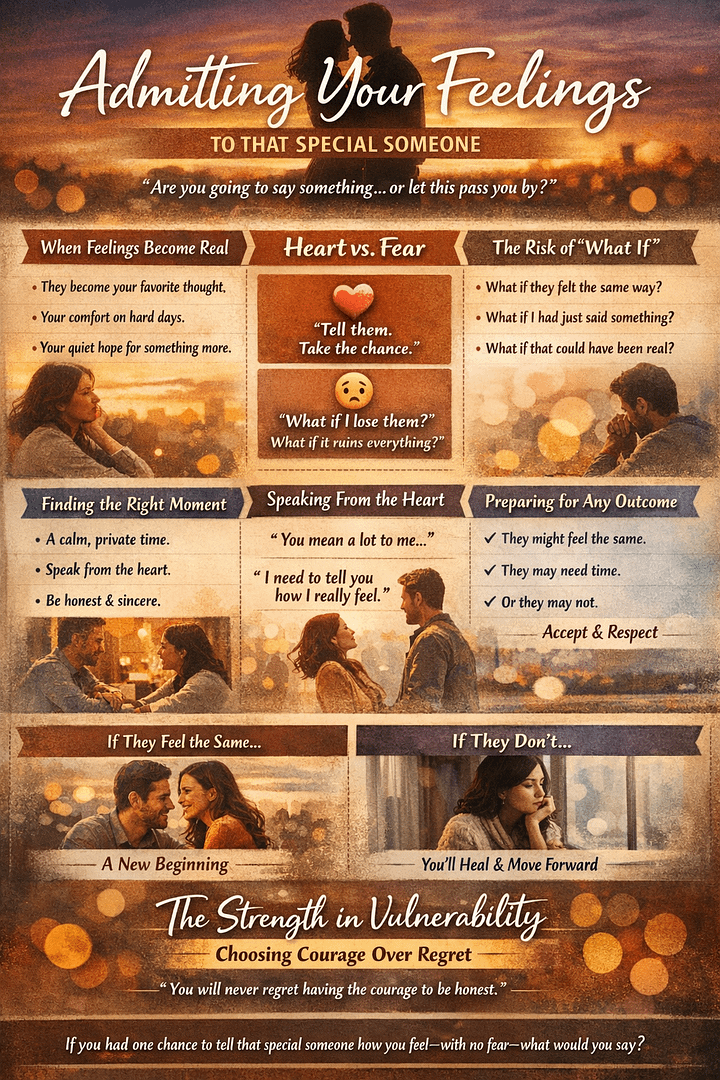
    There comes a moment in life when silence becomes heavier than words. When what you feel inside grows too strong to ignore. It shows up in the quietest ways—in how your day feels incomplete without hearing from them, in how their smile stays with you long after they’re gone, in how your heart reacts before your mind can catch up.

    You try to convince yourself it’s nothing. Just a phase. Just a passing feeling.

    But deep down, you know the truth.

    And that truth keeps asking one question:
    “Are you going to say something… or let this pass you by?”

    When Feelings Become Real

    At first, it’s subtle.

    A little excitement when their name pops up on your phone.
    A little extra attention when they’re talking.
    A little longer thinking about them before you fall asleep.

    But over time, it becomes undeniable.

    They become your favorite thought.
    Your comfort on hard days.
    Your quiet hope for something more.

    And that’s when things begin to shift.

    Because once your feelings become real, pretending they don’t exist becomes exhausting.

    The Battle Between Heart and Fear

    Admitting your feelings is rarely just about love—it’s about courage versus fear.

    Your heart says:
    “Tell them. Be honest. Take the chance.”

    Your mind says:
    “What if you lose them? What if it ruins everything?”

    So you stay in the middle.

    Not moving forward.
    Not letting go.
    Just existing in uncertainty.

    And that space—between what you feel and what you say—is where doubt grows.

    You start questioning everything:
    Do they feel it too?
    Am I imagining this?
    Should I wait?
    What if I say something and regret it?

    But here’s the truth most people don’t say out loud:

    Waiting doesn’t always protect you—it often prolongs the risk.

    Because the longer you wait, the deeper your feelings grow. And the deeper they grow, the harder it becomes to speak.

    The Risk of “What If”

    One of the greatest emotional burdens we carry in life is unfinished truth.

    The things we didn’t say.
    The chances we didn’t take.
    The moments we let pass because fear was louder than courage.

    “What if they felt the same way?”
    “What if I had just said something?”
    “What if that could have been something real?”

    These questions don’t fade easily. They linger.

    And sometimes, the pain of never knowing lasts longer than the sting of rejection ever would.

    Why Honesty Matters More Than Outcome

    When you admit your feelings, you’re not just chasing a result—you’re honoring yourself.

    You’re saying:
    “My feelings are real, and they deserve to be expressed.”

    That alone is powerful.

    Because too often, people shrink themselves to avoid discomfort. They stay quiet to avoid rejection. They hide parts of who they are to protect what they might lose.

    But love—real love—doesn’t grow in silence.

    It grows in honesty.
    In vulnerability.
    In the willingness to be seen without guarantees.

    And even if the outcome isn’t what you hoped for, you walk away with something just as valuable:

    Self-respect.

    Finding the Right Moment

    There is no perfect timing.

    No flawless setting where everything aligns and guarantees the outcome you want.

    But there are better moments—moments where you can be genuine, present, and clear.

    Choose a time when:

    You’re both calm and not distracted
    You can speak without rushing
    You feel grounded enough to express yourself honestly

    And most importantly—choose a moment when you’re ready to accept whatever comes.

    Because timing isn’t about perfection. It’s about intention.

    Speaking From the Heart

    You don’t need rehearsed lines or dramatic confessions.

    In fact, the more real and simple you are, the more powerful your words become.

    It might sound like:

    “I’ve been thinking about this for a while, and I just want to be honest with you…”
    “You mean a lot to me, and my feelings have grown into something more…”
    “I don’t expect anything—I just didn’t want to keep this to myself anymore.”

    The key is not perfection—it’s authenticity.

    People don’t connect to perfect words.
    They connect to real ones.

    Preparing for Any Outcome

    This is where true strength shows.

    Because when you open your heart, you’re stepping into the unknown.

    They may smile and say they feel the same way.
    They may need time to process.
    Or they may gently tell you they don’t feel that way.

    And while rejection hurts—it does not define you.

    It doesn’t mean you misread everything.
    It doesn’t mean your feelings were wrong.
    It simply means the connection wasn’t mutual in the way you hoped.

    And that’s okay.

    Because the right connection—the one meant for you—won’t require you to hide how you feel.

    If They Feel the Same

    If your feelings are returned, something beautiful begins.

    Not because everything becomes perfect—but because it begins with truth.

    A relationship built on honesty starts stronger.
    It grows deeper.
    It carries a level of openness that many relationships never reach.

    Because you didn’t start with guessing—you started with clarity.

    If They Don’t

    This is the part people fear the most—but it’s also where growth happens.

    Yes, it will hurt.
    Yes, it may feel awkward for a while.
    Yes, things might change.

    But you will heal.

    And more importantly—you will move forward without regret.

    You won’t spend months or years wondering what could have been.

    You’ll know.

    And knowing—even when it’s not what you wanted—is a form of peace.

    The Strength in Vulnerability

    Admitting your feelings is not weakness—it’s emotional bravery.

    It takes strength to:

    Risk rejection
    Face uncertainty
    Be open in a world that often encourages people to hide

    Most people never say how they truly feel.

    They play it safe.
    They stay guarded.
    They let opportunities pass them by.

    But you? You chose differently.

    You chose truth over comfort.
    Courage over fear.
    Growth over regret.

    And that matters.

    Final Reflection

    At the end of the day, life is not measured by how perfectly we protected our hearts—but by how honestly we lived.

    Love isn’t guaranteed.
    But neither is tomorrow.

    So if there’s someone who has been on your mind… someone your heart keeps coming back to… someone who makes you wonder “what if”…

    Maybe it’s time to stop wondering.

    Maybe it’s time to speak.

    Because the right person won’t punish you for being real.
    They’ll respect you for it.

    And whether it leads to love… or closure… or a new beginning—

    you will never regret having the courage to be honest.

    Read More Of Love & Relationships

  • When You Feel Like Nobody’s First Choice

    Advertisements

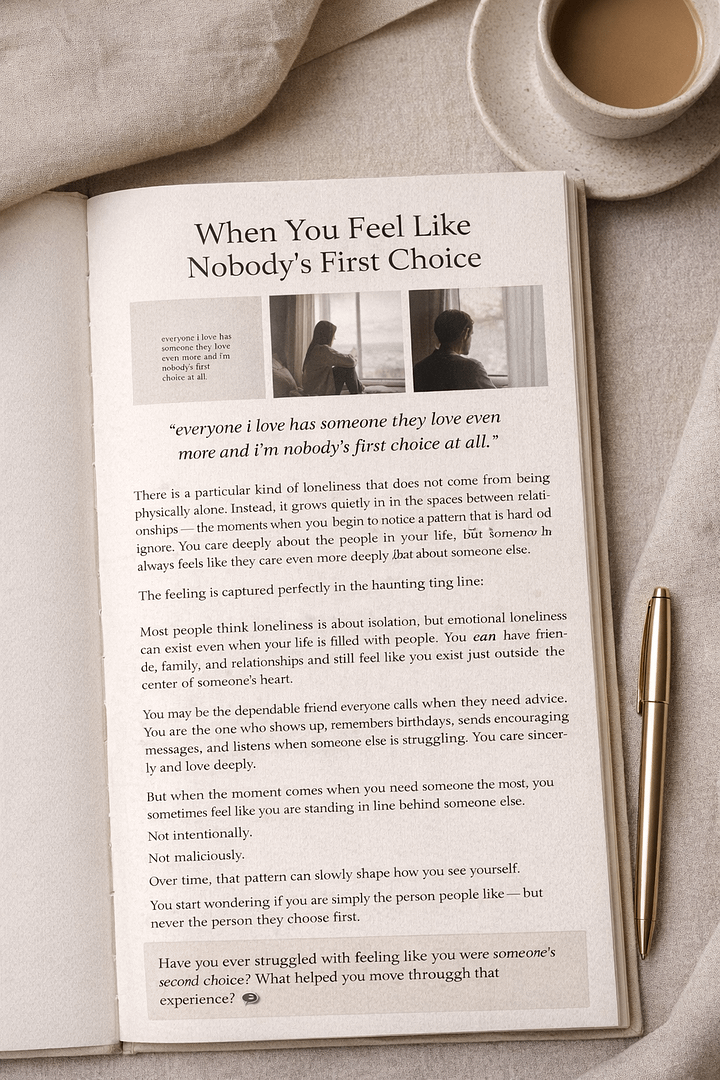
    There is a particular kind of loneliness that does not come from being physically alone. Instead, it grows quietly in the spaces between relationships—the moments when you begin to notice a pattern that is hard to ignore. You care deeply about the people in your life, but somehow it always feels like they care even more deeply about someone else.

    The feeling is captured perfectly in the haunting line:

    “everyone i love has someone they love even more and i’m nobody’s first choice at all.”

    It is a thought that many people carry privately, often afraid to admit it out loud. Because once you say it, you are acknowledging a fear that touches something very vulnerable: the fear of not being chosen.

    The Quiet Weight of Emotional Second Place

    Most people think loneliness is about isolation, but emotional loneliness can exist even when your life is filled with people. You can have friends, family, and relationships and still feel like you exist just outside the center of someone’s heart.

    You may be the dependable friend everyone calls when they need advice. You are the one who shows up, remembers birthdays, sends encouraging messages, and listens when someone else is struggling. You care sincerely and love deeply.

    But when the moment comes when you need someone the most, you sometimes feel like you are standing in line behind someone else.

    Not intentionally.
    Not maliciously.
    But consistently.

    Over time, that pattern can slowly shape how you see yourself.

    You start wondering if you are simply the person people like—but never the person they choose first.

    Loving Deeply in a World of Hesitation

    People who experience this feeling are often the same people who love the hardest. They are emotionally attentive and deeply empathetic. They notice small changes in someone’s voice, the slight shift in someone’s mood, or the unspoken sadness behind a smile.

    They give their energy generously because caring comes naturally to them.

    However, this emotional openness can also make them vulnerable. When you invest your heart so fully in others, every imbalance becomes more noticeable. Every time someone chooses someone else first, it feels like confirmation of a painful narrative forming inside your mind.

    You begin asking quiet questions:

    What am I missing?
    Why am I never the one people choose first?
    Is there something wrong with me?

    These questions can linger for years, even when there are no simple answers.

    When Comparison Becomes a Silent Enemy

    Social media and modern communication can amplify these feelings. Every photo, every public declaration of love, every visible friendship dynamic can create the illusion that everyone else is someone’s priority.

    Meanwhile, you may feel like you are always supporting roles in other people’s stories.

    The danger of this mindset is that it often leads to comparison. You begin measuring your worth against the relationships of others. You look at couples, close friendships, or tight family bonds and assume that you somehow fall short.

    But relationships are complex. What we see on the surface rarely tells the full story.

    Still, the emotional impact of comparison can be powerful. It can convince someone that they are destined to always be “almost enough” but never truly chosen.

    The Emotional Cost of Always Being Strong

    Another hidden aspect of this experience is the role you may have unintentionally taken on: the strong one.

    People who appear emotionally resilient often become the support systems for everyone around them. Because they seem capable, others lean on them during difficult times. Because they seem stable, others assume they do not need the same level of care.

    But strength can sometimes become a mask.

    Behind that dependable presence may be someone who quietly longs for a moment when someone else says, “You matter to me most.”

    Not as an afterthought.
    Not as a backup.
    But as a priority.

    The Truth About Being Chosen

    The painful belief that you are nobody’s first choice often has less to do with your worth and more to do with timing, circumstance, and emotional compatibility.

    People enter our lives at different stages of their own emotional journeys. Some are not ready for deep connection. Some are healing from past wounds. Others may already be attached to relationships that shape their priorities.

    This does not diminish the value of the love you offer.

    In fact, the ability to love deeply is one of the rarest and most meaningful qualities a person can have.

    The challenge is learning to give that love without losing yourself in the process.

    Becoming Your Own First Choice

    One of the most transformative shifts someone can make is learning to choose themselves first.

    This does not mean becoming selfish or closing yourself off emotionally. Instead, it means recognizing that your value should not be determined by who prioritizes you.

    When you begin to respect your own worth, several things start to change.

    You stop chasing validation from people who cannot give it.

    You stop investing emotional energy in relationships that consistently place you second.

    And most importantly, you begin creating space in your life for the people who will truly see you.

    The Love That Feels Different

    When the right connection enters your life, it does not feel like competition. It does not require constant questioning or quiet insecurity.

    It feels steady.

    You do not have to wonder where you stand because the other person makes it clear. They include you in their life without hesitation. They choose you not because you asked for it, but because their heart naturally gravitates toward you.

    In those moments, the old fear begins to fade.

    You realize that you were never unworthy of being someone’s first choice.

    You were simply waiting for someone who recognized your value.

    A Different Ending to the Story

    The feeling that “everyone you love loves someone else more” can be incredibly painful. But it does not define your future or the relationships you will eventually experience.

    Sometimes the people who feel overlooked are the very people who will one day be cherished the most. Their empathy, loyalty, and emotional depth become the foundation of powerful connections when they finally meet someone capable of appreciating them fully.

    The truth is simple, even if it takes time to believe:

    You are not meant to be everyone’s first choice.

    You are meant to be the right person’s first choice.

    And when that happens, it will not feel like you are competing for someone’s heart.

    It will feel like you finally came home.

    Read More Of Love & Relationships
  • When All You Want Is to Talk to That Special Someone

    Advertisements

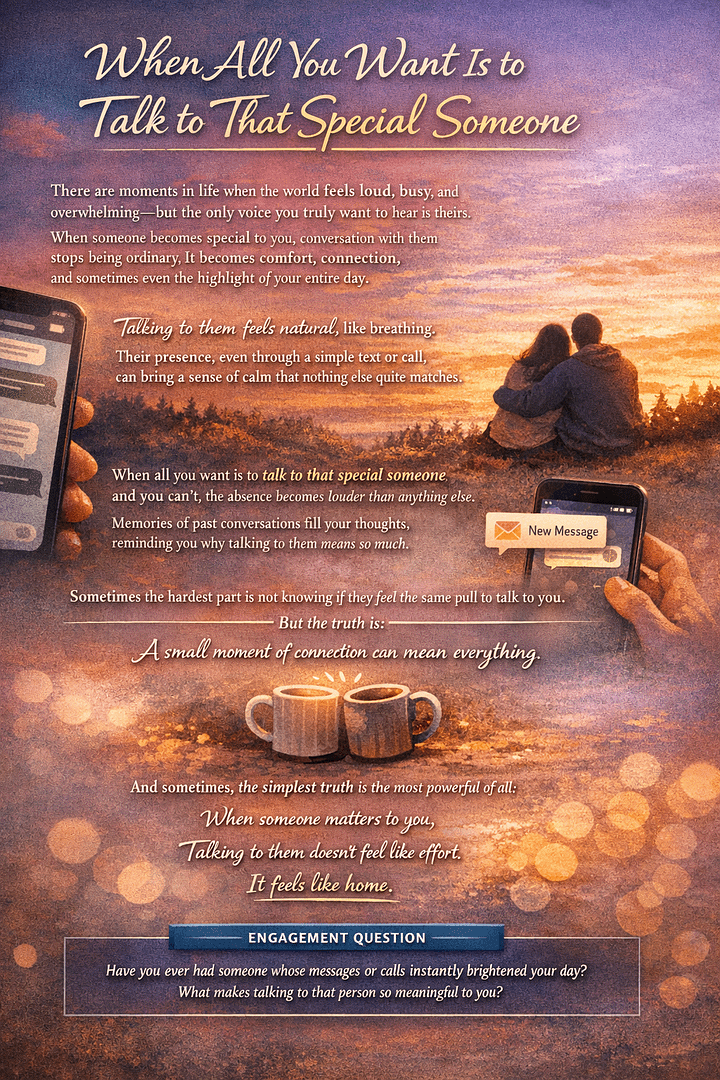
    There are moments in life when the world feels loud, busy, and overwhelming—but the only voice you truly want to hear is theirs. When someone becomes special to you, conversation with them stops being ordinary. It becomes comfort, connection, and sometimes even the highlight of your entire day.

    It’s not always about having something important to say. In fact, most of the time it isn’t. It might be about the little things—how the day went, a funny moment at work, a song that reminded you of them, or even the random thoughts that cross your mind throughout the day. When someone matters to you, talking to them feels natural, like breathing. Their presence, even through a simple text or phone call, can bring a sense of calm that nothing else quite matches.

    For many people, these conversations become a safe place. Life can be complicated, and sometimes we carry things inside that we don’t share with anyone else. But with that one special person, it feels different. You don’t have to pretend to be stronger than you are. You don’t have to filter every thought. You can simply be yourself. In a world that often expects us to wear masks, that kind of connection is rare and deeply meaningful.

    Talking to someone special also creates a rhythm in your life. You begin to look forward to those moments without even realizing it. Maybe it’s a good morning message that starts your day on a brighter note. Maybe it’s a conversation late at night when the rest of the world is quiet and honest thoughts tend to surface. Those moments begin to feel like small traditions—tiny threads that slowly weave two lives together.

    But there is also a quiet ache that can come with it. When all you want is to talk to that special someone and you can’t, the absence becomes louder than anything else. You find yourself checking your phone more often than usual, hoping their name appears on the screen. Even the smallest notification can make your heart skip for a moment, wondering if it might be them.

    In those moments, memories of past conversations tend to surface. You remember the jokes you shared, the late-night talks that seemed to last forever, or the moments when they said exactly what you needed to hear. Those memories remind you why talking to them means so much in the first place.

    Sometimes the hardest part is not knowing if they feel the same pull to talk to you. You might hold back from reaching out, not wanting to seem like you’re bothering them or appearing too eager. Pride, fear, and uncertainty can quietly stand in the way of the simple act of saying, “I miss talking to you.”

    Yet the truth is that human connection is built through these small moments. A quick message. A thoughtful question. A shared laugh. None of it seems extraordinary on the surface, but together they create something powerful. Over time, these conversations form a bond that words alone can’t fully explain.

    Talking to someone special isn’t just about exchanging words—it’s about feeling understood. It’s about knowing that somewhere out there is a person who listens to your thoughts, values your feelings, and genuinely cares about what’s happening in your world.

    Sometimes those conversations are deep and meaningful, touching on dreams, fears, and hopes for the future. Other times they are simple and lighthearted, filled with jokes, stories, or playful teasing. But regardless of the topic, the feeling remains the same: their presence makes the moment better.

    There is also something beautifully human about wanting to share life with someone in real time. When something funny happens, they are the first person you want to tell. When something difficult happens, they are the voice you want to hear. It’s not because they can fix everything, but because their presence makes things feel a little less heavy.

    And sometimes, the truth is simple.
    You don’t need a long conversation.
    You don’t need perfect words.
    You don’t even need a reason to reach out.

    All you need is that small moment of connection.

    Because when someone truly holds a place in your heart, even a short “Hi” can brighten your entire day. Even a few minutes of conversation can remind you that you are not alone.

    In the end, wanting to talk to someone special is one of the purest forms of affection. It means they have become a part of your everyday thoughts. It means their voice, their words, and their presence bring something meaningful into your life.

    And sometimes, the simplest truth is the most powerful of all:

    When someone matters to you, talking to them doesn’t feel like effort.

    It feels like home.

    Read More Of Love & Relationships
  • When You’re in Love With Someone Who Doesn’t Feel the Same

    Advertisements

    There’s a specific kind of heartbreak that doesn’t come from betrayal, lies, or dramatic endings. It comes from loving someone who simply doesn’t love you back the same way.

    No explosion.
    No villain.
    Just imbalance.

    And somehow, that makes it even harder.

    Because when someone hurts you intentionally, anger can help you detach. But when they’re kind, honest, and simply don’t feel what you feel? There’s nothing to fight. Nothing to blame. Just a quiet ache you carry every time you’re around them.

    When Feelings Are One-Sided

    Unrequited love isn’t about being foolish or delusional. It’s about emotional investment landing in a place where it can’t grow.

    You see them differently.
    You feel deeply when they speak.
    You imagine a future they’ve never pictured.

    And the hardest part? They may genuinely care about you — just not in the way your heart longs for.

    That gray area is brutal.

    They might:

    Call you when they need support

    Laugh with you effortlessly

    Confide in you

    Say, “You’re so important to me”

    But they don’t reach for you romantically.
    They don’t choose you exclusively.
    They don’t look at you the way you look at them.

    You’re close — but not close enough.

    The Agony of Being Around Them

    Being around someone you love who doesn’t reciprocate can feel like emotional whiplash.

    One moment, you feel connected.
    The next, you’re reminded that you’re alone in your feelings.

    You might sit across from them at dinner, smiling on the outside while your heart silently breaks. You may watch them talk about someone they’re interested in. You might see them give their attention, affection, or effort to someone else — and have to pretend it doesn’t crush you.

    Even small moments become loaded:

    A hug that lingers too long in your mind

    A compliment that feels like hope

    A delayed text that feels like rejection

    You try to act natural. You tell yourself you can handle it. But inside, you’re constantly adjusting your expectations to survive the interaction.

    It’s exhausting.

    The Inner Conflict

    Loving someone who doesn’t feel the same creates a painful inner split.

    Part of you wants to stay — because being near them feels better than not having them at all.

    Another part of you knows staying keeps you stuck.

    You tell yourself:

    “I can manage my feelings.”

    “I’ll get over it eventually.”

    “Maybe they’ll change their mind.”

    But healing rarely happens while you’re still emotionally entangled.

    When you’re around them often, your brain keeps reinforcing attachment. You don’t get the space needed to let your heart recalibrate. Instead, you stay in a loop of hope, disappointment, and self-questioning.

    How It Affects Your Self-Worth

    Over time, unreciprocated love can quietly damage how you see yourself.

    You may start asking:

    What does the other person have that I don’t?

    Why am I not enough?

    If I love this deeply, why can’t they?

    But attraction and emotional connection aren’t merit-based systems. You can be kind, attractive, loyal, emotionally available — and still not be the right match for someone.

    It’s not a reflection of your value.

    It’s a reflection of compatibility.

    Still, when you’re constantly exposed to someone who doesn’t choose you, it can feel personal. You might shrink yourself. Lower your standards. Accept crumbs of attention because they feel better than nothing.

    That’s when love becomes self-abandonment.

    The Illusion of “Just Friends”

    Many people try to transition into friendship too quickly.

    On the surface, it sounds mature. Healthy. Evolved.

    But if your heart is still hoping for more, friendship can feel like slow torture.

    You celebrate their wins while secretly wishing you were their partner.
    You give advice about their dating life while swallowing your own feelings.
    You show up for them emotionally while denying your own unmet needs.

    True friendship requires emotional neutrality. And you can’t force neutrality.

    It has to grow — often after distance.

    Creating Space Without Bitterness

    Distance doesn’t have to be dramatic. It doesn’t have to come with accusations or slammed doors.

    Sometimes it’s as simple as saying:

    “I care about you, but I need some space to sort through my feelings.”

    That’s not weakness. That’s emotional maturity.

    Creating space allows:

    Your nervous system to calm down

    Your expectations to reset

    Your identity to expand beyond them

    You start remembering who you are outside of longing.

    And something surprising happens when you pull back: clarity replaces obsession. The fantasy loses some of its shine. You begin seeing the full picture instead of just the parts your heart romanticized.

    Grieving What Never Was

    One of the most painful aspects of unrequited love is grieving a relationship that never officially existed.

    There are no anniversaries.
    No breakup speech.
    No clear “end.”

    You’re mourning potential. Possibility. Imagined futures.

    And that grief is valid.

    Allow yourself to feel it without judgment. Cry if you need to. Journal. Talk to someone you trust. Acknowledge that your heart invested in something meaningful — even if it wasn’t mutual.

    Healing begins when you stop minimizing your own pain.

    Opening the Door to Something Better

    Letting go of someone who doesn’t feel the same isn’t giving up on love. It’s making space for love that flows both ways.

    The right connection won’t feel like a constant question mark. It won’t leave you analyzing every interaction. It won’t require you to convince someone to see your worth.

    It will feel steady. Safe. Mutual.

    And when that kind of love arrives, you’ll understand why this one had to end — even if it never truly began.

    A Final Truth

    You can’t force someone to feel what they don’t feel.

    But you can choose how long you stay in a situation that hurts you.

    Loving someone who doesn’t love you back doesn’t make you foolish. It means you have depth. It means your heart is capable of commitment and vulnerability.

    Just make sure that depth is eventually given to someone who meets you there.

    Because you deserve more than proximity.

    You deserve reciprocity.

    Read More Of Love & Relationships
Exit mobile version