
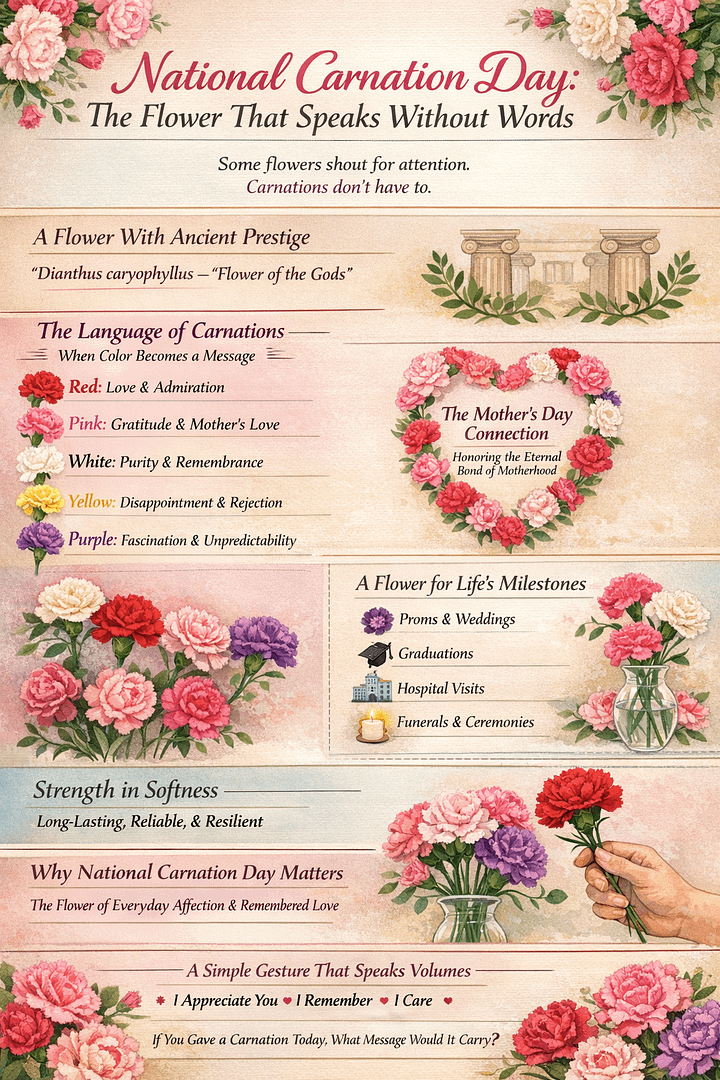
Some flowers shout for attention.
Carnations don’t have to.
They’ve been quietly present in the biggest moments of our lives for generations — celebrations, apologies, graduations, hospital rooms, weddings, memorials. On National Carnation Day, we pause to appreciate a flower that has been speaking for us long before we knew how to say what we felt.
It may not always be called “luxury,” but few flowers carry as much emotional history as the carnation.
A Flower With Ancient Prestige
Carnations aren’t trendy newcomers. They’re botanical elders.
Their scientific name, Dianthus caryophyllus, comes from Greek roots meaning “divine flower” or “flower of the gods.” Ancient Greek and Roman cultures used carnations in ceremonial crowns, garlands, and celebrations. They symbolized distinction, admiration, and honor — a floral badge of importance.
Over centuries, carnations traveled through Europe and the Middle East, eventually becoming one of the most cultivated flowers in the world. They adapted, endured, and spread — much like the emotions they represent.
The Language of Carnations: When Color Becomes a Message
Carnations became central to floriography, the Victorian-era language of flowers. When social rules limited open emotional expression, people used blooms to send coded messages.
Carnations turned into emotional messengers.
Here’s what their colors traditionally say:
-
Red Carnations – Deep love, admiration, and devotion
Not just romance — these can express respect and heartfelt appreciation. -
Pink Carnations – Gratitude and a mother’s eternal love
Often associated with nurturing, care, and remembrance. -
White Carnations – Pure love, innocence, loyalty, and remembrance
Frequently used in weddings and sympathy arrangements. -
Yellow Carnations – Disappointment, rejection, or strained relationships
Proof that flowers can be honest… sometimes brutally. -
Purple Carnations – Fascination and unpredictability
Perfect for someone who keeps life interesting.
It’s rare to find a flower that can comfortably represent both joy and grief, but carnations move between those emotional spaces with grace.
The Mother’s Day Connection
Carnations are forever tied to motherhood.
When Anna Jarvis founded Mother’s Day in the early 1900s, she chose the white carnation to honor her late mother. To her, the bloom represented the purity, faithfulness, and enduring love of a mother — a love that continues even after loss.
That meaning still resonates. Pink and white carnations are staples in Mother’s Day bouquets because they symbolize a bond that time and distance can’t erase.
For many people, carnations are not just decorative — they’re personal.
A Flower for Life’s Milestones
Carnations show up when life changes.
-
Prom corsages
-
Graduation bouquets
-
Wedding boutonnieres
-
Hospital visits
-
Sympathy arrangements
-
Religious ceremonies
They are there at beginnings and endings, in hope and in heartbreak. Few flowers hold space for both celebration and mourning without feeling out of place.
That emotional versatility is part of their quiet power.
Strength in Softness
There’s something symbolic about how durable carnations are.
They last longer in a vase than many delicate blooms. They travel well. They’re affordable. They remain full and vibrant even after days have passed.
They don’t wilt at the first sign of difficulty.
In many ways, carnations represent a kind of love that isn’t flashy — the love that shows up every day, weathers storms, and stays when things get hard.
Not dramatic.
Not rare.
Just reliable.
And sometimes, that’s the most meaningful kind.
Why National Carnation Day Matters Now
In a culture drawn to the exotic and extravagant, carnations remind us of the beauty in the familiar.
They are the flowers of:
-
Everyday affection
-
Quiet gratitude
-
Long-standing loyalty
-
Remembered love
National Carnation Day isn’t about elevating a trendy bloom — it’s about recognizing a flower that has been emotionally present in human life for centuries.
They don’t demand attention.
They hold emotion.
A Simple Gesture That Speaks Volumes
Giving someone a carnation today isn’t about cost or trend. It’s about intention.
It says:
-
I appreciate you.
-
I remember.
-
I care.
-
I’m thinking of you.
Sometimes the simplest flower carries the deepest meaning.
Read More Holidays & National Days
Leave a ReplyCancel reply