Blog

  • 💚 National Organ Donor Day: The Gift That Gives Life

    💚 National Organ Donor Day: The Gift That Gives Life

    Advertisements

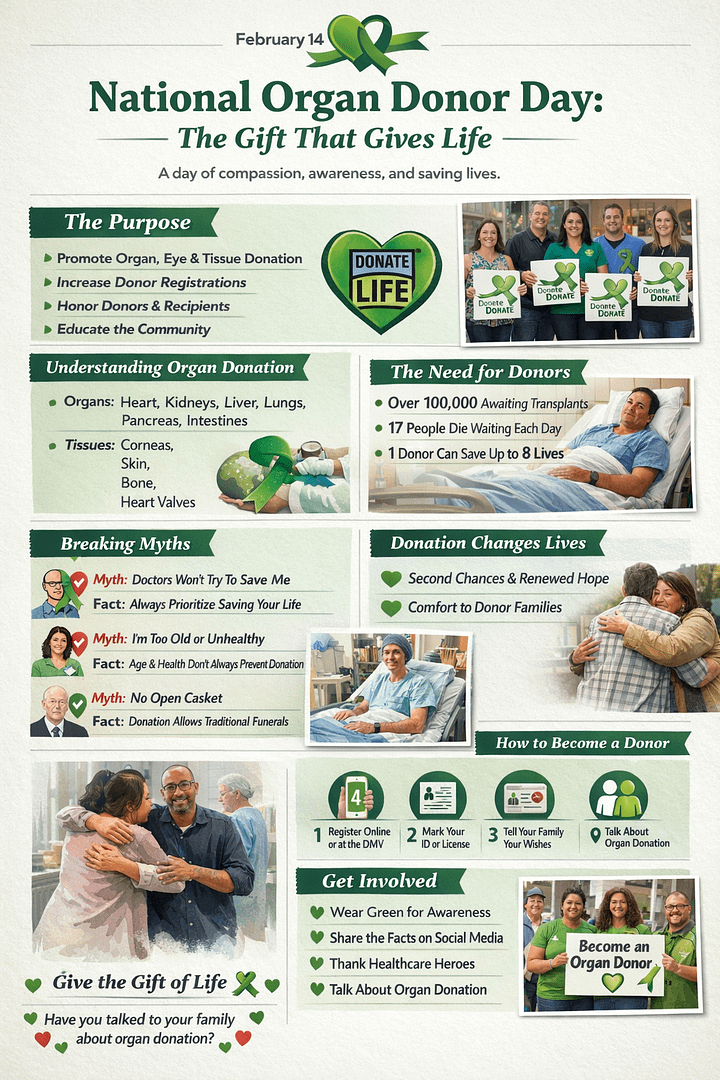
    National Organ Donor Day, observed annually on February 14, stands as one of the most meaningful observances of the year — a day devoted to compassion, generosity, and the extraordinary power of human connection. While Valentine’s Day celebrates love between partners, friends, and families, National Organ Donor Day reminds us that love can also be expressed through a selfless decision that saves lives long after we are gone.

    This day raises awareness about organ, eye, and tissue donation while honoring donors, supporting recipients, and encouraging conversations that can ultimately transform tragedy into hope.

    🌱 The Purpose Behind National Organ Donor Day

    National Organ Donor Day was created to educate the public about the urgent need for registered donors and to dispel myths surrounding organ donation. It also serves as a tribute to those who have given the ultimate gift — the gift of life.

    Organizations like Donate Life America and the United Network for Organ Sharing coordinate national awareness campaigns, manage transplant systems, and work to ensure organs are matched fairly and ethically with patients in need.

    The day focuses on four key goals:

    Increasing donor registrations

    Honoring donors and donor families

    Celebrating transplant recipients

    Educating communities about donation facts

    ❤️ Understanding Organ Donation

    Organ donation occurs when a person allows healthy organs or tissues to be transplanted into someone whose organs have failed due to illness, injury, or genetic conditions.

    Organs That Can Be Donated

    Heart

    Kidneys

    Liver

    Lungs

    Pancreas

    Intestines

    Tissues and Other Donations

    Corneas (restore vision)

    Skin (helps burn victims heal)

    Bone and tendons (restore mobility)

    Heart valves

    A single donor can save up to eight lives through organ donation and improve dozens more through tissue donation.

    📊 The Growing Need for Donors

    Every day, thousands of individuals wait anxiously for a transplant that could give them more time with loved ones. For many patients, organ failure limits everyday life — simple tasks like walking, working, or even breathing become difficult.

    Key realities include:

    New patients are added to transplant waiting lists daily.

    Many people wait years for a compatible organ.

    Some patients never receive the transplant they need in time.

    The shortage of registered donors remains the greatest challenge in transplantation medicine.

    🧠 Breaking Common Myths About Organ Donation

    Misunderstandings often prevent people from registering. National Organ Donor Day works to replace fear with facts.

    Myth: Doctors won’t try as hard to save registered donors.
    Fact: Medical teams treating patients are completely separate from transplant teams. Saving your life is always the first priority.

    Myth: I’m too old or unhealthy to donate.
    Fact: Medical professionals evaluate donation eligibility at the time of death — many people qualify regardless of age or health history.

    Myth: Organ donation conflicts with religion.
    Fact: Most major religions support organ donation as an act of compassion and charity.

    Myth: Donation prevents traditional funeral arrangements.
    Fact: Open-casket funerals are still possible in most cases.

    🌍 The Emotional Impact of Donation

    Organ donation is not only a medical procedure — it is a deeply human experience that connects strangers through shared humanity.

    For Recipients

    Receiving a transplant often means:

    Freedom from life-support treatments like dialysis

    Renewed energy and independence

    The chance to celebrate milestones once thought impossible

    Many recipients describe their transplant anniversary as a “second birthday.”

    For Donor Families

    Though donation often follows profound loss, families frequently find comfort knowing their loved one’s legacy continues through others. Acts of remembrance, letters of gratitude, and awareness events help keep that legacy alive.

    🏥 The Science and Coordination Behind Transplants

    Organ transplantation requires extraordinary coordination among hospitals, surgeons, transportation teams, and national registries.

    When a donor is identified:

    Medical professionals evaluate organ viability.

    Matching systems compare donors with recipients based on compatibility, urgency, and location.

    Surgical teams work quickly — some organs must be transplanted within hours.

    Recipients undergo life-changing surgery followed by careful recovery and lifelong monitoring.

    The process represents one of modern medicine’s most remarkable achievements, blending technology, compassion, and teamwork.

    ✅ How to Become an Organ Donor

    Registering as an organ donor is simple but powerful:

    Sign up through your state donor registry or at the DMV.

    Mark donor status on your driver’s license or ID card.

    Inform family members of your decision.

    Family awareness is essential because loved ones are often involved in confirming donation wishes.

    💚 Ways to Participate in National Organ Donor Day

    You can honor the day in meaningful ways:

    Wear green to promote awareness

    Share educational posts online

    Thank transplant healthcare workers

    Attend local awareness events or donor drives

    Start conversations about donation with friends and family

    Even one conversation can inspire someone to register — potentially saving multiple lives.

    🌟 A Legacy That Lives On

    National Organ Donor Day reminds us that humanity is connected in profound ways. A single decision made today can become tomorrow’s miracle for someone else — a heartbeat restored, eyesight regained, or years of life returned.

    Organ donation transforms loss into hope and grief into generosity. It represents love in its purest form: giving without expecting anything in return.

    Choosing to register as an organ donor is not just a personal decision — it is a promise that life can continue, hope can endure, and compassion can outlive us all.

    Read More Holidays & National Days
  • ❤️ Valentine’s Day: A Celebration of Love, Connection, and Kindness

    Advertisements

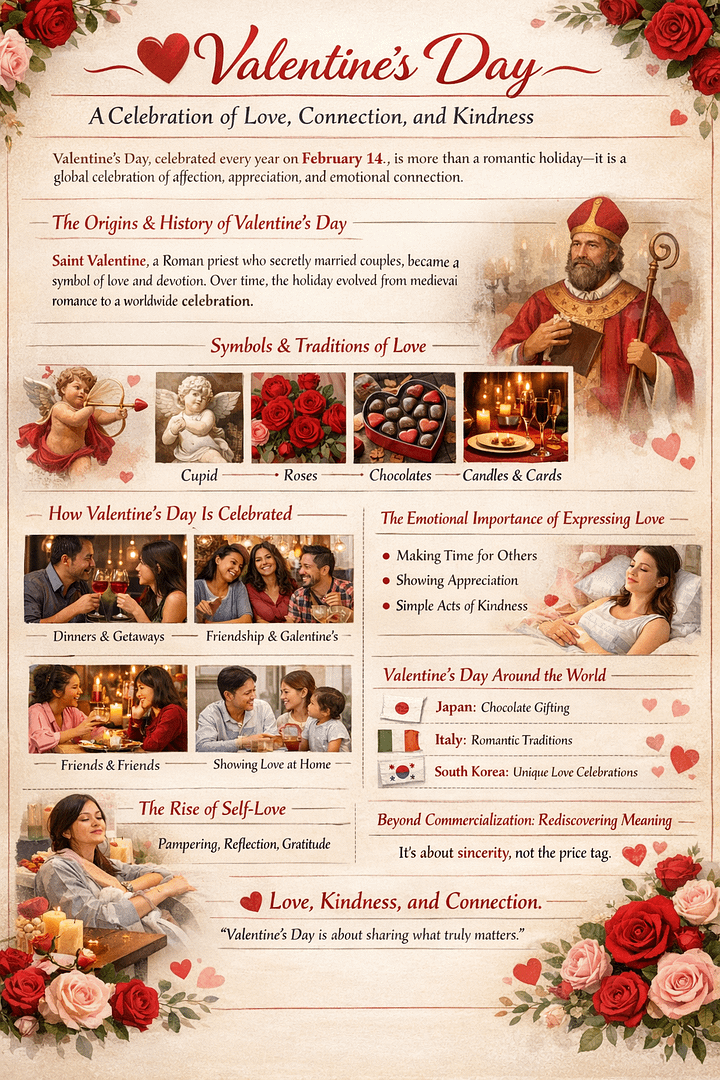
    Valentine’s Day, celebrated every year on February 14, is more than a romantic holiday—it is a global celebration of affection, appreciation, and emotional connection. From grand romantic gestures to quiet moments of gratitude, the day encourages people to express love openly and intentionally.

    Though often associated with couples, Valentine’s Day has evolved into a celebration that embraces friendships, family bonds, compassion, and self-care, reminding us that love exists in many beautiful forms.

    The Origins and History of Valentine’s Day

    The roots of Valentine’s Day reach back to ancient Rome and the story of Saint Valentine, remembered for acts of kindness and devotion. Legends describe him as a priest who secretly married couples during a time when such unions were forbidden, believing love deserved protection and respect.

    Over centuries, the holiday blended religious tradition with folklore. By the Middle Ages, Europeans believed February marked the beginning of birds’ mating season, strengthening the association between the date and romance. Writers and poets began linking the day with courtly love, inspiring handwritten notes and poetic declarations that became early Valentine messages.

    The tradition expanded rapidly during the 18th and 19th centuries when printed greeting cards made expressions of affection accessible to everyone. Today, Valentine’s Day is celebrated worldwide, crossing cultures and generations.

    Symbols and Traditions of Love

    Valentine’s Day is rich with symbols that communicate emotion without words. Many traditions we recognize today carry deeper meanings:

    Hearts symbolize emotional connection and sincerity.

    Red roses represent passion, admiration, and deep affection.

    Chocolates and sweets express sweetness and generosity.

    Greeting cards preserve personal messages and memories.

    Cupid, the playful winged figure from Roman mythology, represents love’s unpredictable and magical nature.

    These symbols help people communicate feelings that can sometimes be difficult to say aloud.

    How Valentine’s Day Is Celebrated Today

    Modern celebrations vary widely depending on culture, personality, and relationship styles. Some people embrace elaborate romantic plans, while others focus on meaningful simplicity.

    Romantic Celebrations

    Couples often celebrate with:

    Candlelit dinners or home-cooked meals

    Weekend getaways or shared experiences

    Personalized gifts or handwritten love letters

    Recreating meaningful memories together

    Friendship and Community

    In recent years, celebrations have expanded to include:

    “Galentine’s” or friendship gatherings

    Appreciation gifts for close friends

    Classroom exchanges among children

    Acts of kindness within communities

    Family Traditions

    Families may celebrate by:

    Sharing special desserts or meals

    Giving small tokens of appreciation

    Teaching children the value of gratitude and kindness

    The Rise of Self-Love on Valentine’s Day

    One of the most meaningful modern shifts is the focus on self-love. Many people now use Valentine’s Day as an opportunity to reconnect with themselves.

    Self-love celebrations might include:

    Taking a personal day to rest and recharge

    Journaling or reflecting on personal growth

    Practicing gratitude and mindfulness

    Treating oneself to something meaningful

    Recognizing your own worth strengthens the ability to love others authentically.

    The Emotional Importance of Expressing Love

    Love is a universal human need. Studies consistently show that emotional connection improves mental well-being, reduces stress, and strengthens resilience. Valentine’s Day serves as a reminder to express appreciation before opportunities pass.

    Simple gestures often carry the greatest emotional impact:

    Saying “I appreciate you”

    Checking in on someone who feels lonely

    Offering forgiveness or reconciliation

    Spending uninterrupted time together

    These moments create lasting memories far beyond material gifts.

    Valentine’s Day Around the World

    Different cultures celebrate the holiday in unique ways:

    Japan: Women traditionally give chocolates, while men reciprocate a month later on White Day.

    Italy: Couples gather in romantic cities and exchange small love tokens.

    South Korea: Multiple love-themed celebrations occur throughout the year.

    United States: Celebrations range from romantic dinners to school exchanges and community events.

    Despite cultural differences, the message remains universal—love connects humanity.

    Beyond Commercialization: Rediscovering Meaning

    While Valentine’s Day is often associated with shopping and gifts, its deeper purpose lies in emotional expression. Love does not require expensive gestures; sincerity matters far more than scale.

    A handwritten letter, shared laughter, or simply being present can mean more than any store-bought item.

    ❤️ Final Reflection

    Valentine’s Day endures because it speaks to something timeless within us—the desire to love and be loved. Whether celebrated with a partner, friends, family, or in peaceful solitude, the day invites us to slow down and recognize the relationships that give life meaning.

    In the end, Valentine’s Day is not defined by roses or chocolates, but by the courage to express what truly matters:

    Love, kindness, and connection.

    Read More Holidays & National Days

  • 💋 Kiss Day: A Celebration of Love, Connection, and Affection

    Advertisements

    Kiss Day, celebrated each year on February 13, holds a special place in Valentine’s Week as one of the most intimate and emotionally expressive days leading up to Valentine’s Day. While gifts and grand gestures often define the season of love, Kiss Day focuses on something far simpler yet deeply powerful — human connection expressed through affection.

    A kiss is more than physical contact. It is a language of emotion, a silent promise, and a moment where feelings are shared without words. Across cultures, generations, and relationships, a kiss remains one of the most timeless symbols of love and closeness.

    The History and Cultural Meaning of Kissing

    Kissing has existed throughout human history as a sign of affection, respect, and unity. Ancient civilizations used kisses in different ways:

    In Ancient Rome, kisses symbolized social rank and respect, with different types reserved for family, friendship, or romance.

    In many European traditions, kisses became greetings between loved ones and close companions.

    Across cultures today, kissing continues to represent emotional trust and connection.

    Although customs vary worldwide, the emotional meaning remains universal — a kiss communicates care and belonging.

    The Emotional Power Behind a Kiss

    A kiss often carries emotions that words struggle to express. It can mean:

    “I’m here for you.”

    “You matter to me.”

    “I love you.”

    “Everything will be okay.”

    Psychologists note that affectionate touch plays a vital role in emotional well-being. A sincere kiss can create feelings of safety and reassurance, helping people feel seen, valued, and emotionally grounded.

    Moments of affection strengthen bonds because they involve vulnerability — allowing another person into your personal space is an act of trust.

    The Science of Kissing: Why It Feels So Powerful

    Behind the romance lies fascinating biology. When people kiss:

    The brain releases oxytocin, strengthening emotional attachment.

    Dopamine increases, creating pleasure and happiness.

    Stress hormones like cortisol decrease, promoting relaxation.

    Heart rates may rise slightly, increasing excitement and emotional awareness.

    These chemical reactions explain why a meaningful kiss can instantly improve mood and deepen emotional connection.

    Types of Kisses and Their Meanings

    Every kiss tells a different story. Understanding these subtle expressions reveals how affection takes many forms.

    💖 Forehead Kiss

    Symbolizes protection, comfort, and emotional security. Often seen as one of the purest forms of affection.

    😊 Cheek Kiss

    Represents friendship, gratitude, and warmth. Common among family and close friends.

    🤝 Hand Kiss

    A gesture of admiration and respect, often associated with old-fashioned romance or honor.

    🔥 Romantic Kiss

    Expresses passion, attraction, and emotional intimacy between partners.

    🌙 Goodbye or Goodnight Kiss

    Offers reassurance and continuity — a promise that connection remains even during absence.

    Why Kiss Day Matters in Modern Life

    Today’s world moves quickly. Messages are typed, emotions are abbreviated, and connection sometimes becomes digital rather than personal. Kiss Day encourages people to slow down and reconnect physically and emotionally.

    It reminds us that relationships thrive not only through communication but through presence — shared moments that cannot be replaced by technology.

    A simple kiss can:

    Repair emotional distance

    Reinforce commitment

    Express appreciation without needing explanation

    Create lasting memories from small moments

    Creative Ways to Celebrate Kiss Day

    Celebrating Kiss Day doesn’t require extravagance. Meaningful experiences matter more than elaborate plans.

    ❤️ Romantic Celebrations

    Plan a candlelit dinner at home.

    Write a love letter describing your favorite memories together.

    Revisit the place where your relationship began.

    Share a slow dance followed by a heartfelt kiss.

    💕 Thoughtful Everyday Gestures

    Surprise your partner with affection during an ordinary moment.

    Start the day with a loving goodbye kiss.

    Express gratitude before sharing a gentle kiss.

    🌍 Long-Distance Love Ideas

    Send a video message blowing a kiss.

    Schedule a virtual date night.

    Mail handwritten notes or photos representing shared memories.

    Kiss Day Beyond Romance

    Kiss Day is not limited to romantic relationships. Affection exists in many forms:

    Parents kissing children goodnight

    Family members greeting one another warmly

    Friends expressing deep appreciation and emotional support

    The day celebrates human closeness itself — reminding us that love exists in many relationships, not just romantic ones.

    The Psychology of Affection and Trust

    Affection builds emotional safety. Studies suggest couples who regularly show physical affection often experience stronger communication and greater relationship satisfaction. Small gestures — holding hands, hugs, and kisses — reinforce emotional bonds over time.

    A kiss becomes meaningful not because of perfection, but because of intention. It shows presence, attention, and emotional investment.

    A Moment That Says Everything

    In many ways, a kiss is a pause in life’s constant motion. Time slows. Distractions disappear. For a brief moment, connection becomes the only thing that matters.

    Kiss Day invites people to be intentional — to express love openly, to appreciate closeness, and to remember that affection is one of the simplest yet most profound human experiences.

    Sometimes the smallest gesture carries the deepest meaning.

    Read More Holidays & National Days

  • 🌿 National Apology Day: The Power of Saying “I’m Sorry”

    Advertisements

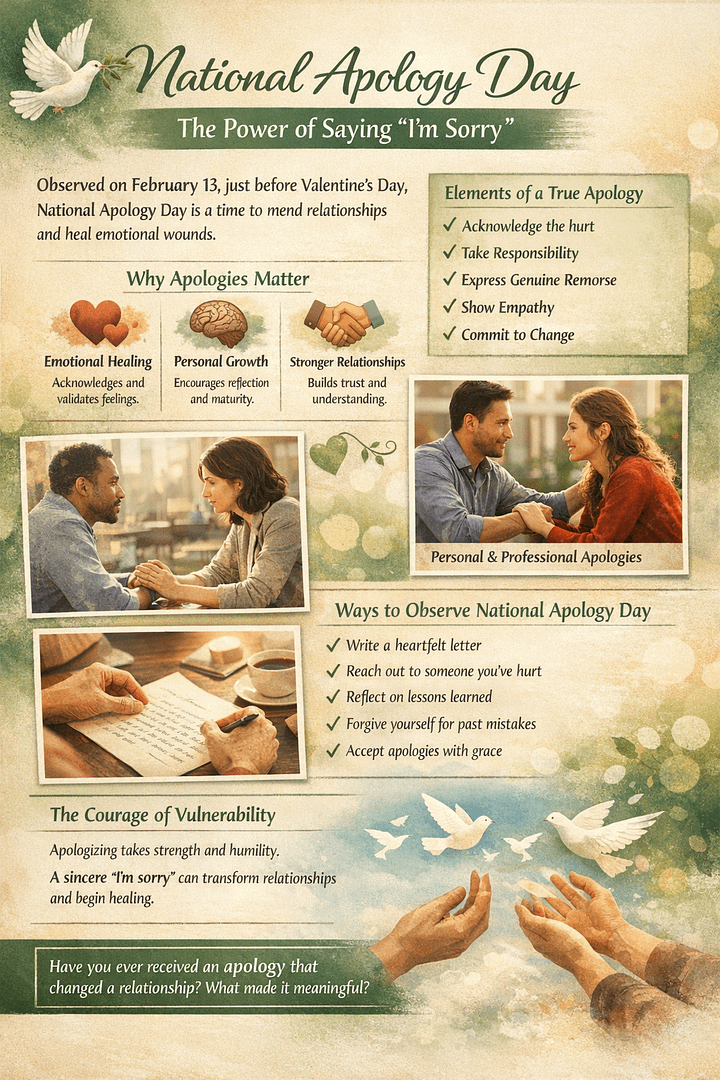
    National Apology Day, observed each year on February 13, serves as a powerful reminder that healing often begins with two simple words: I’m sorry. Falling just before Valentine’s Day — a celebration centered on love and connection — this day encourages people to clear emotional distances, repair broken bonds, and embrace humility as a path toward stronger relationships.

    While apologies may seem small, their emotional impact can be profound. A sincere apology can rebuild trust, soften resentment, and open doors that pride once closed.

    The Purpose Behind National Apology Day

    National Apology Day exists to highlight something many people struggle with: taking responsibility for their actions. In a fast-paced world where misunderstandings happen easily — through conversations, social media interactions, or daily stress — conflicts are unavoidable.

    However, unresolved conflict often lingers longer than the original mistake. Hurt feelings can quietly grow into distance, resentment, or regret. This day encourages individuals to pause, reflect, and choose reconciliation instead of silence.

    Apologizing is not about admitting weakness; it is about valuing relationships more than ego.

    The Psychology of Apologizing

    Research in psychology shows that apologies play a crucial role in emotional well-being and social harmony.

    🧠 Why Apologies Are Hard

    Many people avoid apologizing because they fear:

    Losing respect or authority

    Appearing vulnerable

    Reopening painful conversations

    Being rejected or not forgiven

    Yet avoiding apologies often prolongs emotional discomfort for both parties.

    ❤️ Why Apologies Work

    A genuine apology activates empathy and reduces emotional defensiveness. When someone acknowledges harm, it reassures the other person that their feelings matter. This validation helps restore emotional balance and trust.

    Apologies also reduce guilt and anxiety in the person offering them, creating a sense of closure and emotional relief.

    The Elements of a Meaningful Apology

    A true apology goes beyond habit or obligation. It involves intention and sincerity. Effective apologies typically include five key components:

    Clear Acknowledgment
    Recognize exactly what happened without minimizing it.

    Ownership of Responsibility
    Avoid phrases like “if you felt hurt.” Instead, say “I hurt you.”

    Expression of Genuine Remorse
    Show authentic regret rather than forced politeness.

    Empathy and Understanding
    Demonstrate awareness of how your actions affected the other person.

    Commitment to Change
    Explain how you will act differently moving forward.

    A meaningful apology focuses on healing — not defending oneself.

    Different Types of Apologies

    Not every apology looks the same. National Apology Day recognizes that reconciliation can take many forms.

    🤝 Personal Apologies

    These occur between friends, partners, or family members after misunderstandings or emotional hurt.

    💼 Professional Apologies

    Workplace conflicts often require accountability and respectful communication to rebuild trust among colleagues or teams.

    🌎 Public Apologies

    Leaders, organizations, or communities sometimes issue apologies to acknowledge past harm and begin collective healing.

    💬 Self-Apologies

    Perhaps the most overlooked form — forgiving yourself for past mistakes. Many people carry guilt longer than necessary, preventing personal growth.

    The Role of Forgiveness

    An apology is only one side of reconciliation; forgiveness is the other. National Apology Day gently reminds us that forgiveness does not mean forgetting or excusing harmful behavior. Instead, it means choosing emotional freedom over resentment.

    Forgiveness benefits the person granting it just as much as the person receiving it. Letting go of anger can reduce stress, improve mental health, and restore emotional balance.

    However, forgiveness is a personal process and should never be rushed or forced.

    How to Apologize Effectively

    If you want to use National Apology Day as an opportunity for healing, consider these steps:

    Reflect first — Understand what happened and why it mattered.

    Choose the right moment — Privacy and calmness help sincere conversations.

    Be direct and honest — Avoid excuses or distractions.

    Listen actively — Allow the other person to express their feelings fully.

    Respect their response — Forgiveness may take time.

    Sometimes the goal of an apology is not immediate reconciliation but planting the seed for healing.

    Small Gestures That Make a Big Difference

    Observing National Apology Day doesn’t require grand actions. Meaningful steps include:

    Sending a thoughtful message or handwritten note

    Calling someone you’ve lost touch with after conflict

    Reflecting in a journal about lessons learned

    Practicing empathy in daily interactions

    Offering kindness where tension once existed

    Even acknowledging a minor misunderstanding can prevent larger emotional divides later.

    Apologies in the Digital Age

    Modern communication has changed how people apologize. Text messages and social media make communication immediate, but sincerity can sometimes be lost without tone or body language.

    Whenever possible, meaningful apologies are best delivered:

    Face-to-face

    Through a phone or video conversation

    Or via a carefully written personal letter

    Digital apologies should still carry warmth, clarity, and accountability.

    Why National Apology Day Matters Today

    In a time when disagreements can quickly become divisions, National Apology Day encourages compassion over conflict. It reminds society that emotional intelligence — empathy, accountability, and understanding — is just as important as being heard or proven right.

    Apologies help rebuild not only personal relationships but also communities. They create space for dialogue, healing, and renewed connection.

    Ultimately, apologizing is an act of hope — a belief that relationships are worth repairing.

    A Final Reflection

    Every person carries words they wish they had said differently or moments they wish they could redo. National Apology Day offers a chance to transform regret into action.

    Sometimes the hardest conversations lead to the strongest bonds. A sincere apology can turn distance into closeness, pain into understanding, and endings into new beginnings.

    Because often, healing begins the moment pride steps aside and compassion speaks first.

    Read More Holidays & National Days
  • 💖 Galentine’s Day: Celebrating the Power of Friendship and Sisterhood

    Advertisements

    What Is Galentine’s Day?

    Galentine’s Day, celebrated each year on February 13, is a joyful holiday dedicated to celebrating friendship, support, and the powerful bonds between women. While Valentine’s Day focuses on romantic love, Galentine’s Day shines a spotlight on the relationships that often sustain us through every season of life — our friendships.

    The holiday encourages people to pause and appreciate the friends who uplift, encourage, and stand beside them through both triumphs and challenges.

    Where Did Galentine’s Day Come From?

    Galentine’s Day gained popularity after being featured in the television comedy Parks and Recreation, where the character Leslie Knope hosts an annual brunch celebrating her closest friends. In the show, the day is described as:

    “Ladies celebrating ladies.”

    What started as a fictional celebration quickly became a real-world tradition embraced across social media and communities worldwide.

    Why Galentine’s Day Matters

    In a fast-paced world, friendships can sometimes take a back seat to work, family obligations, and daily responsibilities. Galentine’s Day reminds us that friendship is not secondary — it is essential.

    Strong friendships can:

    Reduce stress and loneliness

    Boost emotional well-being

    Provide encouragement during difficult times

    Create lasting memories and shared joy

    Celebrating these bonds reinforces gratitude and connection, helping relationships grow stronger.

    Popular Ways to Celebrate

    There’s no single way to celebrate Galentine’s Day — the beauty of the holiday lies in personalization. Some favorite traditions include:

    🌸 Brunch Gatherings

    The classic celebration! Friends gather for waffles, mimosas, coffee, and heartfelt conversation.

    🎬 Movie or Self-Care Nights

    Spa nights, cozy pajamas, face masks, and favorite films create a relaxing atmosphere focused on connection.

    💌 Thoughtful Gifts & Notes

    Handwritten letters, small gifts, or simple appreciation messages can mean more than anything expensive.

    🎨 Creative Activities

    Painting nights, crafting sessions, or vision-board making allow friends to bond while expressing creativity.

    ❤️ Acts of Appreciation

    Sometimes the best celebration is simply saying:
    “Thank you for being there for me.”

    Galentine’s Day Beyond Romance

    One of the most beautiful aspects of Galentine’s Day is its inclusivity. It’s not limited by relationship status, age, or background. Anyone can celebrate friendship — whether among lifelong friends, coworkers, family members, or chosen family.

    The day shifts the focus from romantic expectations to community, empowerment, and emotional support.

    The Deeper Meaning

    At its heart, Galentine’s Day reminds us that love exists in many forms. Romantic relationships may come and go, but friendships often become the steady foundation of our lives.

    Celebrating friendship teaches us to:

    Show appreciation more often

    Build stronger emotional connections

    Recognize the people who help us grow

    Sometimes, the people who know us best are the friends who walk beside us — laughing with us, supporting us, and reminding us who we are when we forget.

    Final Thoughts

    Galentine’s Day is more than a trendy celebration — it’s a meaningful reminder that friendship deserves recognition and celebration. Whether through laughter over brunch, heartfelt conversations, or simple gratitude, the day encourages us to honor the relationships that make life brighter.

    Because love isn’t only romantic — sometimes, it’s the friend who answers your call, shares your joy, and stays when life becomes difficult.

    Read More Holidays & National Days

  • Crowned in Quiet Strength

    Advertisements

    She stands in quiet confidence,
    A steady flame in softened light,
    With strength that does not shout aloud
    But glows within the night.

    Her eyes hold stories—deep and wise—
    Of battles faced, of storms endured,
    Yet still they shine with gentleness,
    Compassion strong and pure.

    There’s grace within the way she moves,
    A calm no chaos can undo,
    A heart that bends but never breaks,
    Steadfast, loyal, true.

    Her beauty is not fleeting spark
    Nor borrowed from the dawn—
    It rises from resilience,
    From every trial she’s drawn.

    In silence, she is powerful.
    In softness, she is brave.
    She carries both her tenderness
    And strength she never gave away.

    Lovely not for what she shows,
    But for the depth she’s grown—
    A woman fierce in quiet ways,
    A queen upon her throne.

    Read More Poetry

  • Fat Thursday: A Sweet Celebration Before the Fast

    Advertisements

    Fat Thursday, or Tłusty Czwartek in Polish, is one of the most beloved food traditions in Poland — a day when calories don’t count and saying “no” to dessert is practically against the rules. Falling on the last Thursday before Lent, it marks the joyful closing stretch of Carnival, the festive season that comes before the more solemn 40 days leading up to Easter.

    It’s not just about sweets — it’s about history, heritage, and that universal human instinct to celebrate together before a period of reflection and restraint.

    🍩 A Tradition with Deep Roots

    Fat Thursday dates back centuries. In early Poland, the day wasn’t always about sugary treats. People once celebrated by eating rich, fatty foods like meats and lard, preparing themselves for Lenten fasting. Over time, culinary tastes evolved, and sweet pastries became the highlight.

    By the Middle Ages, fried dough treats gained popularity. Eventually, the pączek became the star of the holiday — and it hasn’t lost its crown since.

    The day symbolizes:

    Indulgence before sacrifice

    Joy before discipline

    Community before solitude

    It’s a cultural rhythm — feast, then fast — that mirrors life’s balance of pleasure and purpose.

    🥯 The Star of the Show: Pączki

    A pączek (plural: pączki) might look like a donut, but it’s richer, denser, and far more decadent.

    What makes them special?

    Made with extra eggs, butter, and sugar

    Deep-fried to golden perfection

    Filled generously — not just a tiny center spot

    Soft, pillowy texture similar to brioche

    Traditional fillings include:

    🌹 Rose petal jam (the classic!)

    🍓 Fruit preserves like raspberry or plum

    🍫 Chocolate

    🍮 Vanilla custard

    They’re usually topped with powdered sugar, glaze, or candied orange peel. One bite and you’ll understand why people line up before sunrise.

    🌍 How People Celebrate

    In Poland, Fat Thursday is practically a national pastry holiday.

    Bakeries produce millions of pączki

    Families buy boxes to share

    Coworkers bring treats to the office

    Schools celebrate with sweet snacks

    There’s even a superstition: If you don’t eat at least one pączek on Fat Thursday, you’ll have bad luck for the year. Nobody wants to risk that.

    Outside Poland, cities with strong Polish communities — like Chicago and Detroit — hold bakery events and festivals, keeping the tradition alive across generations.

    🎭 Carnival Spirit

    Fat Thursday is part of the broader Carnival season, which is full of dancing, costumes, and festivities across Europe. It’s similar in spirit to:

    Mardi Gras in France and the U.S.

    Carnival in Brazil

    Shrove Tuesday in the UK

    Each culture has its own version of one last joyful celebration before Lent begins.

    ❤️ The Meaning Behind the Sweets

    Yes, the pastries are incredible. But Fat Thursday also carries emotional and cultural significance:

    Preserving family recipes

    Sharing with neighbors

    Connecting generations

    Celebrating heritage

    For many, it’s tied to childhood memories — walking into warm bakeries, powdered sugar on coats, and that unmistakable smell of fried dough in winter air.

    😄 Fun Traditions & Quirks

    Some bakeries hide a pączek filled with almonds instead of jam — whoever finds it is said to have extra luck.

    People joke about how many they can eat, but no one is truly counting.

    Fitness goals are officially “paused” for the day.

    ✨ A Simple Joy

    In a busy world, Fat Thursday is a reminder that traditions — especially delicious ones — bring people together. It celebrates laughter, sweetness, and community before life shifts into a quieter, more reflective season.

    And honestly? Any holiday built around pastries is hard not to love.

    Read More Holidays & National Days
  • 🤗 Hug Day: The Power of a Simple Embrace

    Advertisements

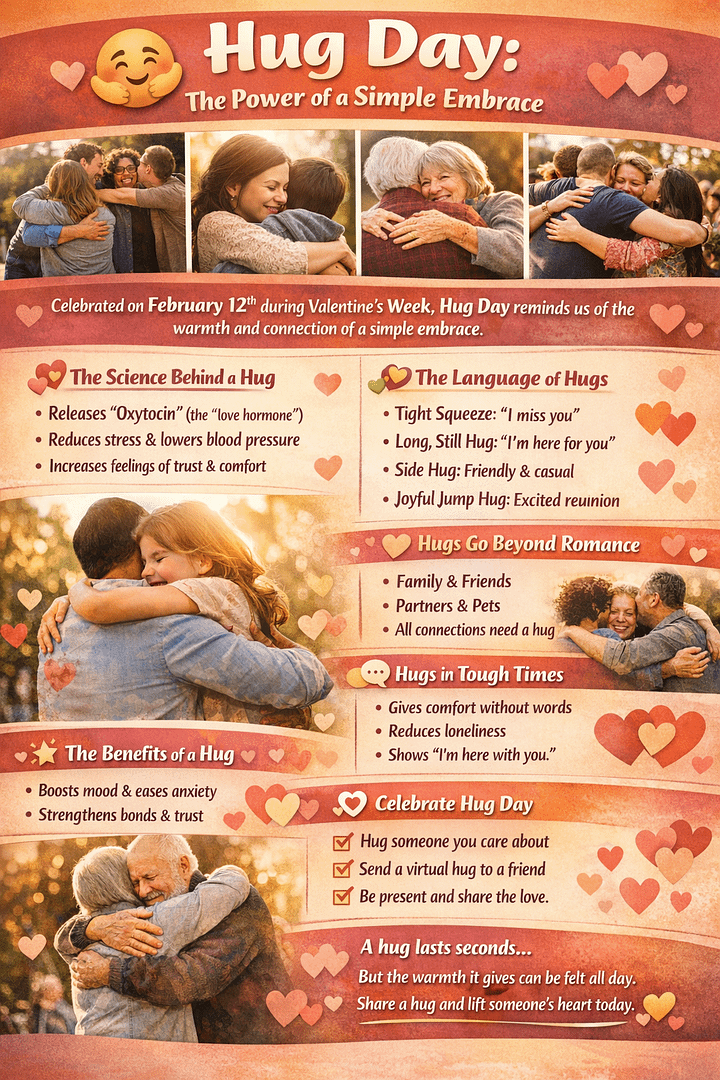
    In a world full of texts, notifications, and quick conversations, Hug Day gently reminds us of something deeply human — the need for real, heartfelt connection. Celebrated on February 12 as part of Valentine’s Week, this day honors one of the simplest yet most powerful gestures we can offer: a hug.

    A hug doesn’t require perfect words. It doesn’t need explanations. It’s a silent way of saying, I’m here. You matter. You’re not alone.

    💞 The Science Behind a Hug

    A genuine embrace does more than warm the heart — it changes the body and mind.

    When you hug someone:

    The brain releases oxytocin, often called the bonding hormone

    Stress hormones like cortisol decrease

    Heart rate and blood pressure can lower

    Feelings of trust and emotional safety increase

    This is why a hug during tough moments can feel like instant relief. It signals the nervous system that you are safe. That comfort is real, physical, and emotional all at once.

    The Language of Different Hugs

    Not every hug says the same thing. Each style carries its own meaning:

    The Tight Squeeze
    Overflowing emotion — love, relief, or deep affection.

    The Long, Still Hug
    Support during grief, stress, or emotional overwhelm. It says, Lean on me.

    The Side Hug
    Friendly, casual comfort — a sign of trust and familiarity.

    The Back Hug
    Protection and closeness, often shared between partners.

    The Joyful Jump Hug
    Pure excitement and happiness — the kind you see at reunions.

    A hug can communicate feelings we struggle to express with words.

    🌍 Hugs Go Beyond Romance

    Hug Day is often associated with couples, but its meaning is much bigger. Hugs strengthen every kind of relationship:

    Parents and children — security and unconditional love

    Friends — loyalty and emotional support

    Grandparents — warmth and reassurance

    Partners — intimacy and connection

    Even pets — comfort and calm

    In every case, a hug reinforces belonging — a fundamental human need.

    💬 Why Hugs Matter in Difficult Times

    When someone is hurting, advice can feel overwhelming. Words may fail. But a hug:

    offers comfort without pressure

    reduces feelings of isolation

    communicates empathy

    creates a sense of stability

    Sometimes the most healing response is not “I understand,” but simply being there.

    🌟 Emotional Benefits That Last

    Regular positive physical contact can:

    improve mood

    reduce anxiety

    strengthen bonds

    build emotional resilience

    foster compassion and trust

    In a time when many people feel disconnected, a hug is a powerful reminder that human warmth still matters.

    🤍 Celebrating Hug Day Meaningfully

    Want to make Hug Day special? Try these:

    ✔ Hug someone you’ve been meaning to reconnect with
    ✔ Offer a longer, more present hug instead of a quick one
    ✔ Comfort someone going through a tough time
    ✔ Send a message with a virtual hug if distance separates you
    ✔ Practice self-compassion — wrap your arms around yourself and breathe

    Even the smallest embrace can brighten someone’s entire day.

    ❤️ Final Thought

    A hug lasts seconds.
    The feeling of being cared for can last much longer.

    Hug Day reminds us that love isn’t always loud. Sometimes it’s quiet, gentle, and wrapped in two arms that say everything without speaking at all.

    So today, don’t hold back. Share a hug. You never know whose day — or heart — you might lift. 🤗

    Read More Holidays & National Days
  • National Shut-In Visitation Day: The Gift of Showing Up

    Advertisements

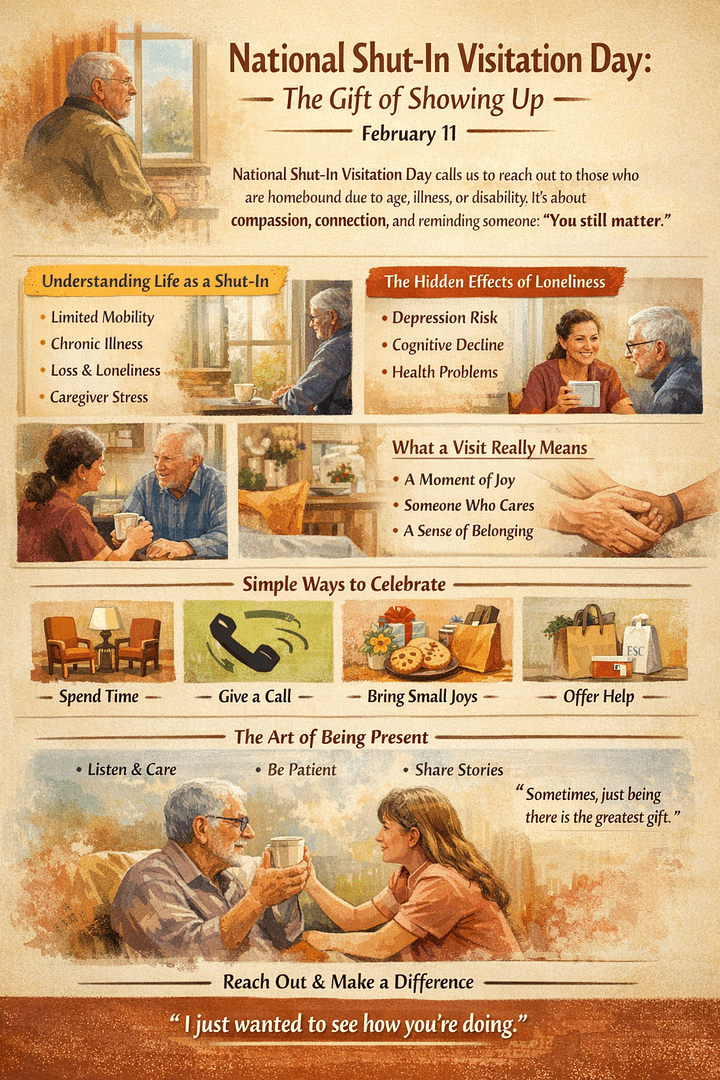
    National Shut-In Visitation Day, observed on February 11, shines a light on people the world too often grows quiet around. It calls us to notice those who are homebound and to act with intention, compassion, and presence. At its heart, this day is not about charity — it’s about human connection.

    In a world that moves fast, shut-ins live in stillness. And while stillness can be peaceful, unwanted isolation can feel heavy.

    Understanding Life as a Shut-In

    Being homebound isn’t simply “staying home.” It often means:

    Physical pain that limits mobility

    Chronic illness or disability

    Lack of transportation

    Mental health struggles like anxiety or depression

    Grief after losing a spouse or loved ones

    Caregiving responsibilities that make leaving difficult

    Over time, social circles shrink. Friends move, family gets busy, and invitations stop coming — not out of cruelty, but forgetfulness. Days become quiet. The phone doesn’t ring as much. The outside world starts to feel far away.

    This is where visitation becomes powerful. It restores a sense of belonging.

    The Hidden Effects of Loneliness

    Loneliness isn’t just emotional — it impacts overall health. Studies consistently link social isolation to:

    Increased risk of depression

    Cognitive decline in older adults

    Higher stress levels

    Poorer physical health outcomes

    A visit provides more than company. It stimulates the mind, lifts the spirit, and reminds someone they are part of the world, not outside of it.

    What a Visit Really Means

    You might think, “What difference can I make in one visit?”
    More than you know.

    For someone who rarely sees others, your visit becomes:

    The highlight of their week

    A reminder that they are remembered

    A chance to laugh or share memories

    A moment of normalcy

    You’re not just filling time — you’re giving dignity, recognition, and emotional warmth.

    Simple Ways to Celebrate the Day

    You don’t need training or special skills. You just need heart.

    💬 Spend Time

    Sit together. Talk about everyday things — the weather, memories, hobbies, family stories. Familiar conversation is comforting.

    ☎️ Call if You Can’t Visit

    A phone call still brings connection. Hearing a friendly voice can brighten an entire day.

    🎁 Bring Small Joys

    Homemade treats

    A favorite magazine

    A puzzle book

    Photos or drawings from children

    A handwritten note

    These small gestures show thoughtfulness.

    🧹 Offer Gentle Help

    Ask if they need anything from the store, help organizing mail, or assistance with a small task. Practical support reduces stress.

    The Art of Being Present

    You don’t have to entertain or impress. The greatest gift is attention.

    Listen more than you speak

    Make eye contact

    Avoid rushing

    Let silence be comfortable

    Many shut-ins carry stories no one has asked to hear in years. When someone listens, it brings a sense of purpose and value.

    Why This Day Matters More Than Ever

    Modern life is connected digitally but disconnected personally. National Shut-In Visitation Day reminds us that real presence still matters. A message online can’t replace sitting beside someone and sharing a moment.

    As communities grow busier, intentional kindness becomes even more meaningful.

    The Ripple Effect of Kindness

    Visiting someone doesn’t just change their day — it changes yours too. People often leave visits feeling:

    More grateful

    More compassionate

    More aware of what truly matters

    Connection feeds both souls.

    A Community That Remembers Everyone

    A strong community is measured by how it treats those who can’t easily participate in everyday life. When we remember the homebound, we build a culture of care.

    National Shut-In Visitation Day reminds us:
    No one should fade into the background of life.

    Sometimes love looks like nothing more than a knock on the door and the words,
    “I just wanted to see how you’re doing.”

    Read More Holidays & National Days
  • I Am Me: The Power of Self-Acceptance in an Imperfect World

    Advertisements

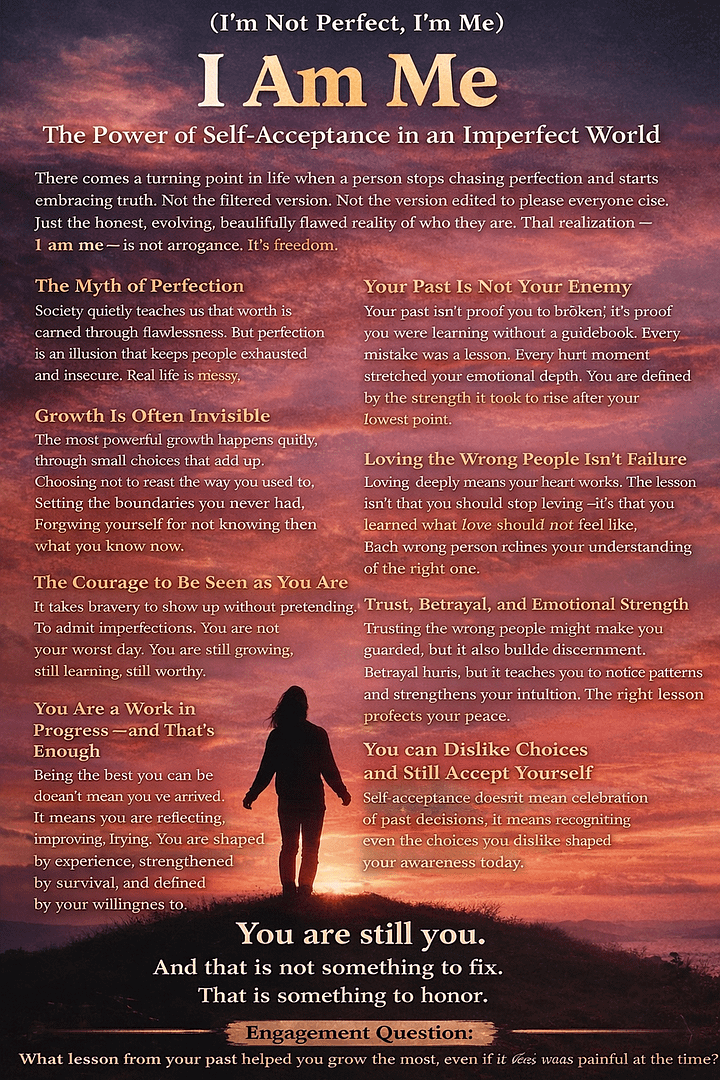
    There comes a turning point in life when a person stops chasing perfection and starts embracing truth. Not the filtered version. Not the version edited to please everyone else. Just the honest, evolving, beautifully flawed reality of who they are. That realization — I am me — is not arrogance. It’s freedom.

    The Myth of Perfection

    Society quietly teaches us that worth is earned through flawlessness. Perfect appearance. Perfect decisions. Perfect relationships. Perfect life. But perfection is an illusion that keeps people exhausted and insecure.

    Real life is messy. People make mistakes, change paths, outgrow relationships, and learn lessons the hard way. Trying to present a polished version of yourself all the time is like holding your breath emotionally — eventually, you burn out.

    Self-acceptance begins when we stop performing and start being.

    Your Past Is Not Your Enemy

    Many people carry silent shame about past decisions. The wrong relationship. The opportunity missed. The words spoken in anger. The trust given to someone who didn’t deserve it. These memories can feel like weights tied to the soul.

    But your past isn’t proof that you’re broken. It’s proof that you were learning without a guidebook. Every mistake was a lesson in disguise. Every failure sharpened your awareness. Every hurt moment stretched your emotional depth.

    You are not defined by your lowest point — you are defined by the strength it took to rise after it.

    Growth Is Often Invisible

    People think growth looks dramatic — a big transformation, a huge success, a clear turning point. But most growth happens quietly:

    Choosing not to react the way you used to

    Walking away from what once felt impossible to leave

    Saying “no” without guilt

    Setting boundaries where there were none

    Forgiving yourself for not knowing then what you know now

    That’s progress. That’s evolution. That’s becoming.

    Loving the Wrong People Isn’t Failure

    One of the most painful human experiences is loving someone who wasn’t right for you. It can leave people questioning their judgment, worth, and ability to choose well.

    But loving deeply is never a mistake. It means your heart works. It means you’re capable of connection. It means you showed up with sincerity. The lesson isn’t that you should stop loving — it’s that you learned what love should not feel like.

    Each wrong person refines your understanding of the right one.

    Trust, Betrayal, and Emotional Strength

    Trusting the wrong people can make someone guarded. But it also builds emotional intelligence. You begin to notice patterns. Red flags become clearer. Your intuition gets stronger.

    Betrayal hurts, but it teaches discernment — and discernment protects peace.

    You Can Dislike Choices and Still Accept Yourself

    Self-acceptance doesn’t mean celebrating every past decision. It means recognizing that even the parts you wish were different played a role in shaping your awareness today.

    There is a difference between:

    Guilt that traps you, and

    Reflection that transforms you

    One keeps you stuck. The other moves you forward.

    “I Wouldn’t Change a Thing” — A Statement of Growth

    When someone says they wouldn’t change their past, it doesn’t mean they enjoyed every moment. It means they understand the connection between struggle and strength. Remove the pain, and you also remove the wisdom. Remove the heartbreak, and you lose the emotional depth. Remove the failures, and you erase the resilience.

    Your journey carved your character.

    The Courage to Be Seen as You Are

    It takes bravery to show up without pretending. To admit imperfections. To stop shrinking for approval. To say, “This is me — still growing, still learning, still worthy.”

    The right people don’t require a flawless version of you. They appreciate authenticity, honesty, and effort.

    You Are a Work in Progress — and That’s Enough

    Being the “best you can be” doesn’t mean you’ve arrived. It means you are trying. Reflecting. Improving. Choosing better when you know better. That ongoing commitment to growth is what truly matters.

    You are not your worst mistake.
    You are not your hardest day.
    You are not the people who misunderstood you.

    You are a person shaped by experience, strengthened by survival, and defined by your willingness to keep going.

    The Quiet Power of Self-Worth

    When you finally accept yourself, something shifts. You stop begging to be understood by those determined to misunderstand you. You stop chasing validation from people who never planned to give it. You stop apologizing for existing.

    And in that moment, confidence isn’t loud. It’s calm. It’s steady. It’s unshaken by outside opinions.

    Because at the end of everything — after the mistakes, the love, the losses, the lessons — one truth remains:

    You are still you.
    And that is not something to fix.
    That is something to honor.

    Read More Of Inspiration & Motivation

Exit mobile version