
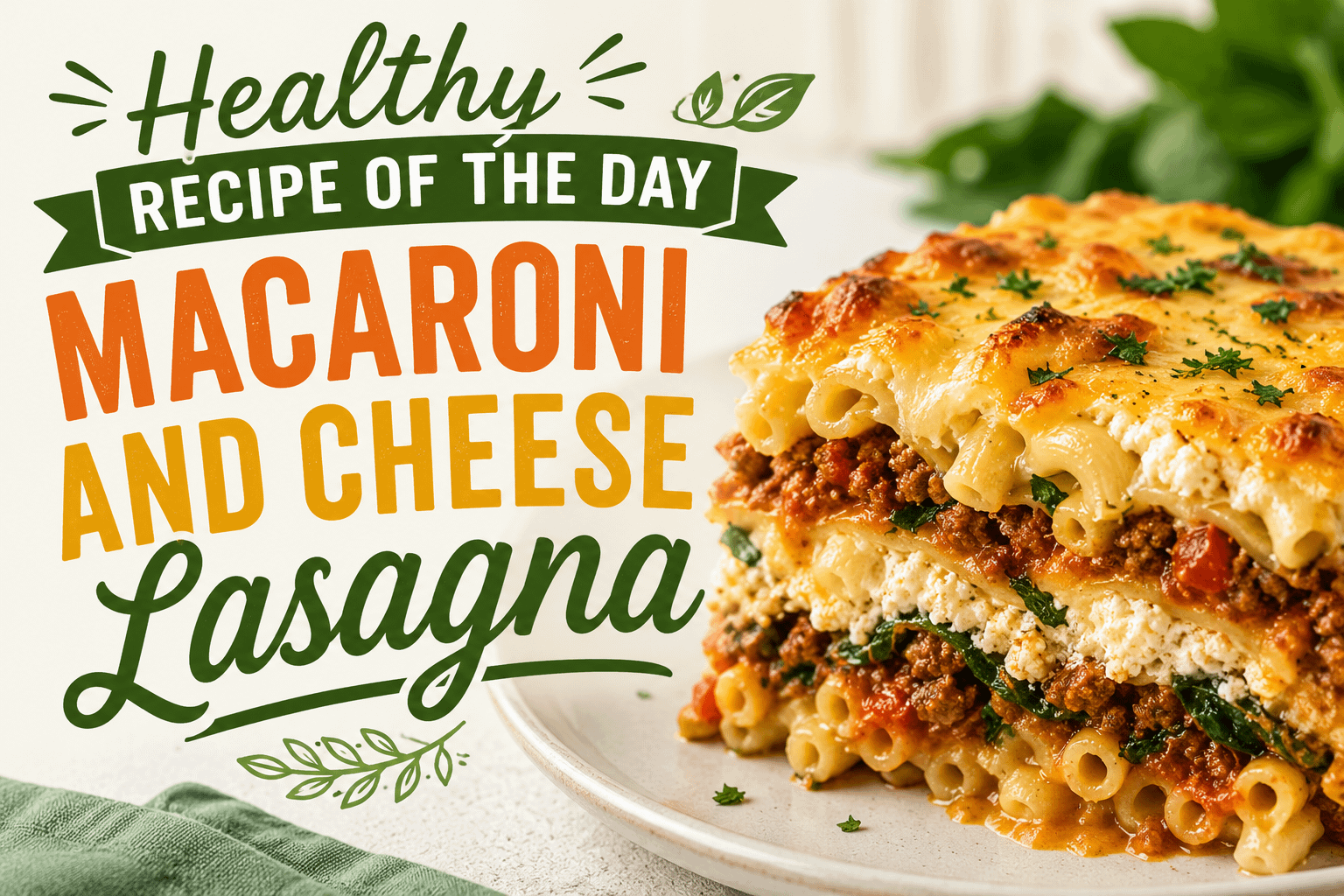
Comfort food has a way of bringing people together. Few dishes prove that better than creamy macaroni and cheese or a bubbling pan of homemade lasagna. Both are warm, filling, cheesy, and perfect for a family dinner. But what happens when you combine the best parts of these two classics while making a few healthier ingredient choices?
You get today’s Healthy Recipe of the Day: Macaroni and Cheese Lasagna.
This creative casserole combines tender macaroni, a flavorful lean meat and tomato sauce, creamy cheese, and layers of vegetables. Instead of trying to turn comfort food into something completely different, this recipe focuses on balance. You still get the cheesy, satisfying experience you expect from macaroni and cheese lasagna, but with more vegetables, protein, and opportunities to use whole-grain and reduced-fat ingredients.
It is a great example of how healthier eating doesn’t always have to mean salads, smoothies, or giving up your favorite foods. Sometimes it simply means taking something you already love and finding ways to make it more nutritious.
Two Comfort-Food Favorites in One Dish
Traditional lasagna usually starts with wide pasta noodles layered with meat sauce, ricotta, mozzarella, and other cheeses. Macaroni and cheese takes a different approach, coating smaller pasta in a rich cheese sauce.
Macaroni and cheese lasagna borrows from both.
Instead of lasagna noodles, elbow macaroni becomes the pasta base. The macaroni is combined with a creamy cheese mixture and layered with a tomato-based meat sauce. Spinach and zucchini add vegetables without taking away from the comforting character of the dish.
The finished casserole has distinct layers, plenty of flavor, and a golden melted-cheese topping.
It is especially useful when you want something hearty enough for the entire family but would also like to sneak a few extra vegetables onto everyone’s plates.
Ingredients
For the Macaroni Layer
- 12 ounces whole-wheat elbow macaroni
- 1 tablespoon olive oil
- 2 cups low-fat milk
- 2 tablespoons whole-wheat flour
- 1 1/2 cups reduced-fat shredded sharp cheddar cheese
- 1/4 cup grated Parmesan cheese
- 1/2 teaspoon garlic powder
- 1/2 teaspoon onion powder
- 1/4 teaspoon black pepper
- Pinch of salt, if desired
For the Meat and Tomato Layer
- 1 pound lean ground turkey or extra-lean ground beef
- 1 small onion, diced
- 2 cloves garlic, minced
- 1 medium zucchini, finely diced
- 2 cups fresh baby spinach, chopped
- 1 can (15 ounces) no-salt-added tomato sauce
- 1 can (14.5 ounces) no-salt-added diced tomatoes, drained
- 1 teaspoon Italian seasoning
- 1/2 teaspoon dried basil
- 1/2 teaspoon dried oregano
- Black pepper to taste
For the Cheese Layer
- 1 cup part-skim ricotta cheese
- 1 large egg
- 1/4 cup grated Parmesan cheese
- 1 teaspoon Italian seasoning
- 1 cup shredded part-skim mozzarella cheese, divided
Directions
Step 1: Preheat the Oven
Preheat your oven to 375°F.
Lightly coat a 9-by-13-inch baking dish with cooking spray or a very small amount of olive oil.
Setting up your baking dish before assembling the casserole makes the layering process much easier.
Step 2: Cook the Macaroni
Bring a large pot of water to a boil and cook the whole-wheat macaroni according to the package directions.
Cook it until just al dente rather than completely soft. The pasta will continue cooking while the casserole is in the oven, so slightly firm macaroni helps prevent the finished dish from becoming mushy.
Drain the macaroni and set it aside.
Step 3: Prepare the Meat Sauce
Heat a large skillet over medium heat.
Add the ground turkey or extra-lean ground beef and diced onion. Cook until the meat is browned and the onion has softened, breaking the meat into small pieces as it cooks.
Drain excess fat if necessary.
Add the minced garlic and diced zucchini. Continue cooking for approximately 3 to 5 minutes.
Stir in the chopped spinach. It may look like a lot at first, but spinach cooks down quickly.
Once the spinach has wilted, add the tomato sauce, diced tomatoes, Italian seasoning, basil, oregano, and black pepper.
Reduce the heat and allow the sauce to simmer for approximately 10 minutes.
This short simmer gives the flavors time to come together while some of the excess moisture evaporates.
Step 4: Make the Lighter Cheese Sauce
In a medium saucepan, heat the olive oil over medium-low heat.
Whisk in the flour and cook for approximately one minute.
Slowly pour in the milk while whisking continuously. Continue stirring until the mixture begins to thicken.
Reduce the heat to low.
Add the cheddar cheese and Parmesan, stirring until the cheese has completely melted and the sauce is smooth.
Season with garlic powder, onion powder, black pepper, and a small pinch of salt if desired.
Remove the saucepan from the heat.
Add the cooked macaroni and gently stir until every piece is coated with the cheese sauce.
You now have the macaroni-and-cheese portion of the casserole.
Step 5: Prepare the Ricotta Mixture
In a small bowl, combine the ricotta cheese, egg, Parmesan cheese, and Italian seasoning.
Stir until smooth and evenly combined.
The ricotta layer gives the casserole more of the creamy texture associated with traditional lasagna.
Step 6: Assemble the Macaroni and Cheese Lasagna
Spread a thin layer of the meat and tomato sauce across the bottom of your prepared baking dish.
Add approximately half of the macaroni and cheese.
Spread half of the remaining meat sauce over the macaroni.
Spoon the ricotta mixture over the sauce and gently spread it into an even layer.
Sprinkle approximately half of the mozzarella over the ricotta.
Add the remaining macaroni and cheese.
Top with the remaining meat sauce and finish with the remaining mozzarella.
If desired, sprinkle a little additional Parmesan or Italian seasoning across the top.
Step 7: Bake
Cover the baking dish loosely with aluminum foil.
Bake for approximately 20 minutes.
Remove the foil and continue baking for another 10 to 15 minutes, or until the casserole is bubbling around the edges and the cheese on top is melted and lightly golden.
For a slightly more browned top, you can place the casserole under the broiler briefly at the end. Watch it carefully because cheese can go from golden to burned very quickly.
Step 8: Let It Rest
Remove the macaroni and cheese lasagna from the oven and allow it to rest for approximately 10 minutes before serving.
This is an important step.
Just like traditional lasagna, the casserole needs a few minutes to settle. Cutting into it immediately can cause the layers to fall apart.
Once rested, scoop it onto plates and enjoy.
Why This Version Is a Healthier Choice
Calling something “healthy” doesn’t mean every ingredient has to be low-fat, low-carbohydrate, or low-calorie. A more practical approach is to look at the entire meal.
This recipe includes several ingredients that can improve its nutritional balance.
Whole-wheat pasta provides more fiber than many traditional refined pasta options. Fiber can also help make a meal feel more satisfying.
Lean ground turkey or extra-lean beef supplies protein while helping limit the amount of saturated fat compared with higher-fat ground meats.
Spinach and zucchini add vegetables directly to the casserole. They provide nutrients and volume while blending naturally with the tomato sauce.
Part-skim and reduced-fat cheeses help preserve the creamy, cheesy character of the recipe without relying entirely on full-fat cheese.
No-salt-added tomato products give you more control over the sodium in the finished dish.
None of these changes require sacrificing the basic experience of eating a comforting pasta casserole.
Don’t Be Afraid of Cheese
Cheese sometimes gets automatically placed in the “unhealthy” category, but nutrition is more complicated than labeling individual foods good or bad.
Cheese provides protein and calcium, and it can add tremendous flavor to a dish. Because cheese is flavorful, you don’t necessarily need enormous quantities to make a meal satisfying.
One helpful strategy is choosing stronger-flavored cheeses.
Sharp cheddar and Parmesan are excellent examples. Their stronger flavors mean smaller quantities can still make a noticeable difference.
Rather than removing cheese from macaroni and cheese lasagna—which would defeat much of the purpose of the dish—we’re using it thoughtfully.
Add Even More Vegetables
One of the easiest ways to customize this casserole is to increase the vegetables.
The zucchini and spinach in the original recipe work especially well because their flavors blend easily with tomato sauce and cheese. However, plenty of other vegetables can work.
Try adding:
- Mushrooms
- Bell peppers
- Broccoli
- Cauliflower
- Carrots
- Yellow squash
- Eggplant
- Kale
Finely chopping vegetables can be especially helpful when serving people who aren’t enthusiastic vegetable eaters.
Mushrooms are particularly good in this recipe because their texture complements ground meat. You could even replace a portion of the ground meat with finely chopped mushrooms.
Make It Vegetarian
You don’t need meat to enjoy macaroni and cheese lasagna.
For a vegetarian version, simply leave out the ground turkey or beef.
Replace it with sautéed mushrooms, lentils, chopped vegetables, or a combination of all three.
Lentils are particularly useful because they add plant-based protein and fiber while maintaining the hearty texture expected from a lasagna-style casserole.
A combination of mushrooms, zucchini, spinach, and lentils creates an incredibly satisfying meatless version.
Turn Up the Protein
If protein is one of your nutritional priorities, there are several easy ways to increase it.
Choose a higher-protein or legume-based pasta instead of regular macaroni. Chickpea and lentil pastas can provide considerably more protein and fiber than traditional refined pasta.
You can also increase the lean ground turkey slightly or add additional ricotta.
Another option is replacing some of the ricotta with low-fat cottage cheese.
Cottage cheese blends surprisingly well into baked pasta dishes and provides plenty of protein.
Control Your Portions
Macaroni and cheese lasagna is filling.
That is actually an advantage when you’re trying to build a satisfying meal.
Rather than filling an entire dinner plate with the casserole, serve a moderate portion alongside vegetables.
A large green salad is one of the easiest choices.
You could also serve it with roasted broccoli, steamed green beans, asparagus, Brussels sprouts, or roasted cauliflower.
This creates a plate where you still enjoy the rich comfort food while vegetables take up a substantial portion of the meal.
Meal Prep Made Easy
Another reason to love this healthy macaroni and cheese lasagna is how well it works for meal preparation.
Make the entire casserole on Sunday and divide leftovers into individual containers.
You’ll have ready-to-reheat lunches or dinners for several days.
Individual portions can be reheated in the microwave or oven.
If the macaroni seems slightly dry after refrigeration, add a tiny splash of milk or tomato sauce before reheating.
Can You Freeze Macaroni and Cheese Lasagna?
Yes.
This recipe can be frozen either before or after baking.
If freezing the entire unbaked casserole, assemble it in a freezer-safe baking dish, cover tightly, and freeze.
For easier weekday meals, however, consider freezing individual cooked portions.
Allow the casserole to cool completely, divide it into freezer-safe containers, label them with the date, and freeze.
When you need an easy meal, thaw a portion overnight in the refrigerator and reheat it thoroughly.
Having homemade meals waiting in the freezer can make healthier eating much easier on busy evenings.
Make It Ahead for Busy Nights
You can assemble the entire casserole earlier in the day or the night before.
Cover the baking dish and refrigerate it until you’re ready to cook.
Because the casserole will be cold when it goes into the oven, you may need to increase the baking time slightly.
This makes macaroni and cheese lasagna a great option for busy families.
Do the preparation when you have time, and dinner becomes mostly hands-off later.
Ways to Change the Flavor
The basic recipe is extremely flexible.
For a little heat, add crushed red pepper flakes or diced jalapeños to the meat sauce.
For additional Italian flavor, increase the basil and oregano and add fresh parsley.
If you love garlic, add an extra clove or two.
You could also replace some of the mozzarella with provolone.
For a smoky flavor, add smoked paprika to the meat sauce.
Just remember that healthier cooking doesn’t have to mean bland cooking. Herbs, spices, garlic, onions, peppers, and other aromatics can provide enormous flavor without requiring heavy sauces.
What to Serve With Macaroni and Cheese Lasagna
Because the casserole already contains pasta, meat, vegetables, tomato sauce, and cheese, you don’t need many side dishes.
Keep the rest of dinner simple.
Try serving it with:
A large garden salad: Mixed greens, tomatoes, cucumbers, carrots, and a light vinaigrette create a refreshing contrast to the warm casserole.
Roasted broccoli: Broccoli becomes slightly crispy and sweeter when roasted, making it an excellent companion to cheesy pasta.
Garlic green beans: Sauté green beans with a small amount of olive oil, garlic, and black pepper.
Roasted asparagus: A little lemon juice adds brightness that complements the rich cheese.
Steamed vegetables: When time is limited, even a simple bag of steamed mixed vegetables works.
You don’t need an elaborate side dish. The goal is simply to add more vegetables and balance the plate.
A Family-Friendly Dinner
One challenge of trying to eat healthier is preparing meals everyone wants to eat.
Making one “healthy” meal for yourself and another meal for everyone else isn’t practical for most households.
Recipes like this can help bridge that gap.
Children and adults who love macaroni and cheese immediately recognize something familiar. Lasagna lovers get tomato sauce, ricotta, mozzarella, and Italian seasonings.
Meanwhile, the cook can incorporate whole grains, lean protein, spinach, zucchini, and other vegetables.
It doesn’t feel like a special diet meal.
It simply feels like dinner.
Healthy Eating Can Still Include Comfort Food
One of the biggest misconceptions about healthier eating is that comfort food has to disappear.
It doesn’t.
A sustainable approach to eating should have room for foods you genuinely enjoy.
The goal can be to improve the nutritional quality of your favorite recipes rather than eliminating them.
Choose whole grains more often.
Use leaner proteins.
Add vegetables wherever they naturally fit.
Watch portions of ingredients that are easy to overdo.
Use herbs and spices generously.
Pair richer foods with vegetables and other nutrient-dense sides.
These small decisions can add up over time.
A bowl of macaroni and cheese isn’t automatically a nutritional failure, just as eating one salad doesn’t automatically create a healthy diet. Overall eating patterns matter.
Today’s recipe demonstrates how those ideas can work in the real world.
Leftover Lunch Idea
Don’t just reheat your leftovers exactly the same way.
Turn a serving of macaroni and cheese lasagna into a completely different lunch.
Heat a smaller portion and serve it over a bowl of baby spinach or mixed greens. Add chopped tomatoes, cucumbers, and bell peppers alongside it.
You still get the warm, cheesy pasta you love, but the overall meal includes a generous amount of fresh produce.
It’s an easy way to stretch leftovers while changing the meal enough that it doesn’t feel like you’re eating the same thing repeatedly.
Cooking Tips for the Best Results
Don’t overcook your macaroni before assembling the casserole. Al dente pasta holds up better during baking.
Drain watery vegetables well. Excess moisture can make the finished casserole runny.
Allow the meat sauce to simmer before assembling the dish. A slightly thicker sauce creates better layers.
Use freshly shredded cheese when possible. It generally melts more smoothly than some pre-shredded varieties.
Let the finished casserole rest before serving. Those 10 minutes make a noticeable difference in texture.
Taste the sauce before assembling everything. This gives you an opportunity to adjust herbs, garlic, pepper, or other seasonings.
Most importantly, customize the recipe.
Cooking at home gives you control over what goes into your food. Take advantage of it.
A New Kind of Comfort Food
Healthy Recipe of the Day: Macaroni and Cheese Lasagna proves that a comforting family dinner can also include thoughtful nutritional choices.
You get creamy macaroni and cheese.
You get hearty lasagna-style meat sauce.
You get ricotta, mozzarella, and Parmesan.
But you also get whole-grain pasta, lean protein, spinach, zucchini, tomatoes, and plenty of opportunities to add even more vegetables.
It’s cheesy without needing to be overloaded with cheese. It’s hearty without requiring extremely fatty meat. And it’s satisfying enough that you won’t feel like you’re eating a watered-down version of the food you really wanted.
Serve it fresh from the oven with a big salad or roasted vegetables, save the leftovers for tomorrow’s lunch, or freeze individual portions for another day.
Healthy eating doesn’t have to mean saying goodbye to comfort food.
Sometimes it simply means giving an old favorite a healthier twist.
Would you try this healthier macaroni and cheese lasagna, and what vegetables would you add to yours?
Leave a ReplyCancel reply