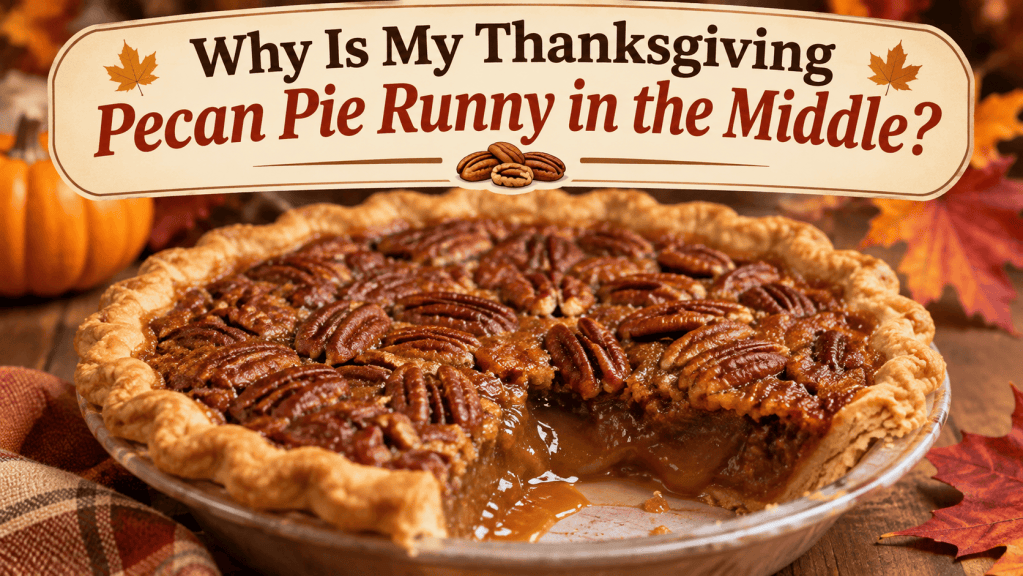
Thanksgiving pecan pie is one of those classic holiday desserts that everyone looks forward to. With its buttery crust, sweet caramel-like filling, and crunchy pecans, it is the perfect way to finish a Thanksgiving dinner. But nothing is more disappointing than cutting into a beautiful pecan pie only to discover that the middle is runny, sticky, or completely liquid.
If your Thanksgiving pecan pie is runny in the middle, you are not alone. This is one of the most common problems home bakers experience when making pecan pie, especially during the busy holiday season.
The good news is that a runny pecan pie does not always mean your dessert is ruined. In many cases, the problem comes down to baking time, oven temperature, ingredient measurements, or simply not allowing the pie enough time to cool.
Understanding why pecan pie becomes runny can help you fix the problem and prevent it from happening again.
Why Does Thanksgiving Pecan Pie Turn Out Runny?
The most common reason pecan pie turns out runny is that the filling has not cooked long enough to set properly.
Unlike fruit pies, which often rely on flour or cornstarch to thicken their filling, traditional pecan pie depends primarily on eggs to create its custard-like structure.
As the pie bakes, the eggs gradually coagulate, helping the sugar and syrup mixture transform into a thick, sliceable filling.
If the filling does not reach the proper temperature, it may remain liquid even when the crust and pecans appear perfectly cooked.
Several factors can contribute to this problem, including:
-
Not baking the pie long enough.
-
Using an oven temperature that is too low.
-
Adding too much corn syrup or other liquid ingredients.
-
Not using enough eggs.
-
Removing the pie before the center has set.
-
Cutting the pie before it has cooled completely.
-
Using a pie dish that changes the baking time.
The key to making a successful Thanksgiving pecan pie is understanding how these factors affect the filling.
1. Your Pecan Pie Is Undercooked
Undercooking is the number one reason Thanksgiving pecan pie remains runny in the middle.
Pecan pie can be deceptive because the top often looks finished before the center has fully cooked.
The pecans may appear golden brown, the crust may look crisp, and the filling around the edges may seem firm. However, the center can still be too soft.
How to Tell If Pecan Pie Is Undercooked
Gently shake the pie dish while it is still in the oven.
A properly baked pecan pie should have a slight wobble in the center, similar to a set custard.
If the middle moves like liquid or creates noticeable waves, the filling needs additional baking time.
The outer portion of the filling should remain relatively stable while the center moves slightly.
How to Fix It
If your pie is still in the oven, continue baking it in five-minute increments.
Check the center after each interval.
If the crust begins browning too quickly, cover the edges loosely with aluminum foil or a pie shield.
Avoid increasing the oven temperature dramatically because this can burn the crust before the filling finishes cooking.
2. Your Oven Temperature Is Too Low
Oven temperature plays an important role in helping pecan pie filling set.
Most traditional pecan pie recipes bake at approximately 350°F, although some begin at a higher temperature before reducing the heat.
If your oven runs cooler than the temperature displayed, the filling may not reach the heat necessary to set properly.
This problem is especially common during Thanksgiving when the oven is frequently opened or several dishes are being cooked at once.
Why Oven Temperature Matters
The eggs in pecan pie need sufficient heat to create the filling’s structure.
When the oven temperature is too low, the pie may take much longer to bake than the recipe suggests.
The crust can also become overbaked while the center remains soft.
How to Prevent This Problem
Use an oven thermometer to confirm that your oven is heating accurately.
Preheat the oven completely before placing the pie inside.
Try not to open the oven door repeatedly during baking.
If you are preparing multiple Thanksgiving dishes, avoid overcrowding the oven because this can interfere with proper heat circulation.
3. You Added Too Much Corn Syrup
Corn syrup is a traditional ingredient in pecan pie because it contributes sweetness, moisture, and the filling’s characteristic texture.
However, adding too much corn syrup can affect how firmly the filling sets.
If the ratio of syrup to eggs is incorrect, the filling may remain overly soft.
Common Measuring Mistakes
One common mistake is measuring liquid ingredients without using the correct measuring equipment.
Another is adding extra syrup because the filling does not initially look thick enough.
Remember that pecan pie filling is supposed to be liquid before baking.
It thickens as the eggs cook and the pie cools.
How to Avoid It
Measure corn syrup carefully using a liquid measuring cup.
Follow the recipe’s ingredient proportions rather than estimating.
If substituting maple syrup, honey, or another sweetener, use a recipe specifically developed for that ingredient because different sweeteners contain different amounts of water and sugar.
4. Your Pecan Pie Does Not Have Enough Eggs
Eggs are one of the most important ingredients in traditional pecan pie.
They help transform the sweet liquid filling into a firm, custard-like consistency.
Without enough eggs, the filling may not develop the structure necessary to hold together when sliced.
Why Eggs Are Important
As the pie bakes, the proteins in the eggs gradually firm up.
These proteins create a network that helps hold the syrup, sugar, butter, and other ingredients together.
If too few eggs are used, the filling may remain loose.
How to Prevent This Problem
Follow the recipe’s egg measurements carefully.
Most traditional nine-inch pecan pie recipes use approximately three large eggs, although the exact amount depends on the other ingredients.
Avoid substituting smaller eggs without accounting for the difference.
When possible, use large eggs if that is what your recipe specifies.
5. You Did Not Let the Pecan Pie Cool Long Enough
One of the biggest mistakes people make with Thanksgiving pecan pie is slicing it too soon.
Even when a pecan pie is fully baked, the filling may still appear soft when it first comes out of the oven.
This is normal.
Pecan pie continues to firm as it cools.
How Long Should Pecan Pie Cool?
Allow your pecan pie to cool on a wire rack for at least three to four hours before slicing.
During this time, the filling gradually becomes firmer and easier to cut.
If you slice the pie while it is still hot, the filling may spill out even though it was baked properly.
Can You Refrigerate Pecan Pie to Help It Set?
Yes.
After the pie has cooled, refrigerating it can help the filling become firmer.
However, refrigeration cannot fully correct a filling that was significantly undercooked.
If the eggs never reached the temperature needed to set, chilling alone will not create the same texture as proper baking.
For food safety, refrigerate pecan pie within two hours after removing it from the oven.
6. Your Pie Dish May Be Affecting the Baking Time
Not all pie dishes bake the same way.
Glass, ceramic, and metal pie dishes conduct heat differently, which can affect how quickly the crust and filling cook.
Glass Pie Dishes
Glass heats more slowly than some metal pans but retains heat well.
A glass dish may require adjustments to baking time depending on the recipe.
Ceramic Pie Dishes
Ceramic dishes can take longer to heat thoroughly.
This may cause the center of the pie to cook more slowly.
Metal Pie Pans
Metal pans generally transfer heat efficiently, helping the crust bake more quickly.
The important thing is to follow the recipe’s instructions while checking the actual doneness of the filling.
Do not rely entirely on the suggested baking time.
7. Your Pecan Pie Filling Is Too Deep
A deep-dish pecan pie contains more filling than a standard pie.
That extra filling requires additional baking time.
If you use a deep-dish pie plate with a recipe designed for a regular nine-inch pie, the center may remain undercooked.
A thicker filling takes longer to heat all the way through.
How to Prevent It
Use the pie dish size recommended in your recipe.
If making a deep-dish pecan pie, choose a recipe specifically developed for that size.
Expect the baking time to be longer, and check the filling carefully before removing the pie from the oven.
What Temperature Should Pecan Pie Be in the Middle?
One of the most reliable ways to determine whether your Thanksgiving pecan pie is finished is to check the internal temperature.
TARGET CENTER TEMPERATURE
200°F (93°C)
A useful doneness target for traditional pecan pie filling.
Insert an instant-read thermometer into the center of the filling, avoiding large pecan pieces and the bottom of the pan.
At approximately 200°F, a traditional pecan pie filling should be sufficiently cooked to set as it cools.
Because recipes vary, follow any specific temperature instructions provided by your recipe.
Using a thermometer is especially helpful when baking several Thanksgiving desserts because it removes much of the guesswork.
Can You Fix a Runny Pecan Pie After Baking?
Sometimes you can fix a runny pecan pie after it has been removed from the oven.
The best solution depends on whether the pie is still warm, has already cooled, or has been refrigerated.
If the Pie Is Still Warm
If you recently removed the pie from the oven and discover that the center is obviously liquid, you may be able to return it to the oven.
Place the pie back into a preheated 325°F to 350°F oven.
Cover the crust edges if necessary.
Continue baking until the filling reaches the appropriate internal temperature and the center is no longer liquid.
If the Pie Has Already Cooled
If the pie has cooled completely but the center remains runny, additional baking may not produce an ideal result.
Rebaking can sometimes help, but the crust may become overly brown and the filling may develop an uneven texture.
If the pie has been stored safely and the filling is only slightly soft, chilling may improve its sliceability.
If the filling is substantially undercooked, especially if it has been sitting at room temperature for more than two hours, it is safer to discard it rather than attempt to rescue it.
If the Pie Is Already Sliced
Once a runny pecan pie has been sliced, fixing the filling becomes much more difficult.
If it was properly cooked but simply has a softer texture than expected, you may still enjoy it as a spoonable dessert.
Serve it chilled with whipped cream or vanilla ice cream.
However, do not serve pie containing substantially undercooked egg filling.
How Do You Know When Thanksgiving Pecan Pie Is Done?
There are several visual signs that can help you determine whether your pecan pie is ready.
A properly baked pecan pie should have:
-
A golden-brown crust.
-
Toasted pecans on the surface.
-
Filling that appears set around the edges.
-
A center that jiggles slightly rather than sloshing.
-
An internal temperature around 200°F.
The center should not be completely rigid when the pie comes out of the oven.
A small amount of movement is normal.
The filling continues to firm as the pie cools.
How Long Should You Bake a Thanksgiving Pecan Pie?
Most traditional nine-inch pecan pies require approximately 50 to 65 minutes at 350°F.
However, the exact baking time depends on the recipe, oven, filling depth, and pie dish.
| Pie type | Approximate baking time |
|---|---|
| Standard 9-inch pecan pie | 50–65 minutes |
| Deep-dish pecan pie | 60–75 minutes or longer |
| Mini pecan pies | 20–35 minutes |
| Pecan pie with extra filling | Varies by depth |
These are general estimates rather than guaranteed cooking times.
Always check the filling for doneness instead of relying exclusively on the clock.
Should Pecan Pie Be Jiggly When You Take It Out of the Oven?
Yes, a properly baked pecan pie should have a slight jiggle in the center.
However, there is an important difference between a gentle wobble and a runny filling.
A finished pecan pie should move slightly as one cohesive filling.
An undercooked pecan pie may ripple or slosh like liquid.
If you are uncertain, use an instant-read thermometer.
This is more reliable than judging the pie entirely by appearance.
Why Is My Pecan Pie Brown on Top but Runny Inside?
A pecan pie can become brown on top before the center finishes baking.
This happens because the pecans and exposed sugar mixture receive heat directly from the oven.
Meanwhile, the center of the filling takes longer to reach the proper temperature.
If your pecan pie looks dark on top but remains runny inside, the problem is usually uneven baking or insufficient cooking time.
How to Fix It
Loosely cover the top of the pie with aluminum foil to prevent additional browning.
Continue baking at a moderate temperature until the filling is properly set.
Avoid pressing foil directly onto the filling because it may stick to the pecans.
Can Too Much Butter Make Pecan Pie Runny?
Yes, using more butter than the recipe requires can contribute to a softer or greasy filling.
Butter adds richness and flavor, but the filling depends on a balanced ratio of eggs, sugar, syrup, and fat.
Excess butter can interfere with the desired texture.
Always measure butter carefully.
If your recipe calls for melted butter, allow it to cool slightly before mixing it with the eggs.
Very hot butter can begin cooking the eggs prematurely and create an uneven filling.
Does Pecan Pie Thicken as It Cools?
Yes.
Pecan pie becomes noticeably firmer as it cools.
When the pie first comes out of the oven, the filling may still be somewhat soft.
As the temperature drops, the filling stabilizes and becomes easier to slice.
However, cooling will not fix a pie that was never properly baked.
If the filling is completely liquid after several hours of cooling, underbaking or incorrect ingredient proportions are likely responsible.
How to Prevent Runny Pecan Pie on Thanksgiving
Thanksgiving can be a hectic day in the kitchen, especially when you are preparing turkey, side dishes, rolls, and multiple desserts.
Fortunately, a few simple habits can help ensure that your pecan pie turns out perfectly.
1. Use a Reliable Recipe
Choose a tested pecan pie recipe with clear ingredient measurements and baking instructions.
Avoid making major substitutions the first time you prepare it.
2. Measure Ingredients Carefully
Use the correct amount of corn syrup, eggs, butter, and sugar.
Even small changes can affect the texture of the filling.
3. Preheat Your Oven
Make sure the oven reaches the required temperature before baking.
An oven thermometer can help confirm accuracy.
4. Check the Center
Do not remove the pie simply because the pecans are golden brown.
Check for a gentle center wobble and verify the internal temperature when possible.
5. Allow Enough Cooling Time
Give the pie several hours to cool before slicing.
If you are preparing dessert for Thanksgiving dinner, baking the pie the day before is often the easiest option.
6. Refrigerate Properly
Because traditional pecan pie contains eggs, refrigerate it within two hours of baking.
Keep it refrigerated until you are ready to serve it.
Is It Better to Make Thanksgiving Pecan Pie the Day Before?
Yes. Making pecan pie the day before Thanksgiving is one of the easiest ways to avoid last-minute dessert problems.
Preparing it ahead of time provides several advantages.
First, the pie has plenty of time to set before serving.
Second, you free up valuable oven space on Thanksgiving Day.
Third, the flavors have time to develop as the pie rests.
Finally, you can check the texture before your guests arrive.
After baking, allow the pie to cool briefly, then refrigerate it within two hours.
Keep it covered in the refrigerator overnight.
For the best texture, remove it shortly before serving if you prefer it less chilled, without leaving it at room temperature for more than two hours.
Frequently Asked Questions About Runny Thanksgiving Pecan Pie
Will a runny pecan pie eventually set?
A properly baked pecan pie will become firmer as it cools. However, a severely undercooked pie may remain runny even after refrigeration.
Can I put my pecan pie back in the oven if it is runny?
Yes, if you discover the problem shortly after baking and the pie has been handled safely. Return it to a moderate oven and continue baking until the center is properly cooked.
Why is my pecan pie still liquid after cooling?
The filling may have been underbaked, or the recipe may contain too much liquid relative to the eggs. Incorrect ingredient measurements can also cause this problem.
Should pecan pie be gooey in the middle?
Yes, pecan pie should have a rich, slightly gooey texture. However, the filling should hold together when sliced rather than flow out like syrup.
Can I use cornstarch to thicken pecan pie?
Some pecan pie recipes include a small amount of cornstarch or flour to help stabilize the filling. However, traditional pecan pie generally relies on eggs. Adding cornstarch to an already baked pie will not solve the problem.
How long does pecan pie need to cool before cutting?
Allow at least three to four hours for cooling and setting, while following the two-hour room-temperature food safety limit. Complete the cooling process in the refrigerator when necessary.
Why did my pecan pie not set overnight?
If the filling remains liquid after overnight refrigeration, it was likely underbaked or the ingredient proportions were incorrect. Refrigeration cannot fully repair an improperly cooked custard.
Final Thoughts: How to Keep Thanksgiving Pecan Pie From Being Runny
A runny Thanksgiving pecan pie can be frustrating, especially when you have spent time preparing a special holiday dessert for family and friends.
Fortunately, most runny pecan pie problems can be prevented by following a few important steps.
Make sure your oven is properly preheated, measure your ingredients accurately, and allow the filling to bake until the center reaches approximately 200°F.
Remember that pecan pie should have a slight wobble when it comes out of the oven, but it should never appear completely liquid.
Most importantly, give your pie enough time to cool and set before slicing.
For an easier Thanksgiving, consider baking your pecan pie the day before. This gives the filling time to firm up and allows you to focus on the rest of your holiday meal.
The secret to a perfect Thanksgiving pecan pie is simple: bake it thoroughly, let it set properly, and never rush the cooling process.
With the right preparation, you can serve a delicious pecan pie with a buttery crust, toasted pecans, and a rich, perfectly set filling that everyone at your Thanksgiving table will enjoy.



Leave a Reply