
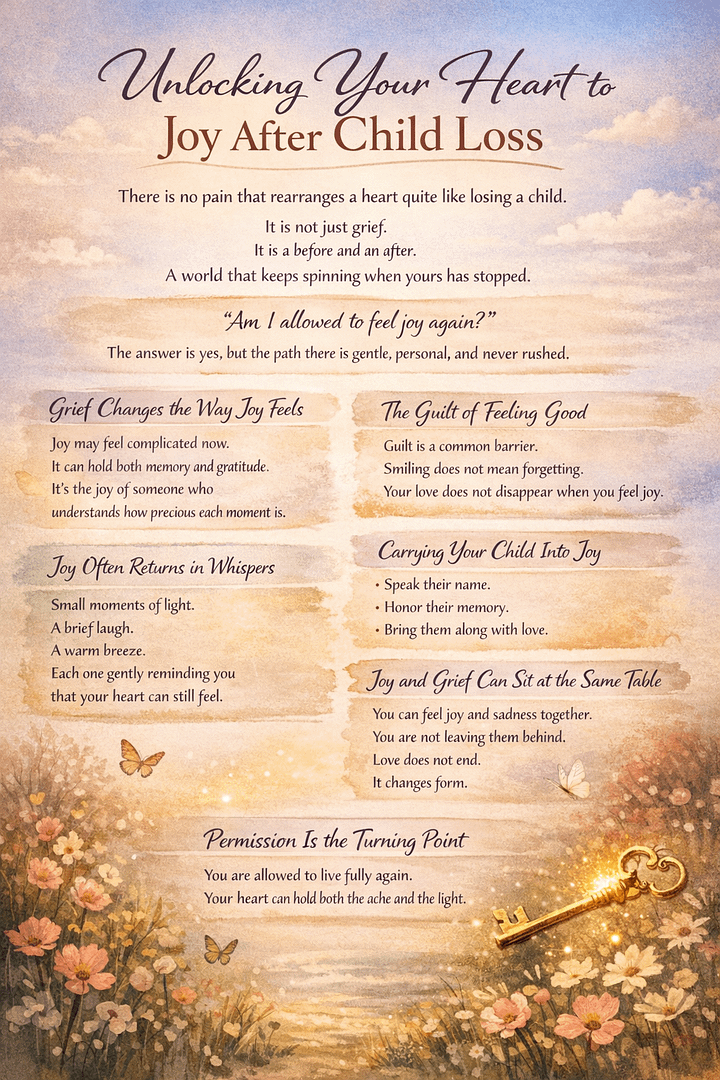
There is no pain that rearranges a heart quite like losing a child.
It is not just grief.
It is a before and an after.
A world that keeps spinning when yours has stopped.
People sometimes expect healing to look like “moving on,” but parents who have experienced child loss know the truth: you don’t move on from your child. You move forward with the love, the ache, and the permanent imprint they left on your soul.
And somewhere along that long, uneven road, a quiet question often rises — sometimes with guilt attached:
“Am I allowed to feel joy again?”
The answer is yes.
But the path there is gentle, personal, and never rushed.
Grief Changes the Way Joy Feels
Before loss, joy may have felt spontaneous. Easy. Light.
After loss, joy can feel complicated — layered with memory, awareness, and the knowledge that life can change in an instant. This doesn’t mean joy is gone forever. It means your heart has depth now that didn’t exist before.
Grief carves space inside you. At first, that space feels like emptiness. Over time, it can also become room for a different kind of joy — one that holds tenderness, perspective, and profound gratitude for small things.
This isn’t the joy of ignorance.
It’s the joy of someone who understands how precious every moment is.
The Guilt of Feeling Good
One of the most painful barriers to joy is guilt.
You might think:
“If I laugh, it means I’m forgetting.”
“How can I celebrate anything when my child is gone?”
“Other people’s happiness feels wrong around my pain.”
This guilt comes from love. It’s the heart’s way of saying, “They mattered.”
But your child’s significance was never dependent on your suffering. Your love for them does not shrink when you smile. Your grief does not disappear when you experience something beautiful.
Two truths can exist together:
You miss them with your whole being.
You are still allowed to feel life.
Joy Often Returns in Whispers
Joy after child loss rarely announces itself. It slips in quietly.
A song you used to love that suddenly sounds comforting instead of unbearable.
A genuine laugh that surprises you.
A peaceful moment where your mind isn’t replaying the “what ifs.”
These small openings can feel almost frightening because they remind you that your heart is still capable of feeling — and feeling means vulnerability.
But each small moment is a thread, gently stitching you back into the living world.
Your Nervous System Needs Safety First
After trauma-level grief, your body lives in survival mode. You may feel numb, anxious, exhausted, or disconnected. This isn’t emotional failure — it’s biology.
Joy returns more easily when your body feels safe enough to soften.
Simple supports can help:
Sitting in nature
Gentle movement like walking
Talking about your child without being rushed
Time with people who don’t try to “fix” you
Quiet rituals that honor their memory
Safety tells your heart: It’s okay to open a little.
Carrying Your Child Into Joy
Some parents worry that if they allow happiness back in, their connection to their child will fade. But love doesn’t work that way.
You can carry them into moments of joy by:
Speaking their name
Keeping traditions alive
Noticing traits of theirs that live in you
Dedicating acts of kindness in their honor
Allowing memories to include smiles, not only tears
Joy can become a continuation of the love story, not an ending.
Joy and Grief Can Sit at the Same Table
One of the most surprising parts of healing is realizing you can laugh and cry in the same day — sometimes in the same hour.
This is not inconsistency.
It is emotional wholeness.
Grief doesn’t leave; it changes shape. And joy doesn’t replace grief; it weaves through it.
You may attend a celebration and feel both warmth and longing. You may hold a new baby and feel love and heartbreak at once. This coexistence is not a sign that you’re “confused.” It’s a sign that your heart is big enough to hold complexity.
Permission Is the Turning Point
Often, the shift toward joy begins when you whisper to yourself:
“I am allowed to live.”
Not because the pain is gone.
Not because you’re “over it.”
But because your child’s love is part of your life story — not the end of it.
You surviving.
You loving again.
You experiencing light again.
These things do not betray your child. They are evidence that love did not die with them.
Joy Will Be Different Now
The joy that returns may be quieter, deeper, and more sacred than before. It may come with tears close by. It may feel fragile. But it will also feel real.
It is the joy of someone who knows:
Life is not guaranteed.
Moments matter.
Love outlives presence.
This kind of joy is not shallow happiness. It is resilience in its most human form.
You Are Not Leaving Them Behind
Opening your heart again does not mean walking away from your child. It means carrying them differently — not only in pain, but in love, in memory, and in the way you see the world now.
They are in your gentleness.
In your strength.
In your compassion for others who hurt.
Your heart continuing to beat, feel, and even find light again is not a betrayal.
It is a quiet testimony:
Love does not end. It changes form.
Joy after child loss is not loud.
It is a small light that says,
“I am still here. And so is love.” 🤍
A Father’s Guide to Surviving the Loss of a Child
Leave a ReplyCancel reply